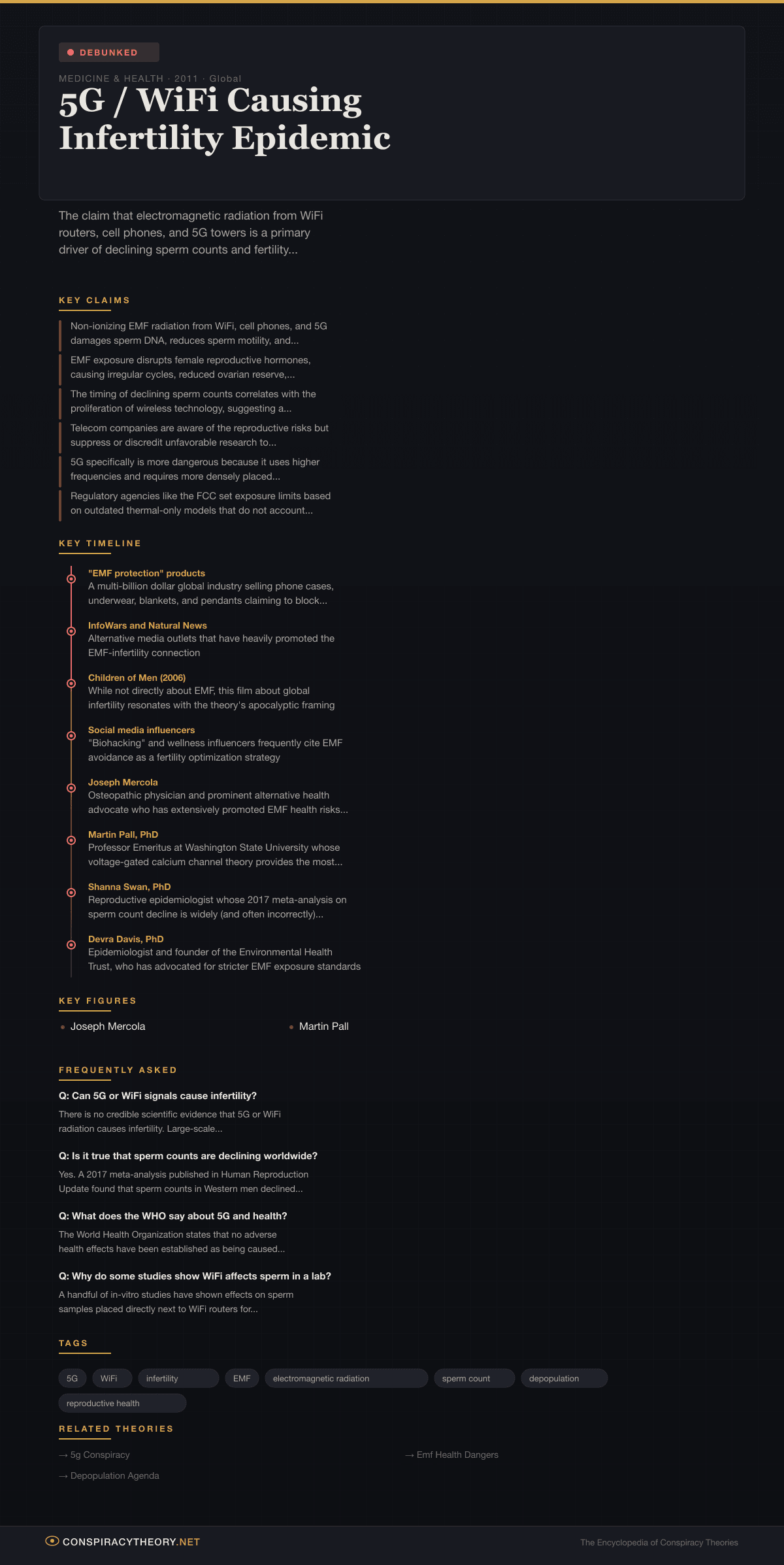
5G / WiFi Causing Infertility Epidemic
Overview
Sperm counts in developed nations have been dropping for decades. That part is not a conspiracy theory — it is a well-documented epidemiological reality that has genuinely alarmed reproductive scientists. Where the conspiracy enters is in the explanation: a growing movement claims that electromagnetic radiation from WiFi routers, cell phones, laptops, and especially 5G towers is the primary driver of this fertility crisis, and that governments and telecom companies are either ignorant of or actively concealing this connection.
The theory gained significant traction during the 5G rollout panic of 2019-2020, when anxieties about the new wireless standard merged with COVID-19 conspiracy theories to produce a potent stew of technophobia. Proponents argue that non-ionizing radiation at microwave frequencies damages sperm DNA, disrupts hormonal signaling, and impairs ovarian function — claims that sound plausible enough to circulate widely but collapse under scientific scrutiny.
The reality is less dramatic but more concerning. Fertility decline is real, and its likely causes — endocrine-disrupting chemicals, obesity, sedentary lifestyles, environmental pollutants, and delayed childbearing — are complex, systemic, and not easily reducible to a single villain. Blaming 5G towers is simpler, scarier, and ultimately counterproductive, because it diverts attention from the actual threats to reproductive health.
Origins & History
Concerns about electromagnetic radiation and health are not new. They date to at least the 1960s, when Soviet researchers published papers claiming microwave exposure caused various ailments in radar operators. Throughout the 1980s and 1990s, power line EMF was a major public health scare, with some studies linking high-voltage transmission lines to childhood leukemia. Most of these associations were eventually found to be weak or non-existent, but they established a template for EMF anxiety.
The specific link between wireless technology and infertility emerged in the early 2010s, driven largely by a 2012 study from the journal Fertility and Sterility in which researchers placed human sperm samples under a laptop connected to WiFi and observed decreased motility and DNA fragmentation compared to controls. The study was widely shared on health blogs and alternative medicine sites, often without the critical context that the sperm was exposed in vitro at distances and durations that bear no resemblance to normal laptop use.
When 5G networks began rolling out in 2018-2019, the infertility narrative merged with broader 5G panic. The higher frequencies used by 5G (millimeter waves in some implementations) sounded more alarming to a public already primed with fears about radiation. Social media posts claimed that 5G towers near schools would sterilize children, that smart meters were causing miscarriages, and that the telecom industry had suppressed studies showing reproductive harm.
The COVID-19 pandemic in 2020 supercharged these fears. Conspiracy theorists who were already suspicious of 5G latched onto the pandemic as evidence of a broader plot, with some claiming the virus itself was a cover story for radiation sickness and that mass vaccination and 5G together constituted a depopulation agenda.
Key Claims
- Non-ionizing EMF radiation from WiFi, cell phones, and 5G damages sperm DNA, reduces sperm motility, and lowers sperm count in men
- EMF exposure disrupts female reproductive hormones, causing irregular cycles, reduced ovarian reserve, and increased miscarriage rates
- The timing of declining sperm counts correlates with the proliferation of wireless technology, suggesting a causal relationship
- Telecom companies are aware of the reproductive risks but suppress or discredit unfavorable research to protect profits
- 5G specifically is more dangerous because it uses higher frequencies and requires more densely placed towers, increasing population-wide exposure
- Regulatory agencies like the FCC set exposure limits based on outdated thermal-only models that do not account for non-thermal biological effects
- Carrying a phone in a front pocket is directly damaging the testes of an entire generation of young men
Evidence
What Proponents Cite
The theory is not built on nothing. There are real data points that, selectively presented, construct a compelling narrative:
The fertility decline is real. A landmark 2017 meta-analysis by Shanna Swan and colleagues in Human Reproduction Update documented a 59.3% decline in total sperm count among men in North America, Europe, Australia, and New Zealand between 1973 and 2011. A 2022 update extended this decline globally and showed it was accelerating. This is not disputed.
In-vitro studies show effects. Several laboratory studies have demonstrated that placing sperm samples in direct proximity to WiFi routers or cell phones for extended periods can reduce motility and increase DNA fragmentation. The 2012 Avendano study is the most cited.
Animal studies are suggestive. Some rodent studies have found decreased sperm parameters in mice exposed to radiofrequency EMF at relatively high power levels over extended periods.
Martin Pall’s voltage-gated calcium channel theory. Professor Martin Pall of Washington State University has published papers arguing that EMF activates voltage-gated calcium channels in cells, triggering oxidative stress cascading that damages reproductive tissue. His work is frequently cited by EMF health advocates.
What the Evidence Actually Shows
Correlation is not causation. The fertility decline began well before widespread wireless adoption. Sperm counts started dropping in the 1970s — decades before WiFi, cell phones, or 5G existed. The timeline better matches the introduction of plasticizers, pesticides, and industrial chemicals into consumer products.
In-vitro conditions are not realistic. Placing semen samples directly against an active WiFi antenna for hours does not replicate how humans interact with devices. EMF intensity drops with the square of distance. The radiation reaching a man’s testes from a phone in his pocket is orders of magnitude weaker than the doses used in concerning lab studies.
Animal studies use unrealistic exposures. The rodent studies that show effects typically use whole-body exposure levels far exceeding anything humans encounter. Studies at real-world exposure levels generally find no significant reproductive effects.
Pall’s theory is contested. Pall’s voltage-gated calcium channel hypothesis has not been validated by independent researchers and is not accepted by mainstream bioelectromagnetics.
Large epidemiological studies find no link. The Danish Cohort Study, which followed over 50,000 women and their cell phone use, found no increase in miscarriage or birth defects. Multiple systematic reviews — including a 2021 review in Environment International — have concluded that current evidence does not support a causal relationship between radiofrequency EMF and adverse reproductive outcomes at typical exposure levels.
Established causes exist. The scientific consensus points to well-documented fertility disruptors: BPA and other endocrine disruptors, obesity, heat exposure (tight underwear, hot laptops on laps), tobacco, alcohol, pharmaceuticals, advanced parental age, and environmental pollutants. These factors have robust evidence bases and plausible biological mechanisms.
Debunking / Verification
The 5G/WiFi infertility theory is classified as debunked because:
- The timeline does not match. Sperm decline predates wireless technology by decades.
- The dose makes the poison. Real-world EMF exposures are orders of magnitude below levels that show effects in laboratory conditions.
- The mechanism is unproven. No validated biological pathway connects non-thermal EMF exposure at consumer levels to reproductive harm.
- Large human studies find no effect. Epidemiological data from tens of thousands of subjects shows no association.
- Better explanations exist. Chemical pollutants, lifestyle factors, and environmental changes have strong evidence bases.
- Regulatory bodies worldwide agree. WHO, ICNIRP, FDA, and other agencies have reviewed the literature and do not identify fertility as a risk from standard EMF exposure.
Medical consensus disclaimer: The decline in global fertility rates is a serious public health concern being actively researched by reproductive endocrinologists worldwide. The evidence points to environmental chemicals, lifestyle factors, and social trends — not electromagnetic radiation. Anyone concerned about fertility should consult a qualified reproductive health specialist.
Cultural Impact
The 5G infertility theory illustrates how a real health concern (declining fertility) can be hijacked by a simpler, scarier, more sharable narrative. It has had several downstream effects:
Social media platforms have struggled to moderate 5G health content, with posts about infertility and EMF regularly going viral on Instagram, TikTok, and X. “EMF protection” has become a product category unto itself — anti-radiation phone cases, “EMF-blocking” underwear for men, shielding fabrics, and grounding mats generate hundreds of millions of dollars in annual revenue, none of which has demonstrated efficacy.
The theory has also contributed to real-world resistance to 5G infrastructure. Cell towers have been vandalized or blocked by local opposition in the UK, Netherlands, Australia, and the United States, sometimes explicitly citing fertility concerns. This has slowed telecommunications deployment in some areas.
Perhaps most consequentially, the focus on EMF as a fertility culprit may be drawing public attention and research funding away from the actual causes of reproductive decline — particularly endocrine-disrupting chemicals in plastics, pesticides, and consumer products — which have far stronger evidence bases and are potentially actionable through regulation.
In Popular Culture
- “EMF protection” products — A multi-billion dollar global industry selling phone cases, underwear, blankets, and pendants claiming to block harmful radiation
- InfoWars and Natural News — Alternative media outlets that have heavily promoted the EMF-infertility connection
- Children of Men (2006) — While not directly about EMF, this film about global infertility resonates with the theory’s apocalyptic framing
- Social media influencers — “Biohacking” and wellness influencers frequently cite EMF avoidance as a fertility optimization strategy
Key Figures
- Joseph Mercola — Osteopathic physician and prominent alternative health advocate who has extensively promoted EMF health risks on his website, one of the most-trafficked alternative health platforms globally
- Martin Pall, PhD — Professor Emeritus at Washington State University whose voltage-gated calcium channel theory provides the most cited scientific framework for EMF health effects; his work is controversial within mainstream bioelectromagnetics
- Shanna Swan, PhD — Reproductive epidemiologist whose 2017 meta-analysis on sperm count decline is widely (and often incorrectly) cited as evidence for the EMF theory; Swan herself identifies endocrine disruptors, not EMF, as primary suspects
- Devra Davis, PhD — Epidemiologist and founder of the Environmental Health Trust, who has advocated for stricter EMF exposure standards
Timeline
| Date | Event |
|---|---|
| 1973-2011 | Period covered by Shanna Swan’s meta-analysis documenting 59% sperm count decline |
| 1996 | WHO launches the International EMF Project to assess health effects |
| 2011 | IARC classifies radiofrequency EMF as “possibly carcinogenic” (Group 2B) |
| 2012 | Avendano et al. publish in-vitro WiFi-sperm study in Fertility and Sterility |
| 2017 | Swan meta-analysis on sperm decline published, widely cited by EMF theorists |
| 2018-2019 | 5G rollout begins; infertility claims merge with broader 5G health panic |
| 2020 | COVID-19 pandemic amplifies 5G conspiracy theories; cell towers vandalized in UK and Europe |
| 2021 | Environment International publishes systematic review finding no EMF-fertility link |
| 2022 | Updated Swan analysis shows global sperm decline accelerating |
| 2023-present | ”EMF protection” product market continues expanding; social media moderation ongoing |
Sources & Further Reading
- Levine, Hagai, et al. “Temporal Trends in Sperm Count: A Systematic Review and Meta-Regression Analysis.” Human Reproduction Update, 2017.
- Avendano, Conrado, et al. “Use of Laptop Computers Connected to Internet Through Wi-Fi Decreases Human Sperm Motility and Increases Sperm DNA Fragmentation.” Fertility and Sterility, 2012.
- Liu, Ke, et al. “Association Between Mobile Phone Use and Semen Quality: A Systematic Review and Meta-Analysis.” Andrology, 2014.
- ICNIRP. “Guidelines for Limiting Exposure to Electromagnetic Fields.” Health Physics, 2020.
- World Health Organization. “Electromagnetic Fields and Public Health: Mobile Phones.” Fact Sheet No. 193, 2014.
- Swan, Shanna. Count Down: How Our Modern World Is Threatening Sperm Counts, Altering Male and Female Reproductive Development, and Imperiling the Future of the Human Race. Scribner, 2021.
- Pall, Martin. “Wi-Fi Is an Important Threat to Human Health.” Environmental Research, 2018.
Related Theories
- 5G Conspiracy Theories — The broader claim that 5G networks pose various health risks, from cancer to COVID-19
- EMF Health Dangers — The general theory that electromagnetic fields from everyday devices cause chronic illness
- Depopulation Agenda — The claim that global elites are deliberately reducing human population through various covert means
- BPA & Endocrine Disruptor Suppression — The more evidence-supported concern about industrial chemicals affecting reproductive health
Frequently Asked Questions
Can 5G or WiFi signals cause infertility?
Is it true that sperm counts are declining worldwide?
What does the WHO say about 5G and health?
Why do some studies show WiFi affects sperm in a lab?
Infographic
Share this visual summary. Right-click to save.