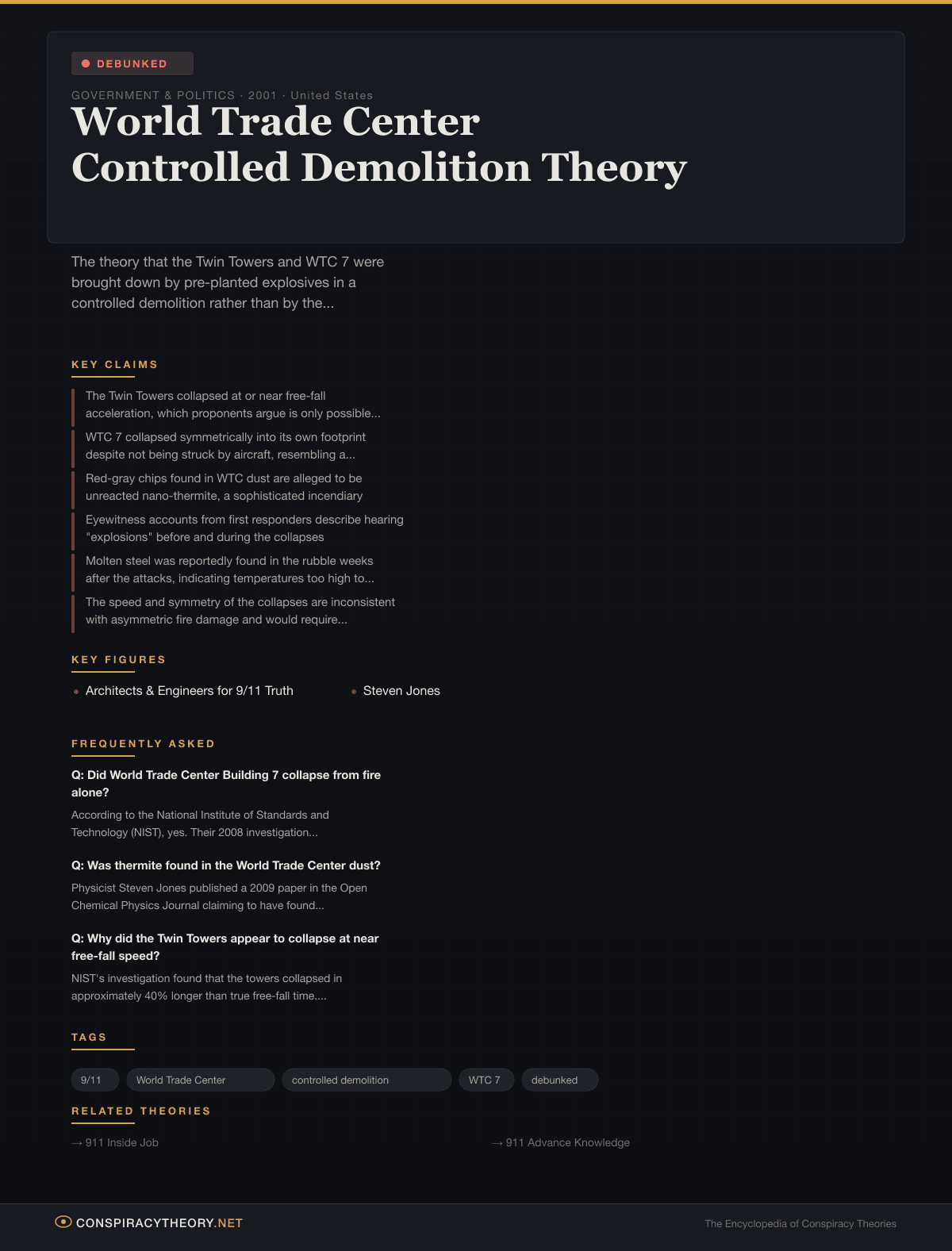
World Trade Center Controlled Demolition Theory
Overview
On the morning of September 11, 2001, as two hijacked Boeing 767s struck the North and South Towers of the World Trade Center in lower Manhattan, a global television audience watched in real time as the buildings burned and then collapsed — the South Tower at 9:59 AM, the North Tower at 10:28 AM, and 7 World Trade Center, a 47-story building not struck by any aircraft, at 5:20 PM. The official investigation, conducted by the National Institute of Standards and Technology, concluded that the impacts and subsequent uncontrolled fires weakened the steel structures until catastrophic failure occurred.
Within hours, an alternative explanation began circulating: the buildings had not fallen from fire and impact damage. They had been brought down by pre-planted explosives in a controlled demolition — a planned destruction that implied government foreknowledge, complicity, or direct involvement in the deadliest terrorist attack in American history.
The controlled demolition theory became the centerpiece of the 9/11 Truth movement and arguably the most influential conspiracy theory of the twenty-first century. It generated organizations, documentaries, academic papers, congressional lobbying campaigns, and polling data showing that significant minorities of the American public questioned the official account. It has also been comprehensively addressed by structural engineers, demolition professionals, and independent researchers who have found the evidence for controlled demolition unpersuasive and the engineering explanation for the collapses sufficient.
Origins & History
Immediate Reactions
The controlled demolition theory began circulating within hours of the attacks. As television cameras broadcast the collapse of the Twin Towers to a global audience, some viewers — including some with engineering or construction backgrounds — noted that the buildings appeared to fall straight down, floor by floor, in a manner visually reminiscent of planned building implosions. The dramatic plumes of dust that ejected laterally during the collapses resembled, to lay observers, the “squibs” (timed explosive charges) visible in controlled demolition footage.
The collapse of 7 World Trade Center intensified these questions. WTC 7 was a 47-story steel-framed high-rise located north of the Twin Towers. It had not been struck by any aircraft, though it had sustained damage from debris falling from the North Tower and had burned uncontrolled for approximately seven hours. When it collapsed at 5:20 PM, falling straight down into its own footprint in approximately 6.5 seconds, many observers found the collapse difficult to reconcile with fire damage alone. No steel-framed high-rise had ever before collapsed entirely due to fire — a fact that WTC 7 demolition proponents cited repeatedly, and that NIST itself acknowledged as unprecedented.
Early Proponents
Early proponents emerged from the engineering and physics communities. In 2002, Jeff King, a former MIT-trained engineer, produced one of the first detailed analyses arguing the collapses were inconsistent with fire-induced failure. His work circulated on early 9/11 truth websites and helped establish the analytical framework — focus on collapse speed, collapse symmetry, and the visual similarity to controlled demolitions — that the movement would use for the next two decades.
The theory gained its most prominent scientific advocate in 2005, when Brigham Young University physicist Steven Jones published a paper titled “Why Indeed Did the WTC Buildings Completely Collapse?” Jones argued that the symmetry, speed, and totality of the collapses pointed to pre-planted explosives, and he specifically proposed thermite — an incendiary mixture of aluminum powder and iron oxide — as the demolition agent. Jones noted that thermite could explain the reported presence of molten metal in the debris pile, the iron-rich microspheres found in WTC dust, and the appearance of the collapses. He later refined his hypothesis to propose “nano-thermite” — a more sophisticated variant using nanoscale particles for faster reaction rates.
Jones’s academic credentials gave the controlled demolition theory a veneer of scientific legitimacy it had previously lacked. His involvement also cost him professionally: Brigham Young University placed him on paid leave in 2006 and he subsequently retired, in a sequence that his supporters characterized as persecution and the university described as concern about the quality of his public claims.
Architects & Engineers for 9/11 Truth
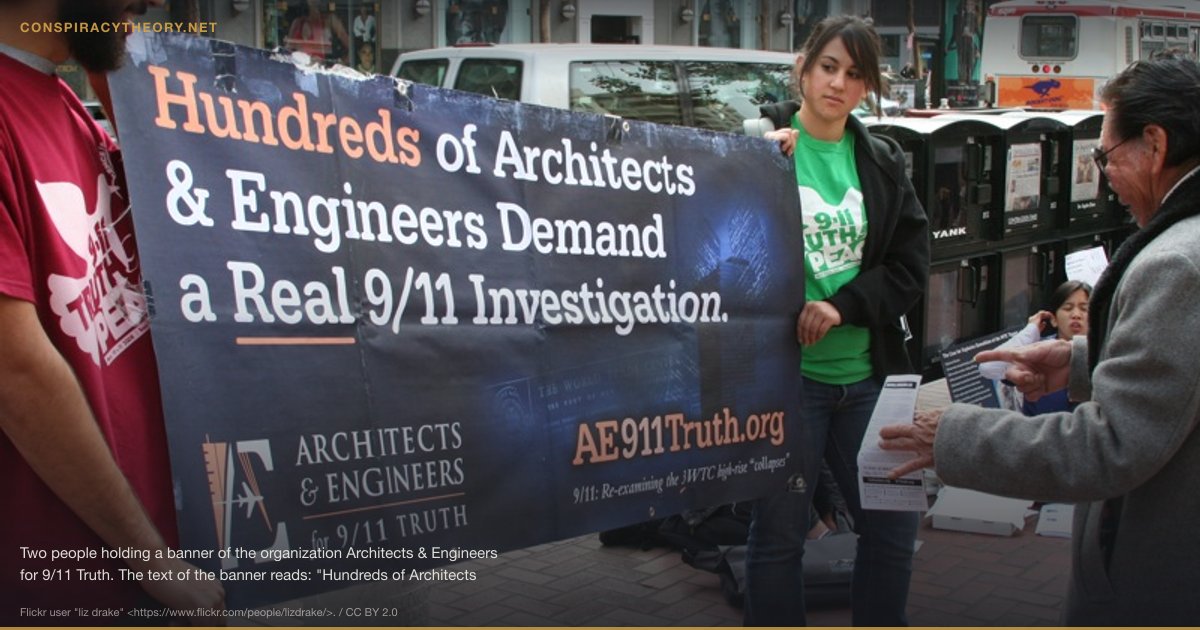
Jones’s work catalyzed the formation of Architects & Engineers for 9/11 Truth (AE911Truth) in 2006, founded by San Francisco architect Richard Gage. The organization eventually gathered petition signatures from over 3,500 architects and engineers calling for a new investigation into the WTC collapses. AE911Truth became the institutional backbone of the controlled demolition movement, producing documentary films (9/11: Blueprint for Truth, 9/11: Explosive Evidence — Experts Speak Out), hosting conferences, maintaining a professional-appearing website, and lobbying Congress.
The organization’s strategy was deliberate: by presenting credentialed professionals — architects, engineers, physicists — making measured technical arguments, AE911Truth sought to distinguish itself from the wilder fringes of 9/11 conspiracy culture. The petition of 3,500 professionals was presented as evidence that the theory had mainstream technical support, though critics noted that 3,500 represents a tiny fraction of the millions of licensed architects and engineers worldwide.
The NIST Investigations
The National Institute of Standards and Technology (NIST) released its investigation of the Twin Towers in 2005 (NCSTAR 1) and its WTC 7 report in 2008 (NCSTAR 1A). These were the most comprehensive structural failure investigations ever conducted, spanning thousands of pages and involving over 200 technical experts.
For the Twin Towers, NIST concluded that the aircraft impacts stripped fireproofing from steel trusses across multiple floors, exposing the steel to fires burning at approximately 1,000 degrees Celsius. At these temperatures, steel retains only about 60% of its room-temperature strength. The weakened trusses sagged, pulling the exterior columns inward and initiating a progressive collapse in which the mass of the upper floors overwhelmed each successive floor’s capacity to resist. Once initiated, the collapse was unstoppable.
For WTC 7, NIST identified thermal expansion of floor beams as the initiating mechanism. Uncontrolled fires burning on Floors 7 through 9 and 11 through 13 caused steel beams to expand, pushing a critical girder off its seat on Column 79. When Column 79 buckled, the building’s east penthouse collapsed first (visible in videos as a visible kink in the roofline), followed by progressive failure of the interior structure, and finally the collapse of the exterior shell. NIST acknowledged that WTC 7 was the first known instance of fire-induced total progressive collapse of a steel-framed high-rise.
The Thermite Paper
In 2009, Jones and several co-authors — including chemist Niels Harrit of the University of Copenhagen — published a paper in the Open Chemical Physics Journal claiming to have identified “active thermitic material” in WTC dust samples. The paper described “red-gray chips” found in dust collected from various locations near Ground Zero and argued that these chips exhibited characteristics consistent with nano-thermite, including an exothermic reaction at temperatures matching thermite ignition.
The paper’s publication proved deeply controversial. The journal’s editor-in-chief, Marie-Paule Pileni — a respected nanomaterials scientist — resigned upon learning of the paper, stating she had not been informed of its submission and questioning the peer review process. Critics, including chemist James Millette, conducted independent analysis of similar WTC dust samples and concluded that the red-gray chips were consistent with LaClede Standard primer paint used on WTC structural steel. Millette’s study, while not published in a peer-reviewed journal, was presented to multiple academic audiences.
The University of Alaska Fairbanks Study
The University of Alaska Fairbanks conducted a four-year computer modeling study of WTC 7’s collapse, released in draft form in 2019 under the direction of Dr. J. Leroy Hulsey. The study concluded that “fire did not cause the collapse of WTC 7 on 9/11,” finding that simultaneous failure of every column in the building would be necessary to replicate the observed collapse — inconsistent with localized fire damage. However, the study was funded entirely by AE911Truth, its methodology was questioned by structural engineers who reviewed it, and it has not been published in a peer-reviewed structural engineering journal. NIST declined to comment on the draft report.
Key Claims
- The Twin Towers collapsed at or near free-fall acceleration, which proponents argue is only possible if structural resistance was removed by explosives
- WTC 7 collapsed symmetrically into its own footprint despite not being struck by aircraft, resembling a classic controlled demolition
- Red-gray chips found in WTC dust are alleged to be unreacted nano-thermite, a sophisticated incendiary
- Eyewitness accounts from first responders describe hearing “explosions” before and during the collapses
- Molten steel was reportedly found in the rubble weeks after the attacks, indicating temperatures too high to be explained by office fires alone
- The speed and symmetry of the collapses are inconsistent with asymmetric fire damage and would require the simultaneous removal of structural support
- NIST’s investigation did not test for explosive residues, which critics call a critical omission
- The 47-story WTC 7 housed offices of the CIA, Secret Service, SEC, and the Mayor’s Office of Emergency Management, suggesting a motive to destroy records
- Lateral ejections of material during the Twin Tower collapses indicate explosive forces, not gravitational collapse
Evidence & Debunking
The case against controlled demolition rests on extensive engineering analysis conducted by multiple independent groups over more than two decades. The controlled demolition hypothesis has been examined and rejected by NIST, the American Society of Civil Engineers, demolition industry professionals, and independent structural engineers.
Collapse Speed
NIST measured collapse initiation times of approximately 9 seconds for the North Tower and 11 seconds for the South Tower — approximately 40% longer than true free-fall time (which would have been approximately 6.5 seconds for the 110-story towers). The progressive collapse mechanism explains the visual appearance of near-free-fall: once the upper section began to fall, each successive floor was struck with a force many times its design capacity. The floors did not meaningfully slow the collapse, but they did slow it measurably — the difference is visible in high-speed video analysis.
For WTC 7, NIST acknowledged approximately 2.25 seconds of free-fall during the exterior collapse but attributed this to the prior failure of internal supports. By the time the exterior shell began to fall, the interior structure had already collapsed (visible as the penthouse dropping into the building), leaving the outer shell as an empty framework with no internal support. An unsupported shell falling with no internal resistance would indeed fall at free-fall speed — and this is exactly what NIST’s analysis showed.
The “Molten Steel” Claim
The “molten steel” claim has been addressed by multiple researchers. NIST and the RJ Lee Group, a scientific consulting firm hired for WTC contamination analysis, both identified molten material in the debris but characterized it as molten aluminum (melting point: 660 degrees Celsius), lead (328 degrees Celsius), and other metals with melting points well below steel’s (approximately 1,500 degrees Celsius). The USGS conducted spectroscopic analysis of WTC dust in 2005 and found compositions consistent with building materials, not thermite residues.
Additionally, underground fires in the debris pile — fed by massive quantities of organic material, paper, plastics, and jet fuel residue in a partially oxygen-deprived environment — burned for weeks, producing temperatures sufficient to melt lower-melting-point metals. This phenomenon is well-documented in large-scale fire events and does not require exotic explanations.
Eyewitness “Explosions”
Regarding eyewitness “explosion” testimony, NIST noted that the sounds described are consistent with mechanical failures, electrical transformer explosions, and the ejection of air and debris during floor collapses — phenomena well-documented in structural failures. Over 10,000 pages of first responder testimony, released by the New York Times in August 2005 following a Freedom of Information Act request, contain varied accounts. While some describe hearing sounds they interpreted as explosions, the overwhelming majority describe the progression of fire, impact damage, and collapse without referencing explosives. The testimony, taken collectively, is far more consistent with fire-induced structural failure than with controlled demolition.
Demolition Industry Assessment
Demolition industry professionals have broadly rejected the theory. Brent Blanchard of Protec Documentation Services, which monitors controlled demolitions professionally, published a detailed 2006 analysis examining seismic data, air quality measurements, and physical evidence from the WTC site. Blanchard found no evidence of explosive signatures in any dataset. He noted that a controlled demolition of the Twin Towers would have required tens of thousands of pounds of explosives, miles of detonation cord, months of preparation in occupied buildings, and a precision timing system that would have been apparent to anyone in the buildings. No demolition professional who reviewed the evidence supported the theory.
Mark Loizeaux of Controlled Demolition, Inc. — one of the world’s leading demolition firms and, ironically, the contractor hired to clean up the WTC site — publicly stated that the collapses were not controlled demolitions and that the suggestion was not supported by the physical evidence.
NIST’s Decision Not to Test for Explosives
NIST’s decision not to test for explosive residues has been one of the most persistent criticisms. NIST defended this decision by stating that the visual and physical evidence — including the absence of the extremely loud detonation sounds that accompany controlled demolitions — gave no indication of explosives, making testing unnecessary. Critics argued this was circular reasoning: by not testing, NIST ensured it could not find what it did not look for. This remains the strongest procedural criticism of the NIST investigation, though it does not, by itself, constitute evidence for explosives.
Key Figures
- Steven Jones (b. 1949): Brigham Young University physicist who became the theory’s most prominent scientific advocate. Published the 2009 nano-thermite paper. Previously known for proposing that Jesus Christ visited the Americas (consistent with LDS theology) and for work on cold fusion.
- Richard Gage (b. 1955): San Francisco architect who founded Architects & Engineers for 9/11 Truth in 2006 and directed the organization’s advocacy for two decades.
- Niels Harrit (b. 1945): Danish chemist at the University of Copenhagen and co-author of the nano-thermite paper.
- J. Leroy Hulsey: University of Alaska Fairbanks professor who directed the AE911Truth-funded computer modeling study of WTC 7.
- Dylan Avery (b. 1981): Director of Loose Change (2005), the documentary that brought the controlled demolition theory to a mass audience.
Timeline
- 2001 (September 11): Twin Towers and WTC 7 collapse; controlled demolition speculation begins the same day
- 2002: Jeff King produces early technical analysis arguing for controlled demolition
- 2004 (July): 9/11 Commission publishes its final report, which does not address WTC 7 or controlled demolition in detail
- 2005: Steven Jones publishes “Why Indeed Did the WTC Buildings Completely Collapse?”
- 2005: NIST publishes its Twin Towers investigation report (NCSTAR 1)
- 2005: Dylan Avery’s documentary Loose Change goes viral online
- 2005 (August): Over 10,000 pages of first responder testimony released via FOIA
- 2006: Richard Gage founds Architects & Engineers for 9/11 Truth
- 2006: Protec Documentation Services publishes its analysis finding no explosive evidence
- 2006: BYU places Steven Jones on paid leave; he subsequently retires
- 2006: Scripps Howard/Ohio University poll finds 36% of Americans consider government involvement in 9/11 likely
- 2007: Bazant and Verdure publish mechanics analysis of progressive collapse in Journal of Engineering Mechanics
- 2008: NIST publishes WTC 7 investigation report (NCSTAR 1A), concluding fire-induced collapse
- 2009: Jones, Harrit et al. publish nano-thermite paper in Open Chemical Physics Journal; editor-in-chief resigns
- 2019: University of Alaska Fairbanks draft study concludes fire did not cause WTC 7 collapse
- 2020s: Theory persists in online communities but has declined in mainstream visibility
Cultural Impact
The controlled demolition theory became the centerpiece of the broader 9/11 Truth movement, which peaked in influence between 2005 and 2010. The 2005 documentary Loose Change, directed by Dylan Avery, became one of the most-watched internet documentaries of its era, reaching an estimated 100 million viewers across multiple versions. Shot on a laptop, updated repeatedly in response to criticism, and distributed primarily through Google Video and later YouTube, Loose Change made the controlled demolition hypothesis accessible to a mass audience and established the internet — rather than books, television, or film — as the primary distribution channel for conspiracy content.
The movement influenced political discourse at its peak. In 2006, a Scripps Howard/Ohio University poll found that 36% of Americans considered it “very likely” or “somewhat likely” that the federal government either assisted in the 9/11 attacks or deliberately did nothing to stop them. Several elected officials, including former Senator Mike Gravel, former Representative Cynthia McKinney, and Yukihisa Fujita of the Japanese Diet, publicly called for new investigations.
The 9/11 Truth movement also served as a template for subsequent conspiracy movements. Its organizational structure — petitions from credentialed professionals, documentary films, annual conferences, online forums, and grassroots activism — was replicated by later movements, including anti-vaccination organizations and COVID-19 conspiracy groups. Researchers studying conspiracy belief, including Cass Sunstein and Adrian Vermeule in their 2009 paper “Conspiracy Theories: Causes and Cures,” used the 9/11 Truth movement as a primary case study for understanding how conspiracy beliefs form, spread, and persist.
The movement’s persistence, despite extensive official investigation and peer-reviewed rebuttal, illustrates how deeply conspiratorial thinking can embed itself in public consciousness during periods of institutional distrust. The Iraq War — launched in 2003 on the basis of intelligence about weapons of mass destruction that proved false — eroded public trust in government statements generally and created a political environment in which questioning the official 9/11 narrative seemed reasonable to many Americans. The WMD debacle was a genuine government deception, and its proximity to 9/11 provided a plausibility structure for the controlled demolition theory that pure evidence alone would not have sustained.
The theory also shaped how the engineering profession communicates about structural failure. NIST’s decision to produce thousands of pages of publicly accessible documentation — including computer models, test data, and detailed narrative reports — reflected an awareness that the findings would face conspiratorial challenge. The exhaustive transparency of the WTC reports set a standard for subsequent government investigations of catastrophic events.
Sources & Further Reading
- National Institute of Standards and Technology. Final Report on the Collapse of the World Trade Center Towers (NCSTAR 1). Washington, DC: U.S. Department of Commerce, 2005.
- National Institute of Standards and Technology. Final Report on the Collapse of World Trade Center Building 7 (NCSTAR 1A). Washington, DC: U.S. Department of Commerce, 2008.
- Bazant, Zdenek P., and Mathieu Verdure. “Mechanics of Progressive Collapse: Learning from World Trade Center and Building Demolitions.” Journal of Engineering Mechanics 133, no. 3 (2007): 308-319.
- Jones, Steven E., et al. “Active Thermitic Material Discovered in Dust from the 9/11 World Trade Center Catastrophe.” Open Chemical Physics Journal 2 (2009): 7-31.
- Blanchard, Brent. “A Critical Analysis of the Collapse of WTC Towers 1, 2 & 7 from an Explosives Engineering Perspective.” Protec Documentation Services, 2006.
- Sunstein, Cass R., and Adrian Vermeule. “Conspiracy Theories: Causes and Cures.” Journal of Political Philosophy 17, no. 2 (2009): 202-227.
- 9/11 Commission Report: Final Report of the National Commission on Terrorist Attacks Upon the United States. New York: W.W. Norton, 2004.
- Thomas, Dave. “The 9/11 Truth Movement: The Top Conspiracy Theory, a Decade Later.” Skeptical Inquirer 35, no. 4 (2011).
- Hulsey, J. Leroy. “A Structural Reevaluation of the Collapse of World Trade Center 7.” University of Alaska Fairbanks, 2020 (draft report).
- Gage, Richard. AE911Truth.org — Architects & Engineers for 9/11 Truth (cited as primary source for the theory’s claims).
Related Theories
- 9/11 Inside Job Theory — the broader claim that the U.S. government orchestrated or facilitated the September 11 attacks
- 9/11 Advance Knowledge — the theory that government officials had foreknowledge of the attacks and allowed them to proceed
- 9/11 Commission Cover-Up — claims that the official investigation was deliberately incomplete or misleading

Watch: Documentaries & Videos
Related documentaries available on YouTube.
9/11: Inside the Pentagon
Loose Change
September 11: The New Pearl Harbor
Frequently Asked Questions
Did World Trade Center Building 7 collapse from fire alone?
Was thermite found in the World Trade Center dust?
Why did the Twin Towers appear to collapse at near free-fall speed?

Infographic
Share this visual summary. Right-click to save.