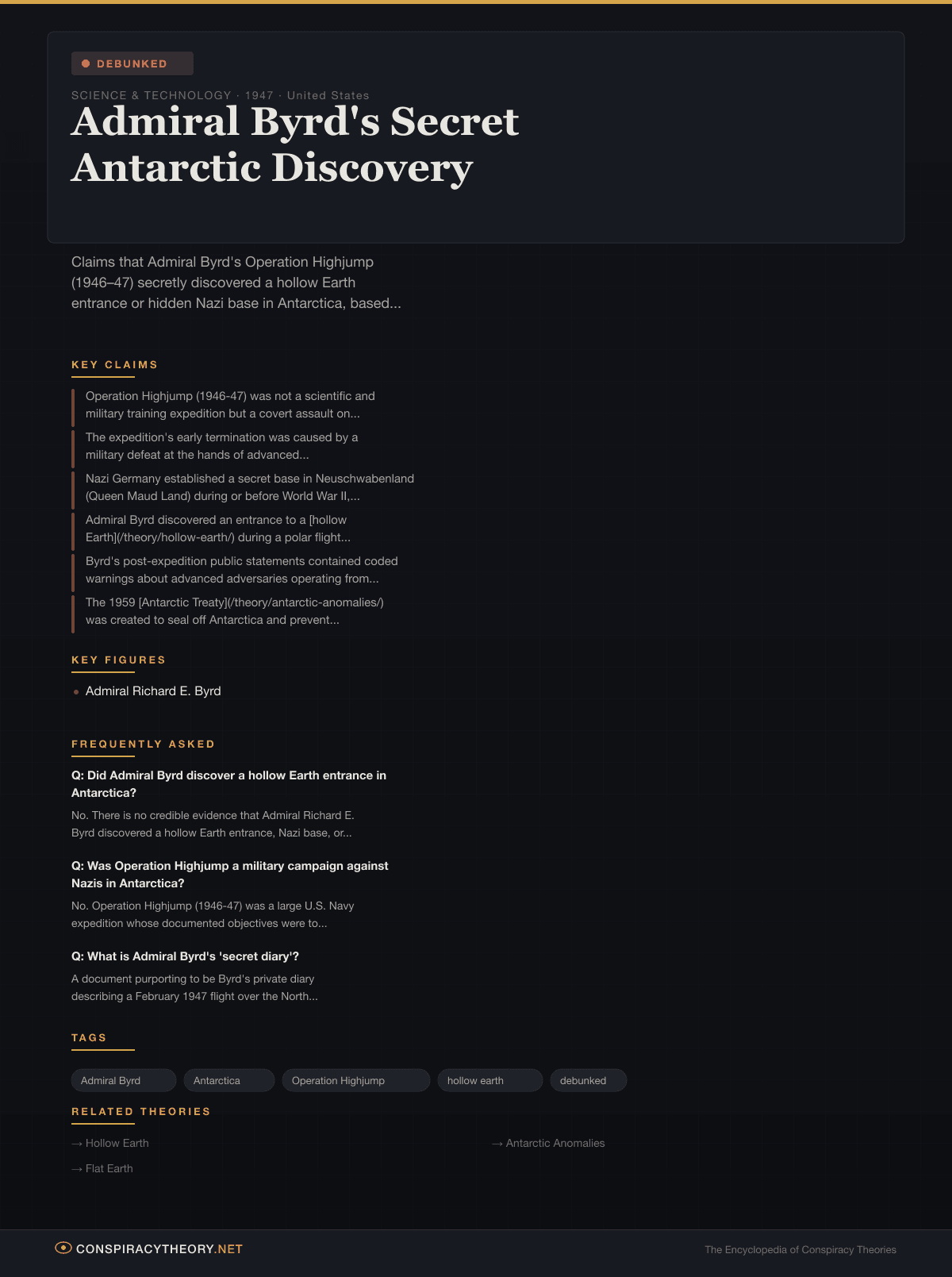
Admiral Byrd's Secret Antarctic Discovery
Overview
Rear Admiral Richard Evelyn Byrd is one of the most decorated and accomplished explorers in American history — a naval aviator, Medal of Honor recipient, and the first person to fly over the South Pole. He led five expeditions to Antarctica between 1928 and 1956, producing an extraordinary body of geographic, meteorological, and scientific data that advanced human understanding of the most remote continent on Earth. His contributions to polar exploration are genuine, significant, and well-documented.
None of that is what the internet wants to talk about. In conspiracy culture, Byrd’s name has been co-opted by a sprawling mythology that bears no resemblance to the documented historical record. According to these narratives, Byrd’s 1946-47 expedition — Operation Highjump — was not a training and exploration mission but a secret military assault on a Nazi base hidden beneath the Antarctic ice. When the expedition returned ahead of schedule, it was not because of bad weather but because Byrd’s forces had been defeated by advanced German technology, possibly flying saucers. And somewhere in the telling, a forged “secret diary” appeared, describing Byrd entering a hollow Earth through a polar opening and meeting an advanced civilization that warned him about humanity’s nuclear weapons.
The theory is a nexus point where hollow Earth speculation, Nazi occultism, UFO mythology, and government cover-up narratives intersect. It has the unfortunate effect of overshadowing the genuine achievements of a remarkable explorer.
Origins & History
The Real Admiral Byrd
Richard Evelyn Byrd (1888-1957) was born in Winchester, Virginia, to a prominent family. He graduated from the U.S. Naval Academy in 1912 and became a pioneering naval aviator during World War I. In the 1920s, he turned his attention to polar exploration, a pursuit that would define his career and his legacy.
On May 9, 1926, Byrd and pilot Floyd Bennett flew a Fokker trimotor aircraft from Spitsbergen, Norway, claiming to have reached the North Pole — a claim for which Byrd received the Medal of Honor but which has since been disputed by aviation historians who question whether the flight time was sufficient to have reached the pole. On November 28-29, 1929, Byrd made the first flight over the South Pole, a feat that is not disputed.
Between 1928 and 1956, Byrd led five expeditions to Antarctica. His first expedition (1928-30) established Little America base on the Ross Ice Shelf. His second (1933-35) is famous for Byrd’s decision to man a weather station alone through the Antarctic winter — an experience that nearly killed him through carbon monoxide poisoning and that he documented in his acclaimed memoir Alone (1938). His subsequent expeditions expanded American knowledge of Antarctic geography and cemented U.S. territorial claims in the emerging Cold War.
Operation Highjump: The Real Mission
Operation Highjump, officially designated Task Force 68, was a U.S. Navy expedition to Antarctica launched in December 1946. It was the largest Antarctic expedition in history to that date, involving 4,700 personnel, 13 ships (including an aircraft carrier and a submarine), and 33 aircraft. The scale of the operation alone was enough to generate speculation — why would the Navy send a carrier group to the bottom of the world?
The documented objectives were practical, if unglamorous: establish the Antarctic research base Little America IV, train personnel and test equipment in polar conditions, consolidate American territorial claims, and conduct aerial photography for cartographic purposes. The Cold War was beginning, and the polar regions were of strategic interest — the shortest flight paths between the United States and the Soviet Union passed over the Arctic, and Antarctica’s strategic potential was being assessed.
The expedition lasted approximately two months, ending ahead of schedule in late February 1947 after the early onset of Antarctic winter made flying conditions untenable. A PBM Mariner flying boat, designated George 1, crashed on December 30, 1946, killing three crew members — Ensign Maxwell A. Lopez, Aviation Machinist’s Mate First Class Wendell K. Hendersin, and Aviation Machinist’s Mate First Class Frederick W. Williams. The expedition’s primary accomplishment was aerial photography: aircraft mapped approximately 60,000 square miles of Antarctic coastline, producing some 70,000 photographs used for cartographic purposes.
In a press conference upon returning, Byrd reportedly discussed lessons learned and the strategic importance of the polar regions. He spoke of the possibility of an enemy attacking across the poles — standard Cold War rhetoric directed at the Soviet Union. These statements were later stripped from context and reinterpreted as coded warnings about something far stranger.
The Nazi Antarctic Base Myth
The first layer of conspiracy narrative appeared in the 1960s and 1970s, emerging from the world of neo-Nazi esoterica. Ernst Zundel, a German-Canadian Holocaust denier writing under the pseudonym Christof Friedrich, promoted the idea that the Third Reich had established a secret base in Antarctica’s Queen Maud Land — a region claimed by Germany in 1939 as “Neuschwabenland” following the Schwabenland expedition. Chilean diplomat and esoteric author Miguel Serrano wove similar themes into his writings on “Esoteric Hitlerism,” a mystical ideology that imagined the Nazis as avatars of a cosmic struggle.
According to this narrative, Operation Highjump was actually a military assault on the Nazi base. The expedition’s early termination — attributed by participants and Navy records to weather — was reframed as evidence of defeat at the hands of advanced German technology, possibly including flying saucers developed from designs by Viktor Schauberger or other supposed Nazi wonder-weapon engineers. The three crewmen who died in the George 1 crash were reimagined as combat casualties.
The theory ignores logistical reality. The 1938-39 German Schwabenland Expedition was a survey mission — aircraft flew over Queen Maud Land and dropped claim markers (metal swastika-bearing darts) onto the ice. No construction materials, no personnel rotation, no supply chain was established. Building and maintaining a permanent base on the most hostile continent on Earth would have required a sustained logistical effort that Germany — which by 1939 was preparing for war in Europe — neither undertook nor had the capacity to undertake. The theory requires believing that a functioning military base was established with no evidence of construction and sustained for years with no evidence of resupply.
The “Secret Diary”
The second and more baroque layer of conspiracy emerged with the publication of a purported “secret diary” of Admiral Byrd, which first circulated in conspiracy communities in the late 1970s and appeared in various self-published pamphlets and books, including one attributed to “Dr. Raymond W. Bernard” (a pseudonym for Walter Siegmeister).
The document describes a February 1947 flight in which Byrd allegedly flew over the North Pole (confusingly, not Antarctica — the diary conflates his different expeditions) and entered an opening in the Earth. Inside, he flew over a green, temperate landscape populated by mammoths and other prehistoric animals. He was contacted by flying craft that escorted his plane to a landing, where he met the “Master” — the leader of an advanced inner-Earth civilization called Arianni. The Master warned Byrd about humanity’s development of nuclear weapons and urged him to carry a message of peace back to the surface world. Byrd was then escorted out of the hollow Earth and returned to his base, where he was debriefed by military and intelligence officials who ordered him to remain silent.
The diary is rejected as a fabrication by every credible source. The Byrd Polar and Climate Research Center at Ohio State University, which holds over 400 linear feet of Byrd’s legitimate papers, correspondence, and expedition records, does not recognize the document. Byrd family members have publicly stated it is a forgery. The text contains geographical errors, anachronistic language, and concepts inconsistent with Byrd’s known writing style and the era. Byrd’s documented activities in February 1947 place him in Antarctica with Operation Highjump, not at the North Pole.
Key Claims
- Operation Highjump (1946-47) was not a scientific and military training expedition but a covert assault on a Nazi base in Antarctica
- The expedition’s early termination was caused by a military defeat at the hands of advanced German technology, including flying saucers
- Nazi Germany established a secret base in Neuschwabenland (Queen Maud Land) during or before World War II, which survived the war
- Admiral Byrd discovered an entrance to a hollow Earth during a polar flight and documented the encounter in a secret diary suppressed by the U.S. government
- Byrd’s post-expedition public statements contained coded warnings about advanced adversaries operating from the polar regions
- The 1959 Antarctic Treaty was created to seal off Antarctica and prevent public access to the hidden base or hollow Earth entrance
- Advanced technology recovered from (or developed at) the Antarctic base was incorporated into secret U.S. military programs
- Byrd’s subsequent Antarctic expeditions, including Operation Deep Freeze (1955-56), were follow-up missions to the hollow Earth discovery
Evidence
The evidence for these claims is nonexistent; the evidence against them is extensive.
Operation Highjump Records
Operation Highjump’s actual activities are well-documented in U.S. Navy records, participant memoirs, and contemporary news coverage. The expedition’s primary accomplishment was aerial photography — aircraft mapped approximately 60,000 square miles of Antarctic coastline, producing some 70,000 photographs used for cartographic purposes. The expedition’s records, held at the National Archives and Records Administration (Record Group 313), contain no references to combat, enemy encounters, or anomalous discoveries. After-action reports describe equipment testing, weather conditions, mapping results, and the George 1 crash — the mundane but valuable work of a military expedition in extreme conditions.
Crew members who served on Operation Highjump published memoirs and gave interviews in the decades following the expedition. None described combat with Nazi forces, encounters with flying saucers, or discoveries of hollow Earth entrances. The conspiracy narrative requires believing that every one of the 4,700 personnel maintained perfect secrecy for the rest of their lives — a level of omerta unprecedented in military history.
The Fabricated Diary
The “secret diary” fails basic authenticity tests. It describes a flight over the North Pole, not Antarctica, conflating Byrd’s different expeditions. It contains anachronistic language and concepts inconsistent with Byrd’s known writing style and the era. The prose has a literary quality more consistent with mid-1970s New Age writing than with a 1947 military officer’s personal journal. The Byrd Polar and Climate Research Center at Ohio State University, which holds Byrd’s legitimate papers, does not recognize the document. Byrd family members have stated it is a fabrication.
The diary first surfaced in conspiracy circles approximately two decades after Byrd’s death in 1957 — conveniently too late for Byrd himself to deny it. Its provenance cannot be traced to any legitimate archival source.
The Nazi Base Impossibility
The claim that Nazi Germany established a significant Antarctic base has no documentary support. Colin Summerhayes and Peter Beeching published a comprehensive investigation in Polar Record (2007), examining German naval records, the expedition reports of the Schwabenland, and Allied intelligence files from the war’s end. They concluded that no base was ever built. The 1938-39 expedition was a survey — a claim-staking exercise using aerial photography, not a construction project. The logistics of sustaining a secret installation on the most remote, inhospitable continent on Earth — without resupply, communication infrastructure, or detection by the dozens of subsequent national expeditions — are implausible in the extreme.
Byrd’s Public Statements
Byrd’s post-expedition public comments, frequently quoted by conspiracy proponents, have been verified against contemporary press transcripts. His statements about the strategic importance of polar regions and the potential for enemies to attack across the poles were standard Cold War rhetoric directed at the Soviet Union, not coded references to underground civilizations or Nazi remnants. In the context of 1947 American strategic thinking, concern about polar attack routes was not mysterious — it was prescient.
Key Figures
- Rear Admiral Richard E. Byrd (1888–1957): American naval officer and polar explorer whose genuine achievements have been co-opted by conspiracy narratives he never endorsed
- Ernst Zundel (1939–2017): German-Canadian Holocaust denier who promoted the Nazi Antarctic base theory under the pseudonym Christof Friedrich
- Miguel Serrano (1917–2009): Chilean diplomat and author of “Esoteric Hitlerism” who incorporated Antarctic mythology into neo-Nazi mysticism
- Dr. Raymond W. Bernard (Walter Siegmeister, 1901–1965): Author who popularized hollow Earth theories and is associated with early versions of the Byrd diary myth
Timeline
- 1926 (May 9): Byrd and Floyd Bennett claim to reach the North Pole by air (later disputed)
- 1929 (November 28-29): Byrd makes the first flight over the South Pole
- 1928–1930: Byrd’s first Antarctic expedition; establishes Little America base
- 1933–1935: Byrd’s second Antarctic expedition; his solitary winter at Advance Base documented in Alone
- 1938–1939: German Schwabenland expedition surveys Queen Maud Land; Germany claims “Neuschwabenland”
- 1946 (December) – 1947 (February): Operation Highjump; 4,700 personnel, 13 ships, 33 aircraft. George 1 crash kills three crewmen. Expedition ends early due to weather
- 1947 (March): Byrd gives press conference discussing Antarctic strategic significance; statements later misquoted
- 1955–1956: Operation Deep Freeze; Byrd’s final Antarctic expedition
- 1957 (March 11): Admiral Byrd dies in Boston at age 68
- 1959: Antarctic Treaty signed, later reinterpreted by conspiracy theorists as a cover-up mechanism
- Late 1970s: “Secret diary” of Admiral Byrd first circulates in conspiracy literature
- 2000s–present: YouTube and social media amplify Admiral Byrd conspiracy theories to mass audiences
Cultural Impact
The Admiral Byrd Antarctic conspiracy has become one of the most durable narratives in the overlapping worlds of hollow Earth theory, Nazi occultism, and UFO lore. It functions as a nexus point connecting multiple conspiracy traditions: the idea of a surviving Fourth Reich, the hollow Earth hypothesis, ancient advanced civilizations, and government cover-ups of extraordinary discoveries.
The narrative has been amplified enormously by internet culture, where Byrd’s genuine historical stature lends a veneer of authority to claims that would otherwise be dismissed outright. YouTube documentaries about Byrd’s “secret mission” routinely accumulate millions of views. The conspiracy has become particularly prominent in flat Earth communities, where Antarctica is reimagined as an ice wall surrounding a disc-shaped Earth, and the Antarctic Treaty is cast as a mechanism to prevent anyone from approaching the edge.
The theories have had the unfortunate effect of overshadowing Byrd’s actual legacy as an explorer and naval officer. Search results for his name increasingly return conspiracy content rather than legitimate historical information, a pattern that concerns archivists and historians who work with his papers. The Byrd Polar and Climate Research Center has had to address conspiratorial claims in its public communications — an absurd situation for an institution dedicated to preserving the records of a genuine polar explorer.
The Antarctic conspiracy genre has also spawned a productive vein of fiction, including novels, video games, and films that draw on the imagery of hidden polar civilizations and Nazi Antarctic bases — most notably the Wolfenstein video game franchise, the Finnish comedy film Iron Sky (2012), and Lovecraftian fiction inspired by H.P. Lovecraft’s 1936 novella At the Mountains of Madness, which imagined alien cities beneath the Antarctic ice decades before the conspiracy theories emerged.
The persistence of the Byrd myth illustrates a broader pattern in conspiracy culture: real people with real accomplishments become vessels for fictional narratives that eclipse their actual histories. Byrd the explorer — courageous, methodical, genuinely pioneering — has been replaced in popular imagination by Byrd the keeper of cosmic secrets, a transformation that says more about the needs of conspiracy culture than about anything that happened in Antarctica.
Sources & Further Reading
- Rose, Lisle A. Explorer: The Life of Richard E. Byrd. University of Missouri Press, 2008.
- Byrd, Richard E. Alone. G.P. Putnam’s Sons, 1938. (Byrd’s own account of his Antarctic experiences.)
- U.S. Navy. Operation Highjump records, National Archives and Records Administration, Record Group 313.
- Summerhayes, Colin P., and Peter Beeching. “Hitler’s Antarctic Base: The Myth and the Reality.” Polar Record 43.224 (2007): 1-21.
- Byrd Polar and Climate Research Center. Richard E. Byrd Papers. Ohio State University Archives.
- Mills, William James. Exploring Polar Frontiers: A Historical Encyclopedia. ABC-CLIO, 2003.
- Barkun, Michael. A Culture of Conspiracy: Apocalyptic Visions in Contemporary America. University of California Press, 2003.
- Standish, David. Hollow Earth: The Long and Curious History of Imagining Strange Lands, Fantastical Creatures, Advanced Civilizations, and Marvelous Machines Below the Earth’s Surface. Da Capo Press, 2006.
Related Theories
- Hollow Earth — the broader theory that the Earth contains a habitable interior, which the Byrd diary myth draws upon
- Antarctic Treaty Cover-Up — theories that the Antarctic Treaty exists to conceal secrets on the continent
- Flat Earth Theory — some flat Earth models incorporate Byrd’s supposed discoveries as evidence of an ice wall
- Nazi Antarctic Base — the specific claim that Nazi Germany established a surviving military installation in Antarctica
Frequently Asked Questions
Did Admiral Byrd discover a hollow Earth entrance in Antarctica?
Was Operation Highjump a military campaign against Nazis in Antarctica?
What is Admiral Byrd's 'secret diary'?

Infographic
Share this visual summary. Right-click to save.