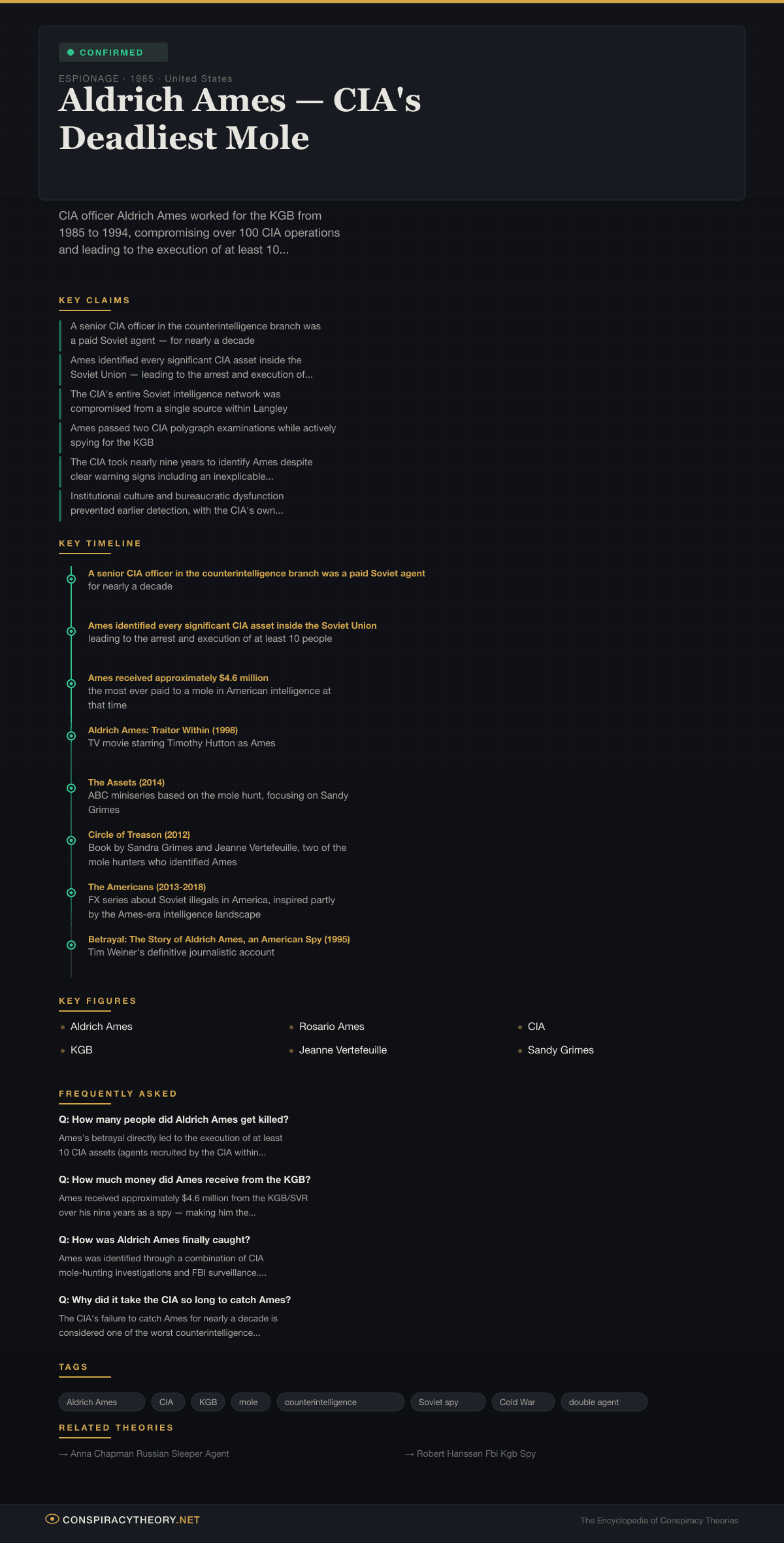
Aldrich Ames — CIA's Deadliest Mole
Overview
On April 16, 1985, a CIA officer named Aldrich Hazen Ames walked into the Soviet Embassy in Washington, D.C., and offered to sell the names of every CIA asset operating inside the Soviet Union. It was the single most devastating act of betrayal in the history of American intelligence.
Over the next nine years, Ames systematically delivered to the KGB — and later the SVR — the identities of virtually every human source the CIA had recruited in the Soviet bloc. At least ten of these agents were executed. Dozens of operations were destroyed. The CIA’s entire Soviet intelligence network, painstakingly built over decades, was incinerated in a matter of months. And Ames, a mediocre analyst with a drinking problem and a taste for expensive Italian shoes, continued reporting to work at Langley every morning, passing polygraphs, attending meetings, and browsing classified files with the full trust of his employer.
The Ames case is not a conspiracy theory in the traditional sense — it is a confirmed conspiracy, a proven fact that was once dismissed as unthinkable. It stands as perhaps the clearest illustration of a truth that runs through much of this wiki: sometimes the most paranoid suspicion imaginable turns out to be an understatement.
Origins & History
Aldrich Ames was born into the CIA. His father, Carleton Cecil Ames, had been an Agency officer who served in Burma in the 1950s. The younger Ames grew up in the Virginia suburbs of Washington, steeped in the culture of American intelligence. He joined the CIA in 1962 at age 21, initially working as a records analyst before transitioning into the Directorate of Operations — the clandestine service.
By most accounts, Ames was never a star. His performance reviews were middling. He had a reputation for sloppy tradecraft, missed deadlines, and heavy drinking. In 1981, he was posted to Mexico City, where he was tasked with recruiting Soviet intelligence officers. He performed adequately but not brilliantly, and his first marriage collapsed during the assignment.
Two things changed in Mexico City. First, Ames met Maria del Rosario Casas Dupuy, a Colombian cultural attache who would become his second wife. Rosario had expensive tastes that Ames’s GS-14 salary could not sustain. Second, Ames began developing a deep cynicism about the CIA and the intelligence business generally. He later described feeling that the work was pointless — that the intelligence he gathered made no difference to policy.
By 1985, Ames was back at CIA headquarters in Langley, Virginia, assigned to the Soviet/East European Division’s counterintelligence branch. This was a position of extraordinary access: Ames could see the identities of virtually every CIA human source inside the Soviet Union. He was, in the language of intelligence, “read into” the most sensitive Soviet operations the Agency ran.
And he was broke. His divorce had been expensive. Rosario’s spending was relentless. He owed $46,000 in credit card debt. On April 16, 1985, Ames walked into the Soviet Embassy on Wisconsin Avenue and handed a note to the duty officer offering information in exchange for $50,000. He included his name and enough identifying detail to establish his bona fides.
The Soviets accepted immediately.
Key Claims
Because this is a confirmed case, the “claims” were once unthinkable allegations that proved true:
- A senior CIA officer in the counterintelligence branch was a paid Soviet agent — for nearly a decade
- Ames identified every significant CIA asset inside the Soviet Union — leading to the arrest and execution of at least 10 people
- The CIA’s entire Soviet intelligence network was compromised from a single source within Langley
- Ames passed two CIA polygraph examinations while actively spying for the KGB
- The CIA took nearly nine years to identify Ames despite clear warning signs including an inexplicable lifestyle upgrade
- Institutional culture and bureaucratic dysfunction prevented earlier detection, with the CIA’s own Inspector General later finding “systemic failures”
- Ames received approximately $4.6 million — the most ever paid to a mole in American intelligence at that time
Evidence
The Scope of Betrayal
On June 13, 1985 — just two months after his initial approach — Ames handed his KGB handler a shopping bag containing between five and seven pounds of classified CIA documents. This single delivery included the identities of virtually every CIA human source operating inside the Soviet Union.
The impact was catastrophic and almost immediate:
Dmitri Polyakov (codenamed TOPHAT) — A two-star general in Soviet military intelligence (GRU) who had spied for the US since 1961, providing invaluable intelligence on Soviet weapons systems. Recalled to Moscow and executed in 1988.
Adolf Tolkachev — A Soviet defense researcher who had provided the CIA with thousands of pages of classified Soviet radar and avionics technology. Arrested in 1985, executed in 1986.
Valery Martynov and Sergei Motorin — KGB officers stationed in Washington who had been recruited by the FBI. Both were recalled to Moscow and executed.
Oleg Gordievsky — A KGB officer working for British MI6. Ames compromised him, but Gordievsky was exfiltrated from Moscow in a daring MI6 operation before the KGB could arrest him. He survived — one of the few who did.
In total, Ames compromised more than 100 CIA operations and identified at least 30 agents working for Western intelligence services. At least 10 were executed. The true number may never be known.
The Money Trail
What makes the Ames case almost farcical in retrospect is how flagrantly he displayed his new wealth. On a CIA salary of roughly $60,000 per year:
- He paid $540,000 in cash for a house in Arlington, Virginia
- He drove a new Jaguar XJ6
- He spent lavishly on home renovations, designer clothing, and fine dining
- He had $1.5 million in bank and investment accounts
- His credit card bills ran to thousands of dollars per month
Nobody at the CIA thought to ask where the money was coming from. When questions were eventually raised, Ames claimed his wife had inherited money from her family in Colombia. This explanation was accepted without verification.
The Polygraph Failures
Ames passed two CIA polygraph examinations during his years as a Soviet agent — in 1986 and 1991. At the time, the CIA relied heavily on polygraphs as a security measure. Ames later described his preparation for the tests as minimal: he simply relaxed and reminded himself to stay calm. The polygraph’s reputation as a reliable lie detector, always dubious in the scientific community, suffered a devastating blow.
The Mole Hunt
The CIA began noticing the loss of its Soviet assets in late 1985 and 1986. Agent after agent went silent. The initial reaction was not to suspect a mole but to blame communications security or Soviet counterintelligence improvements. A defector, Vitaly Yurchenko, briefly provided information suggesting a mole but then re-defected to the Soviet Union, muddying the waters.
A small mole-hunting team was eventually formed in 1986, led by veteran counterintelligence officer Jeanne Vertefeuille and analyst Sandy Grimes. But the investigation was underfunded, understaffed, and hampered by institutional resistance — the CIA did not want to believe one of its own was a traitor. The investigation dragged on for years.
It was not until 1993 that the noose tightened. The FBI opened a formal investigation (codenamed NIGHTMOVER), placed Ames under physical and electronic surveillance, searched his trash, and analyzed his finances. They discovered that his bank deposits aligned precisely with his meetings with Soviet handlers. A search of his home computer revealed communications with the SVR and draft letters discussing intelligence deliveries.
The Arrest and Aftermath
On February 21, 1994, FBI agents arrested Aldrich Ames and his wife Rosario as they drove from their Arlington home. Ames was charged with conspiracy to commit espionage. He pleaded guilty on April 28, 1994, and was sentenced to life in prison without the possibility of parole. Rosario received a five-year sentence for conspiracy to commit espionage and tax evasion.
The fallout within the intelligence community was enormous. CIA Director R. James Woolsey reprimanded 11 CIA officers for their failure to detect Ames but fired none — a decision that provoked outrage in Congress and the media. Woolsey resigned in January 1995. The CIA’s Inspector General published a devastating 400-page classified report documenting systematic failures in security, counterintelligence, and management oversight.
The case also revealed that Ames was not alone. The losses he could not account for led investigators to suspect a second mole — a trail that eventually led to FBI agent Robert Hanssen, who was arrested in 2001 and proved to have been an even longer-serving Soviet/Russian spy.
Cultural Impact
The Ames case fundamentally altered American intelligence culture. Before Ames, the CIA operated on a system of implicit trust — officers who had passed their initial background checks and polygraphs were essentially trusted indefinitely. After Ames, the Agency implemented enhanced financial disclosure requirements, more frequent and rigorous security reviews, and improved coordination between CIA counterintelligence and the FBI.
The case also demolished any remaining faith in the polygraph as a security tool. That a confirmed spy could pass two polygraph examinations while actively betraying his country’s most sensitive secrets proved what critics had long argued: the polygraph detects anxiety, not deception, and a relaxed liar will beat it every time.
More broadly, the Ames case — along with the subsequent Hanssen case — forced a reckoning with the fundamental vulnerability of intelligence organizations. The paradox of intelligence is that the people with the access to betray secrets are the same people you trust most with them. No system can eliminate this vulnerability entirely.
In Popular Culture
- Aldrich Ames: Traitor Within (1998) — TV movie starring Timothy Hutton as Ames
- The Assets (2014) — ABC miniseries based on the mole hunt, focusing on Sandy Grimes
- Circle of Treason (2012) — Book by Sandra Grimes and Jeanne Vertefeuille, two of the mole hunters who identified Ames
- The Americans (2013-2018) — FX series about Soviet illegals in America, inspired partly by the Ames-era intelligence landscape
- Betrayal: The Story of Aldrich Ames, an American Spy (1995) — Tim Weiner’s definitive journalistic account
Key Figures
- Aldrich Hazen Ames (1941-) — CIA officer who spied for the KGB/SVR from 1985-1994; currently serving life without parole at the Federal Correctional Institution in Terre Haute, Indiana
- Maria del Rosario Casas Ames — Ames’s second wife and co-conspirator; served five years in federal prison; deported to Colombia upon release
- Jeanne Vertefeuille — CIA counterintelligence officer who led the mole-hunting team that identified Ames; spent eight years on the investigation
- Sandy Grimes — CIA analyst and mole-hunter who made the critical connection between Ames’s bank deposits and his meetings with Soviet contacts
- Dmitri Polyakov — Two-star Soviet general who spied for the US for over 25 years; betrayed by Ames and executed in 1988
- R. James Woolsey — CIA Director who was criticized for his lenient response to the Ames scandal; resigned in 1995
Timeline
| Date | Event |
|---|---|
| 1962 | Ames joins the CIA as a records analyst |
| 1981-1983 | Posted to Mexico City; meets Rosario Casas; develops cynicism about the Agency |
| 1983-1985 | Returns to Langley; assigned to Soviet/East European counterintelligence with access to asset identities |
| April 16, 1985 | Ames walks into the Soviet Embassy in Washington and offers to spy for $50,000 |
| June 13, 1985 | Delivers shopping bag containing identities of virtually all CIA Soviet assets |
| Late 1985-1986 | CIA assets begin disappearing; at least 10 will be executed |
| 1986 | CIA forms mole-hunting team under Jeanne Vertefeuille |
| 1986 | Ames passes first polygraph while spying |
| 1989 | Pays $540,000 cash for Arlington house; no one at CIA investigates |
| 1991 | Ames passes second polygraph |
| 1993 | FBI opens formal investigation (NIGHTMOVER); places Ames under surveillance |
| February 21, 1994 | FBI arrests Ames and Rosario in Arlington, Virginia |
| April 28, 1994 | Ames pleads guilty to conspiracy to commit espionage; sentenced to life without parole |
| 1995 | CIA Inspector General publishes devastating report on counterintelligence failures; Director Woolsey resigns |
| 2001 | Robert Hanssen arrested as second mole — partly identified through losses Ames couldn’t explain |
Sources & Further Reading
- Weiner, Tim. Betrayal: The Story of Aldrich Ames, an American Spy. Random House, 1995.
- Grimes, Sandra, and Jeanne Vertefeuille. Circle of Treason: A CIA Account of Traitor Aldrich Ames and the Men He Betrayed. Naval Institute Press, 2012.
- Earley, Pete. Confessions of a Spy: The Real Story of Aldrich Ames. G.P. Putnam’s Sons, 1997.
- U.S. Senate Select Committee on Intelligence. “An Assessment of the Aldrich H. Ames Espionage Case and Its Implications for U.S. Intelligence.” November 1, 1994.
- CIA Inspector General. “Report of Investigation: The Aldrich Ames Case.” 1995. (Classified; partially declassified summary available.)
- Wise, David. Nightmover: How Aldrich Ames Sold the CIA to the KGB for $4.6 Million. HarperCollins, 1995.
Related Theories
- Anna Chapman — Russian Sleeper Agent Network — Another confirmed case of Russian espionage operations targeting the United States
- Robert Hanssen — FBI Spy — The second devastating mole case, partly uncovered through the Ames investigation
Frequently Asked Questions
How many people did Aldrich Ames get killed?
How much money did Ames receive from the KGB?
How was Aldrich Ames finally caught?
Why did it take the CIA so long to catch Ames?

Infographic
Share this visual summary. Right-click to save.