Alien Abductions

Overview
Alien abduction claims constitute one of the most enduring and culturally significant categories within UFO and extraterrestrial conspiracy discourse. The phenomenon involves individuals reporting that they have been taken against their will by non-human entities, subjected to physical and psychological examinations aboard craft of apparent extraterrestrial origin, and returned with partial or fully suppressed memories of the experience. These accounts have been reported across dozens of countries, though the overwhelming majority originate in the United States, and they share a remarkably consistent set of narrative elements: missing time, paralysis, bright lights, medical procedures, and encounters with beings described as humanoid with large eyes and grey skin.
The modern alien abduction narrative emerged in the early 1960s with the case of Betty and Barney Hill, an American couple who reported a close encounter while driving through New Hampshire in 1961. Their account, which was recovered in part through hypnotic regression, established many of the tropes that would define subsequent reports for decades. By the 1980s and 1990s, abduction claims had become a mass cultural phenomenon, with researchers such as Budd Hopkins, David Jacobs, and Harvard psychiatrist John E. Mack documenting hundreds of cases and arguing that the consistency of witness testimony pointed to a genuine phenomenon requiring serious investigation.
The alien abduction phenomenon is classified as unresolved. No physical evidence has definitively confirmed that abductions by extraterrestrial beings have occurred, and mainstream psychology offers well-supported alternative explanations rooted in sleep disorders, memory distortion, and the suggestive effects of hypnotic regression. However, the sheer volume of reports, certain unexplained physical trace cases, and the earnest conviction of many witnesses have prevented the subject from being dismissed entirely. The question of whether abduction accounts reflect objective encounters, subjective psychological experiences, or some combination of factors remains open.
Origins & History
The Betty and Barney Hill Case (1961)
The event widely considered the genesis of the modern alien abduction narrative took place on the night of September 19-20, 1961. Betty and Barney Hill, an interracial couple from Portsmouth, New Hampshire, were driving home from a vacation in Montreal when they observed a bright, moving light in the sky near Lancaster, New Hampshire. Barney stopped the car and used binoculars to observe what he described as a large, silent craft with rows of windows, behind which he claimed to see humanoid figures. The couple then experienced a period of confusion and disorientation, arriving home approximately two hours later than expected with no clear memory of the intervening time.
In the days following the incident, Betty began having vivid, recurring nightmares in which she and Barney were taken aboard a craft by small beings and subjected to physical examinations. The couple experienced persistent anxiety and sought treatment from Boston psychiatrist Benjamin Simon in 1964. Under separate hypnotic regression sessions, both Betty and Barney independently described being taken aboard the craft, separated, and examined by beings approximately five feet tall with large eyes, grey skin, and no discernible hair. Betty reported being shown a star map, which she later reproduced from memory. In 1968, amateur astronomer Marjorie Fish identified the map as a potential match for the Zeta Reticuli star system, a claim that generated significant interest but has been disputed by astronomers who argue the match is statistically unremarkable.
The Hills’ account was made public through journalist John G. Fuller’s 1966 book The Interrupted Journey and a subsequent 1975 television film, The UFO Incident. The case established the foundational template for alien abduction narratives: missing time, highway encounters, hypnotic memory recovery, medical examinations, and grey-skinned humanoid beings.
The 1970s: Travis Walton and Expanding Reports
On November 5, 1975, forestry worker Travis Walton disappeared for five days near Snowflake, Arizona, after his logging crew reported seeing him struck by a beam of light from a hovering craft. The six crew members who witnessed the event submitted to and passed polygraph examinations, and an extensive search of the surrounding forest found no trace of Walton. When he reappeared five days later, disoriented and dehydrated, Walton described being aboard a craft and encountering both humanoid and human-appearing beings.
The Walton case was notable for its multiple witnesses and the absence of hypnosis in the initial account. Walton told his story voluntarily, and the independent polygraph results of the crew members were difficult for skeptics to dismiss outright, though critics pointed to inconsistencies in later retellings and the financial motivations created by book and film deals. Walton’s experience was adapted into the 1993 film Fire in the Sky.
The 1980s and 1990s: The Abduction Epidemic
The phenomenon expanded dramatically in the 1980s and 1990s, driven in large part by the work of three key figures. Artist and researcher Budd Hopkins published Missing Time in 1981 and Intruders in 1987, documenting numerous abduction cases and arguing that abductions were far more common than previously believed, with many experiencers unaware of their encounters due to suppressed memories. Hopkins pioneered the use of hypnotic regression as an investigative tool and identified recurring elements across cases: reproductive procedures, implant insertion, and generational abduction patterns.
Historian David Jacobs, a tenured professor at Temple University, built on Hopkins’ work with Secret Life (1992) and The Threat (1998), constructing a more alarming interpretation. Jacobs argued that abductions were part of a systematic alien program focused on hybridization — the creation of human-alien hybrids intended to eventually integrate into human society. While Jacobs’ work drew criticism for its reliance on hypnotic regression and its increasingly alarmist conclusions, it represented one of the most detailed attempts to construct a unified theory from abduction reports.
The most culturally impactful abduction account of this period came from horror novelist Whitley Strieber, whose 1987 book Communion described his own alleged abduction experiences at his cabin in upstate New York. The book spent months on the New York Times bestseller list and its iconic cover image — depicting a grey being with enormous dark eyes, painted by Ted Seth Jacobs — became the definitive visual representation of the alien abduction phenomenon. Strieber’s account was distinctive in its literary quality and psychological complexity; rather than presenting a straightforward abduction narrative, he explored the experience as profoundly ambiguous, terrifying, and potentially transformative.
John E. Mack and Academic Legitimacy
The alien abduction field received its most significant academic endorsement from John E. Mack, a Pulitzer Prize-winning psychiatrist and tenured professor at Harvard Medical School. Mack began investigating abduction claims in 1990, initially expecting to find conventional psychiatric explanations. Instead, he concluded that the experiencers he studied were psychologically normal and that their accounts could not be adequately explained by known psychological mechanisms. His 1994 book Abduction: Human Encounters with Aliens presented thirteen case studies and argued that the phenomenon, whatever its ultimate nature, warranted serious scientific inquiry.
Mack’s involvement provoked significant institutional controversy. Harvard Medical School convened a committee to review his clinical practices — an unprecedented action that drew accusations of academic censorship. The committee ultimately affirmed Mack’s academic freedom while encouraging more methodological rigor. Mack continued his research until his death in a traffic accident in London in 2004.
Key Claims
Proponents of the alien abduction phenomenon and associated conspiracy theories advance several core claims:
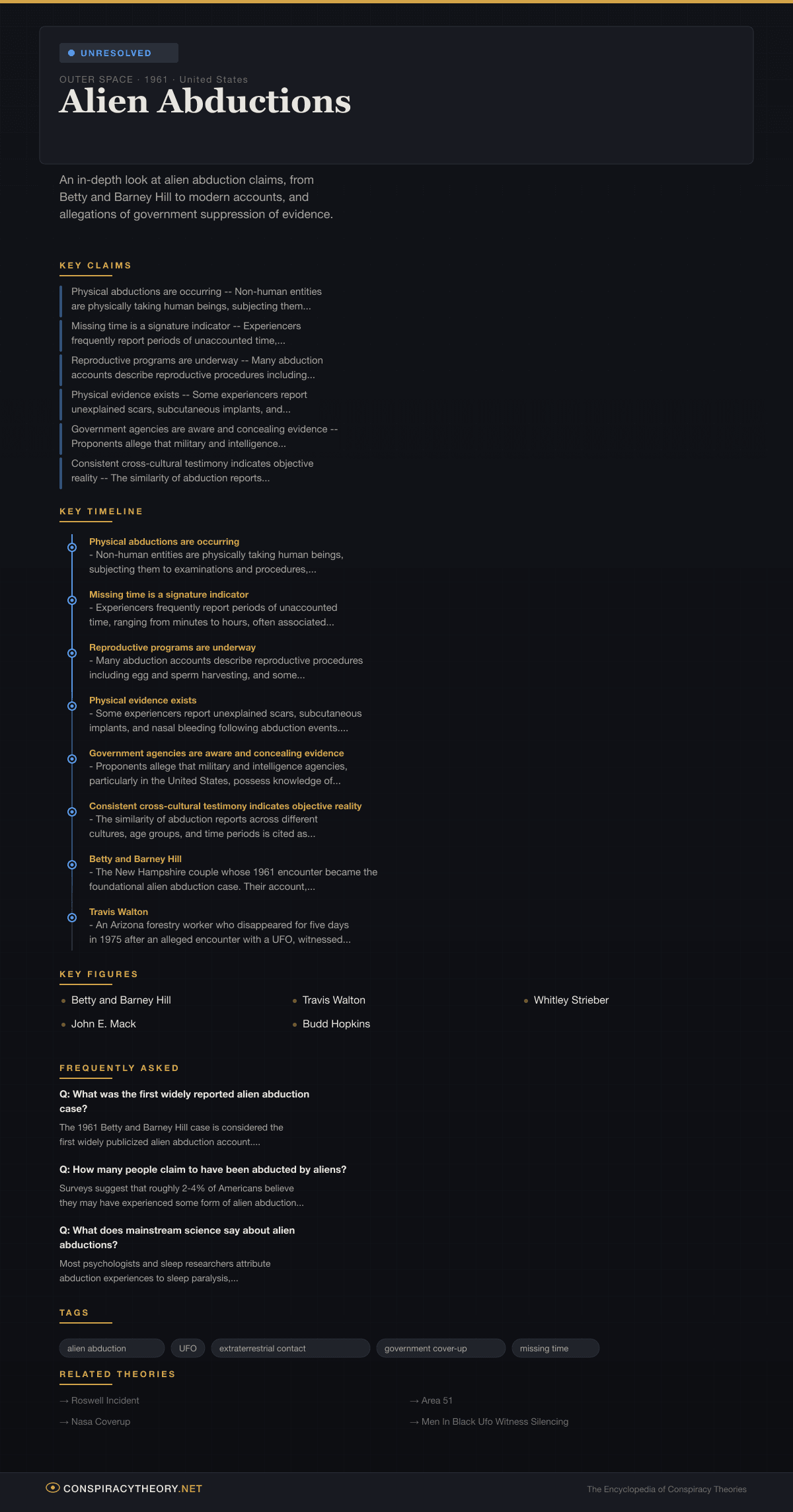
- Physical abductions are occurring — Non-human entities are physically taking human beings, subjecting them to examinations and procedures, and returning them with suppressed or altered memories.
- Missing time is a signature indicator — Experiencers frequently report periods of unaccounted time, ranging from minutes to hours, often associated with highway travel or isolated locations.
- Reproductive programs are underway — Many abduction accounts describe reproductive procedures including egg and sperm harvesting, and some female experiencers report being shown hybrid offspring during subsequent abductions.
- Physical evidence exists — Some experiencers report unexplained scars, subcutaneous implants, and nasal bleeding following abduction events. A small number of alleged implants have been surgically removed and subjected to laboratory analysis.
- Government agencies are aware and concealing evidence — Proponents allege that military and intelligence agencies, particularly in the United States, possess knowledge of the abduction phenomenon and actively suppress it to prevent public panic or to protect relationships with extraterrestrial entities.
- Consistent cross-cultural testimony indicates objective reality — The similarity of abduction reports across different cultures, age groups, and time periods is cited as evidence that the experiences reflect genuine events rather than culturally generated fantasies.
Evidence
Narrative Consistency
Researchers such as Hopkins, Jacobs, and folklorist Thomas E. Bullard have documented a high degree of structural consistency across abduction reports, including among individuals with no prior exposure to abduction literature. Bullard’s 1987 study of over 300 cases identified a common sequence of events — capture, examination, communication, tour of the craft, and return — that appeared across cases regardless of the experiencer’s cultural background. Proponents argue this consistency is difficult to explain through purely cultural mechanisms.
Physical Trace Cases
A small number of abduction cases have involved claims of physical evidence. These include unexplained scars and lesions appearing overnight, nosebleeds, and alleged subcutaneous implants. Podiatric surgeon Roger Leir claimed to have surgically removed several implants from abduction experiencers between 1995 and 2014, describing them as small metallic objects with unusual isotopic ratios. However, independent analysis of these objects has not confirmed an extraterrestrial origin, and critics have noted that metallic foreign bodies can enter the skin through mundane injuries without the individual’s awareness.
Polygraph and Psychological Testing
Several prominent abduction claimants, including Travis Walton and the members of his logging crew, have undergone polygraph examinations with results interpreted as supporting their truthfulness. Psychological evaluations of abduction experiencers have generally found them to be psychologically normal, without elevated rates of psychopathology compared to the general population. Mack’s clinical assessments at Harvard reached similar conclusions.
Debunking / Verification
Sleep Paralysis and Hypnagogic Hallucinations
The most widely accepted scientific explanation for abduction experiences centers on sleep paralysis, a well-documented condition in which individuals awaken while the body remains in the paralytic state associated with REM sleep. During sleep paralysis episodes, individuals are conscious but unable to move and frequently experience vivid hallucinations, a sensation of pressure on the chest, the perception of a threatening presence in the room, and feelings of being physically manipulated or levitated. Cross-cultural studies have shown that the content of these hallucinations is shaped by cultural context: in cultures with abduction narratives, sleep paralysis episodes are more likely to be interpreted as alien encounters.
Hypnotic Regression and False Memory
The heavy reliance on hypnotic regression in abduction research has drawn sustained criticism from memory scientists. Research by psychologists Elizabeth Loftus and others has demonstrated that hypnosis does not reliably recover accurate memories and can instead facilitate the creation of detailed, emotionally compelling false memories. Subjects under hypnosis are highly suggestible, and the expectations of the hypnotist — particularly if the hypnotist believes in the reality of abductions — can shape the content of recalled “memories.” The American Medical Association and the American Psychological Association have both issued statements cautioning against the use of hypnosis for memory recovery.
Critics have noted that the consistency of abduction narratives may itself be an artifact of the hypnotic regression process, in which investigators using similar techniques and holding similar expectations produce similar results across subjects. The narratives may also reflect shared cultural templates disseminated through books, films, and television rather than independent recollections of genuine events.
Fantasy-Prone Personality
Psychologists Sheryl C. Wilson and Theodore X. Barber identified the concept of fantasy-prone personality in 1983, describing individuals who experience exceptionally vivid fantasies, often indistinguishable from reality. Some researchers have found elevated rates of fantasy-proneness among abduction experiencers, suggesting that these individuals may be more susceptible to generating and believing in elaborate imagined scenarios. However, other studies have found no significant difference in fantasy-proneness between experiencers and control groups, and the relevance of this trait remains debated.
Cultural Contamination
Skeptics note that the modern abduction narrative emerged and evolved in close parallel with its depiction in popular culture. The grey alien archetype, now the dominant image in abduction reports, was not prominent in early UFO encounters and became standard only after its popularization through Strieber’s Communion and television depictions such as the 1989 series Alien Nation and the 1993 debut of The X-Files. Earlier abduction accounts described a wider variety of entity types, suggesting that cultural exposure shapes the content of reported experiences.
Cultural Impact
The alien abduction phenomenon has exerted a profound influence on popular culture and public consciousness. The grey alien — large-headed, large-eyed, thin-bodied — has become one of the most instantly recognizable icons in global visual culture, appearing in advertising, fashion, art, and internet memes. The image owes its ubiquity largely to Ted Seth Jacobs’ cover painting for Strieber’s Communion, which became one of the bestselling book covers in publishing history.
In film and television, abduction narratives have provided the basis for works ranging from Steven Spielberg’s Close Encounters of the Third Kind (1977) and its depiction of benevolent contact, to the sustained alien abduction mythology of The X-Files (1993-2018), to the horror-inflected treatment in films such as Fire in the Sky (1993), The Fourth Kind (2009), and Dark Skies (2013). The television series Taken (2002), produced by Spielberg, traced a multigenerational abduction narrative across fifty years of American history.
The phenomenon has also shaped public policy discourse. Congressional hearings on unidentified aerial phenomena (UAP) in 2022 and 2023, while focused primarily on military sightings rather than abduction claims, occurred within a cultural environment significantly shaped by decades of abduction narratives. The establishment of the All-domain Anomaly Resolution Office (AARO) by the U.S. Department of Defense in 2022 reflected a broader institutional willingness to engage with phenomena previously dismissed as fringe, a shift partly attributable to the normalization of extraterrestrial contact narratives in public discourse.
Key Figures
- Betty and Barney Hill — The New Hampshire couple whose 1961 encounter became the foundational alien abduction case. Their account, recovered partly through hypnosis, established the template for decades of subsequent reports.
- Travis Walton — An Arizona forestry worker who disappeared for five days in 1975 after an alleged encounter with a UFO, witnessed by six coworkers. His case remains one of the most debated in abduction literature.
- Budd Hopkins — An American artist and abduction researcher whose books Missing Time (1981) and Intruders (1987) helped establish alien abduction as a mass cultural phenomenon. He pioneered the use of hypnotic regression in abduction research.
- David Jacobs — A Temple University historian who documented hundreds of abduction cases and proposed a hybridization hypothesis. His later work drew criticism for the increasingly leading nature of his hypnotic regression sessions.
- Whitley Strieber — An American author whose 1987 memoir Communion became a bestseller and whose account of his own abduction experiences brought the phenomenon to mainstream audiences.
- John E. Mack — A Harvard Medical School psychiatrist and Pulitzer Prize winner who risked his academic reputation by taking abduction claims seriously and arguing they warranted rigorous scientific investigation.
- Thomas E. Bullard — A folklorist at Indiana University who conducted one of the most systematic comparative studies of abduction narratives, analyzing structural patterns across hundreds of cases.
Timeline
- 1957 — Brazilian farmer Antonio Villas Boas reports being taken aboard a craft and forced into a sexual encounter with a female humanoid, in what may be the earliest detailed abduction account.
- 1961 — Betty and Barney Hill experience their encounter on Route 3 in New Hampshire, later recovered through hypnotic regression with psychiatrist Benjamin Simon.
- 1966 — John G. Fuller publishes The Interrupted Journey, bringing the Hill case to national attention.
- 1973 — Charles Hickson and Calvin Parker report being abducted by robotic beings while fishing on the Pascagoula River in Mississippi. The case receives extensive media coverage.
- 1975 — Travis Walton disappears for five days near Snowflake, Arizona, in one of the most witnessed and debated abduction cases.
- 1981 — Budd Hopkins publishes Missing Time, documenting multiple abduction cases and popularizing the concept of suppressed abduction memories.
- 1987 — Whitley Strieber publishes Communion, which becomes a New York Times bestseller and the most commercially successful abduction account in publishing history.
- 1992 — MIT hosts a five-day academic conference on the abduction phenomenon, organized by John Mack and David Pritchard, lending institutional credibility to the field.
- 1994 — John E. Mack publishes Abduction: Human Encounters with Aliens, prompting Harvard Medical School to review his clinical practices.
- 1998 — David Jacobs publishes The Threat, outlining a comprehensive hybridization hypothesis.
- 2004 — John E. Mack dies in a traffic accident in London, effectively ending the most prominent academic investigation of the abduction phenomenon.
- 2017 — The New York Times reveals the Pentagon’s Advanced Aerospace Threat Identification Program (AATIP), reigniting public interest in government engagement with UFO and contact phenomena.
- 2022 — The U.S. Department of Defense establishes the All-domain Anomaly Resolution Office (AARO) to investigate unidentified anomalous phenomena.
- 2023 — Congressional hearings on UAPs include testimony from military whistleblowers, occurring within a cultural context shaped by decades of abduction narratives.
Sources & Further Reading
- Fuller, John G. The Interrupted Journey: Two Lost Hours “Aboard a Flying Saucer.” Dial Press, 1966
- Hopkins, Budd. Missing Time: A Documented Study of UFO Abductions. Richard Marek Publishers, 1981
- Hopkins, Budd. Intruders: The Incredible Visitations at Copley Woods. Random House, 1987
- Strieber, Whitley. Communion: A True Story. Beech Tree Books, 1987
- Mack, John E. Abduction: Human Encounters with Aliens. Charles Scribner’s Sons, 1994
- Jacobs, David M. Secret Life: Firsthand Accounts of UFO Abductions. Simon & Schuster, 1992
- Jacobs, David M. The Threat: Revealing the Secret Alien Agenda. Simon & Schuster, 1998
- Bullard, Thomas E. UFO Abductions: The Measure of a Mystery. Fund for UFO Research, 1987
- Clancy, Susan A. Abducted: How People Come to Believe They Were Kidnapped by Aliens. Harvard University Press, 2005
- McNally, Richard J. Remembering Trauma. Harvard University Press, 2003
- Walton, Travis. Fire in the Sky: The Walton Experience. Marlowe & Company, 1996
- Wilson, Sheryl C., and Theodore X. Barber. “The Fantasy-Prone Personality.” Psychological Bulletin, 1983
- Loftus, Elizabeth F. The Myth of Repressed Memory. St. Martin’s Press, 1994
Frequently Asked Questions
What was the first widely reported alien abduction case?
How many people claim to have been abducted by aliens?
What does mainstream science say about alien abductions?

Infographic
Share this visual summary. Right-click to save.