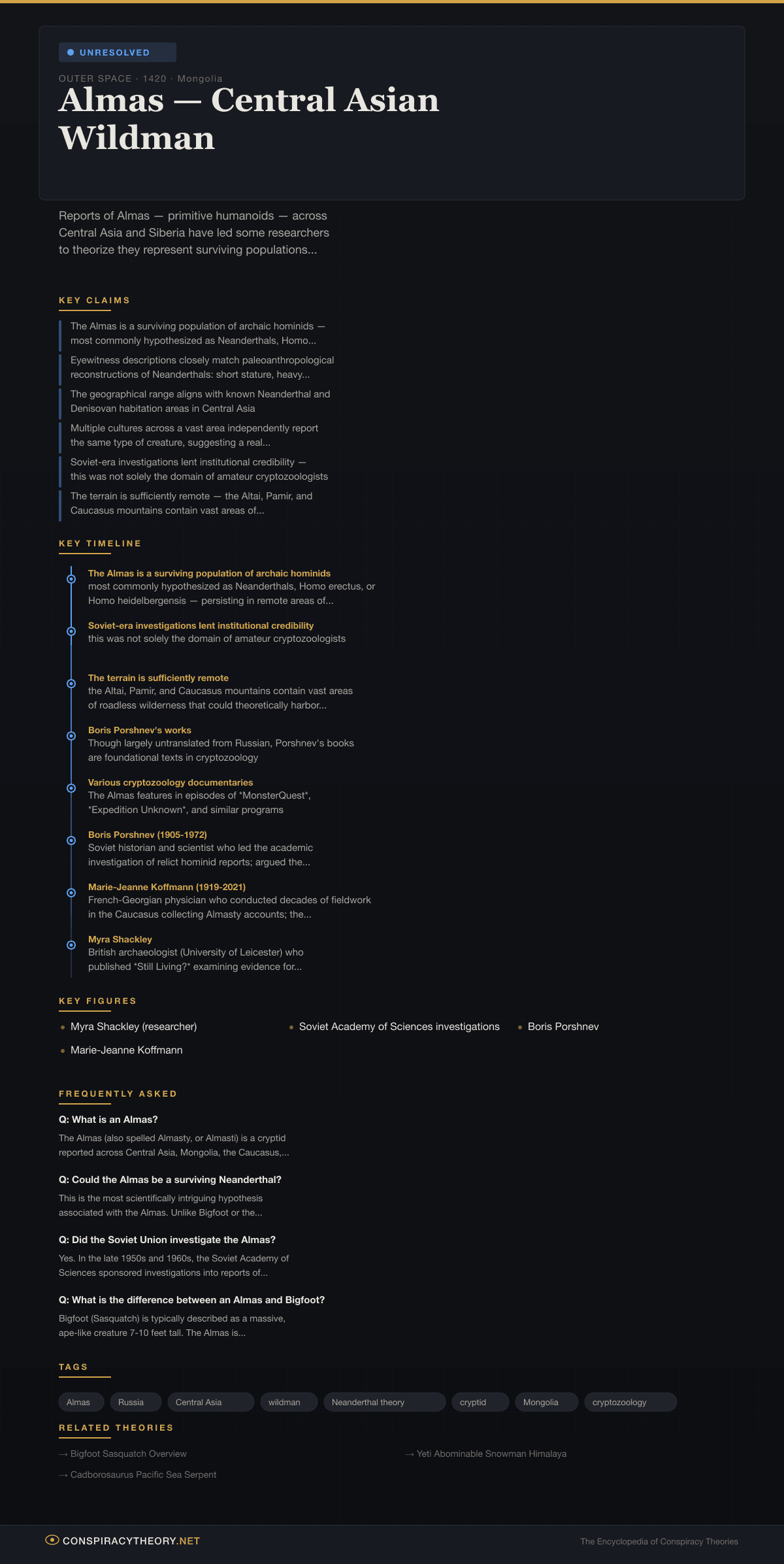
Almas — Central Asian Wildman
Overview
Somewhere in the vast interior of Asia — across the Altai Mountains, the Mongolian steppe, the Caucasus highlands, and the frozen expanses of Siberia — people have been reporting encounters with something that should not exist: a small, hairy, human-like creature that walks upright, avoids contact with modern humans, and seems to inhabit the most remote and inhospitable terrain on Earth.
They call it the Almas. And unlike its more famous cryptid cousins — the towering Bigfoot of North America or the fearsome Yeti of the Himalayas — the Almas is not described as a monster. It is described as a person. A short, primitive, hair-covered person with a heavy brow, a flat nose, and a stocky build that, to anyone with a passing familiarity with paleoanthropology, sounds uncannily like a Neanderthal.
This resemblance is what makes the Almas the most intellectually provocative of all wildman legends. We know that Neanderthals coexisted with modern humans in Central Asia until roughly 40,000 years ago. We know that other archaic hominid species, like the Denisovans, survived in the Altai region until perhaps 30,000 years ago. Is it possible — however remote the probability — that a small, relict population survived into the modern era in some of the most rugged and least explored landscape on Earth?
Almost certainly not. But the story of the search is worth telling anyway.
Origins & History
The Almas tradition in Central Asian culture is ancient. The earliest known written reference appears in a 15th-century Bavarian diary by Hans Schiltberger, a soldier captured by the Mongols around 1420. Schiltberger described being shown two wild people — “covered with hair except for the hands and face” — during his captivity in Mongolia. He noted that they lived in the mountains and were well-known to the local population.
Mongolian and Tibetan cultures have long traditions of wild people. In Mongolia, the creatures are called Almas (from the Mongolian word for “wild man”). In the Caucasus, they are known as Almasty. In Siberia, various indigenous peoples have their own terms. These traditions share common features: the creatures are described as roughly human-sized (about five feet tall), covered in reddish-brown or dark hair, bipedal, tool-using in some accounts, and extremely shy of humans.
What distinguishes these accounts from most cryptid lore is their ordinariness. The Almas is not described as supernatural, demonic, or alien. In many Central Asian cultures, it is simply another kind of person — a more primitive, forest-dwelling kind that modern humans occasionally encounter in the backcountry.
The Almas entered the realm of formal investigation during the Soviet era. In the late 1950s, the Soviet Academy of Sciences commissioned an investigation into reports of relict hominids across Central Asia and the Caucasus. This was not as strange as it sounds in context: the Soviet scientific establishment, less constrained by Western academic taboos in some areas, was willing to investigate phenomena that Western institutions would have dismissed outright.
The leading Soviet figure in Almas research was Professor Boris Porshnev, a historian and polymath who became convinced that reports of wild people deserved systematic investigation. Porshnev collected hundreds of eyewitness accounts from across the Soviet Union and argued in his 1963 book that the Almas represented surviving populations of Neanderthals or other archaic hominids.
Porshnev’s most important collaborator was Marie-Jeanne Koffmann, a French physician of Georgian descent who conducted decades of fieldwork in the Caucasus mountains. Koffmann interviewed hundreds of witnesses, documented multiple sighting locations, and attempted to habituate Almasty to human observers by leaving food at consistent locations. She never obtained physical evidence, but her rigorous methodology and extensive fieldwork represented the most sustained scientific effort to document the phenomenon.
Key Claims
- The Almas is a surviving population of archaic hominids — most commonly hypothesized as Neanderthals, Homo erectus, or Homo heidelbergensis — persisting in remote areas of Central Asia
- Eyewitness descriptions closely match paleoanthropological reconstructions of Neanderthals: short stature, heavy brow ridges, flat nose, stocky build, body hair
- The geographical range aligns with known Neanderthal and Denisovan habitation areas in Central Asia
- Multiple cultures across a vast area independently report the same type of creature, suggesting a real phenomenon rather than cultural diffusion from a single source
- Soviet-era investigations lent institutional credibility — this was not solely the domain of amateur cryptozoologists
- The terrain is sufficiently remote — the Altai, Pamir, and Caucasus mountains contain vast areas of roadless wilderness that could theoretically harbor small populations of an elusive species
Evidence
Eyewitness Accounts
The Almas evidence base consists almost entirely of eyewitness testimony — hundreds of reports collected over centuries. Key accounts include:
Schiltberger’s 1420 account — The earliest written European record, describing captive wild people shown to him in Mongolia.
The Zana story — The most famous and most controversial Almas account. Zana was allegedly a wild woman captured in the Ochamchira region of Abkhazia in the 1850s. Described as tall, muscular, covered in dark reddish-brown hair, with a massive frame and primitive features, she was reportedly kept as a servant and eventually had several children by local men. Her descendants, who lived in the area into the 20th century, were described as exceptionally strong with unusual physical features. In 2013, geneticist Bryan Sykes analyzed DNA from a tooth attributed to one of Zana’s descendants and found it to be 100% sub-Saharan African — suggesting Zana may have been an African woman, perhaps an escaped slave, whose appearance was mythologized.
Koffmann’s Caucasus fieldwork (1960s-2000s) — Koffmann collected over 500 eyewitness accounts from the Kabardino-Balkarian region of the Caucasus. Many witnesses were herders, hunters, and border guards — people with extensive backcountry experience who described encounters with creatures that did not match any known local wildlife.
Soviet military reports — During World War II and the subsequent Cold War period, Soviet soldiers stationed in remote Central Asian regions occasionally filed reports of encounters with wild, human-like creatures. These reports, while not investigated at the time, were later collected by researchers.
Physical Evidence (or Lack Thereof)
The critical weakness of the Almas case is the complete absence of physical evidence. No bones, teeth, hair samples, scat, or other biological material has been conclusively identified as belonging to an unknown hominid species in Central Asia. No remains have ever been found. No clear photographs or video exist.
The Zana DNA analysis, which was hoped to provide breakthrough evidence, instead produced a mundane explanation. Subsequent attempts to analyze other purported Almas samples have yielded results consistent with known species — bears, humans, or domestic animals.
The Neanderthal Hypothesis
The intellectual backbone of serious Almas research is the hypothesis that Central Asian wilderness could harbor surviving Neanderthals. In its favor:
- Neanderthals definitely inhabited Central Asia — the Okladnikov Cave in Siberia and the Teshik-Tash cave in Uzbekistan both yielded Neanderthal remains
- The Denisovans, another archaic hominid, survived in the Altai Mountains until at least 30,000 years ago
- Neanderthals were cold-adapted, tool-using, and capable of surviving in harsh terrain
- Eyewitness descriptions of the Almas align surprisingly well with Neanderthal reconstructions
Against it:
- There is zero fossil or DNA evidence of any hominid species surviving in Central Asia beyond approximately 30,000 years ago
- A breeding population requires at minimum several hundred individuals, which would leave detectable traces
- Modern environmental DNA (eDNA) techniques can detect species from soil and water samples — no unknown hominid DNA has been found
- Neanderthal extinction is well-documented and attributed to competition with modern humans, climate change, and interbreeding
Debunking / Verification
The Almas remains unresolved — there is not enough evidence to confirm the existence of relict hominids, but the consistency and volume of eyewitness accounts across cultures and centuries makes simple dismissal unsatisfying. Several factors contribute to this status:
The Zana case was the strongest lead, and it failed. If Zana’s DNA had shown archaic hominid ancestry, it would have been a scientific earthquake. Instead, it showed she was likely a sub-Saharan African woman — interesting historically but irrelevant to the Almas question.
Eyewitness testimony, however consistent, is not physical evidence. Humans are pattern-recognizing animals who can misidentify bears, hermits, or unfamiliar people as “wild men,” especially in low-light conditions in unfamiliar terrain.
Absence of evidence is evidence of absence — to a degree. After decades of searching, zero physical evidence has been recovered. While the terrain is vast and remote, the same argument was made about other cryptids that also remain unverified.
But the cultural depth is notable. Unlike many modern cryptids, the Almas tradition is embedded deeply in Central Asian culture, predating Western influence and appearing consistently across cultures that had limited contact with each other.
Cultural Impact
The Almas holds a unique position in cryptozoology as the “intellectual’s cryptid.” While Bigfoot and the Loch Ness Monster attract popular fascination and tabloid coverage, the Almas appeals to a more academic audience — people drawn by the genuinely interesting paleoanthropological questions it raises about Neanderthal extinction and the limits of human diversity.
The Almas has also played a role in the broader cryptozoological community’s attempts to gain scientific legitimacy. The Soviet Academy of Sciences investigations are frequently cited as evidence that mainstream science has, at least occasionally, taken wildman reports seriously.
In Central Asian cultures, the Almas continues to function as a figure of folklore — neither feared nor worshipped, but accepted as part of the natural landscape in a way that Western cryptids, with their sensationalized media coverage, are not.
In Popular Culture
- Myra Shackley’s Still Living? (1983) — Academic monograph examining the evidence for relict hominids, focusing significantly on the Almas
- Boris Porshnev’s works — Though largely untranslated from Russian, Porshnev’s books are foundational texts in cryptozoology
- Various cryptozoology documentaries — The Almas features in episodes of MonsterQuest, Expedition Unknown, and similar programs
- Bryan Sykes’ The Nature of the Beast (2015) — Includes the DNA analysis of the Zana case
Key Figures
- Boris Porshnev (1905-1972) — Soviet historian and scientist who led the academic investigation of relict hominid reports; argued the Almas represented surviving Neanderthals
- Marie-Jeanne Koffmann (1919-2021) — French-Georgian physician who conducted decades of fieldwork in the Caucasus collecting Almasty accounts; the most dedicated field researcher on the subject
- Myra Shackley — British archaeologist (University of Leicester) who published Still Living? examining evidence for surviving hominids
- Bryan Sykes (1947-2020) — Oxford geneticist who analyzed purported Almas/Yeti DNA samples, including the Zana case
- Hans Schiltberger (1381-~1440) — Bavarian soldier who provided the earliest known European written account of the Almas during his captivity in Mongolia
Timeline
| Date | Event |
|---|---|
| ~1420 | Hans Schiltberger describes “wild people” shown to him during Mongol captivity |
| ~1850s | Zana, alleged wild woman, captured in Abkhazia (account recorded later) |
| 1920s-1930s | Various encounters reported by Soviet military and explorers in Central Asia |
| Late 1950s | Soviet Academy of Sciences commissions investigation into relict hominid reports |
| 1958 | Porshnev begins systematic collection of Almas eyewitness accounts |
| 1960s | Koffmann begins decades of fieldwork in the Caucasus mountains |
| 1963 | Porshnev publishes major work arguing for surviving Neanderthals in Central Asia |
| 1983 | Myra Shackley publishes Still Living?, bringing the Almas to English-speaking academic audiences |
| 2013 | Bryan Sykes analyzes DNA from purported Zana descendant; results show sub-Saharan African ancestry |
| 2015 | Sykes publishes findings in The Nature of the Beast |
| Present | No physical evidence recovered; occasional eyewitness reports continue |
Sources & Further Reading
- Shackley, Myra. Still Living? Yeti, Sasquatch and the Neanderthal Enigma. Thames and Hudson, 1983.
- Sykes, Bryan. The Nature of the Beast: The First Genetic Evidence on the Survival of Apemen, Yeti, Bigfoot and Other Mysterious Creatures into Modern Times. Coronet, 2015.
- Porshnev, Boris. “The Troglodytidae and the Hominidae in the Taxonomy and Evolution of Higher Primates.” Current Anthropology, 1974.
- Bayanov, Dmitri. In the Footsteps of the Russian Snowman. Crypto-Logos, 1996.
- Sykes, Bryan, et al. “Genetic Analysis of Hair Samples Attributed to Yeti, Bigfoot and Other Anomalous Primates.” Proceedings of the Royal Society B, 2014.
- Coleman, Loren, and Patrick Huyghe. The Field Guide to Bigfoot and Other Mystery Primates. Anomalist Books, 2006.
Related Theories
- Bigfoot / Sasquatch — North America’s wildman, typically described as more ape-like and larger than the Almas
- Yeti / Abominable Snowman — The Himalayan counterpart, with overlapping geographical range
- Cadborosaurus — Another cryptid investigated by credentialed scientists
Frequently Asked Questions
What is an Almas?
Could the Almas be a surviving Neanderthal?
Did the Soviet Union investigate the Almas?
What is the difference between an Almas and Bigfoot?

Infographic
Share this visual summary. Right-click to save.