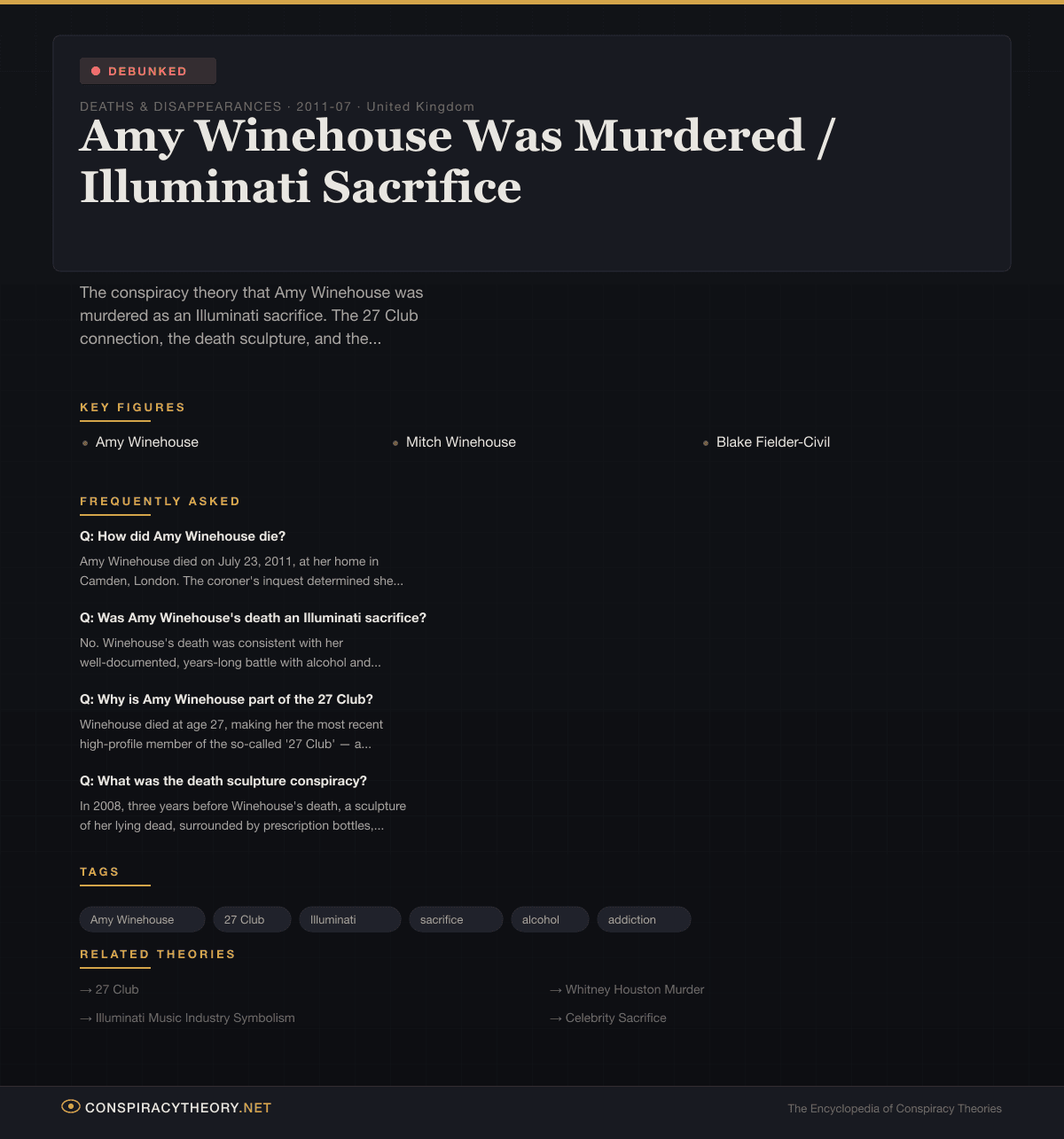
Amy Winehouse Was Murdered / Illuminati Sacrifice

Overview
Amy Winehouse spent the last years of her life dying in public. Not metaphorically — literally, visibly, in front of cameras that documented every stumble, every slurred performance, every emaciated paparazzi shot that the British tabloids ran alongside headlines oscillating between mock concern and gleeful cruelty.
Her performances became national events not for her voice — though when she was sober, it remained one of the most extraordinary instruments in popular music — but for the spectacle of watching someone unravel. The 2008 Grammy performance, beamed via satellite from London because she couldn’t get a U.S. visa due to drug charges, was simultaneously triumphant (she won five Grammys) and devastating (she was visibly unwell). The 2011 Belgrade concert, one of her last, saw fans booing and walking out as she wandered the stage, unable to remember lyrics.
And then, on July 23, 2011, she was found dead in her Camden home at age 27, with a blood alcohol level that would have killed most people twice over. The coroner’s inquest was straightforward: accidental alcohol poisoning.
Within hours, a different explanation was circulating online: Amy Winehouse had been murdered. Sacrificed by the Illuminati. Taken out to join the 27 Club not because of addiction — the thing everyone had watched destroy her for years — but because a shadowy elite demanded blood.
The Facts of Her Death
The Final Weeks
In June 2011, Winehouse attempted a comeback tour. The Belgrade performance on June 18 was a catastrophe — she appeared intoxicated, forgot lyrics, and was physically unsteady. The remaining tour dates were canceled.
She returned to her Camden home and, according to people close to her, went through a period of attempted sobriety followed by relapse. Her live-in security guard, Andrew Morris, later told the inquest that Winehouse had been drinking heavily in the days before her death. She had purchased and consumed large quantities of vodka.
On the evening of July 22, Morris checked on her at approximately 10 p.m. She was lying on her bed, which was not unusual. When he checked again the following afternoon, she was in the same position. She had died sometime during the night.
The Toxicology
The toxicology report found:
- Blood alcohol level of .416% (more than five times the UK legal driving limit of .08%)
- No illegal drugs in her system
- No evidence of physical trauma
- No evidence of foul play
A level of .416% represents extreme, potentially lethal alcohol consumption. For someone with Winehouse’s small frame (she was 5’3” and had become dangerously thin), this level was incompatible with survival. Death was attributed to alcohol toxicity and “inhalation of vomit” — the body’s reflexes suppressed by the extreme alcohol level.
The Second Inquest
In an unusual twist, the original coroner’s inquest was declared void in 2013 when it was discovered that the coroner, Suzanne Greenaway, did not hold the proper legal qualifications for the position. A new inquest was held under a different coroner and reached the identical conclusion: death by misadventure due to alcohol poisoning. This administrative irregularity was seized upon by conspiracy theorists as evidence of a cover-up, despite the fact that the second qualified inquest confirmed the first unqualified one in every detail.
The Conspiracy Theory
The 27 Club Connection
Winehouse’s death at 27 made her the newest member of the “27 Club,” and for conspiracy theorists, this was the primary evidence of foul play. The 27 Club pattern — Hendrix, Joplin, Morrison, Cobain, now Winehouse — seemed too perfect to be coincidence.
But a 2011 study published in the BMJ examined the mortality rates of over 1,000 musicians who had reached the UK album charts and found no spike in deaths at age 27. Musicians do die at higher rates than the general population between ages 20-40, but this elevated risk is evenly distributed across ages, not concentrated at 27. The “27 Club” is a product of selection bias — we notice and remember the famous musicians who died at 27 because we’ve been told to look for them.
The Daniel Edwards Sculpture
In 2008, American sculptor Daniel Edwards created a life-size sculpture depicting Amy Winehouse lying dead, surrounded by prescription pill bottles. The work was exhibited at a London gallery and received significant media coverage.
Three years later, when Winehouse actually died, conspiracy theorists pointed to the sculpture as “predictive programming” — the Illuminati’s supposed practice of embedding future plans in art and media before executing them. In this reading, the sculpture wasn’t commentary on a visible crisis. It was a preview of a scheduled murder.
The more obvious interpretation: in 2008, anyone paying attention could see that Winehouse was in severe danger. Her addiction was international news. She had been hospitalized multiple times. An artist creating a sculpture depicting her death was making a commentary on celebrity culture and tabloid exploitation, not revealing Illuminati plans. The sculpture’s “predictive” quality was simply a reflection of how obviously and publicly Winehouse was suffering.
The Industry Control Narrative
The broader version of the theory positions Winehouse’s death within the Illuminati entertainment industry narrative: she was a uniquely talented artist who either knew too much, resisted industry control, or was due to be “sacrificed” to benefit another artist’s career. Some versions of the theory claim her death was timed to the release of a competing album or the career advancement of a rival artist.
This theory requires ignoring the documented reality: Winehouse had no management during her final months (she had fired her management team), was not involved in any industry disputes, and was not in a position to threaten anyone’s career. She was, by the accounts of everyone around her, a desperately ill woman trying and failing to get sober.
What the Conspiracy Theory Erases
The most harmful aspect of the Winehouse murder theory is what it erases: the reality of addiction, and the very real failures of the people and systems around her.
Amy Winehouse didn’t die because of the Illuminati. She died because:
-
Addiction is a lethal disease: Alcohol use disorder kills approximately 140,000 Americans annually and proportional numbers in the UK. It is among the deadliest conditions in medicine.
-
The tabloid culture was vampiric: The British press profited from documenting Winehouse’s decline while doing nothing to address it. Paparazzi followed her to pharmacies, hospitals, and AA meetings. Her suffering was entertainment.
-
The music industry failed her: Despite generating enormous revenue from her work, the industry structures around her were unable or unwilling to intervene effectively in her addiction.
-
Mental health services were inadequate: Winehouse cycled through treatment programs that didn’t work and was discharged from facilities that should have kept her longer.
The conspiracy theory replaces all of these real, actionable failures with a comfortable fiction: it wasn’t anyone’s fault. It was the Illuminati. There’s nothing we can learn, nothing we can change, nothing we could have done. She was destined to die at 27 because the secret elite willed it.
This is the cruelest function of the sacrifice theory: it lets everyone off the hook.
Cultural Impact
Winehouse’s death — and the conspiracies surrounding it — contributed to a broader conversation about how the entertainment industry and media treat artists struggling with addiction. The 2015 documentary Amy, directed by Asif Kapadia, provided a devastating portrait of the systems that failed her, earning an Academy Award.
Her father Mitch Winehouse founded the Amy Winehouse Foundation, which supports young people struggling with addiction and mental health issues. The foundation’s work represents the constructive response to her death — addressing the actual causes rather than fictional ones.
Timeline
| Date | Event |
|---|---|
| 1983 | Amy Winehouse born in Southgate, London |
| 2003 | Debut album Frank released |
| 2006 | Back to Black released; becomes international sensation |
| 2007 | Marriage to Blake Fielder-Civil; drug use escalates |
| 2008 | Wins five Grammy Awards; Daniel Edwards death sculpture exhibited |
| 2008-2010 | Multiple hospitalizations, arrests, public incidents |
| June 2011 | Belgrade concert disaster; tour canceled |
| July 23, 2011 | Found dead at Camden home; blood alcohol .416% |
| July 2011 | Conspiracy theories about Illuminati sacrifice begin circulating |
| October 2011 | Coroner rules death by misadventure; alcohol poisoning |
| 2013 | Second inquest confirms original findings |
| 2015 | Documentary Amy wins Academy Award |
Sources & Further Reading
- Kapadia, Asif, dir. Amy. A24/Universal Music, 2015.
- Winehouse, Mitch. Amy, My Daughter. It Books, 2012.
- St. Pancras Coroner’s Court. Inquest into the death of Amy Jade Winehouse, October 2011 and January 2013.
- Segal, Ronald. “The 27 Club: Why Do Musicians Die Young?” BMJ, December 2011.
- Newkey-Burden, Chas. Amy Winehouse: The Biography. John Blake Publishing, 2011.
Related Theories
- 27 Club Conspiracy — The pattern of musicians dying at age 27
- Whitney Houston Murder — Similar sacrifice claims about Houston
- Illuminati Music Industry — Broader entertainment industry conspiracy
- Celebrity Sacrifice — The overarching sacrifice theory

Frequently Asked Questions
How did Amy Winehouse die?
Was Amy Winehouse's death an Illuminati sacrifice?
Why is Amy Winehouse part of the 27 Club?
What was the death sculpture conspiracy?
Infographic
Share this visual summary. Right-click to save.