Andy Kaufman Faked His Death
Overview
The theory that comedian and performance artist Andy Kaufman (1949-1984) faked his death from lung cancer on May 16, 1984, as the ultimate expression of his lifelong commitment to hoaxing and audience manipulation, has persisted for over four decades. Unlike most “celebrity faked death” theories, which emerge from fan communities reluctant to accept a beloved figure’s passing, the Kaufman theory has unique characteristics: Kaufman himself explicitly discussed faking his own death on multiple occasions, his entire career was built on blurring the distinction between performance and reality, and key people in his life — including his writing partner Bob Zmuda, his girlfriend Lynne Margulies, and his brother Michael Kaufman — have at various times actively encouraged speculation that he might still be alive.
Andy Kaufman died at age 35 of renal failure caused by large cell carcinoma, a rare and aggressive form of lung cancer. He was treated at Cedars-Sinai Medical Center in Los Angeles, where his diagnosis and death were documented by his oncologist, Dr. Gary Weitman. A death certificate was issued, his body was viewed by family members, and he was buried at Beth David Cemetery in Elmont, New York. His death was witnessed by Margulies and other companions, and his funeral was attended by family and colleagues.
Despite this documentation, the theory is classified as debunked but remains one of the most culturally significant faked-death theories due to the unique circumstances surrounding Kaufman’s persona and legacy. The theory speaks less to the actual evidence of his death than to the extraordinary nature of his art, which so thoroughly demolished the boundary between performance and reality that even death itself became another potential act.
Origins & History
Kaufman’s Life and Art of Deception
To understand why the faked death theory persists, one must understand the nature of Andy Kaufman’s work. Born on January 17, 1949, in New York City, Kaufman developed from childhood an approach to performance that rejected the conventional comedian-audience relationship. He was not, in any traditional sense, a comedian. He did not tell jokes. Instead, he created situations — often uncomfortable, confusing, or confrontational — in which the audience’s uncertainty about what was real and what was performance was itself the art.
His most famous routines exemplified this approach:
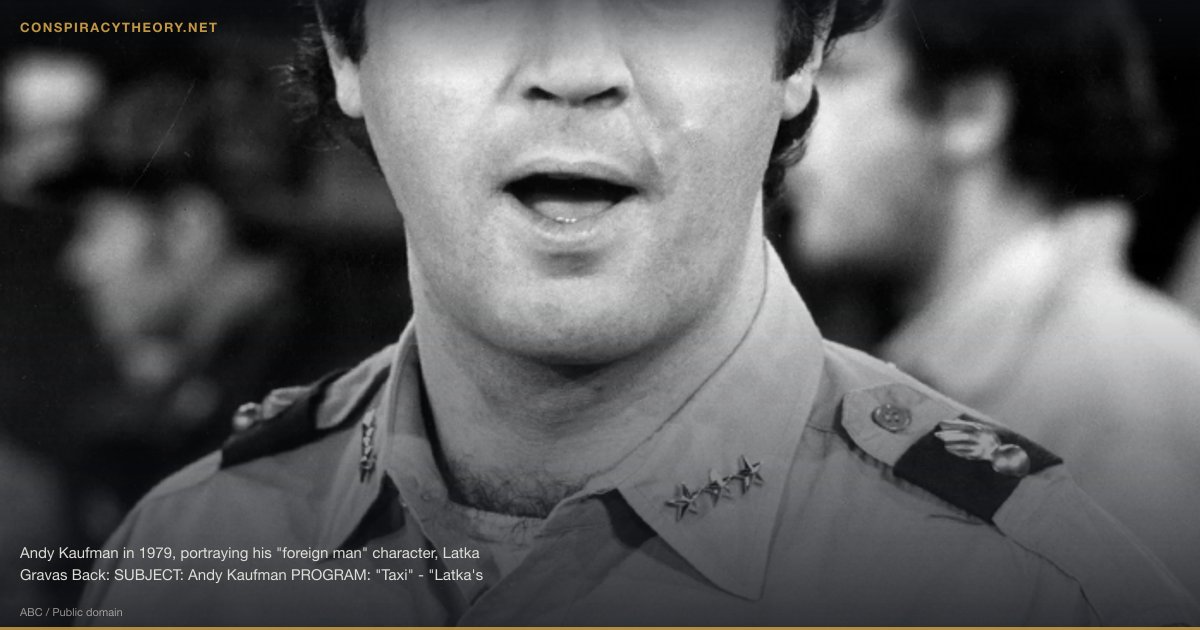
Foreign Man / Latka Gravas: Kaufman’s most commercially successful character was a timid, heavily accented immigrant (later named Latka Gravas for the television series Taxi). The character was a creation of such sustained commitment that many people who met Kaufman socially encountered the character rather than the man.
Tony Clifton: Kaufman created an alter ego — a boorish, talentless, abrasive lounge singer named Tony Clifton — and insisted with complete conviction that Clifton was a real, separate person. He appeared as Clifton in full prosthetic makeup that made him unrecognizable. Crucially, his writing partner Bob Zmuda also performed as Clifton, so that Kaufman and “Clifton” could appear in different places simultaneously, reinforcing the fiction. Kaufman had Clifton contractually written into his Taxi contract as a separate performer and maintained the deception with such determination that producers, crew members, and fellow actors were genuinely unsure whether Clifton was Kaufman or someone else.
Intergender wrestling: Kaufman declared himself the “Inter-Gender Wrestling Champion of the World” and wrestled women on national television, generating enormous controversy and genuine anger. His wrestling feud with professional wrestler Jerry Lawler — which included Lawler apparently injuring Kaufman on the Late Show with David Letterman — was maintained as real for decades before Lawler confirmed it had been a collaboration.
The Taxi conflict: Kaufman openly expressed contempt for Taxi, the show that made him famous, and was eventually fired from the series — an event whose genuine or performative nature remains debated.
These and other episodes established a career-long pattern in which nothing Kaufman did or said could be taken at face value. He trained his audience, his colleagues, and the media to question the reality of everything associated with him. This conditioning is the foundation of the faked death theory.
Kaufman’s Own Statements About Faking His Death
Kaufman discussed faking his death with multiple people on multiple occasions, making these conversations perhaps the most important context for the theory:
According to Bob Zmuda, Kaufman told him as early as the late 1970s that he planned to fake his own death as the ultimate prank, disappearing from public life and reemerging years later. Zmuda has described this as a recurring topic of conversation, with Kaufman exploring various scenarios for how the fake death would be staged and how the eventual reveal would work.
Lynne Margulies, Kaufman’s girlfriend at the time of his death, has confirmed that Kaufman discussed the idea of faking his death, though her accounts of his sincerity about the plan have varied over the years.
Friends and colleagues have reported similar conversations. Kaufman is said to have told multiple people that he would fake his death and return after a period of 20 or 30 years.
The fact that Kaufman explicitly announced his intention to fake his death creates an interpretive paradox. It can be read as evidence that the death was staged (he told people he would do it, and then he did it). But it can equally be read as evidence that the death was genuine and the theory was anticipated (Kaufman, who loved audience confusion, knew that his eventual real death would be doubted because of his reputation, and deliberately seeded the idea to ensure that even his death would generate uncertainty — the ultimate posthumous performance).
The Cancer Diagnosis and Death
In late 1983, Kaufman was diagnosed with large cell carcinoma, a rare form of lung cancer notable for its aggressiveness. The diagnosis was surprising because Kaufman was not a smoker — he was, in fact, a health-conscious individual who practiced Transcendental Meditation and generally avoided substances.
The rarity of the cancer and Kaufman’s non-smoker status immediately generated suspicion among those inclined to doubt the diagnosis. Proponents of the faked death theory argue that a non-smoker developing lung cancer at age 35 is statistically unusual, suggesting the diagnosis may have been fabricated.
However, large cell carcinoma, while more common in smokers, does occur in non-smokers. Approximately 10-15% of lung cancers occur in people who have never smoked. The rarity of the diagnosis does not make it impossible, and the medical records documenting Kaufman’s treatment — including radiation therapy and chemotherapy — are consistent with a genuine cancer case.
During his illness, Kaufman sought both conventional and alternative treatments. He traveled to the Philippines for “psychic surgery” — a practice in which practitioners appear to reach into the patient’s body and remove diseased tissue without incisions. Psychic surgery is widely regarded as a fraudulent practice involving sleight-of-hand and animal tissues. Kaufman’s pursuit of this treatment has been interpreted variously as desperation, genuine belief, or another layer of performance.
On May 16, 1984, Kaufman died at Cedars-Sinai Medical Center. He was 35 years old.
Post-Death Cultivation of Ambiguity
In the years following Kaufman’s death, several key figures actively cultivated uncertainty about whether he was really dead:
Bob Zmuda became the most prominent voice suggesting Kaufman might still be alive. In interviews, books, and public appearances spanning decades, Zmuda hinted, implied, and occasionally stated directly that Kaufman might have faked his death. Zmuda continued to perform as Tony Clifton after Kaufman’s death, sometimes suggesting that Kaufman was “inside the suit.” Zmuda’s behavior created an ongoing source of ambiguity that kept the theory alive.
Zmuda also organized the “Andy Kaufman Awards” annual ceremony, which became a venue for Kaufman-related provocations. The most dramatic of these occurred in 2013.
Michael Kaufman (Andy’s brother) participated in events that encouraged the theory. At the 2013 Andy Kaufman Awards, Michael presented a letter he said Andy had left for the family with instructions to open it in 2013, then introduced a young woman who claimed to be Andy’s daughter. The event generated worldwide media coverage before the woman was identified as Alexandra Tatarsky, an actress with no connection to the Kaufman family. Michael later acknowledged the hoax.
Lynne Margulies co-authored a book with Zmuda (Andy Kaufman: The Truth, Finally, 2014) that explored the faked death question, at times suggesting it might be true while ultimately acknowledging Kaufman’s death was genuine.
Key Claims
- Andy Kaufman faked his death from lung cancer on May 16, 1984, as the ultimate performance art piece
- The cancer diagnosis was fabricated, explaining the statistical unlikelihood of a non-smoking 35-year-old developing lung cancer
- Kaufman told multiple people he planned to fake his death, and then executed the plan
- Bob Zmuda’s decades of hints and ambiguous statements are signals that Kaufman is alive
- The continued post-death performances of Tony Clifton (by Zmuda) may actually involve Kaufman
- Kaufman planned to reveal himself after a set number of years (20 or 30 years after 1984)
- The 2013 “daughter” appearance was a genuine preview of Kaufman’s return, not a separate hoax
- The death certificate, funeral, and medical records were fabricated or falsified with the cooperation of doctors and family
- Kaufman is living under an assumed identity, possibly in a different country
Evidence
Evidence Cited by Proponents
Kaufman’s own statements: He explicitly told multiple people he planned to fake his death. This is the single most compelling element of the theory and is well-documented.
The pattern of deception: Kaufman’s entire career demonstrated a willingness and ability to sustain elaborate deceptions over long periods. The Tony Clifton character, the wrestling feud, and other episodes showed he could recruit collaborators, maintain secrets, and commit to fictional realities with extraordinary persistence.
Zmuda’s behavior: For decades after Kaufman’s death, his closest collaborator actively fueled doubt about whether the death was real. If anyone would know the truth, proponents argue, it would be Zmuda.
The statistical argument: Lung cancer in a non-smoking 35-year-old is statistically unusual, raising questions about the diagnosis’s authenticity.
The 2013 incident: While ultimately revealed as a hoax, the “daughter” appearance demonstrated that the Kaufman inner circle was willing to stage elaborate deceptions related to his death.
No exhumation or DNA testing: Kaufman’s body has never been exhumed or subjected to DNA testing to confirm its identity. In theory, a different body could have been buried.
Evidence Against the Theory
Medical documentation: Kaufman’s cancer was diagnosed and treated by Dr. Gary Weitman, a practicing oncologist at Cedars-Sinai. Medical records document his diagnosis, treatment (radiation and chemotherapy), and death. Dr. Weitman has not participated in any deception narrative and has confirmed the diagnosis and death.
Death certificate and burial: A legal death certificate was issued by the State of California. Kaufman’s body was viewed by family members and buried at Beth David Cemetery. Falsifying a death certificate is a felony, and the conspiracy would require the participation of doctors, hospital staff, funeral home employees, and government officials.
Family grief: Kaufman’s parents, Stanley and Janice Kaufman, expressed genuine grief at their son’s death. While conspiracy theorists can always argue that family members are in on the deception, the documented and sustained grief of his elderly parents argues against a voluntary hoax.
Duration: As of 2026, Kaufman would be 77 years old. The theory requires him to have maintained a secret identity for over 42 years without a single confirmed sighting, slip, or leak. While Kaufman was committed to his deceptions, sustaining one for over four decades — including through the era of social media, smartphone cameras, and facial recognition technology — strains credulity.
Zmuda’s eventual acknowledgment: In the 2014 book Andy Kaufman: The Truth, Finally, co-authored with Margulies, Zmuda ultimately acknowledged that Kaufman’s death was genuine, though even this acknowledgment was framed in characteristically ambiguous terms.
The 2013 hoax was exposed: The “daughter” incident was quickly debunked, demonstrating that those around Kaufman were willing to create Kaufman-related hoaxes independently — meaning that evidence of “signals” that Kaufman is alive may simply be further hoaxes by his associates.
Debunking / Verification
The theory is classified as debunked based on:
- Documented medical evidence of a genuine cancer diagnosis and treatment by a credentialed oncologist at a major medical center
- A legal death certificate issued by the State of California
- Physical viewing of the body by family members
- Burial at a known cemetery
- The passage of over 42 years without any confirmed evidence that Kaufman is alive
- The exposure of the 2013 “daughter” incident as a hoax created by Kaufman’s associates, not by Kaufman
- The ultimate acknowledgment by Zmuda and Margulies that Kaufman genuinely died
The theory persists not because of evidence but because of the unique nature of Kaufman’s art, which makes certainty about anything associated with him feel impossible. In a sense, the theory is the last Andy Kaufman performance — one that continues to blur the line between reality and fiction decades after the performer’s death.
Cultural Impact
The “Andy Kaufman is alive” theory has had significant cultural impact, both as a conspiracy theory and as a reflection of Kaufman’s artistic legacy.
Redefining the limits of performance art: The fact that Kaufman’s death itself became the subject of a performance-or-reality debate demonstrates that he succeeded, perhaps more than any other artist, in demolishing the wall between art and life. The faked death theory is, in a sense, the ultimate validation of his artistic project — even death could not restore the certainty he spent his career destroying.
Influence on performance and comedy: Kaufman’s approach to audience manipulation has influenced subsequent performers including Sacha Baron Cohen (Borat, Ali G), Joaquin Phoenix (I’m Still Here), and numerous performance artists. The faked death theory has become part of this legacy, cited as evidence of Kaufman’s unmatched commitment to the bit.
The Man on the Moon biopic: Jim Carrey’s portrayal of Kaufman in Man on the Moon (1999) brought renewed attention to both Kaufman’s career and the faked death theory. Carrey’s own deep immersion in the role — which reportedly involved remaining in character as Kaufman off-set — further blurred the reality-performance boundary.
The Jim & Andy documentary: Jim & Andy: The Great Beyond (2017, Netflix) documented Carrey’s extreme method approach to the role and explored the philosophical questions about identity and reality that Kaufman’s work raises.
Media literacy: The Kaufman theory is frequently cited in discussions of media literacy, the nature of truth, and the challenges of determining reality in an era of constructed narratives. His career anticipated many of the epistemological challenges of the social media age.
In Popular Culture
- Man on the Moon (1999 film) — Jim Carrey portrays Kaufman; the film’s ending directly addresses the faked death theory
- Jim & Andy: The Great Beyond (2017 Netflix documentary) — Behind-the-scenes look at Carrey’s method portrayal, exploring the reality-performance boundary
- R.E.M., “Man on the Moon” (1992) — Song referencing Kaufman and the faked death theory; title was used for the subsequent biopic
- Bob Zmuda, Andy Kaufman Revealed! (1999) — Zmuda’s first book about Kaufman, which actively cultivated the alive theory
- Lynne Margulies and Bob Zmuda, Andy Kaufman: The Truth, Finally (2014) — Explored and ultimately (ambiguously) dismissed the faked death theory
- Bill Zehme, Lost in the Funhouse: The Life and Mind of Andy Kaufman (1999) — Comprehensive biography
- My Breakfast with Blassie (1983) — Kaufman’s self-produced film, one of his last works
- The Andy Kaufman Awards (annual ceremony at Gotham Comedy Club) — Venue for ongoing Kaufman-related provocations, including the 2013 “daughter” hoax
- Various comedy specials and podcasts exploring Kaufman’s legacy and the faked death theory
Key Figures
Andy Kaufman (1949-1984) — Comedian, performance artist, and actor. Star of Taxi. Creator of Tony Clifton, Foreign Man, and other characters. His career-long commitment to blurring performance and reality laid the groundwork for the faked death theory.
Bob Zmuda — Kaufman’s writing partner, collaborator, and closest professional associate. Performed as Tony Clifton both during and after Kaufman’s life. Actively cultivated the faked death theory for decades before ultimately acknowledging Kaufman’s death in 2014.
Lynne Margulies — Kaufman’s girlfriend at the time of his death. Co-authored a book with Zmuda about Kaufman. Has given varying accounts of whether she believes the death could have been staged.
Michael Kaufman — Andy’s brother. Participated in the 2013 “daughter” hoax at the Andy Kaufman Awards. Has at various times encouraged and dismissed the faked death theory.
Jerry Lawler — Professional wrestler whose feud with Kaufman was presented as genuine for decades before Lawler confirmed it was a collaborative performance. The revelation that the feud was staged reinforced the perception that anything involving Kaufman could be a deception.
Jim Carrey — Actor who portrayed Kaufman in Man on the Moon (1999), bringing renewed attention to Kaufman’s story and the faked death theory.
Dr. Gary Weitman — Kaufman’s oncologist at Cedars-Sinai Medical Center who diagnosed and treated his cancer and confirmed his death.
Timeline
- January 17, 1949 — Andy Kaufman born in New York City
- 1970s — Kaufman develops his performance art approach, creates Foreign Man and Tony Clifton characters
- 1978-1983 — Stars as Latka Gravas on Taxi
- Late 1970s-early 1980s — Tells multiple people, including Zmuda, about plans to fake his death
- 1982-1983 — Intergender wrestling; feud with Jerry Lawler
- Late 1983 — Diagnosed with large cell carcinoma (lung cancer)
- Early 1984 — Undergoes radiation and chemotherapy; seeks alternative treatments including psychic surgery in the Philippines
- May 16, 1984 — Dies at Cedars-Sinai Medical Center, Los Angeles, age 35
- May 1984 — Buried at Beth David Cemetery, Elmont, New York
- 1984-present — Bob Zmuda continues performing as Tony Clifton, fueling speculation
- 1992 — R.E.M. releases “Man on the Moon”
- 1999 — Man on the Moon film released; Zmuda publishes Andy Kaufman Revealed!; Zehme publishes Lost in the Funhouse
- November 11, 2013 — The “daughter” hoax at the Andy Kaufman Awards generates worldwide media coverage before being debunked
- 2014 — Margulies and Zmuda publish Andy Kaufman: The Truth, Finally, ultimately acknowledging his death
- 2017 — Jim & Andy: The Great Beyond released on Netflix
Sources & Further Reading
- Zehme, Bill. Lost in the Funhouse: The Life and Mind of Andy Kaufman. Delacorte Press, 1999.
- Zmuda, Bob, with Matthew Scott Hansen. Andy Kaufman Revealed! Best Friend Tells All. Little, Brown and Company, 1999.
- Margulies, Lynne, and Bob Zmuda. Andy Kaufman: The Truth, Finally. BenBella Books, 2014.
- Keller, Florian. Andy Kaufman: Wrestling with the American Dream. University of Minnesota Press, 2005.
- Man on the Moon. Dir. Milos Forman. Universal Pictures, 1999.
- Jim & Andy: The Great Beyond. Dir. Chris Smith. Netflix, 2017.
- Lawler, Jerry, with Jeff Harris. It’s Good to Be the King… Sometimes. Gallery Books, 2002.
Related Theories
- Elvis is Alive — The most famous faked celebrity death theory, sharing structural similarities with the Kaufman theory
- Paul McCartney Replacement — Another celebrity identity conspiracy involving sustained deception
- Tupac is Alive — A faked death theory similarly sustained by the performer’s cultural significance and mysterious circumstances
Frequently Asked Questions
Did Andy Kaufman really fake his death?
What happened at the 2013 Andy Kaufman Awards when a woman claimed to be his daughter?
Why do people believe Andy Kaufman could still be alive?
What was Andy Kaufman's connection to Tony Clifton and how does it relate to the faked death theory?
Infographic
Share this visual summary. Right-click to save.
