Anti-Vaccination Movement

Overview
The anti-vaccination movement encompasses a broad range of opposition to vaccines, from targeted concerns about specific vaccine ingredients or schedules to wholesale rejection of vaccination as a medical practice. The movement is not new — opposition to vaccination is essentially as old as vaccination itself, dating to resistance against Edward Jenner’s smallpox vaccine in the late 18th century. However, the modern movement gained its most significant momentum from a single fraudulent study published in 1998, and has been dramatically amplified by social media and the internet.
The core conspiratorial claims — that vaccines cause autism, that pharmaceutical companies and governments know vaccines are harmful but promote them for profit, and that the medical establishment suppresses evidence of vaccine dangers — have been comprehensively investigated and debunked. The most rigorous epidemiological studies ever conducted on vaccine safety, encompassing millions of children across multiple countries and decades, have found no link between vaccines and autism or other conditions commonly alleged by anti-vaccination advocates.
Despite this evidence, the movement has had measurable public health consequences. The World Health Organization named vaccine hesitancy one of the top ten threats to global health in 2019. Outbreaks of measles, whooping cough, and other vaccine-preventable diseases have occurred in communities with low vaccination rates, directly attributable to anti-vaccine sentiment. The COVID-19 pandemic dramatically expanded the movement’s reach and influence.
The theory is classified as debunked with respect to its core scientific claims, while acknowledging that legitimate policy questions exist about vaccine mandates, informed consent, and pharmaceutical industry oversight.
Origins & History
Early Opposition (1796-1900s)
Anti-vaccination sentiment emerged almost immediately after Edward Jenner developed the smallpox vaccine in 1796. Religious objectors considered vaccination unnatural — introducing animal material (cowpox) into humans violated divine will. The British Vaccination Act of 1853, which mandated smallpox vaccination, triggered organized resistance, including the formation of the Anti-Vaccination League in 1866. The movement achieved a significant legal victory with the 1898 Vaccination Act, which introduced a “conscientious objector” clause — the first legal recognition of the right to refuse vaccination.
Similar movements arose in the United States, where opposition was often framed in terms of individual liberty and government overreach. Anti-vaccination societies formed in several cities, and legal challenges to mandatory vaccination reached the U.S. Supreme Court, which upheld states’ authority to require vaccination in Jacobson v. Massachusetts (1905).
The DTP Controversy (1970s-1980s)
In the 1970s, concerns emerged about the whole-cell DTP (diphtheria, tetanus, pertussis) vaccine and its possible association with brain damage. A 1974 British study suggested a link, and a 1982 NBC documentary, DPT: Vaccine Roulette, broadcast emotional accounts from parents who believed the vaccine had harmed their children. This led to the formation of Dissatisfied Parents Together (later the National Vaccine Information Center), one of the first modern anti-vaccine advocacy organizations. Subsequent large-scale studies found no causal link, and the development of an acellular pertussis vaccine (DTaP) in the 1990s addressed many safety concerns.
The Wakefield Fraud (1998)
The most consequential event in modern anti-vaccine history was the publication of a study by Andrew Wakefield and twelve co-authors in The Lancet in February 1998. The paper, based on only twelve children, suggested a link between the MMR (measles, mumps, rubella) vaccine and a new syndrome of autism and bowel disease.
Investigative journalist Brian Deer subsequently uncovered that Wakefield had:
- Received over £400,000 from lawyers seeking to sue vaccine manufacturers, an undisclosed conflict of interest
- Filed a patent for a competing single-measles vaccine before publishing his paper against the combined MMR vaccine
- Manipulated the clinical data, altering timelines and misrepresenting patient histories
- Subjected children to invasive medical procedures (colonoscopies, lumbar punctures) without proper ethical approval
Ten of Wakefield’s twelve co-authors withdrew their names from the paper. The Lancet fully retracted the study in 2010. The UK General Medical Council found Wakefield guilty of serious professional misconduct and struck him from the medical register, revoking his license to practice medicine.
Despite the retraction and Wakefield’s disgrace within the medical establishment, the damage was substantial. MMR vaccination rates in the UK dropped from 92% to below 80% in parts of London, falling below the threshold needed for herd immunity. Measles outbreaks followed.
The Thimerosal Scare (1999-2000s)
Parallel to the Wakefield controversy, concerns arose about thimerosal, an ethylmercury-based preservative used in some vaccines. Although the form of mercury in thimerosal (ethylmercury) is metabolically distinct from the neurotoxic methylmercury found in contaminated fish, the association with mercury fueled public anxiety. The CDC and AAP recommended removing thimerosal from childhood vaccines in 1999 as a “precautionary measure.” Autism diagnosis rates continued to climb after thimerosal was removed, providing a natural experiment that contradicted the alleged link.
Robert F. Kennedy Jr. became the most prominent thimerosal critic after publishing an article in Rolling Stone and Salon in 2005 titled “Deadly Immunity,” which alleged a government cover-up of thimerosal dangers. Salon later retracted the article, citing factual errors.
The Social Media Era (2010s-Present)
The rise of social media platforms dramatically amplified anti-vaccine messaging. Facebook groups, YouTube channels, Instagram influencers, and later TikTok creators built large followings around anti-vaccine content. A 2020 study by the Center for Countering Digital Hate identified just twelve individuals (the “Disinformation Dozen”) as responsible for approximately 65% of anti-vaccine content on major social media platforms.
The COVID-19 pandemic (2020-present) massively expanded the anti-vaccine movement’s reach, drawing in populations who had previously accepted childhood vaccines but harbored concerns about the speed of mRNA vaccine development, vaccine mandates, and perceived government overreach.
Key Claims
Vaccines Cause Autism
The most persistent anti-vaccine claim, originating from Wakefield’s retracted paper, alleges that vaccines — particularly the MMR vaccine — cause autism spectrum disorder. Over 1.2 million children have been studied in epidemiological investigations across Denmark, Japan, the United States, Finland, and other countries. None has found any association between vaccination and autism. A 2019 Danish study of over 657,000 children, published in Annals of Internal Medicine, found no increased risk of autism among vaccinated children, including among children with autism risk factors.
Toxic Ingredients
Anti-vaccine advocates frequently cite the presence of formaldehyde, aluminum salts, polysorbate 80, and other substances in vaccines as evidence of toxicity. In reality, these ingredients serve specific functions (preservatives, adjuvants, stabilizers) and are present in quantities far below levels found in everyday foods and the human body. A typical vaccine contains approximately 0.125 mg of aluminum; an infant ingests roughly 7 mg of aluminum daily through breast milk or formula.
Natural Immunity Superiority
Some opponents argue that natural infection provides superior immunity to vaccination, and that vaccine-induced immunity is inferior and temporary. While natural infection can produce robust immunity for some diseases, it comes with the risk of severe illness, complications, and death — precisely the outcomes vaccination is designed to prevent.
Big Pharma Profit Motive
A broader conspiratorial claim alleges that pharmaceutical companies promote vaccines primarily for profit, suppressing evidence of harm to protect revenue. While pharmaceutical companies do profit from vaccines, vaccines represent a relatively small fraction of industry revenue compared to chronic disease medications. The conspiratorial version alleges deliberate harm suppression, which is unsupported by evidence.
Evidence
The Scientific Consensus
The safety and efficacy of vaccines is supported by one of the largest bodies of evidence in medical history:
- The Institute of Medicine (now the National Academy of Medicine) conducted comprehensive reviews of vaccine safety in 2004 and 2011, finding no link between vaccines and autism
- The Cochrane Collaboration — an independent, nonprofit, evidence-review organization with no industry ties — has conducted multiple systematic reviews affirming vaccine safety
- Dozens of countries with independent regulatory agencies and healthcare systems have independently reached the same conclusions about vaccine safety
- The global eradication of smallpox and the near-eradication of polio represent among the greatest achievements in public health history, both accomplished through vaccination
Documented Risks
Vaccines are not risk-free. Known adverse effects include allergic reactions (approximately 1 in 1 million doses for anaphylaxis), injection site reactions, and rare condition-specific risks. The Vaccine Adverse Event Reporting System (VAERS) in the United States collects reports of adverse events, though reports do not establish causation. The National Vaccine Injury Compensation Program has paid approximately $4.7 billion in claims since 1988, though this covers billions of doses administered and the existence of the program reflects a policy decision to maintain public confidence rather than evidence of widespread harm.
Cultural Impact
The anti-vaccination movement has had direct, measurable public health consequences. Measles was declared eliminated from the United States in 2000 but returned with outbreaks in communities with low vaccination rates — notably in Disneyland in 2014-2015 and in Orthodox Jewish communities in Brooklyn in 2018-2019. The WHO reported a 79% increase in measles cases worldwide in 2023 compared to the previous year, attributable in significant part to declining vaccination rates.
The movement has also shaped policy debates around medical freedom, informed consent, and the limits of government authority in public health. California’s passage of SB 277 in 2015, eliminating non-medical vaccine exemptions for school entry, became a flashpoint in this debate.
The COVID-19 pandemic transformed the movement from a niche concern into a mass political phenomenon, with anti-vaccine sentiment becoming intertwined with broader political identities, particularly in the United States.
Timeline
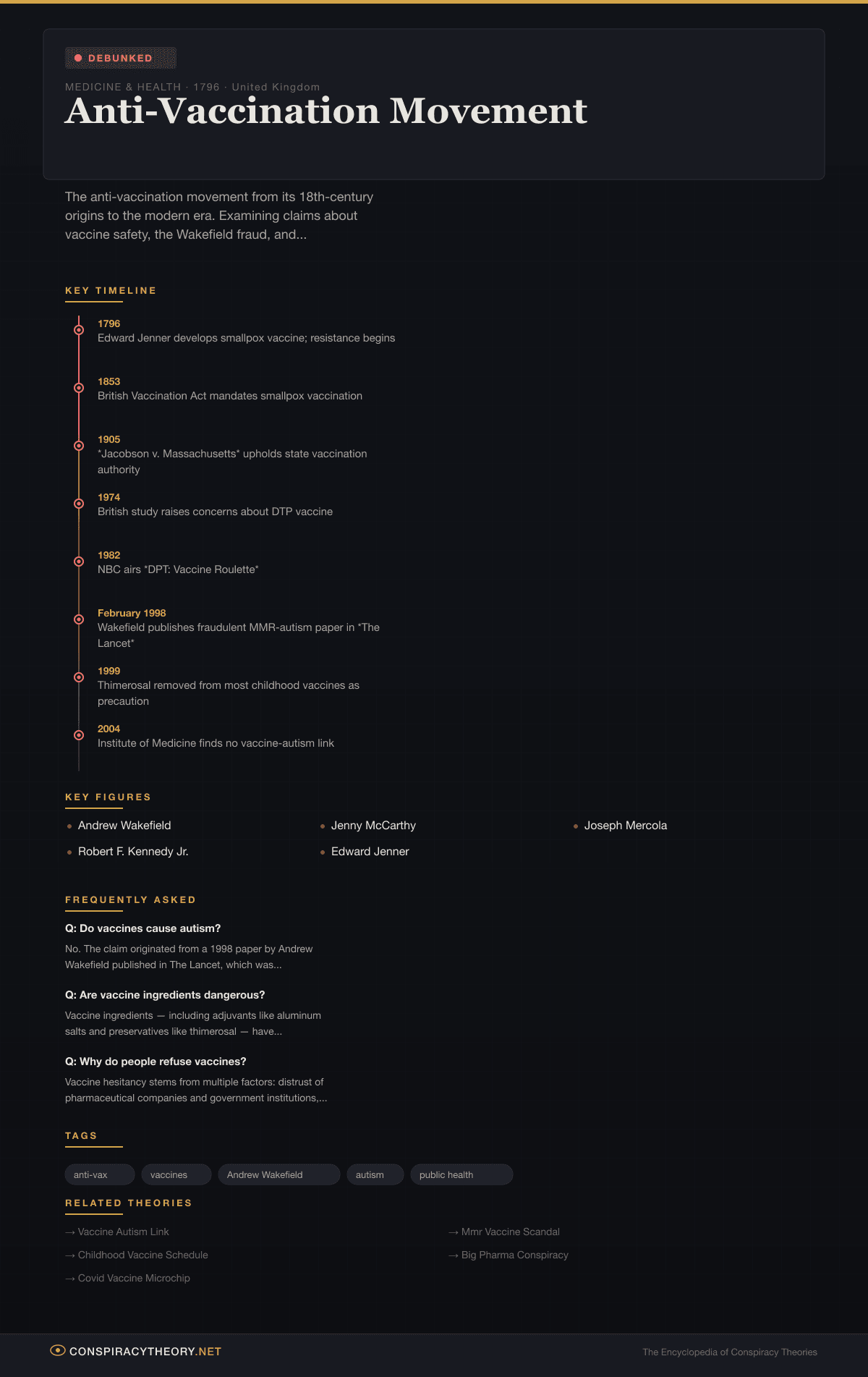
- 1796 — Edward Jenner develops smallpox vaccine; resistance begins
- 1853 — British Vaccination Act mandates smallpox vaccination
- 1905 — Jacobson v. Massachusetts upholds state vaccination authority
- 1974 — British study raises concerns about DTP vaccine
- 1982 — NBC airs DPT: Vaccine Roulette
- February 1998 — Wakefield publishes fraudulent MMR-autism paper in The Lancet
- 1999 — Thimerosal removed from most childhood vaccines as precaution
- 2004 — Institute of Medicine finds no vaccine-autism link
- 2010 — The Lancet retracts Wakefield paper; Wakefield loses medical license
- 2014-2015 — Disneyland measles outbreak traced to unvaccinated visitors
- 2015 — California passes SB 277 eliminating non-medical exemptions
- 2019 — WHO names vaccine hesitancy top-10 global health threat
- 2020-2021 — COVID-19 vaccines developed; anti-vaccine movement dramatically expands
- 2023 — Global measles cases surge 79% year-over-year
Sources & Further Reading
- Deer, Brian. The Doctor Who Fooled the World: Andrew Wakefield’s War on Vaccines. Scribe Publications, 2020
- Offit, Paul A. Deadly Choices: How the Anti-Vaccine Movement Threatens Us All. Basic Books, 2011
- Hviid, Anders, et al. “Measles, Mumps, Rubella Vaccination and Autism.” Annals of Internal Medicine 170, no. 8 (2019): 513-520
- Institute of Medicine. Adverse Effects of Vaccines: Evidence and Causality. National Academies Press, 2011
- Center for Countering Digital Hate. The Disinformation Dozen. 2021
- Jacobson v. Massachusetts, 197 U.S. 11 (1905)
- The Lancet. “Retraction — Ileal-lymphoid-nodular hyperplasia, non-specific colitis, and pervasive developmental disorder in children.” The Lancet 375, no. 9713 (2010): 445
Frequently Asked Questions
Do vaccines cause autism?
Are vaccine ingredients dangerous?
Why do people refuse vaccines?
Infographic
Share this visual summary. Right-click to save.