Area 51
Overview
Area 51 is a highly classified United States Air Force facility located within the Nevada Test and Training Range, approximately 83 miles (134 km) northwest of Las Vegas. Officially designated as Groom Lake or Homey Airport, the installation has been at the center of conspiracy theories involving extraterrestrial technology, alien bodies, reverse-engineered spacecraft, and systematic government cover-ups since at least the late 1980s.
The base is real, and its existence was formally acknowledged by the Central Intelligence Agency in 2013 through declassified documents released under the Freedom of Information Act. What is not settled is whether the facility’s extreme secrecy conceals only conventional military research — as the government maintains — or whether it harbors evidence of extraterrestrial contact, as conspiracy theorists have argued for decades.
Area 51 occupies a unique position in conspiracy culture. Unlike many conspiracy theories that rest on speculation alone, the claims surrounding Area 51 sit against a documented backdrop of genuine government secrecy, confirmed covert programs, and official denials that were later proven false. The U.S. government denied the very existence of the base for decades before finally acknowledging it in 2013. This history of demonstrable secrecy has lent a degree of credibility to more extraordinary claims in the eyes of many theorists and has made Area 51 one of the most enduring subjects in the broader UFO and government cover-up discourse.
Origins & History
The U-2 Program and the Birth of Secrecy
Area 51 was established in 1955 during the early Cold War. The CIA, in collaboration with Lockheed Aircraft Corporation, selected the remote Groom Lake site in the Nevada desert as a testing ground for the U-2 reconnaissance aircraft — a high-altitude spy plane designed to fly over Soviet territory and photograph military installations. The project was codenamed “Project AQUATONE.”
The site was chosen for its extreme isolation, flat dry lakebed suitable for a runway, and proximity to the existing Nevada Test Site, where nuclear weapons were being detonated. Its remoteness provided natural security, and the surrounding restricted airspace — already established for nuclear testing — offered additional layers of protection from prying eyes.
From the outset, the base operated under extraordinary secrecy. Workers were flown in from Las Vegas on unmarked aircraft. The facility did not appear on public maps. Its very existence was classified. When U-2 flights began in 1955, the aircraft’s ability to fly at altitudes exceeding 60,000 feet — far above the ceiling of any known aircraft at the time — generated a wave of UFO reports from commercial pilots and civilians who observed the planes’ reflective surfaces glinting in the sun at seemingly impossible heights. According to CIA documents declassified in 2013, the agency estimated that more than half of all UFO sightings reported in the late 1950s and 1960s were attributable to U-2 and later SR-71 flights. Rather than correct the record, intelligence officials allowed the UFO narrative to persist, as it provided convenient cover for the classified aircraft program.
Expansion and Continued Black Programs
Following the U-2, Area 51 became the primary testing site for a series of advanced aircraft programs, including the A-12 OXCART (predecessor to the SR-71 Blackbird), the D-21 drone, the F-117 Nighthawk stealth fighter, and — according to widely reported but unconfirmed accounts — the B-2 Spirit stealth bomber. Each of these programs operated under intense classification, and each generated its own wave of UFO sightings as witnesses observed aircraft with performance characteristics and geometries unlike anything publicly known.
Throughout the 1960s, 1970s, and 1980s, the base expanded significantly. Satellite imagery and accounts from former workers describe extensive construction including massive hangars, underground facilities, extended runways, and housing for thousands of personnel. The Restricted Area surrounding Groom Lake was progressively enlarged, and public viewing points on nearby mountains were closed off or brought within the security perimeter.
Official Acknowledgment in 2013
For nearly six decades, the U.S. government refused to acknowledge Area 51 by name. Maps referred to the area obliquely, if at all. Government officials who were questioned about the base either declined to comment or referred inquiries to generic statements about the Nevada Test and Training Range.
This changed in June 2013, when the National Security Archive at George Washington University obtained and published a CIA history of the U-2 program through a Freedom of Information Act request originally filed in 2005. The 407-page document, titled “The Central Intelligence Agency and Overhead Reconnaissance: The U-2 and OXCART Programs, 1954-1974,” explicitly named Area 51 and described its use as a testing site for reconnaissance aircraft. Maps in the document pinpointed the facility’s location at Groom Lake.
While the acknowledgment confirmed what had been an open secret for decades, it was the first time the U.S. government formally used the name “Area 51” in a declassified document and admitted to the facility’s existence and purpose.
Key Claims
Conspiracy theories surrounding Area 51 vary in scope and specificity, but several core claims recur across the literature and popular discourse.
Extraterrestrial Technology and Reverse Engineering
The most prominent claim is that Area 51 houses recovered extraterrestrial spacecraft and that U.S. government scientists have been engaged in reverse-engineering alien technology at the facility since at least the late 1940s. Proponents frequently link this claim to the 1947 Roswell incident, alleging that wreckage and possibly alien bodies recovered from the crash site in New Mexico were transported to Area 51 (or its predecessor facilities) for study.
According to this narrative, breakthroughs in stealth technology, fiber optics, integrated circuits, and other innovations were derived — at least in part — from the study of alien craft. Advocates argue that the extreme secrecy surrounding the base, and the government’s decades-long refusal to acknowledge its existence, are consistent with the concealment of discoveries that would fundamentally alter humanity’s understanding of its place in the universe.
Bob Lazar and S-4
The most specific and influential account of alien technology at Area 51 came from Robert Scott Lazar, who in November 1989 appeared in an interview with Las Vegas television journalist George Knapp on KLAS-TV. Lazar claimed that from late 1988 to early 1989, he had been employed as a physicist at a facility he called “S-4,” located near Papoose Lake, approximately 10 miles south of the main Area 51 complex.
Lazar stated that at S-4, he was assigned to examine and reverse-engineer one of nine flying saucers stored at the site. He described the craft as approximately 52 feet in diameter, constructed of a metallic material he could not identify, and powered by an antimatter reactor that utilized Element 115 (moscovium) as its fuel source. He said the element, which was not yet on the periodic table at the time of his claims, produced a gravitational field that could be amplified and directed to achieve propulsion.
Lazar further claimed that briefing documents he was shown at S-4 described the alien craft as originating from the Zeta Reticuli star system and stated that extraterrestrials had been involved with Earth for at least 10,000 years.
Underground Facilities
Numerous accounts describe extensive underground installations at Area 51, allegedly extending far beneath the desert surface. These purported facilities are said to house laboratories, storage areas for recovered alien materials, and transportation tunnels connecting Area 51 to other military installations. Some versions of this claim describe a vast underground rail network linking Area 51 to locations including Los Alamos National Laboratory, the Dulce base in New Mexico, and installations beneath the Denver International Airport.
Evidence for these underground facilities remains entirely anecdotal, consisting primarily of testimony from individuals claiming to be former employees and observations of extensive excavation activity at the site.
Captured or Cooperating Aliens
A subset of Area 51 theories holds that the facility has housed not only alien technology but living extraterrestrial beings. Some accounts describe aliens held in captivity for study, while others suggest cooperative arrangements in which extraterrestrials share technological knowledge with the U.S. government in exchange for permission to conduct activities on Earth, including the abduction of humans for biological study. These claims are among the least supported by any form of verifiable evidence and are generally considered to be at the speculative fringe even within UFO research communities.
Evidence
Declassified Documents
The 2013 CIA documents confirmed that Area 51 exists, was used for classified aircraft testing, and that the government deliberately concealed the base’s purpose from the public. The documents further confirmed that U-2 and OXCART flights accounted for a significant portion of reported UFO sightings in the Cold War era, and that intelligence officials were aware of this fact and chose not to correct public misperceptions.
Additional declassified materials from Project Blue Book (the Air Force’s UFO investigation program, active from 1952 to 1969) show that the military investigated thousands of UFO sightings, the majority of which were attributed to conventional explanations. However, a residual percentage — 701 out of 12,618 cases — were classified as “unidentified,” meaning investigators could not determine a cause.
In 2017, the New York Times revealed the existence of the Advanced Aerospace Threat Identification Program (AATIP), a Pentagon program that investigated unidentified aerial phenomena from 2007 to 2012. While AATIP was not directly connected to Area 51, its existence confirmed that the Department of Defense continued to take unidentified aerial phenomena seriously well into the 21st century. The subsequent release of Navy pilot encounter videos in 2020, officially designated as Unidentified Aerial Phenomena (UAP), further reinforced the argument that the government possesses information about anomalous aerial objects that has not been fully disclosed.
Satellite Imagery
Commercial satellite imagery of Area 51, which became widely available beginning in the early 2000s through services such as Google Earth, shows a large and continuously expanding military installation. The imagery reveals multiple runways (including one exceeding 12,000 feet in length), large hangars, support buildings, housing facilities, and extensive areas of disturbed earth consistent with underground construction. While these features are consistent with a conventional military testing facility, conspiracy theorists argue that the visible surface installations represent only a fraction of the base’s true extent.
The Bob Lazar Controversy
Lazar’s claims remain the most debated element of the Area 51 conspiracy narrative. Several factors lend partial support to his account. A Los Alamos National Laboratory phone directory from the 1980s lists his name, suggesting he had some connection to the facility, though the nature of his role is unclear. Element 115, which Lazar named in 1989 as the fuel source for the alien craft, was synthesized by Russian scientists in 2003 and added to the periodic table as moscovium in 2016 — though skeptics note that its existence as a superheavy element was theoretically predicted before Lazar’s claims and that the synthesized form is highly unstable, with a half-life measured in fractions of a second, making it unsuitable for the sustained energy production Lazar described.
Significant questions about Lazar’s credibility persist. He claims to hold master’s degrees from the Massachusetts Institute of Technology and the California Institute of Technology, but neither institution has records of his attendance. Lazar has stated that his records were erased as part of the government’s effort to discredit him, but no independent evidence supports this assertion. He was convicted of pandering (aiding prostitution) in 1990, a fact critics cite as relevant to his credibility, though supporters argue it may represent government harassment. In 2017, his home and business were raided by the FBI, ostensibly in connection with a murder investigation involving a chemical he had sold, though Lazar and his supporters suggested the raid was related to his Area 51 claims.
Worker Testimony and Lawsuits
In the 1990s, several individuals claiming to be former Area 51 workers filed lawsuits alleging that they had developed serious health problems from exposure to toxic materials burned in open pits at the base. The cases, including Frost et al. v. Perry (later Kasza v. Browner), were significant because the government’s defense effectively required acknowledging operations at the site while arguing that disclosure of specific activities would harm national security. President Bill Clinton signed a presidential determination in 1995 exempting the “operating location near Groom Lake” from environmental disclosure laws — a de facto acknowledgment of the facility’s existence that stopped short of naming it Area 51.
The 2019 “Storm Area 51” Phenomenon
On June 27, 2019, Matty Roberts, a college student from Bakersfield, California, created a Facebook event titled “Storm Area 51, They Can’t Stop All of Us,” scheduling a mass gathering at the base for September 20, 2019. The event, created as a joke, proposed that participants “Naruto run” (a running style from the Japanese anime series Naruto) past military guards to enter the facility and discover its secrets.
The event went viral, accumulating over 3.5 million RSVPs and generating extensive international media coverage. The U.S. Air Force issued a public warning discouraging any attempt to enter the restricted area, stating that it was prepared to protect its assets. Lincoln County, Nevada, preemptively declared a state of emergency in anticipation of large crowds.
On the scheduled date, approximately 1,500 to 3,000 people gathered near the base’s perimeter at the small towns of Rachel and Hiko, Nevada. The gathering took on the character of a festival rather than an incursion. A small number of individuals approached the military perimeter gates but did not attempt entry. Several people were briefly detained; no serious incidents occurred.
The Storm Area 51 event was significant less as a security matter than as a cultural phenomenon. It demonstrated the enduring power of Area 51 as a symbol of government secrecy, the capacity of internet culture to mobilize around conspiracy-adjacent themes through irony and humor, and the degree to which Area 51 had transcended its origins as a subject of fringe speculation to become a mainstream pop-culture touchstone.
Cultural Impact
Area 51 has become arguably the most recognizable symbol of government secrecy and alleged extraterrestrial contact in global popular culture. Its influence extends across virtually every medium of entertainment and public discourse.
In film and television, Area 51 has featured prominently in productions including Independence Day (1996), in which the base serves as a secret facility housing a recovered alien craft; The X-Files (1993-2002, 2016-2018), which drew heavily on Area 51 mythology; and the Transformers franchise. The concept of a secret government base containing alien technology has become a standard trope in science fiction, with Area 51 serving as the default real-world analog.
In journalism and nonfiction, Annie Jacobsen’s 2011 book Area 51: An Uncensored History of America’s Top Secret Military Base brought renewed mainstream attention to the facility, combining documented history of aircraft testing programs with more controversial claims about the base’s activities. George Knapp’s reporting on Bob Lazar and subsequent UFO-related investigations established him as a prominent figure in UFO journalism.
The broader cultural impact of Area 51 extends to the fields of tourism and local commerce. The town of Rachel, Nevada (population approximately 54), the nearest settlement to the base, has become a destination for UFO enthusiasts. The stretch of Nevada State Route 375 passing near the base was officially designated the “Extraterrestrial Highway” by the state of Nevada in 1996. Businesses throughout the region sell Area 51-branded merchandise, and the alien/UFO aesthetic associated with the base has become a significant element of Nevada’s tourism identity.
Area 51 has also had a measurable impact on discourse around government transparency. The base’s history — in which the government denied the existence of a facility that was clearly visible on satellite imagery and known to thousands of workers — has become a frequently cited example in arguments for increased government openness. When the CIA finally acknowledged Area 51 in 2013, the event was covered as a significant moment in the history of government secrecy, not merely as a footnote in UFO lore.
Timeline
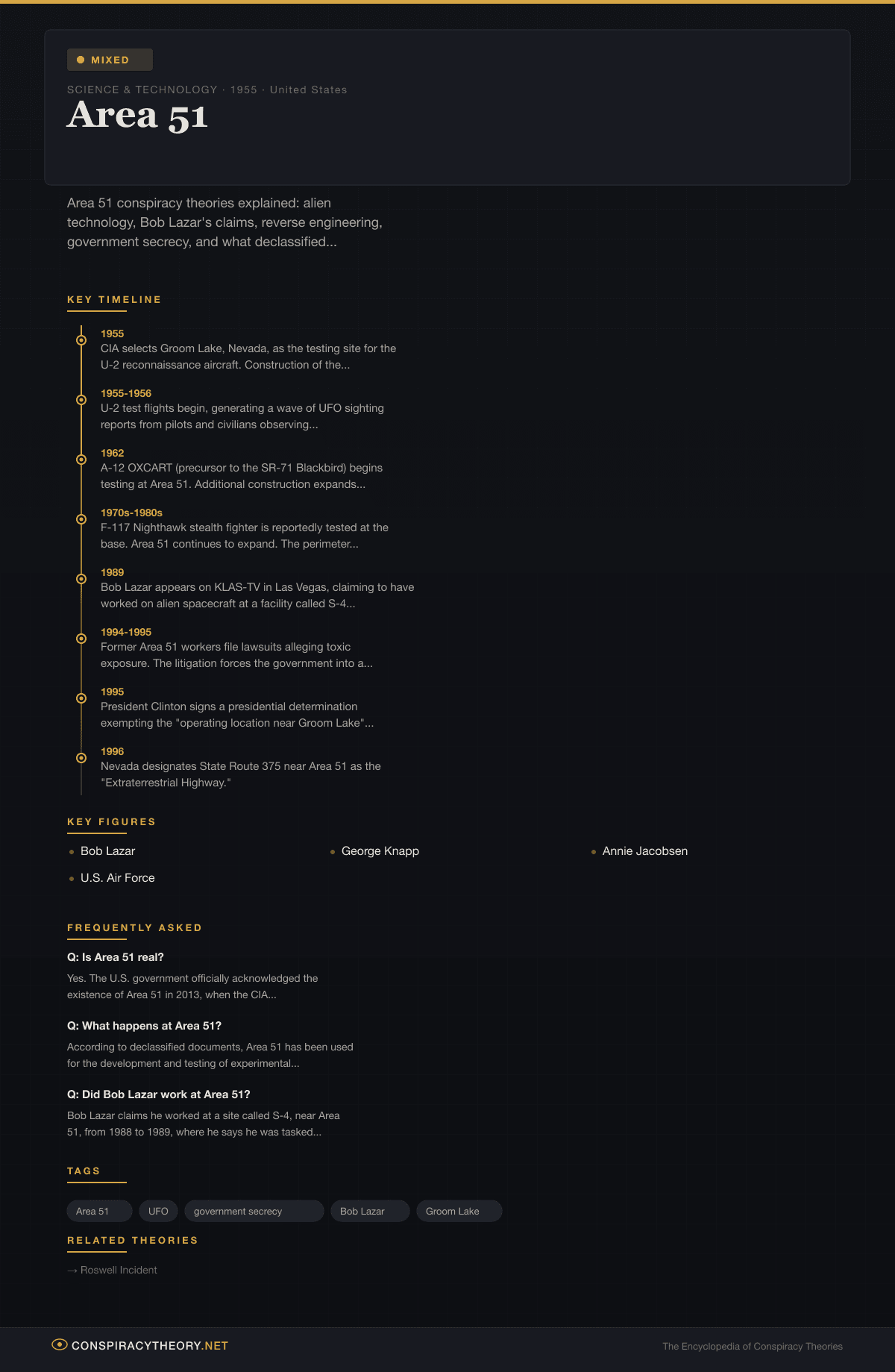
- 1955 — CIA selects Groom Lake, Nevada, as the testing site for the U-2 reconnaissance aircraft. Construction of the base begins. The designation “Area 51” derives from Atomic Energy Commission maps of the Nevada Test Site.
- 1955-1956 — U-2 test flights begin, generating a wave of UFO sighting reports from pilots and civilians observing the high-altitude aircraft.
- 1962 — A-12 OXCART (precursor to the SR-71 Blackbird) begins testing at Area 51. Additional construction expands the facility.
- 1970s-1980s — F-117 Nighthawk stealth fighter is reportedly tested at the base. Area 51 continues to expand. The perimeter security zone is enlarged, restricting public access to nearby viewpoints.
- 1989 — Bob Lazar appears on KLAS-TV in Las Vegas, claiming to have worked on alien spacecraft at a facility called S-4 near Area 51. His interviews, conducted by journalist George Knapp, bring Area 51 into mainstream public awareness as a locus of UFO conspiracy theories.
- 1994-1995 — Former Area 51 workers file lawsuits alleging toxic exposure. The litigation forces the government into a de facto acknowledgment of activities at the site.
- 1995 — President Clinton signs a presidential determination exempting the “operating location near Groom Lake” from environmental disclosure requirements.
- 1996 — Nevada designates State Route 375 near Area 51 as the “Extraterrestrial Highway.”
- 2003 — Russian scientists synthesize Element 115, which Bob Lazar had named in 1989 as the fuel source for alien propulsion systems.
- 2011 — Annie Jacobsen publishes Area 51: An Uncensored History of America’s Top Secret Military Base, drawing on interviews with former workers and declassified documents.
- 2013 — The CIA officially acknowledges the existence of Area 51 through declassified documents released under the Freedom of Information Act.
- 2016 — Element 115 is officially added to the periodic table as moscovium (Mc).
- 2017 — The New York Times reveals the existence of the Pentagon’s Advanced Aerospace Threat Identification Program (AATIP), renewing public interest in government UFO investigations.
- 2019 — The “Storm Area 51” Facebook event goes viral, drawing millions of RSVPs and international media attention. A small festival-like gathering takes place near the base in September.
- 2020 — The U.S. Department of Defense officially releases three Navy videos of Unidentified Aerial Phenomena (UAP), previously leaked in 2017.
- 2023 — Former intelligence official David Grusch testifies before Congress, claiming the U.S. government possesses retrieved non-human craft and biological materials. His testimony does not specifically name Area 51 but reignites debate about secret government programs involving extraterrestrial technology.
Sources & Further Reading
- “The Central Intelligence Agency and Overhead Reconnaissance: The U-2 and OXCART Programs, 1954-1974” — Declassified CIA history, released 2013 via National Security Archive at George Washington University.
- Jacobsen, Annie. Area 51: An Uncensored History of America’s Top Secret Military Base. Little, Brown and Company, 2011.
- Patton, Phil. Dreamland: Travels Inside the Secret World of Roswell and Area 51. Villard Books, 1998.
- Darlington, David. Area 51: The Dreamland Chronicles. Henry Holt and Company, 1997.
- Corbell, Jeremy. Bob Lazar: Area 51 & Flying Saucers. Documentary film, 2018.
- Knapp, George. KLAS-TV investigative reports on Bob Lazar, 1989-present.
- “Glowing Auras and Black Money: The Pentagon’s Mysterious U.F.O. Program.” The New York Times, December 16, 2017.
- Project Blue Book Archive — Declassified U.S. Air Force UFO investigation files, available via the National Archives.
- Richelson, Jeffrey T. The Wizards of Langley: Inside the CIA’s Directorate of Science and Technology. Westview Press, 2001.
- U.S. Senate Select Committee on Intelligence. Hearing on Unidentified Aerial Phenomena, June 2023 (David Grusch testimony).

Frequently Asked Questions
Is Area 51 real?
What happens at Area 51?
Did Bob Lazar work at Area 51?
Infographic
Share this visual summary. Right-click to save.