Atlantis — Lost Advanced Civilization

Overview
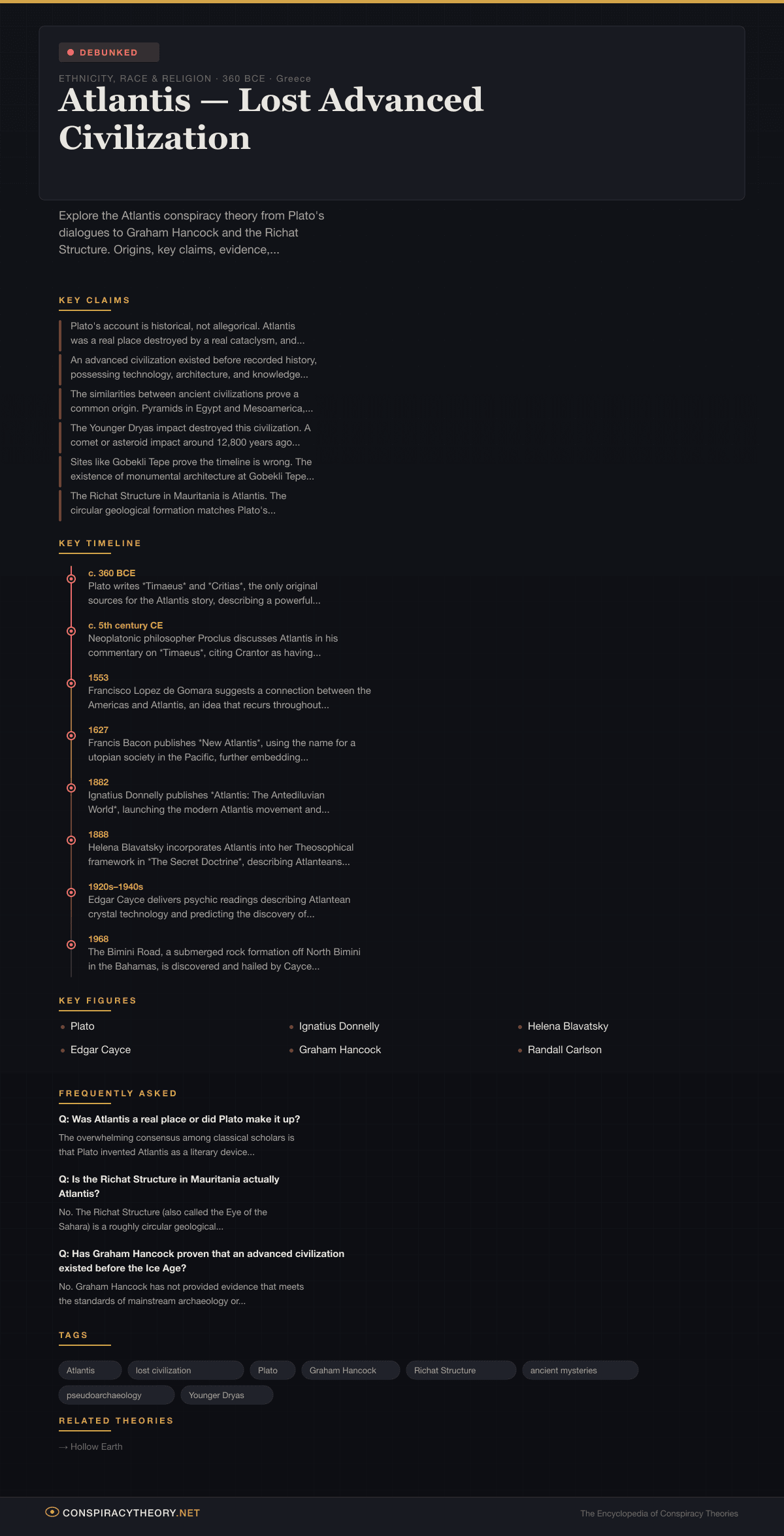
Atlantis is arguably the most famous lost civilization in Western culture — a powerful island empire first described by the Greek philosopher Plato around 360 BCE, which he claimed sank beneath the Atlantic Ocean in a single catastrophic day and night approximately 9,000 years before his own time. Plato’s account, presented as historical fact relayed through a chain of sources tracing back to Egyptian priests, describes Atlantis as a vast maritime power with advanced engineering, enormous wealth, and a sophisticated ring-shaped capital city. After its people grew arrogant and morally corrupt, the gods destroyed Atlantis with earthquakes and floods, submerging it forever beneath the sea.
For more than two millennia, Atlantis has generated an extraordinary volume of speculation, exploration, and pseudoscholarship. From the 19th-century writings of Ignatius Donnelly, who treated Atlantis as the literal origin of all human civilization, to the contemporary claims of Graham Hancock, who argues that a technologically advanced Ice Age civilization was destroyed by a cosmic cataclysm, the Atlantis narrative has been continually reinvented to fit the preoccupations of each era. In recent years, the theory that the Richat Structure in Mauritania is the remnant of Atlantis has gained substantial traction on social media, despite having no archaeological or geological support.
The theory is classified as debunked because no physical evidence of a continent-sized civilization has ever been found in the Atlantic Ocean or any other proposed location. The geological record contains no evidence of the catastrophic submersion of a large landmass within the timeframe described. Plato’s account is regarded by the vast majority of classical scholars as a philosophical allegory, and every proposed “real location” for Atlantis requires fundamental departures from the source text. The broader claim that an advanced pre-Ice Age civilization once existed and was destroyed has produced no artifacts, structures, writing systems, or genetic evidence that would be expected from such a society.
Origins & History
Plato’s Dialogues: Timaeus and Critias (c. 360 BCE)
The sole original source for the Atlantis story is found in two of Plato’s dialogues: Timaeus and the incomplete Critias, written around 360 BCE. In Timaeus, the Athenian statesman Critias recounts a story allegedly told to the Athenian lawgiver Solon by Egyptian priests at the temple of Neith in Sais during Solon’s visit to Egypt around 600 BCE. The priests informed Solon that 9,000 years before their conversation — placing the events around 9600 BCE — a great island power called Atlantis existed beyond the Pillars of Heracles (the Strait of Gibraltar). Atlantis was described as larger than Libya and Asia Minor combined, and it served as a gateway to other islands and to the continent beyond the ocean.
According to Plato’s account, the Atlanteans conquered much of Western Europe and North Africa before being defeated by a virtuous, pre-historic Athens. Following this defeat, violent earthquakes and floods struck, and “in a single day and night of misfortune,” Atlantis sank beneath the sea, leaving only impassable shoals of mud.
In Critias, Plato provided an elaborate description of Atlantis’s geography and society. The island’s capital featured a series of alternating rings of water and land, connected by tunnels and bridges. The central island housed a grand temple to Poseidon, clad in silver and gold with ivory pinnacles. The Atlanteans possessed hot and cold springs, extensive dockyards, horse-racing tracks, and a massive canal connecting the ring city to the sea. The civilization was wealthy, powerful, and initially virtuous, but the divine portion of their nature faded through repeated dilution with mortal stock, and they became greedy and aggressive. The dialogue breaks off abruptly — it is unfinished — just as Zeus prepares to pass judgment on the Atlanteans.
Classical scholars have long noted that the Atlantis story functions within Plato’s broader philosophical project. It serves as a cautionary tale about the corruption of an ideal society and as a foil for his idealized portrait of ancient Athens. Plato routinely invented myths and narratives to illustrate philosophical points, and no ancient Greek historian — including Herodotus, Thucydides, or Aristotle (Plato’s own student) — corroborated the story. Aristotle is reported to have remarked that “he who invented it also destroyed it,” directly attributing the story to Plato’s imagination.
The Classical and Medieval Period
After Plato, interest in Atlantis was sporadic. Some Neoplatonic philosophers in late antiquity, particularly Proclus in the 5th century CE, discussed the story and debated whether it was literal or allegorical. Proclus cited the geographer Crantor as having visited Sais and confirmed the account, though the reliability of this claim is disputed among modern scholars and Crantor’s original text is lost.
During the medieval period, Atlantis received relatively little scholarly attention. The dominant Christian cosmological framework left limited room for a pre-Flood civilization of the kind Plato described, though some writers attempted to reconcile Atlantis with the biblical narrative of Noah’s Flood.
The Age of Exploration and Colonial-Era Theories
European exploration of the Americas in the 15th and 16th centuries revived interest in Atlantis. Francis Bacon’s utopian novel New Atlantis (1627) used the name as a literary device, and various writers speculated that the Americas themselves might be the remnants of Atlantis or its colonies. The Spanish historian Francisco López de Gómara suggested in 1553 that Plato’s account might refer to the New World, and the idea that Indigenous American civilizations were connected to Atlantis became a recurring — and deeply problematic — theme in colonial and post-colonial thought.
Ignatius Donnelly and the Birth of Atlantology (1882)
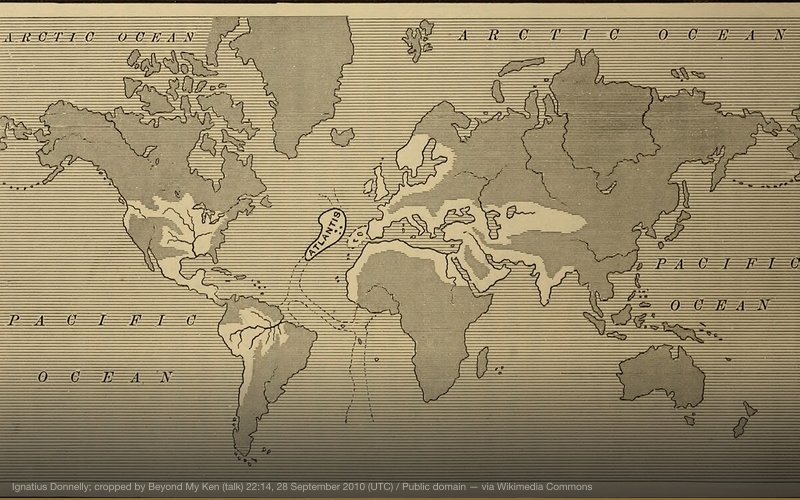
The modern Atlantis movement begins with Ignatius Donnelly, a U.S. Congressman from Minnesota, who published Atlantis: The Antediluvian World in 1882. Donnelly’s book was a bestseller that went through dozens of editions and fundamentally shaped all subsequent Atlantis speculation. He argued that Plato’s account was essentially historical, that Atlantis was the original seat of civilization from which all other ancient cultures derived, and that the mythologies of diverse peoples around the world were garbled memories of Atlantean history.
Donnelly proposed thirteen theses, including that Atlantis was the region where humanity first rose from barbarism to civilization, that it was the original homeland of the Aryans, Semites, and other races, that the gods of Greek, Norse, and other mythologies were the kings and queens of Atlantis, and that Egypt was the oldest colony of Atlantis. While Donnelly presented his arguments with impressive erudition for the era, his methodology relied on superficial cultural parallels, unsupported diffusionist assumptions, and a pre-modern understanding of geology and anthropology.
Theosophy, Occultism, and Race Theories
The Atlantis concept was eagerly adopted by occult movements of the late 19th and early 20th centuries. Helena Blavatsky, co-founder of the Theosophical Society, incorporated Atlantis into her elaborate cosmological framework in The Secret Doctrine (1888). Blavatsky described the Atlanteans as the “Fourth Root Race” in a sequence of spiritual evolution, possessing psychic powers and advanced technology before their destruction. Her follower W. Scott-Elliot published The Story of Atlantis (1896), which included maps of the supposed continent based entirely on claimed clairvoyant visions.
These occult traditions frequently entangled Atlantis with racial hierarchy, portraying the Atlanteans as a white or “Aryan” master race whose descendants became the founders of civilization in Egypt, India, and the Americas. This racial dimension made Atlantis attractive to fringe political movements, and elements of Atlantean mythology were incorporated into certain strands of Nazi occultism, though the practical influence of these ideas on Third Reich policy is debated by historians.
Edgar Cayce’s Psychic Readings (1920s–1940s)
American psychic Edgar Cayce gave numerous readings throughout the 1920s, 1930s, and 1940s in which he described Atlantis as an advanced civilization that possessed crystal-based energy technology, flying machines, and laser-like weapons. Cayce claimed that refugees from Atlantis’s destruction had fled to Egypt, the Yucatan, and other regions, and that records of Atlantean civilization were stored in a hidden “Hall of Records” beneath the Great Sphinx of Giza. Cayce predicted that portions of Atlantis would rise from the ocean near Bimini in the Bahamas in 1968 or 1969.
When a submerged formation of rectangular limestone blocks — now known as the Bimini Road — was discovered off the coast of North Bimini in 1968, Cayce’s followers hailed it as a fulfillment of this prophecy. Geological investigation has since determined that the formation is a natural feature of beach-rock that fractured into regular blocks through natural geological processes, consistent with similar formations found elsewhere in the Bahamas and Caribbean.
Key Claims
Atlantis proponents advance a wide range of claims, which vary significantly depending on the era and the specific advocate. The most persistent include:
- Plato’s account is historical, not allegorical. Atlantis was a real place destroyed by a real cataclysm, and Plato recorded a genuine tradition preserved by Egyptian priests.
- An advanced civilization existed before recorded history, possessing technology, architecture, and knowledge equal to or exceeding that of later civilizations.
- The similarities between ancient civilizations prove a common origin. Pyramids in Egypt and Mesoamerica, flood myths across cultures, and shared architectural or astronomical knowledge point to a single lost precursor civilization.
- The Younger Dryas impact destroyed this civilization. A comet or asteroid impact around 12,800 years ago triggered catastrophic flooding, ending the Ice Age and wiping out an advanced society (the principal modern variant, advanced by Graham Hancock and Randall Carlson).
- Sites like Gobekli Tepe prove the timeline is wrong. The existence of monumental architecture at Gobekli Tepe (c. 9500 BCE) demonstrates that sophisticated civilizations existed far earlier than orthodox archaeology acknowledges.
- The Richat Structure in Mauritania is Atlantis. The circular geological formation matches Plato’s concentric ring description and was once surrounded by water.
- The Sphinx is far older than conventional dating suggests. Water erosion on the Sphinx enclosure (as argued by Robert Schoch) indicates it was carved thousands of years before the conventional date of c. 2500 BCE.
- Academic archaeology suppresses evidence of pre-Ice Age civilizations to protect established theories, careers, and funding structures.
Evidence & Debunking
No Archaeological Evidence of Atlantis
Despite over a century of searching, no archaeological evidence of a continent-sized advanced civilization has been found in the Atlantic Ocean. Modern oceanographic surveys, including extensive mapping of the Atlantic seabed by institutions such as the National Oceanic and Atmospheric Administration (NOAA) and various international research programs, have produced detailed maps of the ocean floor. The Mid-Atlantic Ridge — sometimes proposed as a remnant of Atlantis — is a tectonic spreading center where new oceanic crust is formed, not a sunken continent. Plate tectonics, which is supported by an overwhelming body of geological evidence, provides no mechanism by which a large landmass could sink beneath the ocean in the manner and timeframe Plato described.
The Allegory Interpretation
The majority of classical scholars — including experts in Plato’s philosophy such as Julia Annas, Christopher Gill, and Alan Cameron — interpret Atlantis as a deliberate literary invention. Cameron’s detailed 1983 analysis argued that the story’s narrative framing (a chain of oral transmission spanning thousands of years through multiple intermediaries) is a standard Platonic device for introducing fictional narratives. Plato used similar techniques elsewhere: the allegory of the cave in Republic, the Allegory of Er, and the Allegory of the Ring of Gyges are all invented narratives serving philosophical purposes. No independent Egyptian records of Atlantis have ever been found despite extensive archaeological work in Egypt spanning two centuries.
The Richat Structure
The Richat Structure (Eye of the Sahara) in Mauritania is a roughly circular geological formation about 40 kilometers in diameter that gained popularity as a proposed Atlantis location primarily through YouTube videos beginning around 2018. The theory relies on a superficial visual resemblance to Plato’s concentric rings. However, the Richat Structure fails to match Plato’s description in nearly every particular: it is located deep inland in the Sahara, not on an island in the Atlantic; it has no harbor or connection to the sea; it is far smaller than the dimensions Plato provided; and it contains no archaeological evidence of human habitation or construction of any kind. Geologically, the structure is a well-studied eroded dome composed of Proterozoic and Paleozoic rocks, with some features dating back hundreds of millions of years. Its concentric appearance results from the differential weathering of alternating bands of harder quartzite and softer rock.
Graham Hancock and the Younger Dryas Hypothesis
Graham Hancock, a British journalist and author, has been the most prominent modern advocate for a lost advanced civilization. Beginning with Fingerprints of the Gods (1995) and continuing through Magicians of the Gods (2015) and America Before (2019), as well as his Netflix series Ancient Apocalypse (2022), Hancock has argued that an advanced civilization existed during the Ice Age and was destroyed by a cataclysm associated with the Younger Dryas period (approximately 12,800–11,600 years ago).
Hancock’s argument relies heavily on the Younger Dryas impact hypothesis — the proposal that a comet or asteroid impact triggered the Younger Dryas cold period and associated flooding. While the impact hypothesis itself is a legitimate (though debated) scientific proposal advanced by researchers including Richard Firestone and Allen West, the leap from “a cosmic impact may have occurred” to “the impact destroyed a technologically advanced global civilization” is entirely Hancock’s addition and has no support in the scientific literature.
Professional archaeologists have extensively criticized Hancock’s methodology. His arguments rely on anomaly hunting — selecting features of archaeological sites that appear difficult to explain and attributing them to a lost civilization, while ignoring the extensive evidence that documents the gradual development of the cultures in question. His treatment of Gobekli Tepe is illustrative: while Hancock presents the site as evidence that an advanced civilization must have seeded its construction, the archaeologists who actually excavated the site — led by Klaus Schmidt and later by Lee Clare of the German Archaeological Institute — have documented it as the product of sophisticated hunter-gatherer communities, consistent with the broader archaeological record of the region.
The Sphinx Water Erosion Hypothesis
Robert Schoch, a geologist at Boston University, argued in 1991 that the vertical weathering patterns on the walls of the Sphinx enclosure at Giza were caused by prolonged rainfall, which would date the original carving of the Sphinx to a period before 5000 BCE when the Sahara received significantly more rain. This claim has been disputed by most Egyptologists and many geologists. Critics including James Harrell and K. Lal Gauri have argued that the erosion patterns can be explained by chemical weathering, salt crystallization, and the differential erosion of the limestone layers, processes that do not require a substantially older date. The archaeological context of the Sphinx — its alignment with the pyramid complex, associated temples, and material culture — is consistent with the conventional date of c. 2500 BCE during the reign of Pharaoh Khafre.
The Problem of Missing Evidence
The fundamental challenge for all lost advanced civilization theories is the absence of physical evidence. A civilization with the technology, population, and global reach described by Hancock and others would have left behind abundant physical traces: metal tools and alloys, written records, permanent structures, ceramics, middens, burials, agricultural modifications, roads, quarries, mines, and genetic evidence in descendant populations. No such evidence has been found that cannot be attributed to known historical cultures. The archaeological record of the Pleistocene epoch — while incomplete — has been extensively studied across every continent, and it consistently shows a pattern of increasingly complex hunter-gatherer societies, not a technologically advanced global civilization.
Cultural Impact
Literature and Popular Culture
Atlantis has been one of the most enduringly popular subjects in Western fiction and speculative writing. Since Plato’s original account, thousands of books — both fiction and nonfiction — have been written about the lost continent. Notable literary treatments include Jules Verne’s Twenty Thousand Leagues Under the Sea (1870), in which Captain Nemo visits the submerged ruins of Atlantis; Pierre Benoit’s L’Atlantide (1919), which places a surviving Atlantean civilization in the Sahara; and numerous comic book, video game, and film depictions including Disney’s Atlantis: The Lost Empire (2001) and the DC Comics/Warner Bros. Aquaman franchise.
Pseudoarchaeology and Alternative History
Atlantis has served as the foundational narrative for the broader genre of pseudoarchaeology and alternative history. The basic template established by Donnelly — ancient advanced civilization destroyed by catastrophe, survivors seed later cultures, mainstream scholars suppress the truth — has been applied not only to Atlantis but to Lemuria, Mu, and various ancient astronaut scenarios. Graham Hancock’s work has brought this framework to the largest audience in its history, with his Netflix series Ancient Apocalypse becoming one of the platform’s most-watched documentary programs upon its release in 2022, despite vocal criticism from the archaeological community.
Influence on Fringe Movements
The Atlantis narrative has historically been adopted by movements with troubling ideological commitments. Its use in Theosophical racial hierarchies, its occasional incorporation into white nationalist mythology (portraying Atlanteans as a white master race), and its deployment to deny Indigenous peoples credit for their own civilizational achievements (by attributing pyramids, megaliths, and other monuments to Atlantean refugees) have been documented by scholars including Jason Colavito, David S. Anderson, and Jeb Card. While many contemporary Atlantis enthusiasts hold no such views, the theory’s history of entanglement with racial ideology remains an important dimension of its cultural legacy.
Timeline
- c. 360 BCE — Plato writes Timaeus and Critias, the only original sources for the Atlantis story, describing a powerful island civilization destroyed approximately 9,000 years before Solon’s time.
- c. 5th century CE — Neoplatonic philosopher Proclus discusses Atlantis in his commentary on Timaeus, citing Crantor as having confirmed elements of the account with Egyptian priests.
- 1553 — Francisco Lopez de Gomara suggests a connection between the Americas and Atlantis, an idea that recurs throughout the colonial period.
- 1627 — Francis Bacon publishes New Atlantis, using the name for a utopian society in the Pacific, further embedding Atlantis in European intellectual culture.
- 1882 — Ignatius Donnelly publishes Atlantis: The Antediluvian World, launching the modern Atlantis movement and arguing that Atlantis was the origin of all civilization.
- 1888 — Helena Blavatsky incorporates Atlantis into her Theosophical framework in The Secret Doctrine, describing Atlanteans as the “Fourth Root Race.”
- 1920s–1940s — Edgar Cayce delivers psychic readings describing Atlantean crystal technology and predicting the discovery of ruins near Bimini.
- 1968 — The Bimini Road, a submerged rock formation off North Bimini in the Bahamas, is discovered and hailed by Cayce followers as Atlantean ruins. Geologists later determine it is a natural beach-rock formation.
- 1991 — Robert Schoch presents his Sphinx water erosion hypothesis, arguing the Sphinx is thousands of years older than conventional dating suggests.
- 1995 — Graham Hancock publishes Fingerprints of the Gods, arguing that an advanced Ice Age civilization was destroyed by a cataclysm and that survivors established later cultures in Egypt, Mesoamerica, and elsewhere.
- 2007 — Researchers including Richard Firestone publish evidence for a possible Younger Dryas impact event, which Hancock later incorporates into his lost civilization thesis.
- 2015 — Hancock publishes Magicians of the Gods, expanding his arguments with reference to Gobekli Tepe and the Younger Dryas impact hypothesis.
- 2018 — The theory that the Richat Structure in Mauritania is Atlantis gains traction through YouTube channels and social media.
- 2022 — Hancock’s Netflix series Ancient Apocalypse premieres, becoming a major streaming hit and drawing extensive criticism from professional archaeologists.
- 2024 — Ancient Apocalypse: The Americas (Season 2) is released on Netflix, continuing Hancock’s arguments with focus on sites in the Western Hemisphere.
Sources & Further Reading
- Plato. Timaeus and Critias. c. 360 BCE. (Multiple modern translations available, including those by Robin Waterfield and Donald J. Zeyl)
- Donnelly, Ignatius. Atlantis: The Antediluvian World. Harper & Brothers, 1882
- Blavatsky, Helena. The Secret Doctrine. The Theosophical Publishing Company, 1888
- Cameron, Alan. “Crantor and Posidonius on Atlantis.” Classical Quarterly, Vol. 33, No. 1, 1983, pp. 81–91
- Gill, Christopher. “The Genre of the Atlantis Story.” Classical Philology, Vol. 72, No. 4, 1977, pp. 287–304
- Vidal-Naquet, Pierre. The Atlantis Story: A Short History of Plato’s Myth. University of Exeter Press, 2007
- Hancock, Graham. Fingerprints of the Gods. William Heinemann, 1995
- Hancock, Graham. Magicians of the Gods. Coronet, 2015
- Schoch, Robert M. “Redating the Great Sphinx of Giza.” KMT: A Modern Journal of Ancient Egypt, Vol. 3, No. 2, 1992
- Firestone, Richard B., et al. “Evidence for an extraterrestrial impact 12,900 years ago that contributed to the megafaunal extinctions and the Younger Dryas cooling.” Proceedings of the National Academy of Sciences, Vol. 104, No. 41, 2007, pp. 16016–16021
- Fagan, Garrett G., ed. Archaeological Fantasies: How Pseudoarchaeology Misrepresents the Past and Misleads the Public. Routledge, 2006
- Anderson, David S., and Jeb J. Card, eds. Lost City, Found Pyramid: Understanding Alternative Archaeologies and Pseudoscientific Practices. University of Alabama Press, 2023
- Colavito, Jason. The Mound Builder Myth: Fake History and the Hunt for a “Lost White Race.” University of Oklahoma Press, 2020
- Matton, Sylvain. “Richat Structure.” Journal of African Earth Sciences, Vol. 44, 2006 (geological studies of the formation)
Frequently Asked Questions
Was Atlantis a real place or did Plato make it up?
Is the Richat Structure in Mauritania actually Atlantis?
Has Graham Hancock proven that an advanced civilization existed before the Ice Age?
Infographic
Share this visual summary. Right-click to save.