Avril Lavigne Was Replaced

Overview
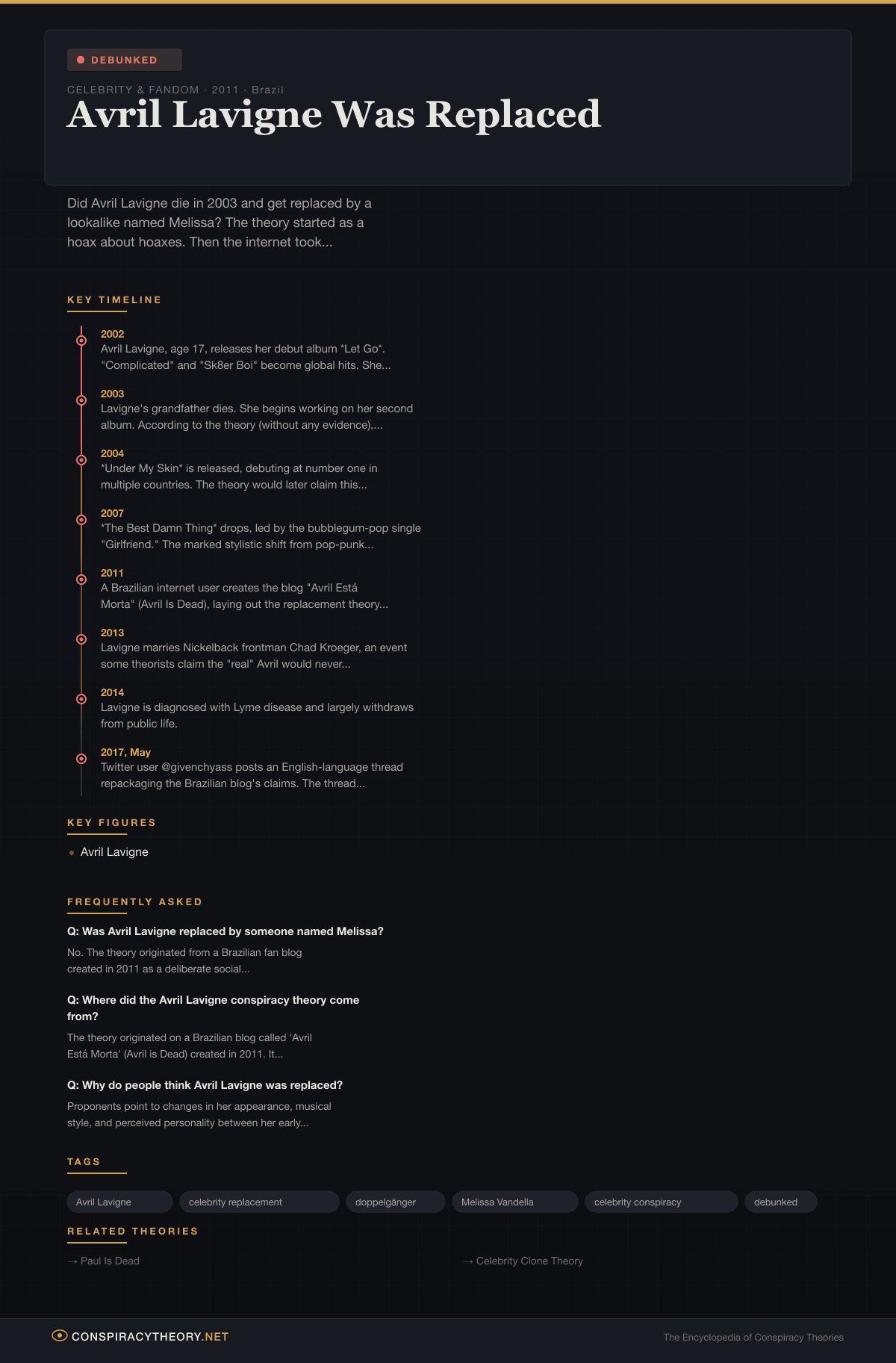
Here is a thing that the internet decided was true: In 2003, at the absolute peak of her career — the Complicated era, the tank tops and the neckties, the middle finger to the entire pop-star machine — Avril Lavigne killed herself. Her record label, rather than absorb the financial catastrophe of losing one of the best-selling artists on the planet, made a business decision. They had a backup. A body double named Melissa Vandella, previously hired for paparazzi decoy duty, was promoted to full-time Avril. New nose, new vibe, slightly different bone structure if you squint at the right photos. The switcheroo happened quietly, and for twenty-plus years, the woman selling out arenas and appearing on talk shows has been someone else entirely.
It is, to be clear, completely untrue. The theory was literally invented as a demonstration of how easy it is to invent conspiracy theories. The person who created it said so. Publicly. On the record. And it did not matter even slightly, because by the time that context caught up to the claim, the claim had already lapped it six times and was trending worldwide.
The Avril Lavigne replacement theory is one of the most perfectly constructed conspiracy theories of the internet age — not because it’s convincing, but because it’s fun. It has everything: a beloved celebrity, a shadowy doppelganger with a suspiciously specific name, side-by-side photo comparisons that make you tilt your head for just a second, and a narrative engine powered by the universal human experience of watching someone you liked in high school become a different person. It is the Paul Is Dead theory reborn for the age of Twitter threads and TikTok deep dives, and it tells us more about how we process change — in celebrities, in ourselves — than it tells us about Avril Lavigne.
The Girl Who Invented Punk (According to Hot Topic)
To understand why this theory works, you have to understand what Avril Lavigne meant to a very specific generation of teenagers.
When Let Go dropped in June 2002, Avril was seventeen years old, from Napanee, Ontario (population: roughly 5,000), and she was selling a version of rebellion that felt accessible in a way that actual punk never did. She wasn’t Courtney Love. She wasn’t even Gwen Stefani. She was the girl in your homeroom who drew stars on her Converse and thought Chad from math class was a poser. “Complicated” and “Sk8er Boi” weren’t musically complex, but they didn’t need to be — they were anthems for a demographic that wanted to feel edgy without actually having to do anything edgy.
The album sold 16 million copies worldwide. Avril was everywhere. And crucially, she was specific. The baggy cargo pants, the wife-beaters layered over long sleeves, the studded belts, the raccoon eyeliner — this was a look, a persona, a vibe. Fans didn’t just listen to Avril Lavigne. They dressed like her. They tied neckties over band tees because she did. She was, for a certain cohort of early-2000s adolescents, an identity.
Which means she was also a fixed point. And fixed points are dangerous, because people don’t stay fixed.
Under My Skin, Over Their Heads
The second album, Under My Skin, came out in 2004. It was darker, more introspective, produced partly by Chantal Kreviazuk and her husband Raine Maida of Our Lady Peace. It debuted at number one in eight countries. It was, by most accounts, a natural artistic progression — a 19-year-old who’d spent two years on a global tour processing what sudden fame actually feels like, and writing songs about it.
But something had shifted. Not in the music, really — the shift was in how fans perceived Avril. She was growing up. The cargo pants were giving way to something more polished. The tomboy-punk persona was softening at the edges. She was dating musicians, appearing at fashion events, generally doing the things that 19-year-old millionaire pop stars do. For fans who’d imprinted on the 17-year-old skater girl, this felt like a betrayal, or at the very least, a discrepancy.
By 2007, when The Best Damn Thing produced the inescapable “Girlfriend” — a straight-up bubblegum pop track with a cheerleader chant — the transformation was, for a certain type of fan, complete. This wasn’t the Avril they’d known. This Avril was too pop, too girly, too produced. The eyeliner was more precise. The wardrobe was more designer. The whole vibe was different.
And here’s the thing about conspiracy theories: they flourish in exactly that gap between expectation and reality. When the world doesn’t match the story you’ve been telling yourself, you have two options. You can update the story. Or you can decide the world has been switched out for a fake.
Avril Está Morta
In 2011, a Brazilian internet user created a blog called “Avril Está Morta” — Portuguese for “Avril Is Dead.” The blog laid out, in meticulous detail, the theory that Avril Lavigne had died by suicide in late 2003, devastated by the pressures of fame and the death of her grandfather. According to the blog, her record label — unwilling to lose their cash cow — activated a contingency plan. A young woman named Melissa Vandella, who had previously been employed as a lookalike for paparazzi decoy purposes, was given the full Avril treatment. New wardrobe, new handlers, same stage name. The real Avril was buried. Melissa took her place. The machine kept running.
The blog was good. It was structured like an investigative report. It had side-by-side photo comparisons with helpful red circles. It pointed out alleged differences in nose shape, jawline, mole placement. It noted the handwriting differences between early-career Avril and later-career Avril. It even highlighted a photo where what appeared to be the word “Melissa” was written on Lavigne’s hand — supposedly a moment of identity leakage, the replacement accidentally revealing herself.
It was compelling in the way that all good conspiracy content is compelling: it took real data points (a person’s appearance changed over time, their musical style evolved, their handwriting looked different in photos taken years apart) and reframed them inside a narrative that made those changes feel sinister rather than normal.
And then the blog’s creator did something unusual. They explained, publicly, that the whole thing was a social experiment.
The point of “Avril Está Morta” was never to prove that Avril Lavigne had been replaced. The point was to demonstrate how easy it is to build a conspiracy theory out of nothing. The blogger wanted to show that with selective evidence, suggestive framing, and the natural human tendency toward pattern recognition, you could construct a convincing-sounding alternate reality about literally anyone. They chose Avril because her career offered the right raw materials — visible stylistic changes, a period of reduced public visibility, enough photos to cherry-pick from — but the exercise could have been done with any celebrity who’d been famous long enough to visibly age.
The blog circulated in Portuguese-language internet communities for six years. It was a curiosity, a conversation piece among Brazilian Avril fans. It was not, in any meaningful sense, a global phenomenon.
Then Twitter got hold of it.
The 2017 Viral Explosion
In May 2017, a Twitter user with the handle @givenchyass posted a thread. The thread laid out the Avril Lavigne replacement theory in English, complete with the side-by-side photos, the “Melissa” hand-writing evidence, the musical evolution timeline. It was presented without the context of the original blog being a social experiment. It was presented, essentially, as a genuine investigation.
The thread went thermonuclear. Hundreds of thousands of retweets. Millions of impressions. Within 48 hours, every major media outlet on the internet was covering it. BuzzFeed. Vice. The Guardian. The New York Times. Time magazine. Rolling Stone. Slate. The coverage was generally skeptical — most outlets noted the theory’s debunked origins — but the coverage itself amplified the signal beyond anything the original blog could have achieved.
This is the part that should worry you, if you think about misinformation dynamics for a living: the debunking was in the coverage. Reporters did their jobs. They noted the social experiment angle. They quoted the original blogger. They pointed out that the “evidence” was explainable by normal aging and stylistic evolution. And none of it mattered. The theory had a better narrative than the debunking. “Pop star secretly dies and is replaced by a lookalike named Melissa” is a story. “Person ages normally over fifteen years and changes their musical style” is not a story. The competition wasn’t even close.
By the end of May 2017, the Avril Lavigne replacement theory had achieved a kind of internet immortality. It exists now in a permanent state of viral recurrence — popping up on TikTok and Reddit and Twitter/X every few months, always finding a new audience that hasn’t encountered it before, always generating the same cycle of incredulous discovery, forensic photo comparison, reluctant fascination, and eventual debunking that doesn’t quite stick.
The “Evidence,” Such As It Is
Let’s walk through the claims, because they’re genuinely entertaining even if they don’t hold up to thirty seconds of scrutiny.
The Face Changed
The core evidence is photographic. Side-by-side comparisons show alleged differences in Lavigne’s nose shape, jawline, eyebrow arch, cheekbone prominence, and the position of facial moles and birthmarks between her early career (2002-2003) and later years.
This is what’s known in the conspiracy business as “zooming in until reality breaks down.” Forensic photography experts have pointed out, with audible exhaustion, that the alleged differences are fully explained by: the subject aging from 17 to her 40s; changes in lighting, camera angle, and lens distortion; different makeup application; normal subcutaneous fat loss between adolescence and adulthood; potential cosmetic procedures (which are ubiquitous among celebrities and don’t require a body-swap explanation); and the simple fact that photographs are two-dimensional representations of a three-dimensional person, and comparing two photos taken under different conditions is not facial recognition.
Moles and birthmarks, frequently cited as “proof,” are particularly unreliable markers. They can appear to move depending on facial expression. They can be covered by makeup or added by it. Photos are regularly mirrored by publications, swapping left and right. A mole on the left cheek in one photo and the right cheek in another isn’t evidence of a replacement — it’s evidence that one of the images was flipped.
The Music Changed
The evolution from the raw pop-punk of Let Go to the polished pop of The Best Damn Thing to the electronic elements of later work is cited as evidence that a different person with different musical instincts took over.
This is perhaps the weakest strand of the theory, because artistic evolution is not just normal — it’s the default. Artists who sound exactly the same across a twenty-year career are the exception, not the rule. Pink went from R&B to pop-punk to stadium pop. Paramore went from emo to new wave. Taylor Swift went from country to synth-pop to indie folk and back. Radiohead went from Britpop to… whatever Kid A is. If consistent stylistic evolution were evidence of replacement, the music industry would be staffed entirely by body doubles.
The production landscape also shifted dramatically between 2002 and 2007. Pop-punk’s commercial moment crested around 2004-2005. By 2007, labels were steering artists toward poppier, more radio-friendly sounds because that’s where the market was going. Avril’s stylistic shift tracks almost perfectly with industry-wide trends — not a personnel change, but a market adjustment.
The Name on the Hand
A photograph circulated showing what appears to be the name “Melissa” written on Lavigne’s hand. This is perhaps the single most compelling-looking piece of evidence, in the sense that it seems oddly specific and hard to explain away. But “hard to explain away” isn’t the same as “evidence of a body double.” The photo’s provenance has never been independently verified. Even accepting it as genuine, there are approximately ten thousand reasons a person might have someone else’s name written on their hand — a friend’s name, a fan’s name, a reminder, a note for a dedication, an inside joke. The theory requires you to believe that a body double engaged in the most elaborate identity deception in entertainment history would accidentally write her real name on her hand in public. This is not how deceptions work.
The Personality Shifted
Fans note that later-era Avril seems more outgoing, less angsty, more comfortable in the spotlight. She married Chad Kroeger of Nickelback in 2013 — a union that some theorists claim the “real” Avril, with her punk sensibilities, would never have pursued. (The logical leap from “she married someone I don’t think she’d marry” to “she’s been replaced by a clone” is doing a lot of heavy lifting here.)
What the personality evidence actually demonstrates is that people change. A teenager who was uncomfortable with fame might, after fifteen years of therapy, life experience, and simply growing up, become an adult who handles it differently. This is not mysterious. This is the human condition. Everyone you went to high school with is a different person now, and none of them have been replaced by Melissa.
The Handwriting Changed
Proponents have compared Lavigne’s autographs from different periods and identified differences in letter formation, slant, and style.
Handwriting analysis as a forensic discipline is already on shaky scientific ground — the National Academy of Sciences issued a report in 2009 noting significant concerns about its reliability. Comparing casual autographs from different periods is even less meaningful. People’s handwriting changes based on speed, writing surface, fatigue, whether they’ve had coffee, and the simple passage of time. An autograph signed by a frazzled 18-year-old at a meet-and-greet line and one signed by a relaxed 35-year-old at a planned event are going to look different. They’d look different even if the person signing them hadn’t aged seventeen years in between.
The Paul Is Dead Template
The Avril theory is, structurally, a near-perfect copy of the Paul Is Dead conspiracy from the 1960s. The parallels are almost comically precise:
| Element | Paul Is Dead (1969) | Avril Is Dead (2011/2017) |
|---|---|---|
| Beloved musician | Paul McCartney | Avril Lavigne |
| Alleged death | Car crash, 1966 | Suicide, 2003 |
| Replacement name | William Campbell / Billy Shears | Melissa Vandella |
| Physical “evidence” | Height differences, ear shape | Nose shape, mole placement |
| Musical “evidence” | Post-Revolver experimentation | Post-Let Go pop evolution |
| Hidden “clues” | Backward messages, album art | ”Melissa” on hand, lyrical analysis |
| Origin | College newspaper satire | Brazilian social experiment blog |
Both theories emerged as something other than sincere belief — Fred LaBour’s original “Paul Is Dead” article for the Michigan Daily was satirical, and the “Avril Está Morta” blog was an explicit social experiment. Both were taken seriously by audiences who encountered them without context. Both proved essentially impossible to fully debunk once they achieved viral status.
The repetition of this pattern across sixty years suggests something deeper than coincidence. Celebrity replacement theories seem to be a recurring template that human psychology is wired to find compelling — a narrative structure that maps neatly onto our discomfort with the fact that people change. When someone we admired at one moment in time becomes a different version of themselves, the replacement theory offers a comforting alternative: the person you loved didn’t change. They were stolen.
It’s parasocial grief dressed up as investigation.
Why This Theory Won’t Die
The Avril Lavigne replacement theory has several structural advantages that keep it circulating years after it was thoroughly debunked.
It’s entertaining. Unlike theories about government surveillance or pharmaceutical conspiracies, the Avril theory is fun. It doesn’t require you to be angry or scared. It’s a puzzle, a parlor game, a thing you can tweet about with a mix of genuine curiosity and ironic detachment. The barrier to engagement is low. You don’t need to believe it to enjoy it.
It has great visuals. The side-by-side photo comparisons are inherently engaging content. They invite scrutiny. They make you look, and once you’re looking, you’re participating. The theory turns every photo of Avril Lavigne into a potential clue, which means it has essentially infinite content.
The debunking is boring. “Person ages normally” is a less compelling counter-narrative than “person is secretly replaced.” The truth, in this case, is mundane. The lie is a thriller. This asymmetry is one of the core challenges of fighting misinformation: accurate information often has a narrative disadvantage.
It exists in an irony-sincerity gray zone. Many people who share the theory don’t literally believe it. They share it because it’s funny, or interesting, or because engaging with it is a form of internet-culture participation. This makes it hard to categorize and harder to counter. You can’t debunk a joke. You can’t fact-check a vibe.
New audiences keep discovering it. Every generation of internet users encounters the theory fresh. A teenager on TikTok in 2025 wasn’t around for the 2017 Twitter discourse. For them, the theory is brand new, and the debunking context may not arrive alongside it.
Avril Responds
Lavigne herself has addressed the theory multiple times, generally with the bemused tolerance of someone who can’t quite believe this is a thing she has to deal with.
In a 2018 interview on Australia’s The Kyle and Jackie O Show, she was asked directly whether she’d been replaced. “Some people think that I’m not the real me, which is so weird,” she said, laughing it off while clearly finding the whole thing slightly absurd. She acknowledged that people change over time and suggested the theory was “just the internet being the internet.”
In social media posts over the years, she’s referenced the theory with humor — neither feeding it with outrage nor ignoring it entirely. Communications researchers have actually pointed to her approach as a model for how public figures can handle viral misinformation: acknowledge it, defuse it with levity, don’t amplify it with anger.
But she’s also noted, less humorously, that the theory’s foundational claim — that she died by suicide — is hurtful. It trivializes suicide as a plot device. It’s a reminder that even the “fun” conspiracy theories have human costs, and that the person at the center of the joke didn’t ask to be the punchline.
The Lyme Disease Chapter
In 2014, Lavigne was diagnosed with Lyme disease, a tick-borne illness that can cause severe fatigue, joint pain, cognitive difficulties, and other debilitating symptoms. She largely withdrew from public life for several years, re-emerging in 2018 with the album Head Above Water, which addressed her health struggles directly.
The theory’s proponents, naturally, attempted to fold this into the narrative. Some suggested the Lyme disease diagnosis was a cover story for inconsistencies in the replacement’s performance. Others argued that the “real” Avril’s absence was the period during which Melissa was undergoing additional training or physical modification. The malleability is instructive — conspiracy theories are narrative frameworks that can absorb any new information without breaking. Contradictory evidence doesn’t disprove the theory; it becomes part of the theory. This is unfalsifiability in action, and it’s one of the key features that distinguishes conspiracy thinking from genuine investigation.
For Lavigne, who was dealing with a genuinely serious and life-altering illness, having her health used as grist for a conspiracy theory she never asked to be part of added an unnecessary layer of stress to an already difficult period.
What the Theory Actually Teaches Us
Strip away the specifics — the nose comparisons, the handwriting analysis, the name on the hand — and the Avril Lavigne replacement theory is really a case study in several well-documented psychological phenomena.
Pareidolia and apophenia. Humans are pattern-recognition machines. We see faces in clouds, messages in static, and conspiracies in coincidence. The theory works because our brains are wired to find connections, and once we’re told to look for differences between two photos, we will find them — even if those differences are entirely explained by normal variables.
Confirmation bias. Once the replacement framework is established, every piece of evidence gets filtered through it. A change in appearance confirms the theory. No change in appearance means the replacement is getting better at mimicking the original. The framework is self-reinforcing.
The parasocial gap. Fans form intense one-directional relationships with celebrities, and those relationships are based on a fixed image of who that celebrity is. When the celebrity changes — as all humans do — the parasocial relationship creates a sense of betrayal or loss. The replacement theory literalizes that feeling: the person you loved really was taken from you, just not by death. By a record label with a contingency plan and a woman named Melissa.
The social experiment that proved itself. The most remarkable thing about the Avril Lavigne theory is that it was created to demonstrate how conspiracy theories work, and then it became a conspiracy theory that works. The meta-narrative — “this was designed as a hoax about hoaxes, and people believed it anyway” — is itself the most compelling evidence the original blogger could have hoped for. They set out to prove that misinformation is dangerously easy to create and nearly impossible to contain once it’s loose. They succeeded beyond their wildest expectations.
The Broader Celebrity Replacement Universe
The Avril theory doesn’t exist in isolation. It’s part of a sprawling constellation of celebrity clone and replacement theories that have proliferated in the internet age. Gucci Mane, Eminem, Beyonce, Dave Chappelle, Kanye West, Britney Spears — all have been subject to claims that they were killed and replaced by doubles, clones, or synthetic duplicates. The specifics vary, but the template is always the same: a celebrity changes in some visible way, and the change is attributed to replacement rather than to the normal passage of time and experience.
What connects all of these theories is a fundamental discomfort with the idea that people are not static. We want our celebrities to remain the version of themselves that we fell in love with, and when they don’t, it’s easier — emotionally, if not logically — to conclude that they’ve been swapped out than to accept that the person we idolized was never a fixed entity in the first place.
The Paul Is Dead theory established this template in 1969. The Avril theory perfected it for the social media age. And the next version is probably being constructed right now, on some corner of the internet, about some celebrity who had the audacity to age in public.
Timeline
- 2002 — Avril Lavigne, age 17, releases her debut album Let Go. “Complicated” and “Sk8er Boi” become global hits. She sells 16 million copies and becomes the defining pop-punk voice of a generation of teenagers.
- 2003 — Lavigne’s grandfather dies. She begins working on her second album. According to the theory (without any evidence), she dies by suicide during this period and is replaced by Melissa Vandella.
- 2004 — Under My Skin is released, debuting at number one in multiple countries. The theory would later claim this was the first album recorded by the replacement.
- 2007 — The Best Damn Thing drops, led by the bubblegum-pop single “Girlfriend.” The marked stylistic shift from pop-punk to polished pop becomes a key data point for conspiracy theorists.
- 2011 — A Brazilian internet user creates the blog “Avril Está Morta” (Avril Is Dead), laying out the replacement theory in detail as a deliberate social experiment about misinformation.
- 2013 — Lavigne marries Nickelback frontman Chad Kroeger, an event some theorists claim the “real” Avril would never have allowed.
- 2014 — Lavigne is diagnosed with Lyme disease and largely withdraws from public life.
- 2017, May — Twitter user @givenchyass posts an English-language thread repackaging the Brazilian blog’s claims. The thread goes mega-viral, generating coverage from The New York Times, Rolling Stone, Vice, Time, BuzzFeed, and dozens of other outlets.
- 2018 — Lavigne directly addresses the theory in media interviews, denying it with bemusement. She releases Head Above Water, her first album since the Lyme disease diagnosis.
- 2019-present — The theory continues to recirculate on TikTok, Reddit, and Twitter/X, finding new audiences with each cycle. Lavigne occasionally addresses it on social media with humor.
- 2022 — Lavigne releases Love Sux, a return to pop-punk that some theorists paradoxically cite as evidence that the label is trying to make “Melissa” seem more like the original Avril.
Sources & Further Reading
- “Avril Está Morta” (original Brazilian blog, 2011). Archived versions available through the Wayback Machine.
- Grow, Kory. “Avril Lavigne Addresses Conspiracy Theory That She Died Years Ago.” Rolling Stone, May 16, 2017.
- Bruner, Raisa. “The Avril Lavigne Conspiracy Theory, Explained.” Time, May 16, 2017.
- Victor, Daniel. “Avril Lavigne Is Not Dead, but the Conspiracy Theory Lives On.” The New York Times, May 15, 2017.
- Martinelli, Marissa. “Why Is Everyone Talking About an Avril Lavigne Conspiracy Theory?” Slate, May 2017.
- Patterson, Spencer. “The Avril Lavigne Body Double Conspiracy Theory, Explained.” Vice, 2017.
- Wardle, Claire, and Hossein Derakhshan. “Information Disorder: Toward an Interdisciplinary Framework for Research and Policymaking.” Council of Europe, 2017.
- National Research Council. Strengthening Forensic Science in the United States: A Path Forward. National Academies Press, 2009.
- Butter, Michael, and Peter Knight, eds. Routledge Handbook of Conspiracy Theories. Routledge, 2020.
- Sunstein, Cass R., and Adrian Vermeule. “Conspiracy Theories: Causes and Cures.” Journal of Political Philosophy 17, no. 2 (2009): 202-227.
Related Theories
- Paul Is Dead — The original celebrity replacement conspiracy, alleging Paul McCartney died in 1966 and was replaced by a lookalike named William Campbell. The direct ancestor of the Avril theory.
- Celebrity Clone Theory — The broader universe of theories claiming celebrities are routinely cloned or replaced by manufactured doubles.
- Celebrity Replacement — General theories about public figures being substituted with lookalikes or body doubles.
Frequently Asked Questions
Was Avril Lavigne replaced by someone named Melissa?
Where did the Avril Lavigne conspiracy theory come from?
Why do people think Avril Lavigne was replaced?
Infographic
Share this visual summary. Right-click to save.