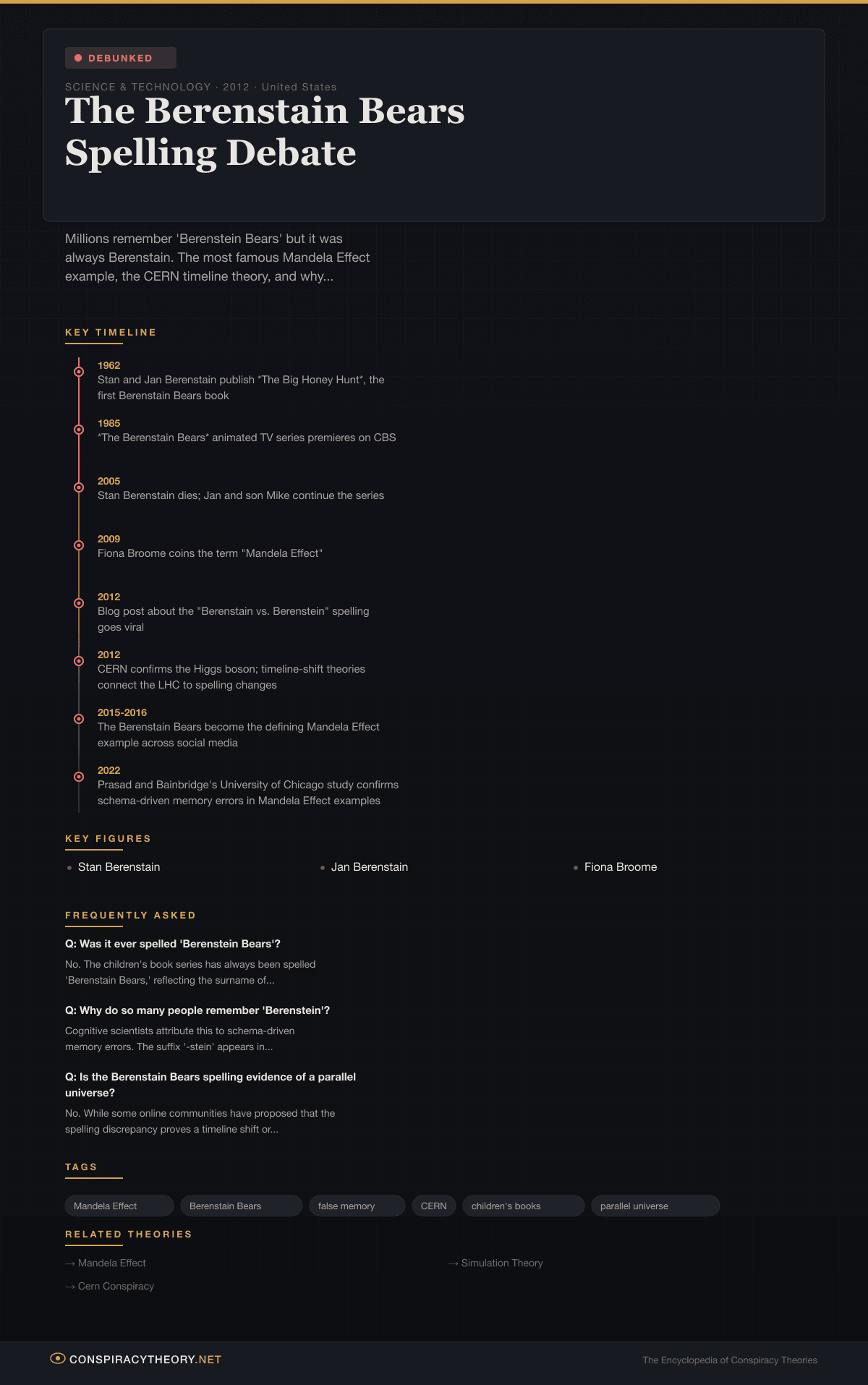
The Berenstain Bears Spelling Debate
Overview
You remember it wrong. You, specifically, reading this right now — you almost certainly remember the name of that beloved children’s book series about a family of bears as “The Berenstein Bears.” You remember the letters on the cover. You can picture them. You’d bet money on it.
You’d lose that bet. It has always been “The Berenstain Bears.” With an A. Not an E. Not ever, not once, not in any edition, printing, translation, or television adaptation across more than six decades of publication. The name comes from the surname of its creators — Stan and Jan Berenstain — and it has never been anything else.
This is the single most famous example of the Mandela Effect, and it has driven more people to question the nature of reality than any philosophy class ever has. The sheer number of people who independently converge on the exact same wrong spelling — not “Berenstine” or “Berenstene” or any other variant, but specifically “Berenstein” — has fueled theories ranging from parallel universe bleed-through to CERN’s Large Hadron Collider accidentally tearing a hole in spacetime. The reality, as is often the case, is less dramatic but arguably more fascinating.
The Facts
Stan and Jan Berenstain published their first book, The Big Honey Hunt, in 1962. The family surname was Berenstain — derived from the German “Bernstein” but Anglicized differently when the family immigrated to the United States. Over the following decades, the series grew to more than 300 titles, sold over 300 million copies, spawned multiple animated television series, and became one of the most ubiquitous fixtures of American childhood.
At no point in this history did anyone involved — not the authors, not the publishers, not Random House, not PBS — use the spelling “Berenstein.” The A was always there, sitting quietly on every cover, every spine, every title page, waiting for the internet to notice that millions of readers had been misreading it their entire lives.
The discrepancy entered public consciousness around 2012, when a blogger posted about discovering the “correct” spelling and the post went viral. Within months, the Berenstain/Berenstein debate had become the defining example of what Fiona Broome had dubbed the Mandela Effect three years earlier. Reddit threads sprawled into thousands of comments. People posted photographs of their childhood copies, zooming in on the covers with a mixture of vindication and existential dread.
The photographs always showed “Berenstain.”
Why Your Brain Does This
The cognitive explanation is almost embarrassingly simple, which is probably why people resist it. The suffix “-stein” is one of the most common name endings in the English-speaking world. Einstein. Frankenstein. Goldstein. Weinstein. Epstein. Silverstein. Your brain has encountered “-stein” thousands of times. It has encountered “-stain” as a name suffix approximately never.
When you first saw “Berenstain” as a child — on a book cover, in a library, on a TV screen — your brain didn’t carefully encode each letter. It grabbed the overall shape, recognized the familiar pattern, and filed it under the nearest known category: “-stein.” This isn’t a failure of memory. It’s memory working exactly as designed, prioritizing efficiency over accuracy.
What makes this particular example so powerful is that the error is self-reinforcing. Every time you recalled the name, you reconstructed it using the “-stein” schema. Every reconstruction strengthened the false version. By the time you were an adult, you hadn’t just misread the name once as a child — you’d rebuilt the wrong version hundreds of times, each rebuild making it feel more certain.
Elizabeth Loftus’s research on reconstructive memory predicts exactly this kind of error. Memory isn’t a filing cabinet; it’s a game of telephone you play with yourself, and each round introduces drift toward the expected.
The CERN Timeline Shift Theory
The most elaborate conspiracy explanation for the Berenstain spelling holds that CERN’s Large Hadron Collider, which began operations in 2008, inadvertently merged two parallel universes or shifted Earth’s timeline. In the “original” timeline, the theory goes, the name really was “Berenstein.” The LHC’s high-energy particle collisions disrupted spacetime, sliding everyone into a slightly different universe where minor details — including the spelling of a children’s book series — are different. Our memories of “Berenstein” are real memories from the real timeline; it’s reality that changed, not us.
This theory gained traction because it offered something cognitive science couldn’t: the comfort of being right. Admitting you misread a book title for thirty years is humbling. Learning that a particle accelerator in Switzerland accidentally rewrote reality is, frankly, cooler.
Physicists have not been kind to this theory. The energies produced by the LHC, while impressive by human standards, are trivial compared to cosmic ray collisions that have been hitting Earth’s atmosphere for billions of years. If particle collisions could merge timelines, the cosmos would have been doing it constantly since before life existed.
The Residue Hunters
A cottage industry has developed around finding “residue” — supposed evidence of the original “Berenstein” spelling that survived the timeline shift. Believers have pointed to old VHS labels with apparent misspellings, TV Guide listings, and even a 2001 newspaper clipping from a Pennsylvania paper that used “Berenstein.” These are presented as proof that the spelling was changed and some physical artifacts weren’t updated.
The simpler explanation — that other people also made the same common misspelling — is apparently less satisfying.
Cultural Impact
The Berenstain/Berenstein debate has become shorthand for the entire Mandela Effect phenomenon. It’s the example people reach for first, the one that produces the most visceral reaction, and the one most likely to make someone question their own cognitive reliability. The Berenstain family has addressed the controversy with good humor; Mike Berenstain, who continued the series after his parents’ deaths, has noted that the family spent their entire lives correcting people’s spelling of their name long before the internet decided it was evidence of a multiverse.
Timeline
- 1962 — Stan and Jan Berenstain publish The Big Honey Hunt, the first Berenstain Bears book
- 1985 — The Berenstain Bears animated TV series premieres on CBS
- 2005 — Stan Berenstain dies; Jan and son Mike continue the series
- 2009 — Fiona Broome coins the term “Mandela Effect”
- 2012 — Blog post about the “Berenstain vs. Berenstein” spelling goes viral
- 2012 — CERN confirms the Higgs boson; timeline-shift theories connect the LHC to spelling changes
- 2015-2016 — The Berenstain Bears become the defining Mandela Effect example across social media
- 2022 — Prasad and Bainbridge’s University of Chicago study confirms schema-driven memory errors in Mandela Effect examples
Sources & Further Reading
- Prasad, Deepak and Wilma Bainbridge. “The Visual Mandela Effect as Evidence for Shared and Specific False Memories.” Psychological Science 33, no. 12 (2022)
- Loftus, Elizabeth F. “Planting Misinformation in the Human Mind.” Learning & Memory 12, no. 4 (2005)
- French, Christopher C. “The Mandela Effect and New Findings in False Memory Research.” The Skeptic, 2019
- Berenstain, Mike. Various interviews regarding the family name spelling, 2015-2016
Frequently Asked Questions
Was it ever spelled 'Berenstein Bears'?
Why do so many people remember 'Berenstein'?
Is the Berenstain Bears spelling evidence of a parallel universe?

Infographic
Share this visual summary. Right-click to save.