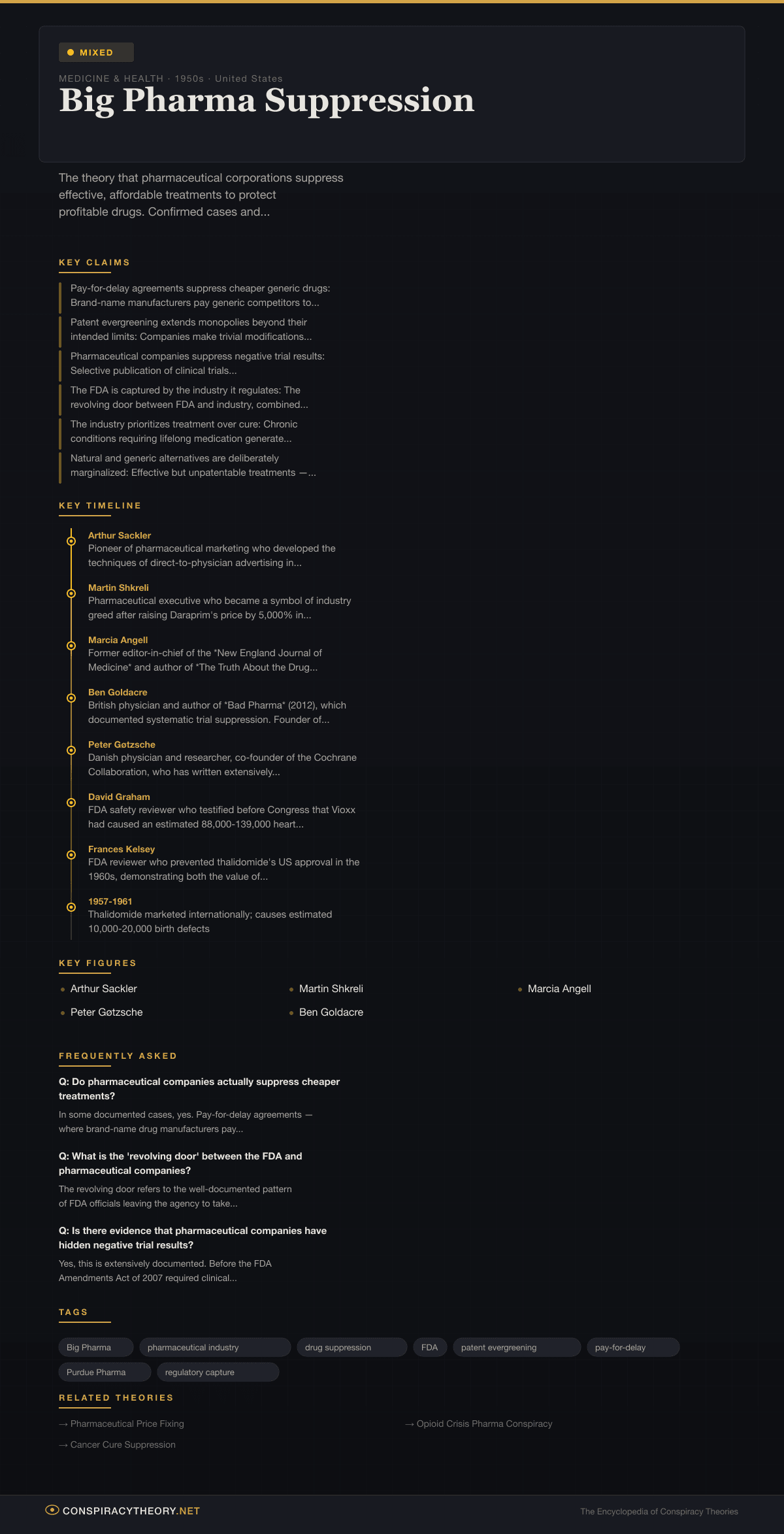
Big Pharma Suppression
Overview
The pharmaceutical industry is the most profitable sector in the American economy, and it has earned every dollar of suspicion directed at it. The theory of “Big Pharma suppression” encompasses a spectrum of claims — from well-documented corporate malfeasance to unsubstantiated allegations of suppressed miracle cures. At one end, you have Purdue Pharma executives who knew OxyContin was addictive and lied about it for decades, or pay-for-delay schemes where brand-name manufacturers literally pay competitors not to sell cheaper generics. These are not theories. They are findings of federal courts. At the other end, you have claims that pharmaceutical companies are sitting on cures for cancer, diabetes, and other diseases because treatment is more profitable than curing — claims that, while emotionally resonant, lack credible evidence. Understanding Big Pharma suppression requires separating what is proven from what is projected, and recognizing that the industry’s documented crimes are damning enough without embellishment.
Origins & History
The roots of pharmaceutical industry distrust stretch back at least to the thalidomide disaster of the late 1950s and early 1960s, when the sedative thalidomide, marketed to pregnant women for morning sickness, caused severe birth defects in an estimated 10,000 to 20,000 children worldwide. The drug had been approved in dozens of countries with inadequate testing, and only an FDA reviewer named Frances Kelsey — who delayed US approval because she was unsatisfied with the safety data — prevented a larger American catastrophe. The thalidomide disaster led to the 1962 Kefauver-Harris Amendment, which for the first time required drug manufacturers to prove efficacy as well as safety before FDA approval.
But the pharmaceutical industry’s relationship with the public was already complicated before thalidomide. The Sackler brothers — Arthur, Mortimer, and Raymond — had pioneered aggressive pharmaceutical marketing in the 1950s and 1960s, developing techniques that transformed how drugs were sold to doctors and the public. Arthur Sackler, widely considered the father of modern pharmaceutical advertising, created the template for direct-to-physician marketing that would eventually evolve into the machinery behind the opioid epidemic.
The modern era of Big Pharma suppression theory crystallized in the 1980s and 1990s, driven by several converging developments. The Bayh-Dole Act of 1980 allowed universities to patent discoveries made with federal funding and license them to private companies. This fundamentally changed the relationship between publicly funded research and pharmaceutical profits — drugs developed with taxpayer money could now be sold at monopoly prices. The Prescription Drug User Fee Act (PDUFA) of 1992 allowed the FDA to charge drug companies fees to review their applications, creating a financial relationship between the regulator and the regulated that critics argued compromised the FDA’s independence. The pharmaceutical industry’s lobbying expenditure exploded, reaching $4.7 billion between 1998 and 2020 — more than any other industry, including oil and gas, defense, and insurance combined.
The Pay-for-Delay Scandal
One of the most concrete forms of pharmaceutical suppression is the pay-for-delay agreement, also known as a “reverse payment settlement.” Under the Hatch-Waxman Act of 1984, generic drug manufacturers can challenge brand-name patents before they expire. When they do, brand-name companies sometimes respond not by defending their patents in court but by paying the generic manufacturer to delay entering the market — effectively paying competitors not to compete.
The Federal Trade Commission has fought pay-for-delay deals for over two decades. A 2010 FTC study estimated that these agreements cost American consumers approximately $3.5 billion per year in higher drug prices. In 2013, the Supreme Court ruled in FTC v. Actavis that pay-for-delay agreements could violate antitrust law, but the ruling left significant room for the practice to continue in modified forms. Between 2004 and 2020, the FTC identified over 200 pay-for-delay agreements.
The sums involved are staggering. In one notable case, brand-name manufacturer AbbVie paid generic competitors approximately $450 million to delay bringing a generic version of testosterone gel AndroGel to market. Consumers continued paying brand-name prices for years while two companies that could have offered a cheaper product chose to accept payment instead.
Patent Evergreening
Patent evergreening — the practice of making minor modifications to a drug approaching patent expiration to secure new patents and extend market exclusivity — is another documented suppression mechanism. Pharmaceutical companies have extended monopolies on blockbuster drugs by reformulating tablets as capsules, developing extended-release versions, creating new salt forms, or combining existing drugs into single pills.
The case of AstraZeneca’s Nexium is emblematic. When the patent on the blockbuster heartburn drug Prilosec (omeprazole) approached expiration, AstraZeneca introduced Nexium (esomeprazole) — essentially a purified version of the same active molecule. The company spent over $500 million marketing Nexium as a superior drug, despite clinical evidence showing minimal meaningful difference from Prilosec. When generic omeprazole became available at a fraction of the price, AstraZeneca’s marketing successfully shifted many patients to the patent-protected Nexium, which continued generating billions in annual revenue.
Trial Suppression and Publication Bias
The selective publication of clinical trial results represents perhaps the most scientifically consequential form of pharmaceutical suppression. Before mandatory trial registration requirements, pharmaceutical companies routinely conducted multiple trials and published only those showing favorable results.
The paroxetine (Paxil/Seroxat) case is the most thoroughly documented example. GlaxoSmithKline conducted Study 329, examining paroxetine’s effectiveness in treating depression in adolescents. When the study’s own data showed the drug was no more effective than placebo and was associated with increased suicidal thinking in young patients, the company published a ghostwritten version of the study in the Journal of the American Academy of Child and Adolescent Psychiatry that characterized the results as showing “generally well tolerated and effective” treatment. Internal company documents obtained through litigation revealed that GSK had known about the suicide risk for years and had deliberately concealed it. The company eventually paid $3 billion in fines — the largest healthcare fraud settlement in history at that time — though no executives were criminally charged.
British physician and academic Ben Goldacre documented the scope of trial suppression across the industry in his 2012 book Bad Pharma. Goldacre demonstrated that approximately half of all clinical trials were never published, with negative results far more likely to be suppressed than positive ones. The resulting distortion of the medical literature meant that doctors were making prescribing decisions based on an incomplete and systematically biased evidence base.
Key Claims
-
Pay-for-delay agreements suppress cheaper generic drugs: Brand-name manufacturers pay generic competitors to delay market entry, keeping prices artificially high. This is confirmed and documented by the FTC.
-
Patent evergreening extends monopolies beyond their intended limits: Companies make trivial modifications to drugs to secure new patents, blocking generic competition for years or decades beyond the original patent term.
-
Pharmaceutical companies suppress negative trial results: Selective publication of clinical trials has systematically distorted the medical literature, concealing evidence of drug risks and inefficacy.
-
The FDA is captured by the industry it regulates: The revolving door between FDA and industry, combined with user fee financing, compromises the agency’s independence and leads to approval of drugs that are less safe or effective than the public is told.
-
The industry prioritizes treatment over cure: Chronic conditions requiring lifelong medication generate more revenue than one-time cures, creating a structural disincentive to develop curative treatments.
-
Natural and generic alternatives are deliberately marginalized: Effective but unpatentable treatments — from generic drugs to certain supplements — receive no investment because they cannot generate sufficient returns, and the industry actively discourages their use.
-
Cancer cures have been suppressed: The most extreme version of the theory claims that cures for cancer exist but are being withheld because cancer treatment is a $200+ billion industry.
Evidence
Confirmed Suppression
The evidence for financial and regulatory suppression by pharmaceutical companies is overwhelming and comes primarily from court records, government investigations, and the companies’ own internal documents.
Purdue Pharma and OxyContin: In 2007, Purdue Pharma and three of its executives pleaded guilty to federal charges of misbranding OxyContin. The company had marketed the drug as less addictive than other opioids, claiming it provided 12-hour pain relief that would reduce abuse potential. Internal documents revealed that the company knew within years of OxyContin’s 1996 launch that the drug’s effects wore off before twelve hours in many patients — leading to dose escalation, withdrawal symptoms, and addiction. The subsequent opioid epidemic killed over 500,000 Americans. The Sackler family extracted over $10 billion from Purdue Pharma before the company declared bankruptcy.
Vioxx (rofecoxib): Merck withdrew the painkiller Vioxx from the market in 2004 after a study confirmed that it doubled the risk of heart attack and stroke. Internal emails obtained through litigation showed that Merck scientists had identified cardiovascular risks years earlier but the company continued marketing the drug and downplayed the evidence. An FDA safety reviewer, David Graham, estimated that Vioxx caused between 88,000 and 139,000 heart attacks during its time on the market, approximately 30-40% of which were fatal. Merck eventually paid $4.85 billion to settle approximately 27,000 lawsuits.
The FTC’s pay-for-delay record: The Federal Trade Commission has documented over 200 pay-for-delay agreements since the early 2000s. These agreements have delayed generic entry for drugs including Androgel, Provigil, Nexium, and numerous others, costing consumers billions in aggregate.
Lobbying and political influence: The pharmaceutical industry has spent more on lobbying than any other sector — $4.7 billion between 1998 and 2020, according to OpenSecrets. The industry deployed 1,500 lobbyists in 2019 alone, nearly three for every member of Congress. This spending has demonstrably influenced legislation: the 2003 Medicare Modernization Act, which created Medicare Part D prescription drug coverage, explicitly prohibited Medicare from negotiating drug prices with manufacturers — a provision worth hundreds of billions to the industry.
Unsubstantiated Claims
The claim that pharmaceutical companies are suppressing cures for cancer and other major diseases does not withstand scrutiny, despite its emotional appeal. The pharmaceutical industry is not a monolith — it consists of thousands of companies, universities, and research institutions across dozens of countries, many with competing interests. A cancer cure would be worth hundreds of billions of dollars to whichever company developed it. The notion that such a cure could be suppressed across this fragmented, competitive, international landscape strains credulity.
Moreover, the people who work in pharmaceutical research — chemists, biologists, clinical investigators — have family members who get cancer. The idea that thousands of scientists would collectively suppress a cure that could save their own loved ones requires a level of institutional loyalty and moral bankruptcy that, while not impossible in isolated cases, is implausible at scale.
The confirmed cases of suppression — pay-for-delay, trial hiding, patent evergreening — are financial in nature. Companies suppress cheaper alternatives, not revolutionary cures. They hide data showing their drugs don’t work or are dangerous, not data showing that a competitor’s drug could cure a disease. The distinction matters because it shapes appropriate policy responses.
Debunking / Verification
The Big Pharma suppression theory requires nuanced evaluation because its component claims range from thoroughly documented to wholly speculative.
Verified: Pay-for-delay agreements, patent evergreening, selective trial publication, regulatory revolving door, aggressive and sometimes deceptive marketing, lobbying influence over drug pricing legislation, and specific cases of concealing drug risks (OxyContin, Vioxx, Paxil) are all documented beyond reasonable dispute.
Partially supported: The claim that the FDA is “captured” by industry has significant evidence — the user fee model, the revolving door, and instances where FDA officials overruled their own safety reviewers — but the agency also rejects or delays many drug applications and has issued major safety warnings over industry objections. The FDA’s relationship with industry is compromised in specific, documented ways without being the wholesale rubber stamp that some critics allege.
Not supported: The suppression of cancer cures, miracle natural remedies, or other revolutionary treatments lacks credible evidence. While individual cases of promising research being underfunded due to lack of patent potential are real and concerning, this is different from active suppression. The problem is a market failure — no one invests in unpatentable treatments — not a conspiracy to hide cures.
Marcia Angell, former editor-in-chief of the New England Journal of Medicine and one of the pharmaceutical industry’s most credible critics, has drawn precisely this distinction. In her 2004 book The Truth About the Drug Companies, Angell documented extensive industry malfeasance while explicitly rejecting conspiracy theories about suppressed cures. The real scandal, Angell argued, is that the industry spends far more on marketing than on research, develops “me-too” drugs that offer no improvement over existing treatments, and extracts monopoly rents from a captured regulatory system — all without needing to suppress any revolutionary breakthroughs.
Cultural Impact
Distrust of the pharmaceutical industry consistently ranks among the highest of any sector in public opinion surveys. A 2019 Gallup poll found that the pharmaceutical industry had the lowest favorability rating of any business sector — lower than the federal government, lower than oil and gas, lower than health insurance companies. This distrust is not irrational; it reflects decades of documented corporate misconduct.
The Big Pharma suppression narrative has had significant public health consequences. Vaccine hesitancy, which the World Health Organization named one of the top ten threats to global health in 2019, draws substantially on distrust of pharmaceutical companies and the regulatory agencies that approve their products. The COVID-19 pandemic dramatically amplified these dynamics, with vaccine skepticism driven in part by the documented history of pharmaceutical fraud and the legitimate (if ultimately unfounded) concern that emergency authorization processes had cut safety corners.
The opioid epidemic brought pharmaceutical suppression from conspiracy theory into mainstream discourse. The Sackler family’s extraction of billions from Purdue Pharma while concealing OxyContin’s addictive properties — and the failure of the FDA and DEA to intervene effectively — confirmed many Americans’ worst suspicions about the industry. Patrick Radden Keefe’s Empire of Pain (2021) and Alex Gibney’s documentary Crime of the Century (2021) brought the story to massive audiences.
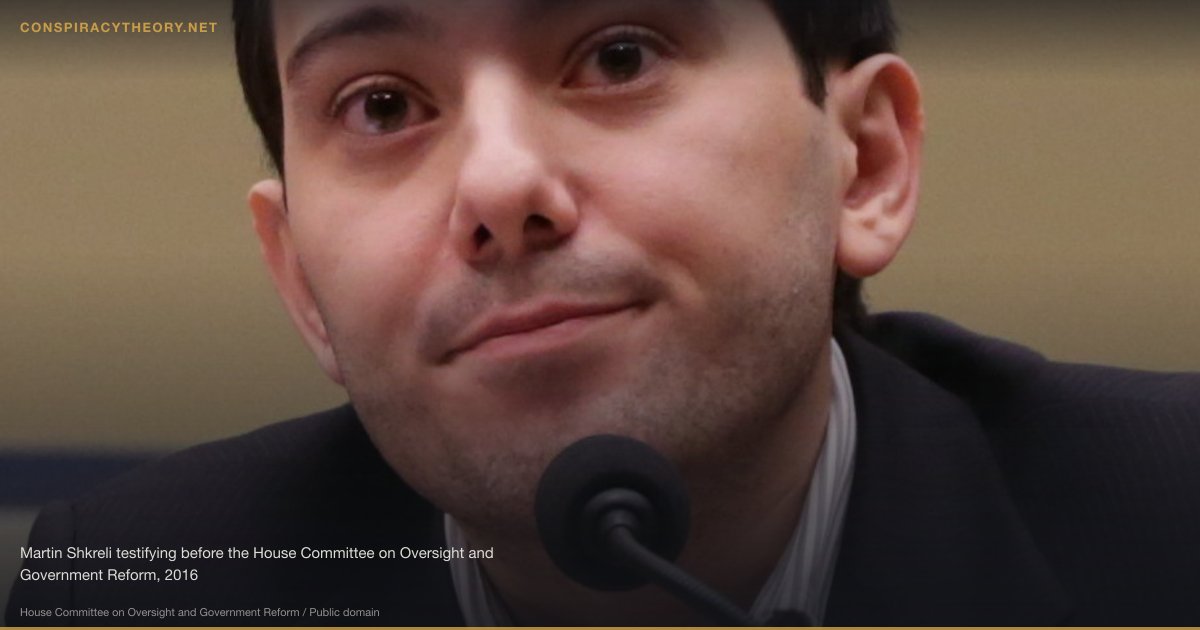
Martin Shkreli’s 2015 decision to raise the price of Daraprim — a decades-old anti-parasitic drug — from $13.50 to $750 per pill overnight became a cultural flashpoint, embodying the public’s perception of pharmaceutical greed. While Shkreli was eventually imprisoned for securities fraud rather than drug pricing, his case crystallized the narrative of an industry that prioritizes profit over patients.
The pharmaceutical price-fixing issue has generated sustained political attention across party lines, with both Republican and Democratic administrations pursuing — with varying degrees of commitment — efforts to reduce drug prices. The Inflation Reduction Act of 2022, which for the first time allowed Medicare to negotiate prices for certain drugs, represented the most significant legislative response to pharmaceutical pricing concerns in decades.
Key Figures
-
Arthur Sackler — Pioneer of pharmaceutical marketing who developed the techniques of direct-to-physician advertising in the 1950s-1960s. His family later owned Purdue Pharma, maker of OxyContin.
-
Martin Shkreli — Pharmaceutical executive who became a symbol of industry greed after raising Daraprim’s price by 5,000% in 2015. Convicted of securities fraud in 2017.
-
Marcia Angell — Former editor-in-chief of the New England Journal of Medicine and author of The Truth About the Drug Companies (2004). One of the most credible and influential critics of the pharmaceutical industry.
-
Ben Goldacre — British physician and author of Bad Pharma (2012), which documented systematic trial suppression. Founder of the AllTrials campaign for clinical trial transparency.
-
Peter Gøtzsche — Danish physician and researcher, co-founder of the Cochrane Collaboration, who has written extensively about pharmaceutical industry corruption and its influence on medical research. Author of Deadly Medicines and Organised Crime (2013).
-
David Graham — FDA safety reviewer who testified before Congress that Vioxx had caused an estimated 88,000-139,000 heart attacks, publicly criticizing his own agency’s failure to act on safety signals.
-
Frances Kelsey — FDA reviewer who prevented thalidomide’s US approval in the 1960s, demonstrating both the value of independent regulatory review and the consequences when it fails.
Timeline
- 1957-1961 — Thalidomide marketed internationally; causes estimated 10,000-20,000 birth defects
- 1962 — Kefauver-Harris Amendment strengthens FDA drug approval requirements
- 1980 — Bayh-Dole Act allows universities to patent publicly funded research
- 1984 — Hatch-Waxman Act creates framework for generic drug approval and patent challenges
- 1992 — Prescription Drug User Fee Act (PDUFA) allows FDA to charge drug companies for application reviews
- 1996 — Purdue Pharma launches OxyContin with aggressive “less addictive” marketing
- 1999 — Vioxx (rofecoxib) approved by FDA
- 2001 — GlaxoSmithKline publishes misleading Study 329 on paroxetine in adolescents
- 2003 — Medicare Modernization Act prohibits Medicare from negotiating drug prices
- 2004 — Merck withdraws Vioxx after cardiovascular risk confirmation; David Graham testifies to Congress
- 2007 — Purdue Pharma pleads guilty to misbranding OxyContin; pays $635 million in fines
- 2007 — FDA Amendments Act requires clinical trial registration on ClinicalTrials.gov
- 2010 — FTC estimates pay-for-delay agreements cost consumers $3.5 billion annually
- 2012 — Ben Goldacre publishes Bad Pharma; AllTrials campaign launched
- 2013 — Supreme Court rules in FTC v. Actavis that pay-for-delay agreements may violate antitrust law
- 2013 — GlaxoSmithKline pays $3 billion in healthcare fraud settlement (Paxil, Avandia, Wellbutrin)
- 2015 — Martin Shkreli raises Daraprim price from $13.50 to $750 per pill
- 2019 — Purdue Pharma files for bankruptcy; Sackler family agrees to multibillion-dollar settlement
- 2022 — Inflation Reduction Act allows Medicare to negotiate prices for select drugs
Sources & Further Reading
- Angell, Marcia. The Truth About the Drug Companies: How They Deceive Us and What to Do About It. Random House, 2004.
- Goldacre, Ben. Bad Pharma: How Drug Companies Mislead Doctors and Harm Patients. Fourth Estate, 2012.
- Gøtzsche, Peter C. Deadly Medicines and Organised Crime: How Big Pharma Has Corrupted Healthcare. Radcliffe Publishing, 2013.
- Keefe, Patrick Radden. Empire of Pain: The Secret History of the Sackler Dynasty. Doubleday, 2021.
- Posner, Gerald. Pharma: Greed, Lies, and the Poisoning of America. Avid Reader Press, 2020.
- Federal Trade Commission. “Pay-for-Delay: How Drug Company Pay-Offs Cost Consumers Billions.” January 2010.
- Human Rights Watch. “All Trials Registered, All Results Reported.” Multiple reports, 2013-2020.
- Lexchin, Joel. Doctors in Denial: Why Big Pharma and the Canadian Medical Profession Are Too Close for Comfort. Lorimer, 2017.
Related Theories
- Pharmaceutical Price-Fixing — Documented collusion among generic drug manufacturers to fix prices
- Opioid Crisis Pharma Conspiracy — The Sackler family and Purdue Pharma’s role in creating the opioid epidemic
- Cancer Cure Suppression — The specific claim that cures for cancer have been discovered and suppressed
Frequently Asked Questions
Do pharmaceutical companies actually suppress cheaper treatments?
What is the 'revolving door' between the FDA and pharmaceutical companies?
Is there evidence that pharmaceutical companies have hidden negative trial results?
Infographic
Share this visual summary. Right-click to save.