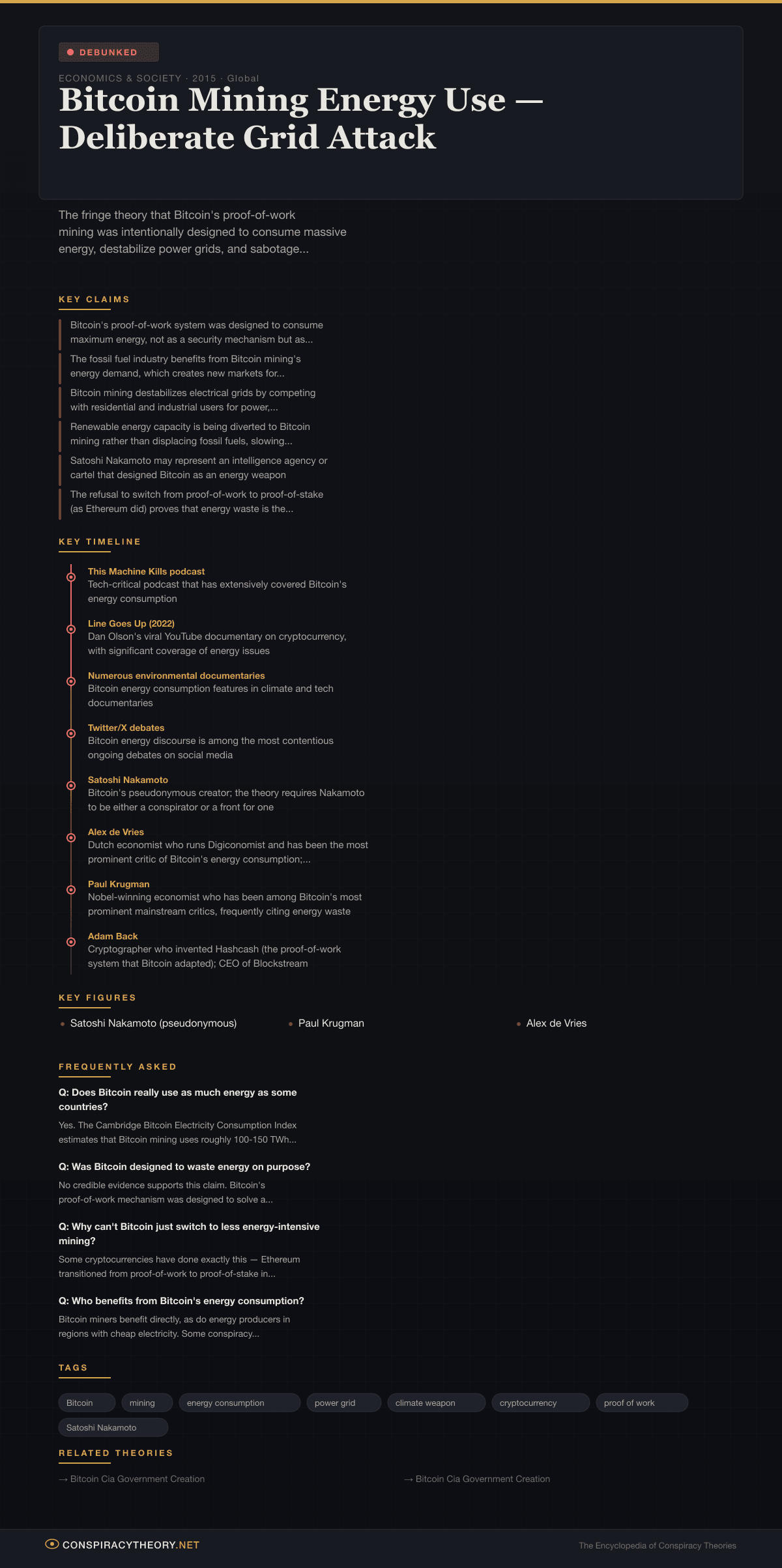
Bitcoin Mining Energy Use — Deliberate Grid Attack

Overview
Bitcoin uses an enormous amount of electricity. This is not a conspiracy theory — it is a straightforward engineering fact. The Cambridge Centre for Alternative Finance estimates that the Bitcoin network consumes roughly 100 to 150 terawatt-hours of electricity annually, on par with the total energy use of mid-sized countries. A single Bitcoin transaction uses more electricity than the average American household consumes in a month. Mining operations the size of warehouses run thousands of specialized computers 24 hours a day, generating heat, noise, and electricity bills that would bankrupt a small city.
Where this enters conspiracy territory is the explanation. A fringe theory — which gained traction in environmental activist circles, parts of the political left, and certain corners of the financial establishment — holds that Bitcoin’s extraordinary energy consumption is not an unintended consequence of its design but a deliberate feature. In its various formulations, the theory claims that Bitcoin was designed to function as an energy weapon: a mechanism to consume renewable energy capacity, destabilize power grids, increase carbon emissions, create artificial energy scarcity, or some combination thereof.
The theory is creative and, in a way, flattering to its unnamed villains. It imagines an architect of sublime strategic patience — someone who designed a financial instrument in 2008 specifically to cause climate damage a decade later. The reality is both simpler and more interesting: proof-of-work mining is the solution that a pseudonymous programmer found to a genuine computer science problem, and its energy consequences were not planned but emerged from the interaction of clever mathematics with market incentives.
Origins & History
Bitcoin’s energy consumption was not initially a concern. When Satoshi Nakamoto published the Bitcoin whitepaper in October 2008 and launched the network in January 2009, mining could be done on a laptop. The entire network consumed less energy than a kitchen appliance.
The proof-of-work concept — the idea that miners must solve computationally intensive puzzles to validate transactions and earn new Bitcoin — was borrowed from earlier work by Adam Back (Hashcash, 1997) and Hal Finney (Reusable Proof of Work, 2004). The purpose was straightforward: in a decentralized network with no central authority, you need a mechanism to prevent any single participant from taking control. Proof-of-work achieves this by making the cost of attacking the network proportional to the computational power you control. To cheat, you would need to outspend every honest miner combined.
This works. The Bitcoin network has never been successfully attacked at the protocol level. But it works by design through waste — by making miners spend real energy solving mathematical puzzles that serve no purpose other than proving they were solved. As Bitcoin’s value rose, so did the economic incentive to mine it, and so did the energy consumption.
By 2013, specialized mining hardware (ASICs) had replaced personal computers. By 2017, industrial-scale mining farms were drawing electricity from hydroelectric dams in China, geothermal plants in Iceland, and natural gas wells in Texas. By 2021, Bitcoin’s estimated energy consumption exceeded that of many nations.
The “deliberate energy weapon” narrative emerged around 2015-2017, when environmental concerns about Bitcoin first reached mainstream media. It drew from several sources:
Climate activists who saw Bitcoin as a direct threat to emissions targets. The Digiconomist blog, run by Dutch economist Alex de Vries, became an influential source for Bitcoin energy data and criticism.
Traditional finance critics who viewed Bitcoin as inherently valueless and therefore its energy use as pure waste. Nobel laureate Paul Krugman wrote multiple New York Times columns characterizing Bitcoin as an energy-burning scheme to move money backwards technologically.
Conspiracy theorists who connected Bitcoin’s energy use to broader narratives about deliberate environmental destruction, noting that major mining operations often ran on fossil fuels and that the fossil fuel industry had invested in mining infrastructure.
The theory reached its most elaborate form in claims that Satoshi Nakamoto was a front for an intelligence agency or fossil fuel cartel that designed Bitcoin specifically to create energy demand that would undermine the transition to renewable energy.
Key Claims
- Bitcoin’s proof-of-work system was designed to consume maximum energy, not as a security mechanism but as a deliberate energy sink
- The fossil fuel industry benefits from Bitcoin mining’s energy demand, which creates new markets for stranded natural gas and extends the economic viability of fossil fuel infrastructure
- Bitcoin mining destabilizes electrical grids by competing with residential and industrial users for power, causing brownouts and price increases
- Renewable energy capacity is being diverted to Bitcoin mining rather than displacing fossil fuels, slowing the green energy transition
- Satoshi Nakamoto may represent an intelligence agency or cartel that designed Bitcoin as an energy weapon
- The refusal to switch from proof-of-work to proof-of-stake (as Ethereum did) proves that energy waste is the feature, not the bug
- Mining operations in developing countries extract energy from populations that need it, constituting a form of energy colonialism
Evidence
What’s True About Bitcoin’s Energy Problem
The underlying facts that feed this theory are real:
The energy consumption is massive. 100-150 TWh/year is not trivial. This is a legitimate environmental concern that serious researchers and policymakers are grappling with.
Fossil fuels power much of it. While Bitcoin advocates emphasize the use of renewable energy (particularly hydroelectric power in regions with excess capacity), studies suggest that as of 2023, roughly 40-60% of Bitcoin mining was powered by fossil fuels, depending on the methodology.
Grid strain has occurred. In Texas, Kazakhstan, Iran, and other jurisdictions, large mining operations have competed with local populations for electricity, sometimes contributing to grid instability. Texas experienced strain during winter storms when mining operations consumed power needed for heating.
The fossil fuel connection is real but not conspiratorial. Oil companies like ExxonMobil and ConocoPhillips have partnered with Bitcoin miners to monetize stranded natural gas — gas produced as a byproduct of oil drilling that would otherwise be vented or flared. This is economically rational behavior, not evidence of a conspiracy.
What Doesn’t Hold Up
The design intent claim is unsupported. Satoshi Nakamoto’s writings — the whitepaper, forum posts, and emails — discuss proof-of-work purely in terms of security and decentralization. There is no evidence in any known Nakamoto communication that energy consumption was a goal rather than a cost. Nakamoto even discussed the possibility of energy-efficient mining in early forum posts.
Proof-of-work predates Bitcoin. The concept was invented by Cynthia Dwork and Moni Naor in 1993 and independently by Adam Back in 1997 — as anti-spam measures, not energy weapons. Satoshi adapted an existing tool for a new purpose.
Energy consumption scales with price, not design. If Bitcoin were worth $1 instead of tens of thousands of dollars, mining would consume negligible energy because the economic incentive would not justify the cost. The energy consumption is a function of market value, not deliberate engineering.
Alternatives exist and are used. Ethereum’s 2022 switch to proof-of-stake reduced its energy use by 99.95%. If Bitcoin’s community chose to adopt similar changes, it could. The resistance to doing so comes from a philosophical commitment to proof-of-work’s security model, not from hidden energy-consumption objectives.
No conspiracy is needed to explain the outcome. Bitcoin’s energy consumption is an entirely predictable result of market incentives applied to proof-of-work mining. Miners compete to solve puzzles. More valuable puzzles attract more miners. More miners consume more energy. No mastermind required.
Debunking / Verification
This theory is classified as debunked because:
- The design intent claim has zero evidence. No known Nakamoto communication supports it.
- The mechanism (proof-of-work) predates Bitcoin and was designed for an unrelated purpose.
- Energy consumption is a function of price, not architectural intent.
- The conspiracy is unnecessary — standard economic incentives fully explain the observed outcome.
- The theory requires an implausibly prescient architect who in 2008 designed a system specifically to cause energy problems that only materialized a decade later.
What is legitimate: Environmental concern about Bitcoin’s energy footprint is entirely valid and is taken seriously by researchers, regulators, and even parts of the cryptocurrency community. The critique is not fringe; it is mainstream and well-supported. What is fringe is the claim that this energy consumption was deliberately engineered as a weapon.
Cultural Impact
The Bitcoin energy debate has had significant real-world consequences. New York State enacted a moratorium on new proof-of-work mining operations in 2022. The European Parliament debated (and narrowly rejected) restrictions on proof-of-work mining. China banned Bitcoin mining in 2021 (though miners relocated to other countries). Multiple municipalities have enacted regulations on mining operations due to noise, heat, and energy grid impacts.
The “deliberate sabotage” variant of the theory, while fringe, has influenced the tone of mainstream criticism by injecting conspiratorial framing into legitimate environmental policy debates. When Senator Elizabeth Warren described Bitcoin as an “environmental disaster” or when the European Central Bank published reports critical of Bitcoin’s energy use, they were making mainstream policy arguments — but the conspiratorial narrative ensured that parts of the cryptocurrency community dismissed all energy criticism as part of a coordinated attack.
This polarization — where legitimate criticism is contaminated by conspiracy thinking, causing proponents to dismiss all criticism — is a pattern that appears across many topics on this wiki.
In Popular Culture
- This Machine Kills podcast — Tech-critical podcast that has extensively covered Bitcoin’s energy consumption
- Line Goes Up (2022) — Dan Olson’s viral YouTube documentary on cryptocurrency, with significant coverage of energy issues
- Numerous environmental documentaries — Bitcoin energy consumption features in climate and tech documentaries
- Twitter/X debates — Bitcoin energy discourse is among the most contentious ongoing debates on social media
Key Figures
- Satoshi Nakamoto — Bitcoin’s pseudonymous creator; the theory requires Nakamoto to be either a conspirator or a front for one
- Alex de Vries — Dutch economist who runs Digiconomist and has been the most prominent critic of Bitcoin’s energy consumption; publishes peer-reviewed energy estimates
- Paul Krugman — Nobel-winning economist who has been among Bitcoin’s most prominent mainstream critics, frequently citing energy waste
- Adam Back — Cryptographer who invented Hashcash (the proof-of-work system that Bitcoin adapted); CEO of Blockstream
- Nic Carter — Bitcoin researcher who has published extensive counterarguments to energy criticisms, arguing that Bitcoin increasingly uses renewable and stranded energy
Timeline
| Date | Event |
|---|---|
| 1993 | Dwork and Naor propose proof-of-work concept |
| 1997 | Adam Back implements Hashcash |
| October 2008 | Satoshi Nakamoto publishes Bitcoin whitepaper |
| January 2009 | Bitcoin network launches; mining possible on ordinary computers |
| 2013 | ASIC mining hardware replaces general-purpose computers; energy use begins scaling |
| 2017 | Bitcoin energy consumption reaches mainstream media attention; Digiconomist gains influence |
| 2018 | Cambridge Centre for Alternative Finance launches Bitcoin Electricity Consumption Index |
| 2019 | Estimated Bitcoin energy use exceeds that of Switzerland |
| 2021 | China bans Bitcoin mining; miners relocate to US, Kazakhstan, and other countries |
| September 2022 | Ethereum switches from proof-of-work to proof-of-stake, cutting energy use 99.95% |
| November 2022 | New York enacts moratorium on new proof-of-work mining operations |
| 2023-present | Bitcoin energy debate continues; mining increasingly incorporates stranded and renewable energy |
Sources & Further Reading
- Nakamoto, Satoshi. “Bitcoin: A Peer-to-Peer Electronic Cash System.” 2008.
- de Vries, Alex. “Bitcoin’s Growing Energy Problem.” Joule, 2018.
- Cambridge Centre for Alternative Finance. “Cambridge Bitcoin Electricity Consumption Index.” University of Cambridge.
- Stoll, Christian, et al. “The Carbon Footprint of Bitcoin.” Joule, 2019.
- Carter, Nic. “How Much Energy Does Bitcoin Actually Consume?” Harvard Business Review, 2021.
- International Energy Agency. “Bitcoin Mining and the Environment.” Various reports.
- Mora, Camilo, et al. “Bitcoin Emissions Alone Could Push Global Warming Above 2C.” Nature Climate Change, 2018.
- Blandin, Apolline, et al. “3rd Global Cryptoasset Benchmarking Study.” Cambridge Centre for Alternative Finance, 2020.
Related Theories
- Satoshi Nakamoto Identity — The mystery of who created Bitcoin, central to the “deliberate design” variant of the energy theory
- Bitcoin as CIA Creation — The related theory that Bitcoin was created by an intelligence agency, sometimes incorporating energy consumption as an objective

Frequently Asked Questions
Does Bitcoin really use as much energy as some countries?
Was Bitcoin designed to waste energy on purpose?
Why can't Bitcoin just switch to less energy-intensive mining?
Who benefits from Bitcoin's energy consumption?

Infographic
Share this visual summary. Right-click to save.