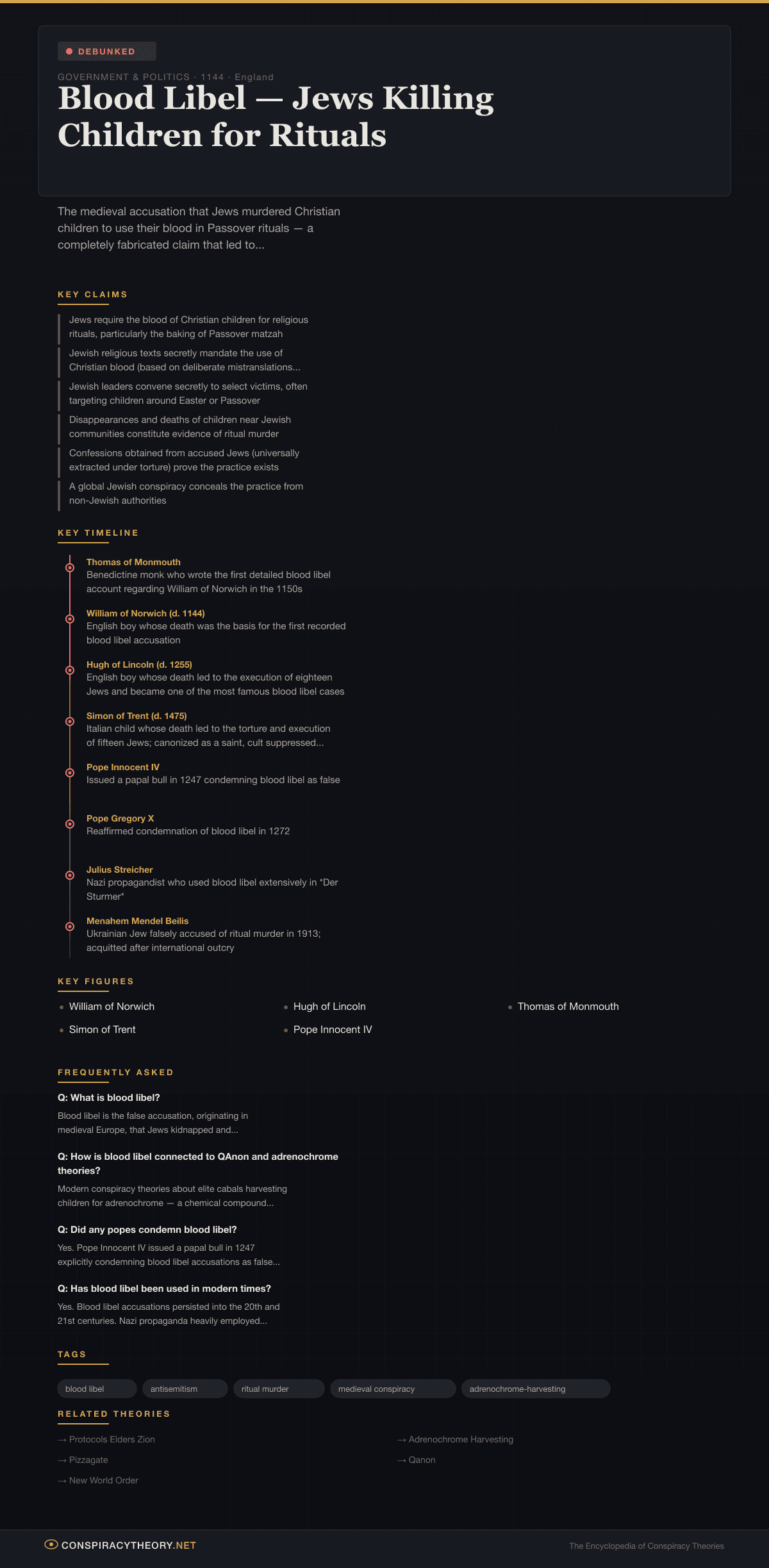
Blood Libel — Jews Killing Children for Rituals
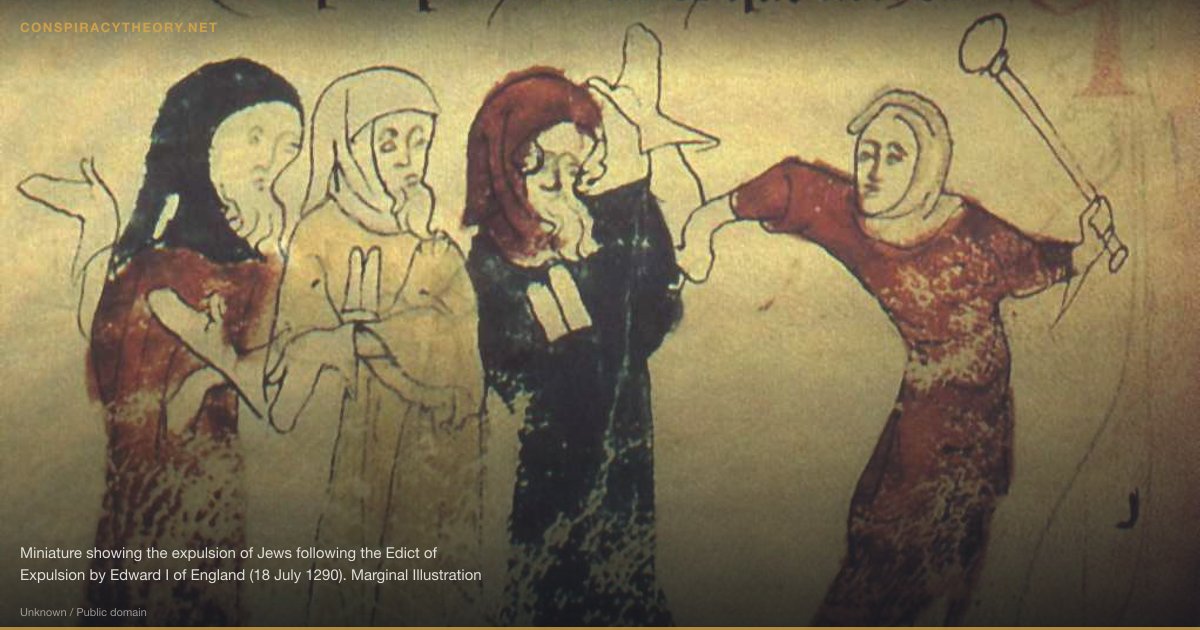
Overview
Blood libel is the false accusation that Jews ritually murder Christian children to harvest their blood for use in religious ceremonies, most commonly the baking of Passover matzah. First recorded in Norwich, England in 1144, the accusation spread across medieval Europe and became one of the most destructive and persistent antisemitic conspiracy theories in history. Despite having no basis in fact — and directly contradicting Jewish religious law, which strictly prohibits the consumption of blood — blood libel led to centuries of massacres, forced expulsions, torture, and pogroms that killed thousands of Jewish people.
The theory’s significance extends far beyond medieval history. Blood libel provided the template for a recurring pattern in conspiracy thinking: the accusation that a secretive, powerful minority group preys upon innocent children. This template has been recycled across centuries, from the witch trial panics of the early modern period to the Satanic Panic of the 1980s, and most recently into the QAnon movement and its fixation on adrenochrome harvesting. Understanding blood libel is essential to understanding how conspiratorial antisemitism operates and how ancient prejudices are repackaged for modern audiences.
The theory has been conclusively debunked through centuries of investigation. Multiple popes formally condemned the accusations as baseless. Confessions used as evidence were extracted through torture. No physical evidence has ever substantiated the claims. Modern historians unanimously regard blood libel as a fabrication rooted in religious prejudice, economic resentment, and political opportunism.
Origins & History
The William of Norwich Case (1144)
The first recorded blood libel accusation emerged in Norwich, England in 1144, when the body of a twelve-year-old boy named William was found in the woods outside the city. A Benedictine monk named Thomas of Monmouth wrote an account several years later claiming that local Jews had kidnapped and crucified the boy in a ritual reenactment of the Crucifixion of Christ. Thomas claimed a convert from Judaism had informed him that Jewish leaders gathered annually to select a Christian child for sacrifice.
No contemporary evidence supported these claims. No arrests were made at the time of William’s death. Thomas of Monmouth wrote his account years after the event, and his primary source — the alleged Jewish convert — was never independently corroborated. Despite this, a cult developed around “Saint William of Norwich,” and the story established a template that would be repeated across Europe for centuries.
Spread Across Medieval Europe
Following the Norwich case, blood libel accusations proliferated rapidly. Key incidents include:
- Gloucester, England (1168): A boy named Harold was found dead, and Jews were accused of ritual murder.
- Blois, France (1171): Over thirty Jews were burned alive following a blood libel accusation, despite no body ever being found.
- Lincoln, England (1255): The death of nine-year-old Hugh of Lincoln led to the arrest of over ninety Jews. Eighteen were executed. The case became famous through its inclusion in Chaucer’s Canterbury Tales.
- Trent, Italy (1475): A two-year-old boy named Simon disappeared, and the local Jewish community was accused of his murder. Fifteen Jews were tortured and burned. Simon was canonized as a saint (his cult was officially suppressed by the Vatican in 1965).
- La Guardia, Spain (1491): A blood libel case involving an allegedly crucified Christian child was used to justify the expulsion of Jews from Spain in 1492.
Papal Condemnations
Significantly, multiple popes formally condemned blood libel as false. Pope Innocent IV issued a papal bull in 1247, Lachrymabilem Judaeorum, which explicitly stated that the accusations were baseless and that Christians who made them were acting unjustly. Pope Gregory X reaffirmed this position in 1272, ordering that no Christian should accuse Jews of using human blood in their rituals. Pope Clement XIV issued a similar decree in 1758.
These papal interventions demonstrate that even within the medieval Church hierarchy, the accusations were recognized as fabrications. However, local clergy, secular rulers, and popular movements continued to promote blood libel despite official condemnation.
The Damascus Affair (1840)
Blood libel did not remain confined to the Middle Ages. In 1840, the disappearance of a Capuchin friar named Father Thomas in Damascus led to the arrest and torture of several prominent Jewish community members. Under torture, some confessed to ritual murder. The case became an international incident, with Jewish leaders from Europe and America lobbying for the prisoners’ release. The surviving prisoners were eventually freed, but the case revived blood libel accusations across the Middle East and became a fixture of antisemitic propaganda in the region.
Nazi Exploitation
The Nazi regime made extensive use of blood libel imagery. Julius Streicher’s newspaper Der Sturmer regularly published blood libel stories and illustrations depicting Jews as child murderers. A special 1934 issue was devoted entirely to ritual murder accusations. The Nazis understood that blood libel provided an emotionally powerful framework for dehumanizing Jews, and they deployed it systematically as part of their broader propaganda campaign leading to the Holocaust.
Key Claims
Proponents of blood libel, across its various historical manifestations, have made the following core claims:
- Jews require the blood of Christian children for religious rituals, particularly the baking of Passover matzah
- Jewish religious texts secretly mandate the use of Christian blood (based on deliberate mistranslations and fabrications of Talmudic passages)
- Jewish leaders convene secretly to select victims, often targeting children around Easter or Passover
- Disappearances and deaths of children near Jewish communities constitute evidence of ritual murder
- Confessions obtained from accused Jews (universally extracted under torture) prove the practice exists
- A global Jewish conspiracy conceals the practice from non-Jewish authorities
- The crucifixion of children mimics the Crucifixion of Christ as a deliberate act of blasphemy
Evidence
Why the Accusation Is False
The evidence against blood libel is comprehensive and conclusive:
Religious law contradiction: Jewish dietary law (kashrut) contains one of the most emphatic prohibitions in all of Jewish religious practice: the absolute ban on consuming blood. Leviticus 17:10-14 explicitly forbids the consumption of blood in any form. Kosher slaughter practices are specifically designed to drain all blood from meat before consumption. The accusation that Jews use human blood in food preparation is not merely unsupported — it directly contradicts one of the most fundamental principles of the religion.
Torture-derived confessions: Every “confession” cited as evidence of blood libel was obtained through torture. The Trent case of 1475 is particularly well-documented: the accused Jews were subjected to strappado (suspension by the arms tied behind the back) for days before confessing. Modern legal and psychological scholarship has firmly established that confessions obtained under torture are unreliable.
No physical evidence: In nearly nine centuries of accusations, no physical evidence of ritual murder has ever been produced. No ritual implements, no instruction manuals, no credible witnesses who were not themselves under coercion.
Papal investigations: Multiple investigations commissioned by popes — who had both the authority and the institutional apparatus to conduct thorough inquiries — concluded that the accusations were baseless.
Pattern of opportunism: Historians have documented that blood libel accusations consistently coincided with periods when local authorities owed debts to Jewish moneylenders, when economic competition made Jewish merchants targets, or when political leaders needed a scapegoat for unrelated crises. The accusations served transparent economic and political purposes.
Debunking / Verification
Blood libel is classified as debunked. The classification rests on the following:
- The complete absence of physical evidence across nearly 900 years of accusations
- The fundamental incompatibility of the claims with Jewish religious law
- The documented use of torture to obtain every confession ever cited as evidence
- Formal condemnations by multiple popes, including investigations that found the accusations baseless
- Unanimous scholarly consensus among modern historians that blood libel is a fabrication
- The documented pattern of blood libel accusations serving political and economic agendas unrelated to any actual crimes
No credible historian, theologian, or legal scholar has ever found evidence supporting blood libel claims. The Anti-Defamation League, Yad Vashem, and virtually every academic institution that has studied the phenomenon classify it unequivocally as a fabrication.
Cultural Impact
Template for Modern Conspiracy Theories
Blood libel’s most significant legacy is structural rather than specific. It established a conspiracy theory template — a secretive elite group kidnapping children for ritualistic purposes — that has been recycled repeatedly across centuries. The Satanic Panic of the 1980s, which saw hundreds of false accusations of ritual child abuse at daycare centers, employed virtually identical narrative structures. More recently, the QAnon movement’s fixation on elite pedophile rings and adrenochrome harvesting follows the same pattern with remarkable precision.
Scholars including historian David Kertzer and journalist Mike Rothschild have documented the direct lineage from blood libel to modern conspiracy movements. The QAnon claim that a cabal of elites (frequently identified with individuals of Jewish heritage) kidnaps children to extract adrenochrome from their blood is, structurally, blood libel with updated vocabulary.
Persistence in the Middle East
Blood libel accusations remain active in parts of the Middle East. The 2002 Saudi Arabian state television series Horseman Without a Horse depicted the Protocols of the Elders of Zion as fact, including blood libel scenes. Hamas officials have made blood libel accusations in public statements and television appearances. The persistence of these claims in regional media has been documented by organizations including MEMRI and the Anti-Defamation League.
Impact on Jewish-Christian Relations
The legacy of blood libel has had profound effects on interfaith relations. The Catholic Church’s formal repudiation of collective Jewish guilt for the death of Christ in the 1965 declaration Nostra Aetate was partly motivated by recognition of how blood libel and related accusations had contributed to centuries of persecution. The suppression of the cult of Simon of Trent in the same year was a direct acknowledgment that blood libel had been used to justify the murder of innocent people.
In Popular Culture
- Geoffrey Chaucer, The Canterbury Tales (c. 1390): The Prioress’s Tale recounts a version of the Hugh of Lincoln story, reflecting how deeply blood libel had penetrated medieval English culture.
- Bernard Malamud, The Fixer (1966): A novel based on the 1913 Beilis affair in Kiev, where a Jewish man was falsely accused of ritual murder. Won the Pulitzer Prize and National Book Award.
- Umberto Eco, The Prague Cemetery (2010): A novel exploring the creation of antisemitic conspiracy theories, including blood libel and the Protocols of the Elders of Zion.
- Various documentaries and academic works have examined blood libel’s history, including its connections to modern conspiracy movements.
Key Figures
- Thomas of Monmouth — Benedictine monk who wrote the first detailed blood libel account regarding William of Norwich in the 1150s
- William of Norwich (d. 1144) — English boy whose death was the basis for the first recorded blood libel accusation
- Hugh of Lincoln (d. 1255) — English boy whose death led to the execution of eighteen Jews and became one of the most famous blood libel cases
- Simon of Trent (d. 1475) — Italian child whose death led to the torture and execution of fifteen Jews; canonized as a saint, cult suppressed in 1965
- Pope Innocent IV — Issued a papal bull in 1247 condemning blood libel as false
- Pope Gregory X — Reaffirmed condemnation of blood libel in 1272
- Julius Streicher — Nazi propagandist who used blood libel extensively in Der Sturmer
- Menahem Mendel Beilis — Ukrainian Jew falsely accused of ritual murder in 1913; acquitted after international outcry
Timeline
- 1144 — Death of William of Norwich; first recorded blood libel accusation
- 1171 — Over thirty Jews burned alive in Blois, France following blood libel accusation
- 1247 — Pope Innocent IV issues papal bull condemning blood libel
- 1255 — Hugh of Lincoln case; eighteen Jews executed in England
- 1272 — Pope Gregory X reaffirms condemnation of blood libel
- 1475 — Simon of Trent case; fifteen Jews tortured and killed in Italy
- 1491 — La Guardia case in Spain used to justify 1492 expulsion of Jews
- 1758 — Pope Clement XIV issues condemnation of blood libel
- 1840 — Damascus affair; Jews tortured into confessions in Syria
- 1903 — Kishinev pogrom in Russia partly motivated by blood libel rumors
- 1913 — Beilis trial in Kiev; defendant acquitted after international pressure
- 1934 — Der Sturmer publishes special issue devoted to ritual murder claims
- 1965 — Vatican suppresses cult of Simon of Trent; issues Nostra Aetate
- 2002 — Saudi television series depicts blood libel as fact
- 2017-present — QAnon movement recycles blood libel tropes through adrenochrome narrative
Sources & Further Reading
- Dundes, Alan, ed. The Blood Libel Legend: A Casebook in Anti-Semitic Folklore. University of Wisconsin Press, 1991.
- Hsia, R. Po-chia. The Myth of Ritual Murder: Jews and Magic in Reformation Germany. Yale University Press, 1988.
- Kertzer, David I. The Popes Against the Jews: The Vatican’s Role in the Rise of Modern Anti-Semitism. Alfred A. Knopf, 2001.
- Langmuir, Gavin I. Toward a Definition of Antisemitism. University of California Press, 1990.
- Malamud, Bernard. The Fixer. Farrar, Straus and Giroux, 1966.
- Rose, E.M. The Murder of William of Norwich: The Origins of the Blood Libel in Medieval Europe. Oxford University Press, 2015.
- Rothschild, Mike. The Storm Is Upon Us: How QAnon Became a Movement, Cult, and Conspiracy Theory of Everything. Melville House, 2021.
- Toaff, Ariel. Blood Passover: The Jews of Europe and Ritual Murder (controversial and widely criticized academic work). Il Mulino, 2007.
Related Theories
- Protocols of the Elders of Zion — Fabricated antisemitic text that drew on blood libel themes
- Adrenochrome Harvesting — Modern conspiracy theory that mirrors blood libel’s child-victim narrative structure
- Pizzagate — Conspiracy theory about elite child abuse that recycled blood libel tropes
- QAnon — Movement incorporating adrenochrome and child-trafficking narratives with structural parallels to blood libel
- New World Order — Conspiracy theory about global elite control that frequently incorporates antisemitic elements
Frequently Asked Questions
What is blood libel?
How is blood libel connected to QAnon and adrenochrome theories?
Did any popes condemn blood libel?
Has blood libel been used in modern times?

Infographic
Share this visual summary. Right-click to save.