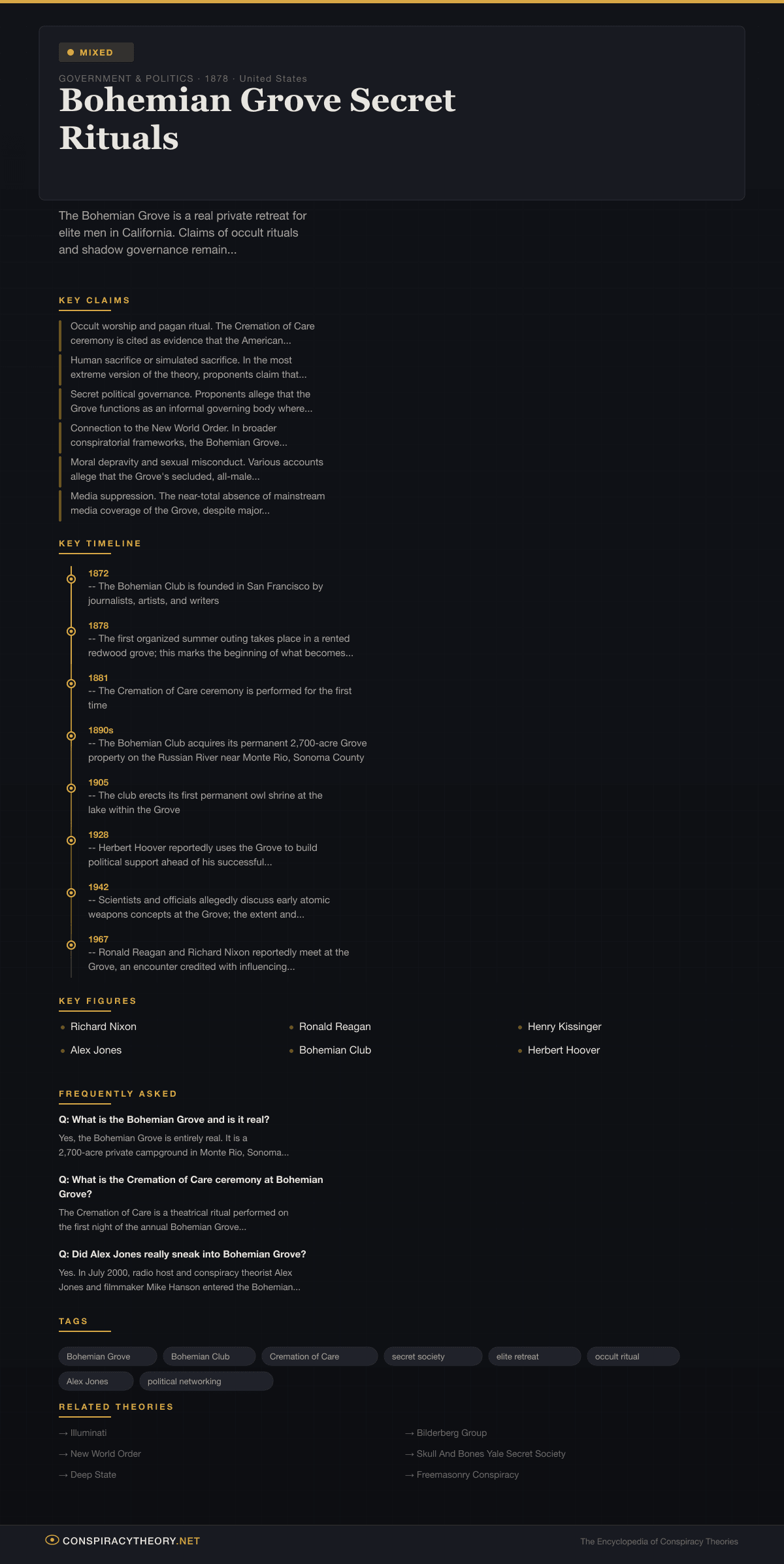
Bohemian Grove Secret Rituals

Overview
The Bohemian Grove is a 2,700-acre privately owned campground located in a redwood forest near Monte Rio in Sonoma County, California. It is the site of an annual two-to-three-week summer retreat hosted by the Bohemian Club, an exclusive men’s social club founded in San Francisco in 1872. The encampment, held every July, draws approximately 2,500 members and guests from the highest levels of American political, business, military, and cultural life. Past attendees have included every Republican U.S. president since Calvin Coolidge, along with numerous Democratic officials, corporate executives, media figures, university presidents, and military leaders.
The Grove has been the subject of persistent conspiracy theories since at least the mid-twentieth century. These theories center on the Cremation of Care, a theatrical ritual performed on the first evening of the encampment, in which robed figures burn an effigy before a 40-foot owl statue. Conspiracy theorists claim the ceremony constitutes genuine occult worship, that the Grove serves as a venue for secret political deal-making beyond democratic accountability, and that the gathering is evidence of a ruling cabal that controls the United States and, in some versions, the world.
The theory’s status is classified as mixed. The factual foundation is solid: the Bohemian Grove exists, the retreat is real, extremely powerful people attend, the Cremation of Care ceremony takes place, and significant political relationships have been forged at the encampment. However, the more expansive claims --- that the ceremony involves actual pagan or satanic worship, that binding policy decisions are made in the Grove, or that the retreat constitutes proof of a shadowy global elite --- remain unsubstantiated by credible evidence.
Origins & History
The Founding of the Bohemian Club (1872)
The Bohemian Club was founded on April 6, 1872, by a group of journalists, writers, musicians, and artists in San Francisco. The club’s original purpose was to provide a social gathering place for men engaged in creative and intellectual pursuits. Its name reflected the “bohemian” literary and artistic sensibility of its founders, who included journalists from the San Francisco Chronicle and other local newspapers.
In its early years, the club was largely composed of working artists and writers. However, by the 1880s and 1890s, wealthy businessmen began joining in increasing numbers, attracted by the club’s cultural cachet and social networking opportunities. Over time, the membership shifted decisively toward the affluent and powerful, though the club has maintained a tradition of including artists, musicians, and academics alongside its political and corporate members.
The club’s motto is “Weaving Spiders Come Not Here,” a line adapted from Shakespeare’s A Midsummer Night’s Dream. It is intended to signal that business dealings and political negotiations should be left outside the clubhouse and the Grove. Whether this injunction is honored in practice is one of the central questions in the conspiracy literature.
The Grove and the Summer Encampment
The Bohemian Club acquired its current Grove property on the Russian River in the 1890s and began holding organized summer retreats there shortly afterward. The encampment evolved over the early twentieth century into its current form: a multi-week gathering in which attendees stay in rustic “camps” (approximately 120 named camps are scattered through the redwood forest, each housing 10 to 30 members), attend lectures and performances known as “Lakeside Talks,” participate in musical and theatrical productions, and socialize in a secluded, all-male environment.
The Lakeside Talks are a particularly notable feature of the encampment. These are formal presentations given by prominent figures on topics of current significance. Past speakers have addressed subjects ranging from nuclear weapons policy to international trade to space exploration. The talks are delivered informally and off the record, which proponents of the conspiracy theory view as evidence of covert policy coordination.
The Cremation of Care
The Cremation of Care ceremony dates to 1881 and has been performed annually (with rare exceptions) ever since. The ceremony takes place on the first Saturday evening of the encampment at an area called the Owl Shrine, dominated by a large concrete owl statue on the shore of a man-made lake. The ceremony involves the following elements:
- A procession of participants in hooded robes carrying torches
- Orchestral and choral music, much of it composed specifically for the ceremony
- A scripted dramatic dialogue, often involving a “High Priest” figure and a voice attributed to the owl
- The placement of an effigy called “Care” (or “Dull Care”) into a coffin
- The ceremonial burning of the effigy
Club members describe the ritual as a symbolic act of liberation, in which participants are encouraged to release their everyday professional worries and enjoy the fellowship of the retreat. The ceremony draws on theatrical traditions common in nineteenth-century American fraternal organizations, many of which employed elaborate ritual performances involving costumes, props, and allegorical narratives.
Political Significance
The Bohemian Grove’s political significance is not merely a matter of conspiracy theory. Several well-documented events underscore the retreat’s role as a site of elite networking:
- Herbert Hoover reportedly laid the groundwork for his 1928 presidential campaign at the Grove, where he cultivated relationships with influential Republicans.
- In a 1971 recorded conversation (part of the Nixon White House tapes), President Richard Nixon described the Grove as “the most faggy goddamned thing you could ever imagine,” while also acknowledging the political networking that took place there.
- Ronald Reagan and Richard Nixon are reported to have met at the Grove in 1967, an encounter some historians credit with helping to shape the direction of Republican politics in the following decade.
- The Manhattan Project is sometimes linked to the Grove, as physicist Edward Teller reportedly discussed early nuclear weapons concepts with other scientists and officials at the 1942 encampment, though the extent of these discussions remains debated.
Key Claims
Conspiracy theories about the Bohemian Grove span a wide spectrum, from modest allegations of insider political networking to extreme claims of satanic worship. The most commonly circulated assertions include:
-
Occult worship and pagan ritual. The Cremation of Care ceremony is cited as evidence that the American elite secretly practice pagan, druidic, or satanic religion. Proponents point to the owl statue (which some identify with the ancient Canaanite deity Moloch or the Mesopotamian goddess Lilith), the fire ritual, the hooded robes, and the quasi-liturgical scripted dialogue as proof that the ceremony is a genuine act of worship rather than a theatrical tradition.
-
Human sacrifice or simulated sacrifice. In the most extreme version of the theory, proponents claim that the effigy burned in the Cremation of Care represents --- or in some tellings, actually involves --- a human sacrifice. Alex Jones, after infiltrating the Grove in 2000, described the ceremony as a “mock human sacrifice” and suggested it reflected the attendees’ actual beliefs and desires. No credible evidence of real human sacrifice has ever been produced.
-
Secret political governance. Proponents allege that the Grove functions as an informal governing body where U.S. presidents are selected, wars are planned, and major policy decisions are made outside the democratic process. The concentration of political leaders, military officials, and corporate executives at the retreat is cited as evidence that the encampment is more than a social gathering.
-
Connection to the New World Order. In broader conspiratorial frameworks, the Bohemian Grove is identified as one node in a network of elite institutions --- including the Bilderberg Group, the Council on Foreign Relations, the Trilateral Commission, and Skull and Bones --- that collectively constitute a secret ruling class pursuing global governance.
-
Moral depravity and sexual misconduct. Various accounts allege that the Grove’s secluded, all-male environment facilitates illicit behavior, including heavy alcohol consumption, public nudity, and the procurement of sex workers. Some of these claims have been partially corroborated by firsthand accounts from employees and trespassers, while others appear to be embellishments or conflations.
-
Media suppression. The near-total absence of mainstream media coverage of the Grove, despite major media executives being members of the Bohemian Club, is interpreted as evidence of coordinated media suppression comparable to allegations about Bilderberg Group coverage.
Evidence & Debunking
What Supports Concern
Several verifiable facts provide a legitimate basis for scrutiny of the Bohemian Grove:
-
The retreat is real and elite. The existence of the Grove, the encampment, and the Cremation of Care ceremony are not in dispute. The membership roster of the Bohemian Club includes former presidents, secretaries of state, defense secretaries, Supreme Court justices, Federal Reserve chairmen, and leaders of Fortune 500 companies. This is one of the most concentrated gatherings of political and economic power in the world, and it takes place in near-total secrecy.
-
The ceremony is unusual. Whatever its intended meaning, the Cremation of Care is an objectively remarkable spectacle: grown men in robes burning an effigy before a giant owl in a redwood forest at night, accompanied by scripted incantations. It is understandable that this imagery, when encountered without context, would generate alarm or suspicion.
-
Political networking occurs. Despite the club’s motto discouraging business talk, multiple firsthand accounts confirm that political discussions and relationship-building take place at the Grove. The Reagan-Nixon meeting and the reported Manhattan Project discussions are the most commonly cited examples. Sociologist G. William Domhoff, who conducted the most thorough academic study of the Bohemian Grove, concluded that the retreat serves important social bonding functions for the American upper class, even if it is not a site of formal policy-making.
-
Secrecy invites suspicion. The Bohemian Club’s aggressive efforts to maintain privacy --- including legal action against trespassers, restrictions on photography, and nondisclosure expectations for members --- naturally generate speculation about what is being hidden.
-
The Nixon tape is on the record. Nixon’s candid recorded comments about the Grove confirm that even insiders viewed it as politically significant and socially peculiar.
What Undermines the Conspiracy Narrative
-
The ceremony has a documented history. The Cremation of Care traces back to 1881 and evolved from theatrical traditions common among nineteenth-century American men’s clubs and fraternal orders. It is well within the conventions of organizations like the Masons, the Odd Fellows, and the Knights of Pythias, which all employed elaborate costumed rituals with allegorical themes. Placing the ceremony in this historical context significantly diminishes the argument that it constitutes genuine occult worship.
-
No evidence of human sacrifice. The claim that the Cremation of Care involves real or symbolic human sacrifice is not supported by any credible evidence. Multiple eyewitness accounts, including the footage obtained by Alex Jones, show the burning of a constructed effigy. No law enforcement investigation has ever produced evidence of criminal activity related to the ceremony.
-
The owl is not Moloch. The identification of the owl statue with the ancient deity Moloch is historically inaccurate. Moloch is associated in ancient texts with a bull or calf, not an owl. The owl is the traditional symbol of the Bohemian Club, chosen because of its association with wisdom and the nighttime hours favored by the club’s founding artists and writers.
-
Informal networking is not secret governance. The fact that powerful people socialize and discuss ideas at the Grove does not establish that binding decisions are made there. Powerful people network at many venues --- country clubs, corporate retreats, charity galas, and university reunions. Domhoff’s research concluded that the Grove facilitates class cohesion and social bonding but found no evidence of formal policy-making or decision-taking.
-
Thousands of attendees, no whistleblowers. Over more than a century, tens of thousands of men have attended the encampment. No credible insider has come forward with evidence of occult practices, criminal behavior, or organized conspiratorial decision-making. Given the number of people involved, the absence of such testimony is significant.
-
Jones’s footage supports the mundane interpretation. Ironically, the Alex Jones footage, intended to expose sinister rituals, largely confirmed the descriptions provided by journalists and academics who had previously studied the Grove. The ceremony is theatrical, scripted, and performed in the style of a campfire pageant, albeit an extraordinarily elaborate one.
Cultural Impact
Conspiracy Culture
The Bohemian Grove occupies a prominent place in the American conspiracy theory landscape. It functions as what researchers call a “bridging theory” --- a conspiracy claim grounded in verifiable facts (the retreat, the membership, the ceremony) that serves as an entry point into broader, more speculative conspiratorial frameworks about secret societies, the New World Order, and occult elite governance.
The Grove’s visual imagery --- the owl, the robes, the fire --- is particularly potent in conspiracy culture because it provides concrete, dramatic visual evidence that appears to confirm claims about elite ritualism. Screenshots and clips from Jones’s footage are among the most widely circulated images in conspiracy media.
Alex Jones and the 2000 Infiltration
Alex Jones’s July 2000 infiltration of the Bohemian Grove was a watershed moment for both the conspiracy theory and for Jones’s career. The resulting documentary, Dark Secrets: Inside Bohemian Grove, was one of the earliest viral conspiracy videos of the internet age. It provided Jones with credibility among conspiracy audiences and established the Bohemian Grove as a permanent fixture in his media programming. Jones has described the event as one of the defining moments of his career, and references to the Grove remain a staple of his broadcasts.
The footage gave tangible visual form to what had previously been an obscure theory discussed mainly in fringe publications. After Jones’s documentary circulated, the Bohemian Grove became a mainstream reference point in conspiracy discussions, appearing in online forums, social media posts, and popular culture.
Academic Study
The most significant academic treatment of the Bohemian Grove is sociologist G. William Domhoff’s The Bohemian Grove and Other Retreats: A Study in Ruling-Class Cohesiveness (1974). Domhoff approached the Grove from the perspective of power structure research, not conspiracy theory. He argued that the retreat serves as a social bonding mechanism for the American upper class, reinforcing shared identity and mutual trust among elites who then interact in professional and political contexts. His work is frequently cited by both supporters and critics of the conspiracy theory, though he himself rejected the occult and secret-governance interpretations.
Journalist Philip Weiss published a detailed account of his own unauthorized visit to the Grove in a November 1989 article for Spy magazine titled “Inside Bohemian Grove.” Weiss described a scene of heavy drinking, casual nudity, sophomoric humor, and political conversation, but nothing resembling occult ritual or conspiratorial planning.
Popular Culture
The Bohemian Grove has been referenced in numerous films, television shows, novels, and video games. It features prominently in conspiracy-themed documentaries and has appeared in fictional form in television programs dealing with secret societies and elite power. The owl symbol associated with the Grove has become a widely recognized icon in conspiracy culture, often used as shorthand for the alleged occult practices of the ruling class.
Timeline
- 1872 --- The Bohemian Club is founded in San Francisco by journalists, artists, and writers
- 1878 --- The first organized summer outing takes place in a rented redwood grove; this marks the beginning of what becomes the annual encampment
- 1881 --- The Cremation of Care ceremony is performed for the first time
- 1890s --- The Bohemian Club acquires its permanent 2,700-acre Grove property on the Russian River near Monte Rio, Sonoma County
- 1905 --- The club erects its first permanent owl shrine at the lake within the Grove
- 1928 --- Herbert Hoover reportedly uses the Grove to build political support ahead of his successful presidential campaign
- 1942 --- Scientists and officials allegedly discuss early atomic weapons concepts at the Grove; the extent and significance of these discussions remains debated
- 1967 --- Ronald Reagan and Richard Nixon reportedly meet at the Grove, an encounter credited with influencing Republican politics
- 1971 --- President Nixon, captured on White House tapes, makes candid remarks about the Grove, confirming its political and social character
- 1974 --- G. William Domhoff publishes The Bohemian Grove and Other Retreats, the first major academic study of the retreat
- 1989 --- Philip Weiss publishes “Inside Bohemian Grove” in Spy magazine, providing a detailed firsthand journalistic account
- 2000, July --- Alex Jones and Mike Hanson infiltrate the Grove and film the Cremation of Care ceremony; Jones releases the documentary Dark Secrets: Inside Bohemian Grove
- 2004 --- Jones releases a follow-up documentary, The Order of Death, expanding on his Bohemian Grove claims
- 2010s --- The Bohemian Grove becomes a mainstream topic in conspiracy culture, driven by social media sharing of Jones’s footage and discussion on platforms such as YouTube and Reddit
- 2018 --- Renewed public interest following increased scrutiny of elite social networks in the wake of the Jeffrey Epstein case
- 2020s --- The Grove continues to host annual encampments; conspiracy theories about the retreat remain widely circulated in online communities
Sources & Further Reading
- Domhoff, G. William. The Bohemian Grove and Other Retreats: A Study in Ruling-Class Cohesiveness. Harper & Row, 1974. (The foundational academic study of the Grove as a site of upper-class social bonding.)
- Weiss, Philip. “Inside Bohemian Grove.” Spy magazine, November 1989. (A firsthand journalistic account of an unauthorized visit to the encampment.)
- Jones, Alex. Dark Secrets: Inside Bohemian Grove. Documentary film, 2000. (Footage of the Cremation of Care ceremony recorded during Jones’s infiltration.)
- Phillips, Peter. “A Relative Advantage: Sociology of the San Francisco Bohemian Club.” Ph.D. dissertation, University of California, Davis, 1994. (An academic sociological study of the Bohemian Club’s membership and social functions.)
- Dunning, Brian. “Bohemian Grove.” Skeptoid podcast, episode 530, 2016. (A skeptical analysis of the conspiracy claims surrounding the Grove.)
- Van der Zee, John. The Greatest Men’s Party on Earth: Inside the Bohemian Grove. Harcourt Brace Jovanovich, 1974. (An early journalistic account of the retreat and its social dynamics.)
- Nixon, Richard. White House tape recordings, 1971. (Includes candid presidential remarks about the Bohemian Grove.)
- Domhoff, G. William. “Social Cohesion and the Bohemian Grove: The Power Elite at Summer Camp.” Who Rules America? website, University of California, Santa Cruz. (An updated summary of Domhoff’s research on the Grove.)
- Ronson, Jon. Them: Adventures with Extremists. Simon & Schuster, 2001. (Includes sections on the Bohemian Grove as part of a broader investigation into conspiracy culture.)

Watch: Documentaries & Videos
Related documentaries available on YouTube.
Dark Secrets Inside Bohemian Grove
Frequently Asked Questions
What is the Bohemian Grove and is it real?
What is the Cremation of Care ceremony at Bohemian Grove?
Did Alex Jones really sneak into Bohemian Grove?

Infographic
Share this visual summary. Right-click to save.