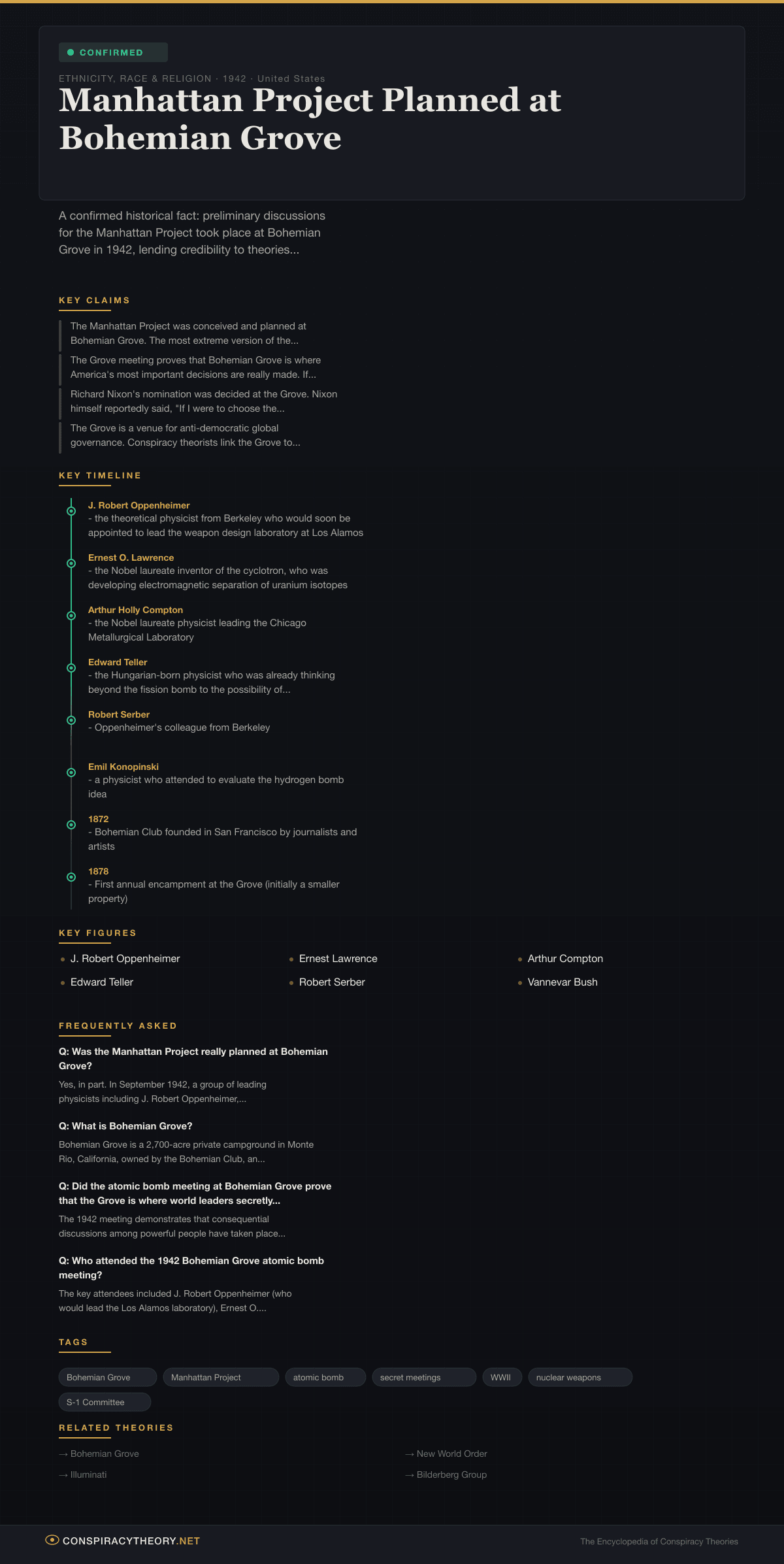
Manhattan Project Planned at Bohemian Grove
Overview
In the summer of 1942, in a redwood grove on the Russian River in Sonoma County, California, a handful of physicists gathered to discuss whether it was possible to build a weapon that could destroy a city.
The setting was Bohemian Grove, the exclusive private retreat of the Bohemian Club of San Francisco. The physicists — J. Robert Oppenheimer, Ernest Lawrence, Arthur Compton, Edward Teller, Robert Serber, and Emil Konopinski — were meeting under the auspices of the S-1 Committee, the federal body coordinating America’s secret nuclear weapons research. Over several days, amid the towering old-growth redwoods, amid the cocktail parties and theatrical performances and the famous “Cremation of Care” ceremony, these men laid the theoretical groundwork for what would become the Manhattan Project.
This is not a conspiracy theory. It is a documented historical fact, confirmed by the participants themselves in memoirs, interviews, and official histories. And that is precisely what makes it so interesting — and so useful to conspiracy theorists.
The Bohemian Grove atomic bomb meeting is a case study in how a verified event becomes the cornerstone of unverified claims. The fact that preliminary planning for the most destructive weapon in human history occurred at a secretive private retreat for the American elite has been cited for decades as proof that Bohemian Grove is not merely a summer camp for rich men, but a venue where the world’s most consequential decisions are made beyond democratic oversight. The logic runs: if they planned the atomic bomb there, what else have they planned?
It is a fair question. The answer, however, is more mundane than the conspiracy theories suggest.
Origins & History
The Bohemian Club and Its Grove
The Bohemian Club was founded in San Francisco in 1872 by journalists, artists, and musicians — bohemians in the cultural sense. Within decades, however, the club’s membership shifted to include the city’s business and political elite, who were drawn by the social cachet and the artistic programming. By the early twentieth century, the Bohemian Club was one of the most exclusive private clubs in the United States, and its annual summer encampment at the Grove — a 2,700-acre property on the Russian River — had become a premier gathering of American power.
The Grove encampment, held each July for approximately two weeks, brings together some 2,500 members and guests. The membership list reads like a who’s who of American establishment power: presidents (both Roosevelts, Eisenhower, Nixon, Reagan, both Bushes), cabinet secretaries, Supreme Court justices, Fortune 500 CEOs, university presidents, military leaders, and prominent figures in media and the arts. Henry Kissinger has attended. So has Colin Powell. So has every Republican president since Coolidge (and several Democrats).
The encampment features “Lakeside Talks” — informal lectures on policy topics given by prominent figures — as well as theatrical performances, concerts, and heavy drinking. Members camp in themed camps with names like “Mandalay,” “Stowaway,” and “Cave Man.” The most famous ritual is the “Cremation of Care,” an opening ceremony in which a mock human sacrifice is performed before a 40-foot concrete owl statue, symbolizing the casting off of worldly concerns for the duration of the encampment.
The combination of extreme secrecy, extraordinary concentration of power, and ritualistic ceremony involving a giant owl and a mock sacrifice has made Bohemian Grove one of the most fertile conspiracy theory venues in America. The 1942 atomic bomb meeting is the factual hook on which many of these theories hang.
The S-1 Committee and the Road to the Bomb
To understand why physicists were discussing nuclear weapons at a private retreat in Sonoma County, it is necessary to understand the bureaucratic and scientific context of 1942.
The possibility of a nuclear chain reaction had been understood since 1938, when German scientists Otto Hahn and Fritz Strassmann achieved nuclear fission. In August 1939, Albert Einstein and Leo Szilard sent their famous letter to President Roosevelt warning that Nazi Germany might develop an atomic bomb and urging the United States to begin its own research program.
Roosevelt responded by creating the Advisory Committee on Uranium, which evolved through several reorganizations into the S-1 Committee of the Office of Scientific Research and Development, headed by Vannevar Bush and James Conant. By early 1942, the S-1 Committee had funded research at several universities, including Ernest Lawrence’s Radiation Laboratory at Berkeley, Arthur Compton’s Metallurgical Laboratory at the University of Chicago, and Harold Urey’s laboratory at Columbia.
The critical question in mid-1942 was how to enrich uranium — that is, how to separate the fissile isotope uranium-235 from the far more abundant uranium-238. Several methods were being pursued in parallel: electromagnetic separation (Lawrence’s approach, using calutrons), gaseous diffusion (the approach favored at Columbia), centrifuge separation, and plutonium production through nuclear reactors (Compton’s approach in Chicago). Each method was enormously expensive and technically uncertain. The United States needed to decide which approaches to pursue at industrial scale.
The Grove Meeting
Ernest Lawrence was a member of the Bohemian Club. In September 1942, during or near the annual encampment, Lawrence hosted a meeting at the Grove that brought together key figures in the bomb project. The attendees included:
- J. Robert Oppenheimer — the theoretical physicist from Berkeley who would soon be appointed to lead the weapon design laboratory at Los Alamos
- Ernest O. Lawrence — the Nobel laureate inventor of the cyclotron, who was developing electromagnetic separation of uranium isotopes
- Arthur Holly Compton — the Nobel laureate physicist leading the Chicago Metallurgical Laboratory
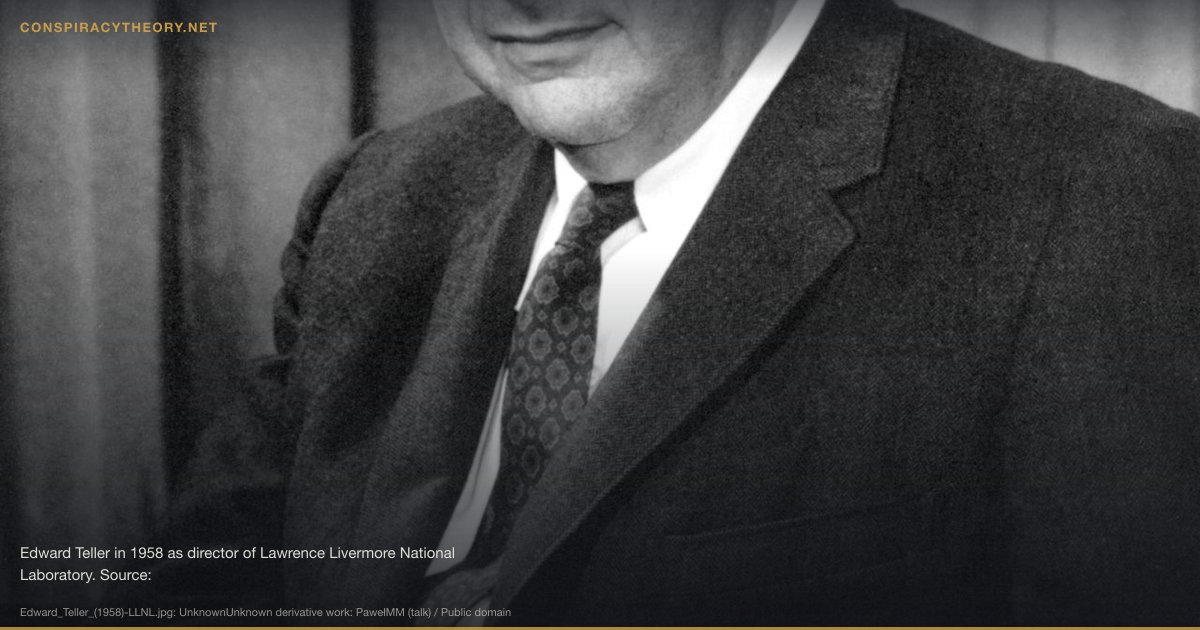
- Edward Teller — the Hungarian-born physicist who was already thinking beyond the fission bomb to the possibility of a thermonuclear (hydrogen) weapon
- Robert Serber — Oppenheimer’s colleague from Berkeley
- Emil Konopinski — a physicist who attended to evaluate the hydrogen bomb idea
The meeting covered two main topics. First, the practical question of how to produce enough fissile material for a bomb, including comparisons of the various enrichment methods being developed. Second — and more dramatically — the theoretical possibility of a “Super,” a thermonuclear weapon using the fission bomb as a trigger to ignite a fusion reaction.
It was at this meeting that Teller raised a chilling question: could a nuclear detonation ignite the nitrogen in Earth’s atmosphere, effectively setting the planet on fire? Konopinski was assigned to evaluate this possibility and eventually concluded that it was not a realistic risk — but for a period, the physicists at Bohemian Grove seriously discussed whether the weapon they were designing could accidentally destroy all life on Earth.
Arthur Compton later wrote about the meeting in his memoir Atomic Quest (1956), confirming the Grove as the location and describing the discussions in detail. He noted the odd juxtaposition of discussing planetary annihilation in a setting of redwood trees and summer leisure.
From the Grove to Los Alamos
The Bohemian Grove meeting was an important step in the development of the Manhattan Project, but it was not the sole or even primary decision-making event. The formal establishment of the Manhattan Engineer District under Brigadier General Leslie Groves occurred in August 1942, before the Grove meeting. The decision to pursue multiple enrichment methods simultaneously had already been made at the governmental level. Oppenheimer’s appointment to lead the weapons laboratory at Los Alamos was made by Groves in October 1942, after the Grove meeting but based on a longer process of evaluation.
What the Grove meeting provided was an opportunity for the key scientific leaders to discuss technical questions in an informal, private setting — the same function the Grove serves in other policy areas. It was not a case of shadowy elites making decisions that properly belonged to democratic institutions. The decisions about the Manhattan Project were made through a combination of scientific advisory bodies (the S-1 Committee, the National Academy of Sciences), military command (Groves, the Army Corps of Engineers), and presidential authority (Roosevelt’s authorization of the project).
Key Claims
-
The Manhattan Project was conceived and planned at Bohemian Grove. The most extreme version of the claim holds that the decision to build the atomic bomb was made at the Grove by a cabal of scientists and power brokers operating outside governmental oversight. Status: Overstated. Important technical discussions occurred at the Grove, but the decision to build the bomb was made through governmental channels, and the Grove meeting was one event in a longer process.
-
The Grove meeting proves that Bohemian Grove is where America’s most important decisions are really made. If the atomic bomb was discussed there, so are wars, financial policy, and political appointments. Status: Unverified. The atomic bomb meeting is documented; other alleged policy decisions at the Grove are matters of speculation, though informal influence among powerful attendees is certainly plausible.
-
Richard Nixon’s nomination was decided at the Grove. Nixon himself reportedly said, “If I were to choose the speech that gave me more attention in my career, it would be the Lakeside Talk at the Bohemian Grove in 1967.” Some interpret this as evidence that his 1968 presidential nomination was effectively decided at the Grove. Status: Mixed. Nixon’s Lakeside Talk was a significant moment in his political comeback, but the nomination was decided by Republican primary voters and convention delegates.
-
The Grove is a venue for anti-democratic global governance. Conspiracy theorists link the Grove to the New World Order, the Illuminati, and the Bilderberg Group as part of a network of elite venues where a shadow government operates. Status: Unverified. The Grove is unquestionably a venue where powerful people network and discuss policy informally, but evidence of coordinated, anti-democratic governance is lacking.
Evidence
Confirmed Facts
The 1942 Bohemian Grove meeting is documented in multiple primary sources:
- Arthur Compton’s memoir Atomic Quest (1956) describes the meeting in detail, including the location, attendees, and topics discussed.
- Edward Teller’s memoirs reference the meeting and the discussion of atmospheric ignition risk.
- Robert Serber’s The Los Alamos Primer and later memoir Peace & War confirm his attendance.
- Official histories of the Manhattan Project, including Richard Rhodes’s Pulitzer Prize-winning The Making of the Atomic Bomb (1986), document the Grove meeting as part of the project’s development.
The Bohemian Club’s role as a gathering place for American elites is also well documented. Membership lists, press coverage, and accounts from members and guests confirm the club’s extraordinary concentration of power and influence.
Herbert Hoover, a longtime Bohemian Club member, was a central figure at the Grove for decades. Dwight Eisenhower attended as a guest. Ronald Reagan and Richard Nixon were both members. The journalist Philip Weiss infiltrated the 1989 encampment for Spy magazine, providing a detailed eyewitness account of the social dynamics and activities.
In 2000, Alex Jones secretly filmed portions of the Cremation of Care ceremony, releasing the footage and claiming it depicted an occult ritual. The footage showed robed figures conducting the ceremony before the owl statue, which Jones interpreted as evidence of pagan worship or worse. Members and scholars described the ceremony as theatrical pageantry — a tradition dating to the club’s bohemian roots — rather than a genuine ritual.
What Is Not Confirmed
There is no documented evidence that specific wars, coups, financial policies, or political appointments have been decided at Bohemian Grove. While it is virtually certain that influential conversations occur during the encampment — that is the entire point of networking among powerful people — the leap from “influential people talk informally” to “a shadow government makes binding decisions” is not supported by evidence.
The conspiracy theories that link the Grove to the New World Order, Satanic rituals, or coordinated global governance rely on the same logic as many other elite-conspiracy theories: the fact that powerful people gather in private is treated as sufficient evidence that they are plotting against the public interest. The 1942 atomic bomb meeting is then cited as the proof that such plotting produces real-world results.
Debunking / Verification
This theory is classified as confirmed — the 1942 meeting at Bohemian Grove where Manhattan Project scientists discussed atomic weapons is a documented historical fact, not a conspiracy theory.
However, the implications drawn from this fact by conspiracy theorists are largely unverified. The confirmed event does not demonstrate that:
- All major American policy decisions are made at the Grove
- The Grove functions as a shadow government
- The Cremation of Care ceremony is a genuine occult ritual
- The Grove is part of a New World Order or Illuminati network
The Manhattan Project meeting demonstrates that Bohemian Grove serves as a venue where powerful people discuss consequential matters informally. This is neither surprising nor sinister in itself — similar conversations occur at Davos, at the Aspen Ideas Festival, at private dinners in Washington and New York, and in corporate boardrooms. The question of whether such informal elite networking undermines democratic governance is a legitimate one, but it is a question of political theory and institutional design, not evidence of a conspiracy.
Cultural Impact
The Bohemian Grove has occupied a unique position in American conspiracy culture since at least the 1970s, when its existence became more widely known outside Northern California’s elite circles. The Manhattan Project connection has been particularly important in establishing the Grove’s credibility as a venue of genuine consequence — without it, the Grove might be dismissed as nothing more than an exclusive summer camp.
Alex Jones’s 2000 infiltration of the Grove, and his subsequent documentary Dark Secrets: Inside Bohemian Grove, brought the location to a mass audience for the first time. Jones presented the Cremation of Care ceremony as evidence of Satanic or occult practices among the global elite. The footage became one of the foundational documents of the modern conspiracy theory movement, viewed millions of times online and referenced in countless subsequent conspiracy narratives.
The Grove has become a fixture in popular conspiracy culture, referenced in television shows (The Simpsons, Futurama), novels, and online forums. It occupies a position alongside the Bilderberg Group, the Trilateral Commission, and the Council on Foreign Relations as alleged nodes in a network of elite power that operates beyond democratic accountability.
The Manhattan Project connection gives these conspiracy theories a factual anchor that most similar claims lack. When a conspiracy theorist says “they planned the atomic bomb at Bohemian Grove,” that statement is essentially true — and it makes subsequent, unverified claims about the Grove seem more plausible by association. This rhetorical technique — establishing credibility through verified facts before introducing unverified claims — is a common feature of conspiracy discourse.
Timeline
- 1872 — Bohemian Club founded in San Francisco by journalists and artists
- 1878 — First annual encampment at the Grove (initially a smaller property)
- 1899 — Club acquires the current 2,700-acre Grove property on the Russian River
- August 1939 — Einstein-Szilard letter to Roosevelt warns of atomic bomb possibility
- June 1942 — S-1 Committee reorganized under the Office of Scientific Research and Development
- August 1942 — Manhattan Engineer District formally established under the Army Corps of Engineers
- September 1942 — Key physicists meet at Bohemian Grove to discuss uranium enrichment and the hydrogen bomb
- October 1942 — Oppenheimer appointed to lead the Los Alamos laboratory
- July 16, 1945 — Trinity test: first nuclear detonation at Alamogordo, New Mexico
- August 6 & 9, 1945 — Atomic bombs dropped on Hiroshima and Nagasaki
- 1956 — Arthur Compton publishes Atomic Quest, confirming the Grove meeting
- 1967 — Richard Nixon delivers Lakeside Talk at the Grove; later credits it as pivotal to his political comeback
- 1989 — Journalist Philip Weiss infiltrates the Grove for Spy magazine
- 2000 — Alex Jones secretly films the Cremation of Care ceremony
- 2000s-present — Bohemian Grove becomes a staple of conspiracy theory culture
Sources & Further Reading
- Compton, Arthur Holly. Atomic Quest: A Personal Narrative. Oxford University Press, 1956.
- Rhodes, Richard. The Making of the Atomic Bomb. Simon & Schuster, 1986.
- Domhoff, G. William. The Bohemian Grove and Other Retreats: A Study in Ruling-Class Cohesiveness. Harper & Row, 1974.
- Teller, Edward, with Judith Schoolery. Memoirs: A Twentieth-Century Journey in Science and Politics. Perseus Publishing, 2001.
- Weiss, Philip. “Masters of the Universe Go to Camp: Inside the Bohemian Grove.” Spy magazine, November 1989.
- Serber, Robert. Peace & War: Reminiscences of a Life on the Frontiers of Science. Columbia University Press, 1998.
- Phillips, Peter. “A Relative Advantage: Sociology of the San Francisco Bohemian Club.” Doctoral dissertation, University of California, Davis, 1994.
Related Theories
- Bohemian Grove — The broader set of conspiracy theories about the Grove
- New World Order — The theory of a secret elite planning global governance
- Illuminati — Theories about secret societies controlling world events
- Bilderberg Group — Similar conspiracy theories about elite private gatherings
Frequently Asked Questions
Was the Manhattan Project really planned at Bohemian Grove?
What is Bohemian Grove?
Did the atomic bomb meeting at Bohemian Grove prove that the Grove is where world leaders secretly make policy?
Who attended the 1942 Bohemian Grove atomic bomb meeting?
Infographic
Share this visual summary. Right-click to save.