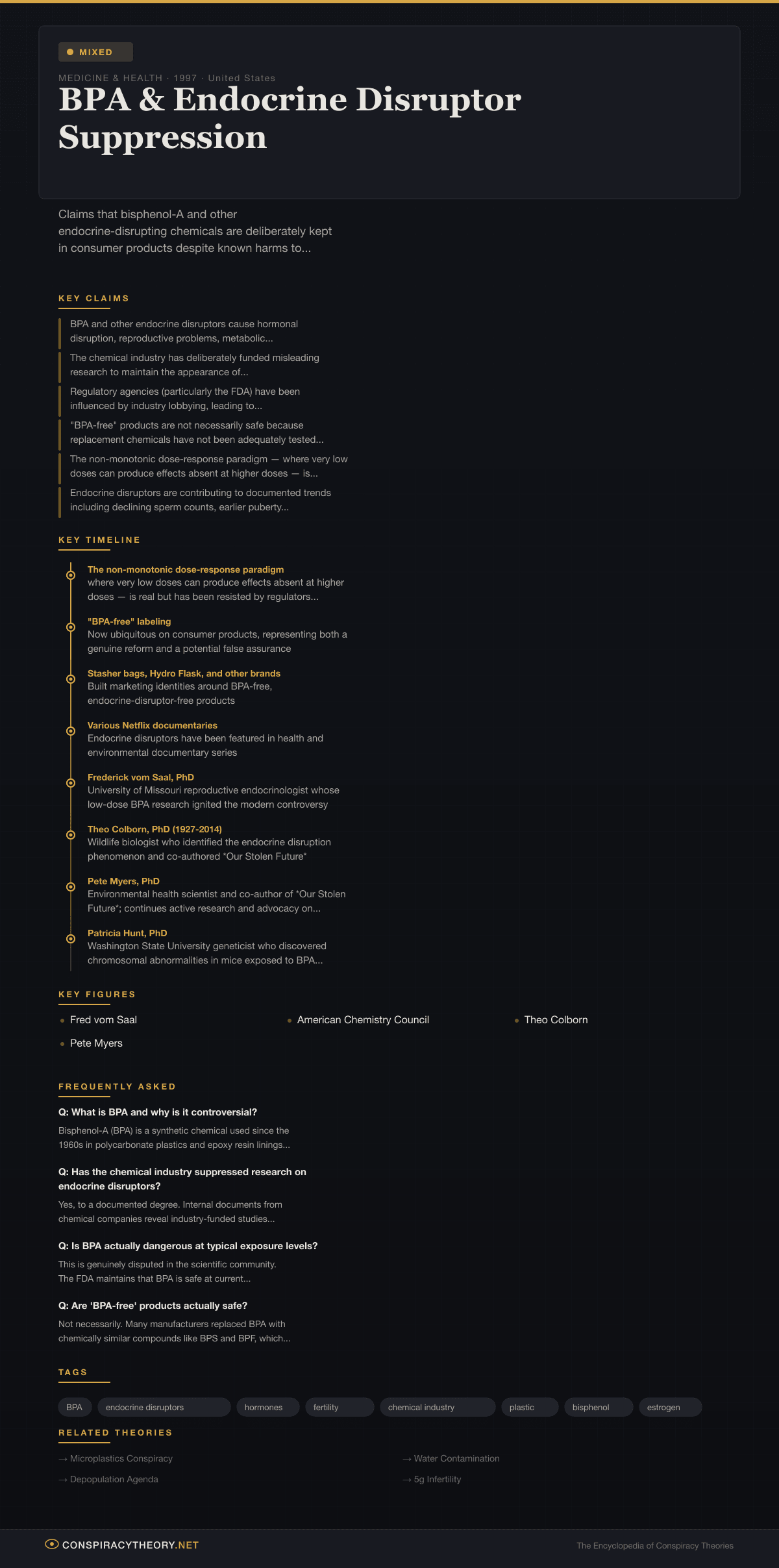
BPA & Endocrine Disruptor Suppression

Overview
In 1936, two British biochemists discovered that bisphenol-A — a synthetic compound first created in 1891 — could mimic the hormone estrogen in the body. They noted this interesting fact, filed it away, and moved on to other things. Two decades later, the chemical industry discovered that BPA was extremely useful as a building block for polycarbonate plastics and epoxy resins. It was strong, clear, heat-resistant, and cheap. By the 1960s, BPA was everywhere: in baby bottles, water bottles, food can linings, dental sealants, receipt paper, and hundreds of other consumer products. Approximately 6 million metric tons are produced annually.
The industry knew from the very beginning that BPA was an estrogen mimic. They used it anyway because it was an excellent material, because exposure levels were assumed to be too low to matter, and because the regulatory framework of the mid-twentieth century did not require companies to prove their chemicals were safe before selling them — it required regulators to prove they were dangerous after the fact.
What followed is a story that conspiracy theorists characterize as deliberate suppression and mainstream observers characterize as regulatory failure. Both descriptions contain truth. The chemical industry funded studies designed to produce favorable safety data. It lobbied to keep regulatory thresholds high. It attacked the credibility of independent researchers who published concerning findings. And when public pressure finally forced action, manufacturers replaced BPA with structurally similar chemicals (BPS, BPF) that may be equally problematic — a pattern researchers call “regrettable substitution.”
Whether this constitutes a conspiracy or merely the normal pathological behavior of a profit-driven industry dealing with inconvenient science is partly a question of semantics. What is clear is that the public was exposed to a known endocrine-active chemical for decades while the industry that profited from it worked systematically to prevent or delay regulation.
Origins & History
Early Knowledge
BPA’s estrogenic properties were known from the 1930s. British biochemists Edward Charles Dodds and Wilfrid Lawson synthesized and tested BPA as a potential synthetic estrogen for medical use. They found it was estrogenic but weak — and moved on to develop diethylstilbestrol (DES), a far more potent synthetic estrogen that would later become infamous for causing cancer and reproductive abnormalities in the children of women who took it during pregnancy.
The chemical industry’s embrace of BPA began in the 1950s when scientists discovered its usefulness as a monomer for polycarbonate plastics. The material properties were excellent. The estrogenic properties were considered irrelevant at the doses leaching from consumer products.
The vom Saal Revolution
The modern BPA controversy was ignited by Dr. Frederick vom Saal, a reproductive endocrinologist at the University of Missouri. In 1997, vom Saal published a landmark study showing that mice exposed to extremely low doses of BPA — doses comparable to human environmental exposure — showed significant reproductive effects including enlarged prostates, reduced sperm production, and early onset of puberty.
Vom Saal’s work was revolutionary and threatening to the chemical industry for two reasons:
First, it demonstrated effects at doses far below the thresholds the EPA and FDA had established as safe. Traditional toxicology assumed a linear dose-response relationship: more chemical, more effect. Vom Saal’s data suggested that BPA, like other endocrine disruptors, followed a non-monotonic dose-response curve — meaning that very low doses could produce effects that were absent at higher doses. This concept upended the entire regulatory framework for chemical safety.
Second, it directly challenged the industry’s safety assurance. If BPA caused reproductive effects at doses typical of human exposure, then every person eating canned food, every baby drinking from a polycarbonate bottle, and every cashier handling thermal receipt paper was being exposed to a biologically active chemical.
The Industry Response
The chemical industry’s response followed a playbook that had been perfected by the tobacco industry:
Funding counter-research. The American Chemistry Council (ACC) and the plastics industry funded studies designed to fail to replicate vom Saal’s findings. A 2005 analysis by vom Saal and Claude Hughes found a striking pattern: 100% of industry-funded studies found BPA safe at low doses, while more than 90% of independently funded studies found harmful effects. This “funding effect” became itself a subject of scientific study.
Attacking researchers. Scientists who published unfavorable BPA findings reported professional retaliation — difficulty obtaining funding, hostile peer reviews, and public attacks on their credibility. Vom Saal, Patricia Hunt (who discovered chromosomal abnormalities in mice exposed to BPA from damaged cages), and others described sustained industry pressure.
Lobbying regulators. The ACC lobbied the FDA and EPA to maintain existing safety thresholds, arguing that the agency’s existing risk assessments were sound and that low-dose studies were methodologically flawed.
“BPA-free” as marketing strategy. When public pressure made BPA untenable in certain products — particularly baby bottles — the industry pivoted to marketing “BPA-free” products. But the replacement chemicals (BPS, BPF, BPAF) were structurally similar and largely untested. Emerging research suggests many of these substitutes have similar endocrine-disrupting properties.
The Regulatory Divergence
The BPA story has produced a remarkable divergence between US and European regulatory approaches:
The FDA has maintained that BPA is safe at current exposure levels, though it banned BPA from baby bottles and sippy cups in 2012 (after manufacturers had already voluntarily removed it). The FDA’s position is based on its own studies using traditional dose-response models.
The European Food Safety Authority (EFSA) dramatically lowered its tolerable daily intake for BPA in 2023 — by a factor of 20,000 — to 0.2 nanograms per kilogram of body weight per day. This threshold is so low that virtually all current exposure levels exceed it.
France banned BPA from all food packaging in 2015, the most aggressive national regulation to date.
The Endocrine Society, representing over 18,000 endocrinologists, has issued multiple statements declaring that endocrine disruptors including BPA pose a significant public health threat at current exposure levels.
Key Claims
- BPA and other endocrine disruptors cause hormonal disruption, reproductive problems, metabolic disorders, and developmental abnormalities at doses currently considered safe by US regulators
- The chemical industry has deliberately funded misleading research to maintain the appearance of scientific uncertainty about BPA’s safety
- Regulatory agencies (particularly the FDA) have been influenced by industry lobbying, leading to safety standards that are too permissive
- “BPA-free” products are not necessarily safe because replacement chemicals have not been adequately tested and may have similar properties
- The non-monotonic dose-response paradigm — where very low doses can produce effects absent at higher doses — is real but has been resisted by regulators because accepting it would require fundamental reform of chemical safety evaluation
- Endocrine disruptors are contributing to documented trends including declining sperm counts, earlier puberty onset, rising obesity rates, and increasing rates of hormonal cancers
Evidence
What Is Well-Established
BPA is an endocrine disruptor. This is not disputed by any serious scientific body. BPA binds to estrogen receptors and can influence hormonal signaling.
Human exposure is universal. The CDC’s National Health and Nutrition Examination Survey found detectable BPA levels in 93% of Americans aged six and older. BPA leaches from food can linings, polycarbonate containers, thermal receipt paper, and other sources.
Industry funding biases research outcomes. The correlation between funding source and study results — with industry-funded studies overwhelmingly finding safety and independent studies overwhelmingly finding harm — is statistically striking and has been documented in peer-reviewed analyses.
Theo Colborn’s foundational work. Wildlife biologist Theo Colborn’s 1996 book Our Stolen Future (co-authored with Dianne Dumanoski and Pete Myers) documented endocrine disruption across wildlife species and humans, drawing parallels to Rachel Carson’s Silent Spring. The book brought the endocrine disruptor concept to public and scientific attention.
The European regulatory shift is significant. EFSA’s 20,000-fold reduction in the tolerable daily intake is not the action of an organization influenced by conspiracy theory — it reflects a genuine reassessment of the scientific evidence by a conservative regulatory body.
What Is Contested
Whether current exposure levels cause health effects in humans. Animal studies strongly suggest yes. Epidemiological studies show associations but struggle with the challenge of finding unexposed control populations (since exposure is nearly universal). The FDA’s position relies on a subset of studies; EFSA’s relies on a different subset.
Whether the industry conduct constitutes a “conspiracy.” Industry lobbying, funding favorable research, and attacking critics are standard corporate behavior that occurs across sectors. Whether this rises to the level of conspiracy — implying conscious coordination to suppress known truths — or simply reflects institutional incentives is debatable.
The non-monotonic dose-response question. This is the technical heart of the debate. If BPA and other endocrine disruptors do not follow linear dose-response curves, then the entire regulatory framework for chemical safety — which assumes higher doses mean more risk — is fundamentally flawed. Endocrinologists generally accept non-monotonic response; traditional toxicologists are more skeptical.
Debunking / Verification
This theory is classified as mixed because it contains both confirmed and unsubstantiated elements:
Confirmed:
- BPA is an endocrine disruptor
- The chemical industry funded biased research and lobbied against regulation
- “BPA-free” replacement chemicals may have similar properties
- Regulatory standards vary dramatically between jurisdictions, suggesting genuine scientific uncertainty
- Human exposure is universal and measurable
Unsubstantiated:
- That the industry is deliberately maintaining BPA exposure as part of a conscious depopulation agenda
- That regulators are knowingly allowing a harmful chemical to remain in use (as opposed to being genuinely uncertain about low-dose effects)
- That the fertility decline is primarily attributable to BPA specifically (rather than the broader category of endocrine disruptors, lifestyle factors, and other environmental changes)
Medical consensus disclaimer: The safety of BPA at current exposure levels is a subject of active scientific debate. Major health organizations differ in their assessments. Individuals concerned about endocrine disruptor exposure should consult their healthcare provider and consider reducing exposure to BPA and similar chemicals as a precautionary measure.
Cultural Impact
The BPA controversy has had wide-reaching effects on consumer behavior, product design, and regulatory philosophy:
Consumer awareness of endocrine disruptors has driven a massive “BPA-free” product market — now worth billions of dollars — though the safety of replacement chemicals remains uncertain.
The concept of “regrettable substitution” — replacing a known harmful chemical with an unstudied one — has become a recognized problem in chemical safety regulation, partly because of the BPA experience.
The precautionary principle versus the innovation principle — the philosophical divide between European and American approaches to chemical safety — is perhaps best illustrated by the BPA case. Europe’s decision to dramatically lower BPA thresholds while the US maintains higher limits reflects fundamentally different approaches to uncertainty.
Shanna Swan’s Count Down (2021) brought endocrine disruptors into mainstream public discourse by connecting them to the documented decline in sperm counts. Swan’s work, while focused on the broader category of endocrine disruptors, gave new urgency to the BPA debate.
In Popular Culture
- Theo Colborn, Dianne Dumanoski, and Pete Myers, Our Stolen Future (1996) — The foundational popular science book on endocrine disruption
- Shanna Swan, Count Down (2021) — Bestselling book connecting endocrine disruptors to reproductive decline
- “BPA-free” labeling — Now ubiquitous on consumer products, representing both a genuine reform and a potential false assurance
- Stasher bags, Hydro Flask, and other brands — Built marketing identities around BPA-free, endocrine-disruptor-free products
- Various Netflix documentaries — Endocrine disruptors have been featured in health and environmental documentary series
Key Figures
- Frederick vom Saal, PhD — University of Missouri reproductive endocrinologist whose low-dose BPA research ignited the modern controversy
- Theo Colborn, PhD (1927-2014) — Wildlife biologist who identified the endocrine disruption phenomenon and co-authored Our Stolen Future
- Pete Myers, PhD — Environmental health scientist and co-author of Our Stolen Future; continues active research and advocacy on endocrine disruptors
- Patricia Hunt, PhD — Washington State University geneticist who discovered chromosomal abnormalities in mice exposed to BPA from damaged cages
- Shanna Swan, PhD — Reproductive epidemiologist whose sperm count meta-analysis and popular book Count Down brought endocrine disruptors to mainstream attention
- American Chemistry Council — Industry lobbying organization that has been the primary defender of BPA safety
Timeline
| Date | Event |
|---|---|
| 1891 | BPA first synthesized by Russian chemist Alexander Dianin |
| 1936 | Dodds and Lawson identify BPA’s estrogenic properties |
| 1950s | BPA adopted as a monomer for polycarbonate plastics; commercial production begins |
| 1960s | BPA used in food can linings, baby bottles, and other consumer products |
| 1996 | Theo Colborn publishes Our Stolen Future, bringing endocrine disruption to public attention |
| 1997 | Vom Saal publishes landmark low-dose BPA study in mice |
| 2003 | Patricia Hunt publishes chromosomal abnormality findings in BPA-exposed mice |
| 2005 | Vom Saal and Hughes document funding bias in BPA research |
| 2008 | Canada becomes first country to ban BPA in baby bottles |
| 2010 | FDA expresses “some concern” about BPA effects on fetuses, infants, and children |
| 2012 | FDA bans BPA from baby bottles and sippy cups (after manufacturers already removed it) |
| 2015 | France bans BPA from all food packaging |
| 2017 | ECHA (European Chemicals Agency) identifies BPA as a substance of very high concern |
| 2021 | Shanna Swan publishes Count Down, connecting endocrine disruptors to fertility decline |
| 2023 | EFSA lowers BPA tolerable daily intake by factor of 20,000 |
| Present | Debate continues; replacement chemical safety under increasing scrutiny |
Sources & Further Reading
- Colborn, Theo, Dianne Dumanoski, and Pete Myers. Our Stolen Future. Dutton, 1996.
- vom Saal, Frederick, and Claude Hughes. “An Extensive New Literature Concerning Low-Dose Effects of Bisphenol A Shows the Need for a New Risk Assessment.” Environmental Health Perspectives, 2005.
- Rochester, Johanna. “Bisphenol A and Human Health: A Review of the Literature.” Reproductive Toxicology, 2013.
- EFSA. “Re-evaluation of the Risks to Public Health Related to the Presence of Bisphenol A in Foodstuffs.” 2023.
- Swan, Shanna. Count Down. Scribner, 2021.
- Vandenberg, Laura, et al. “Hormones and Endocrine-Disrupting Chemicals: Low-Dose Effects and Nonmonotonic Dose Responses.” Endocrine Reviews, 2012.
- Hunt, Patricia, et al. “Bisphenol A Exposure Causes Meiotic Aneuploidy in the Female Mouse.” Current Biology, 2003.
- Michaels, David. Doubt Is Their Product: How Industry’s Assault on Science Threatens Your Health. Oxford University Press, 2008.
Related Theories
- Microplastics Conspiracy — The related concern about plastic-derived chemicals entering the human body
- Water Contamination — BPA and other endocrine disruptors have been detected in water supplies
- Depopulation Agenda — Conspiracy theorists sometimes frame endocrine disruption as deliberate population reduction
- 5G / WiFi Infertility — An alternative (and less evidence-supported) theory for the same fertility decline that endocrine disruptors may partially explain
Frequently Asked Questions
What is BPA and why is it controversial?
Has the chemical industry suppressed research on endocrine disruptors?
Is BPA actually dangerous at typical exposure levels?
Are 'BPA-free' products actually safe?

Infographic
Share this visual summary. Right-click to save.