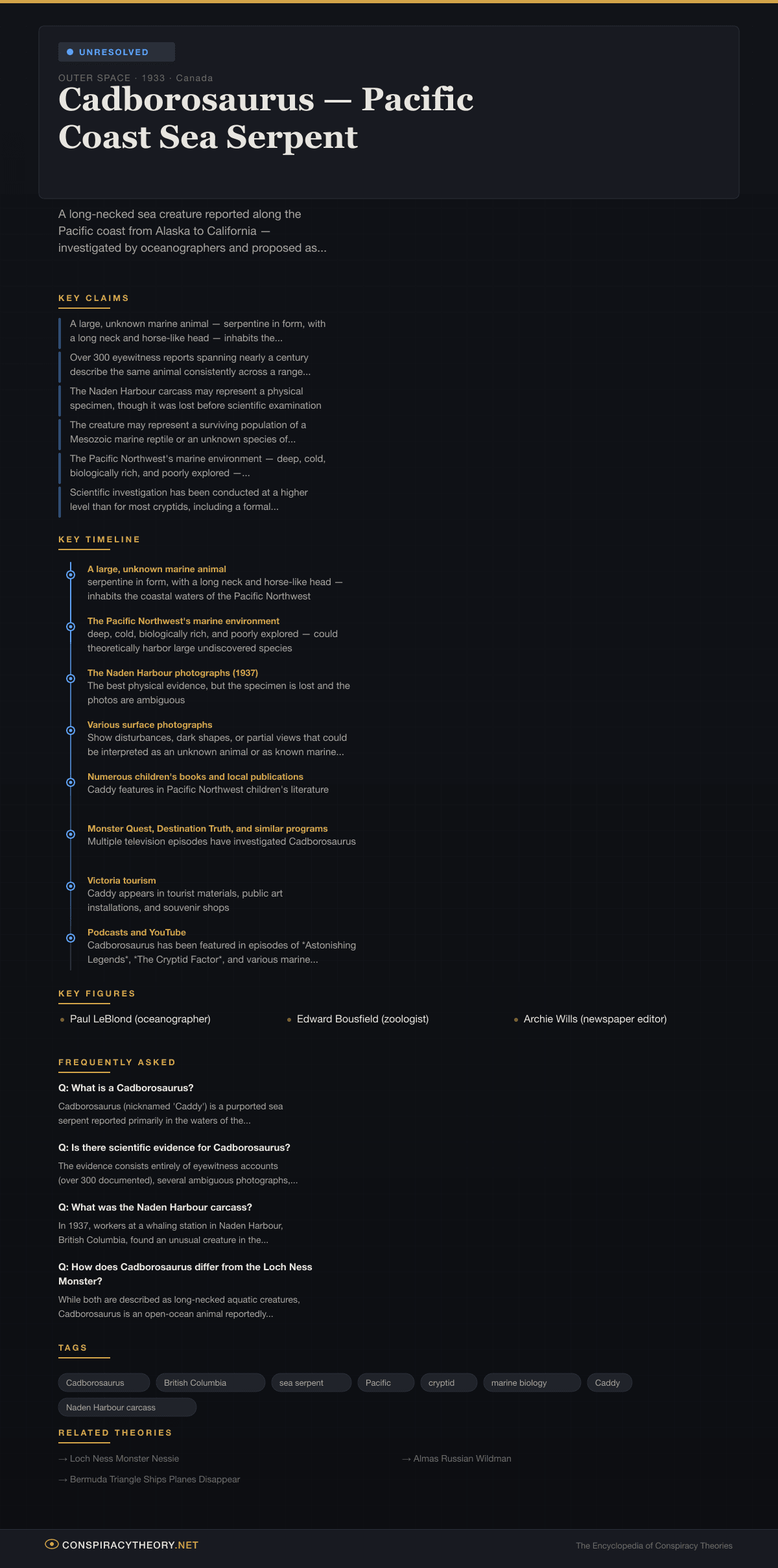
Cadborosaurus — Pacific Coast Sea Serpent

Overview
The waters off the coast of British Columbia are among the most biologically rich and least explored marine environments on Earth. The Pacific Northwest continental shelf drops into abyssal depths within miles of the shoreline. Underwater canyons, upwelling zones, and complex current patterns create a mosaic of habitats that continues to yield new species discoveries. In the last few decades, scientists have documented previously unknown deepwater octopuses, new species of whale beaked beyond anything in the textbooks, and marine communities around hydrothermal vents that rewrite the rules of biology.
It is in this context — a genuine frontier of marine discovery — that reports of Cadborosaurus willsi take on a different character than your average lake monster yarn. “Caddy,” as locals call it, is a sea creature reported along the Pacific coast from Alaska to California, with the highest concentration of sightings in the inland waters of British Columbia and Washington State. Over 300 sightings have been documented since the 1930s. Witnesses describe a serpentine animal 15 to 60 feet long, with a horse-like or camel-like head on a long neck, a body with vertical undulations (unlike the horizontal undulations of known snakes and eels), and flippers or lobes along its length.
What distinguishes Cadborosaurus from most cryptids is the caliber of some of its investigators. Oceanographer Paul LeBlond, a professor at the University of British Columbia and former president of a major international oceanographic organization, spent decades collecting and analyzing Cadborosaurus reports. Together with zoologist Edward Bousfield of the Canadian Museum of Nature, LeBlond published a formal species description — Cadborosaurus willsi — in a 1995 paper and a subsequent book. This was not a tabloid exercise; it was a genuine, if controversial, attempt to apply scientific methodology to a body of eyewitness data.
The animal has not been found. No specimen has been recovered. The one promising piece of physical evidence — a strange carcass photographed in a whaling station in 1937 — was discarded before it could be examined. But the question Cadborosaurus raises is worth asking: in an ocean that covers 70% of the planet’s surface and has been less than 5% explored in any depth, how confident can we be that our catalog of large marine species is complete?
Origins & History
The First Reports
While Indigenous peoples of the Pacific Northwest have oral traditions describing sea serpents and water spirits, the modern Cadborosaurus story begins in October 1933, when two Victoria, British Columbia residents reported seeing a strange creature in Cadboro Bay. The sighting was reported to the Victoria Daily Times, whose editor, Archie Wills, dubbed the creature “Cadborosaurus” — combining “Cadboro Bay” with the Greek suffix for lizard. The name stuck.
The timing was not coincidental. The Loch Ness Monster had exploded into international headlines just months earlier, in April 1933, and the media was hungry for similar stories. Wills was a savvy editor who recognized the commercial value of a local sea monster. But unlike many monster crazes, the Cadborosaurus reports did not fade after the initial publicity. Instead, they accumulated steadily over the following decades.
By the 1990s, when LeBlond and Bousfield conducted their systematic review, more than 200 reports had been documented. The witnesses included fishermen, boat captains, Coast Guard personnel, marine biologists, and ordinary coastal residents. The descriptions were remarkably consistent given the range of witnesses and locations: a long neck, a head like a horse or camel, a serpentine body that moved with vertical undulations, and an overall length ranging from 15 feet to 60 feet or more.
The Naden Harbour Carcass
The single most tantalizing piece of physical evidence in Cadborosaurus history was found in 1937 — and then thrown away.
Workers at the whaling station at Naden Harbour in the Queen Charlotte Islands (now Haida Gwaii) were processing a sperm whale when they found an unusual creature in the whale’s stomach. The animal was roughly 10-12 feet long, with a long flexible neck, a small head, a serpentine body, and what appeared to be flippers or tail flukes. Several photographs were taken by station personnel before the specimen was discarded.
These photographs — particularly one clear shot showing the creature laid out on the deck — have been the subject of intense debate for nearly a century. The carcass does not obviously match any known species. Proposed identifications include:
- A decomposed basking shark. When basking sharks decompose, the gill arches and jaw detach, leaving the cranium on the spinal column in a configuration that can resemble a long-necked creature. This is the most common skeptical explanation for sea serpent carcasses worldwide.
- A fetal baleen whale. The creature’s proportions could potentially match a fetal whale, which would have been present in a sperm whale’s stomach as undigested prey.
- A previously undocumented species. LeBlond and Bousfield argued that the photographs showed features — including apparent vertebral flexibility and limb structures — inconsistent with either a decomposed shark or a fetal whale.
Without the specimen itself, the debate is irresolvable. The photographs are the only remaining evidence, and they are ambiguous enough to support multiple interpretations.
LeBlond and Bousfield’s Scientific Proposal
In 1995, Paul LeBlond and Edward Bousfield took the extraordinary step of formally describing Cadborosaurus willsi as a new species in a paper published in the journal Amphipacifica. They proposed that the creature was a surviving reptilian species, possibly related to plesiosaurs or other Mesozoic marine reptiles, adapted to the cold waters of the North Pacific.
The paper and the subsequent book Cadborosaurus: Survivor from the Deep (1995) represented a serious attempt to apply zoological methodology to the Cadborosaurus data set. LeBlond and Bousfield analyzed over 200 eyewitness reports, categorized the creature’s described morphology, and proposed a formal taxonomic classification.
The scientific community’s reaction was largely skeptical. Critics pointed out that:
- Describing a new species based on eyewitness testimony and ambiguous photographs, without a physical specimen, violates fundamental principles of zoological taxonomy
- The survival of a Mesozoic marine reptile into the modern era, while not technically impossible, would require extraordinary evidence
- Eyewitness descriptions of marine animals are notoriously unreliable, with known species (oarfish, basking sharks, whale flukes, kelp mats) routinely misidentified as sea serpents
- The paper was published in Amphipacifica, a journal edited by Bousfield himself, raising questions about peer review rigor
LeBlond, who was a respected figure in physical oceanography, acknowledged these criticisms while maintaining that the consistency and volume of the eyewitness data warranted formal scientific attention.
Key Claims
- A large, unknown marine animal — serpentine in form, with a long neck and horse-like head — inhabits the coastal waters of the Pacific Northwest
- Over 300 eyewitness reports spanning nearly a century describe the same animal consistently across a range from Alaska to California
- The Naden Harbour carcass may represent a physical specimen, though it was lost before scientific examination
- The creature may represent a surviving population of a Mesozoic marine reptile or an unknown species of elongate marine animal
- The Pacific Northwest’s marine environment — deep, cold, biologically rich, and poorly explored — could theoretically harbor large undiscovered species
- Scientific investigation has been conducted at a higher level than for most cryptids, including a formal species description by credentialed researchers
Evidence
Eyewitness Reports
The strength of the Cadborosaurus case lies in the volume and consistency of eyewitness accounts. LeBlond and Bousfield’s database included reports from:
- Commercial fishermen familiar with local marine fauna
- Coast Guard personnel
- Boat captains and maritime workers
- At least one marine biologist
- Multiple-witness sightings where two or more people observed the same creature simultaneously
Consistent descriptive features across reports include:
- A head described as horse-like, camel-like, or giraffe-like
- A long, flexible neck
- A body moving with vertical undulations (in contrast to horizontal undulations seen in known marine reptiles and fish)
- An overall length estimated between 15 and 60 feet
- Dark coloration on the dorsal surface, lighter below
- Speed in the water estimated at 25-40 knots in some accounts
The Photograph Problem
Several photographs purportedly showing Cadborosaurus exist, but none is conclusive:
- The Naden Harbour photographs (1937) — The best physical evidence, but the specimen is lost and the photos are ambiguous
- Various surface photographs — Show disturbances, dark shapes, or partial views that could be interpreted as an unknown animal or as known marine fauna (seals, sea lions, otters, or kelp)
- No underwater photography or video exists despite the vast amount of marine videography conducted in Pacific Northwest waters
Marine Biology Context
The Pacific Northwest continues to produce new species discoveries:
- The megamouth shark (Megachasma pelagios) was not discovered until 1976
- New species of beaked whales have been described in recent decades
- Giant Pacific octopuses remain poorly documented despite their size
- Oarfish — which can reach 36 feet in length and closely match some sea serpent descriptions — are rarely observed despite being globally distributed
- The coelacanth — a large fish believed extinct for 66 million years — was discovered alive in 1938
These discoveries demonstrate that large marine animals can evade scientific documentation for extended periods. However, none of these examples involves a marine reptile, and the absence of any known living plesiosaur or similar creature in the fossil record since the Cretaceous extinction (66 million years ago) makes the “surviving reptile” hypothesis extremely unlikely.
Debunking / Verification
Cadborosaurus is classified as unresolved — there is not enough evidence to confirm the existence of an unknown species, but the body of eyewitness data is more substantial than for most cryptids:
Against confirmation:
- No physical specimen has ever been recovered and examined
- The Naden Harbour carcass was lost; the photographs are ambiguous
- No DNA evidence exists
- Eyewitness testimony, however consistent, is not a substitute for physical evidence in zoological taxonomy
- Known species (oarfish, basking sharks, sea lions, kelp mats) can produce “sea serpent” appearances
Against simple dismissal:
- The volume of reports (300+) is unusually high for a cryptid
- The consistency of descriptions across decades and witnesses is notable
- The involvement of credentialed scientists (LeBlond, Bousfield) elevates the investigation above typical cryptozoological efforts
- The Pacific Northwest marine environment genuinely harbors undiscovered species
The honest assessment: The most likely explanation for Cadborosaurus sightings is misidentification of known species — oarfish, basking sharks, whale flukes, rafts of kelp, or groups of seals or sea otters moving in line. But the consistency of the long-neck-and-horse-head description across so many independent witnesses is a data point that resists easy dismissal.
Cultural Impact
Cadborosaurus has become an important part of Pacific Northwest maritime culture. Victoria, British Columbia, has embraced “Caddy” as a local mascot — the creature appears in tourist materials, public art, and local business branding. The annual “Caddy sighting season” generates media interest and tourism revenue during the summer months.
In the broader cryptozoological community, Cadborosaurus is often held up as one of the “best cases” — a cryptid with a strong eyewitness database, credentialed investigators, and a plausible ecological context. It occupies a tier above creatures like Bigfoot or the Loch Ness Monster in terms of scientific engagement, even though the evidentiary gap (no physical specimen) is the same.
The LeBlond-Bousfield species description also raised important questions about the methodology of cryptozoology. Can a species be scientifically described based on eyewitness testimony and photographs alone? The International Commission on Zoological Nomenclature does not technically prohibit it, but the practice is deeply controversial and has not gained acceptance.
In Popular Culture
- LeBlond and Bousfield, Cadborosaurus: Survivor from the Deep (1995) — The foundational scientific book on the subject
- Numerous children’s books and local publications — Caddy features in Pacific Northwest children’s literature
- Monster Quest, Destination Truth, and similar programs — Multiple television episodes have investigated Cadborosaurus
- Victoria tourism — Caddy appears in tourist materials, public art installations, and souvenir shops
- Podcasts and YouTube — Cadborosaurus has been featured in episodes of Astonishing Legends, The Cryptid Factor, and various marine biology channels
Key Figures
- Paul LeBlond, PhD (1938-2020) — Professor of Oceanography at the University of British Columbia; former president of the International Association for the Physical Sciences of the Oceans; devoted decades to Cadborosaurus research and co-authored the formal species description
- Edward Bousfield, PhD (1926-2016) — Zoologist at the Canadian Museum of Nature; co-authored the Cadborosaurus species description and published extensively on marine invertebrates
- Archie Wills — Editor of the Victoria Daily Times who coined the name “Cadborosaurus” in 1933
- Henry Svendsen — Whaling station worker at Naden Harbour who reportedly identified and photographed the 1937 carcass
Timeline
| Date | Event |
|---|---|
| Pre-colonial | Indigenous peoples of the Pacific Northwest include sea serpent creatures in oral traditions |
| October 1933 | First modern sighting reported in Cadboro Bay, Victoria, BC |
| 1933 | Editor Archie Wills coins the name “Cadborosaurus” |
| 1934 | Additional sightings reported along the BC coast; Caddy enters local folklore |
| 1937 | Unusual carcass found in a sperm whale’s stomach at Naden Harbour; photographed and discarded |
| 1940s-1970s | Sporadic sightings continue; reports collected by local newspapers and researchers |
| 1970s-1980s | LeBlond and Bousfield begin systematic collection of sighting reports |
| 1992 | LeBlond and Bousfield publish analysis of sighting patterns |
| 1995 | Formal species description published in Amphipacifica; book Cadborosaurus: Survivor from the Deep released |
| 2009 | An Alaskan fishing boat captures video of an unidentified marine animal; some identify it as possible Cadborosaurus (disputed) |
| 2020 | Paul LeBlond dies; Cadborosaurus research loses its most prominent scientific advocate |
| Present | Sightings continue to be reported; no physical evidence has been recovered |
Sources & Further Reading
- LeBlond, Paul, and Edward Bousfield. Cadborosaurus: Survivor from the Deep. Horsdal & Schubart, 1995.
- Bousfield, Edward, and Paul LeBlond. “An Account of Cadborosaurus willsi, New Genus, New Species, a Large Aquatic Reptile from the Pacific Coast of North America.” Amphipacifica, 1995.
- Ellis, Richard. Monsters of the Sea. Alfred A. Knopf, 1994.
- Naish, Darren. “Cadborosaurus: A Surviving Plesiosaur?” Tetrapod Zoology, various entries.
- Coleman, Loren, and Patrick Huyghe. The Field Guide to Lake Monsters, Sea Serpents, and Other Mystery Denizens of the Deep. TarcherPerigee, 2003.
- Woodley, Michael. “In the Wake of Bernard Heuvelmans: An Introduction to the History and Future of Sea Serpent Classification.” Journal of Scientific Exploration, 2008.
Related Theories
- Loch Ness Monster — The world’s most famous lake monster, with parallels in description and debate
- Almas — Central Asian Wildman — Another cryptid investigated by credentialed scientists
- Bermuda Triangle — Shares the theme of unexplained phenomena in specific marine geography
Frequently Asked Questions
What is a Cadborosaurus?
Is there scientific evidence for Cadborosaurus?
What was the Naden Harbour carcass?
How does Cadborosaurus differ from the Loch Ness Monster?
Infographic
Share this visual summary. Right-click to save.