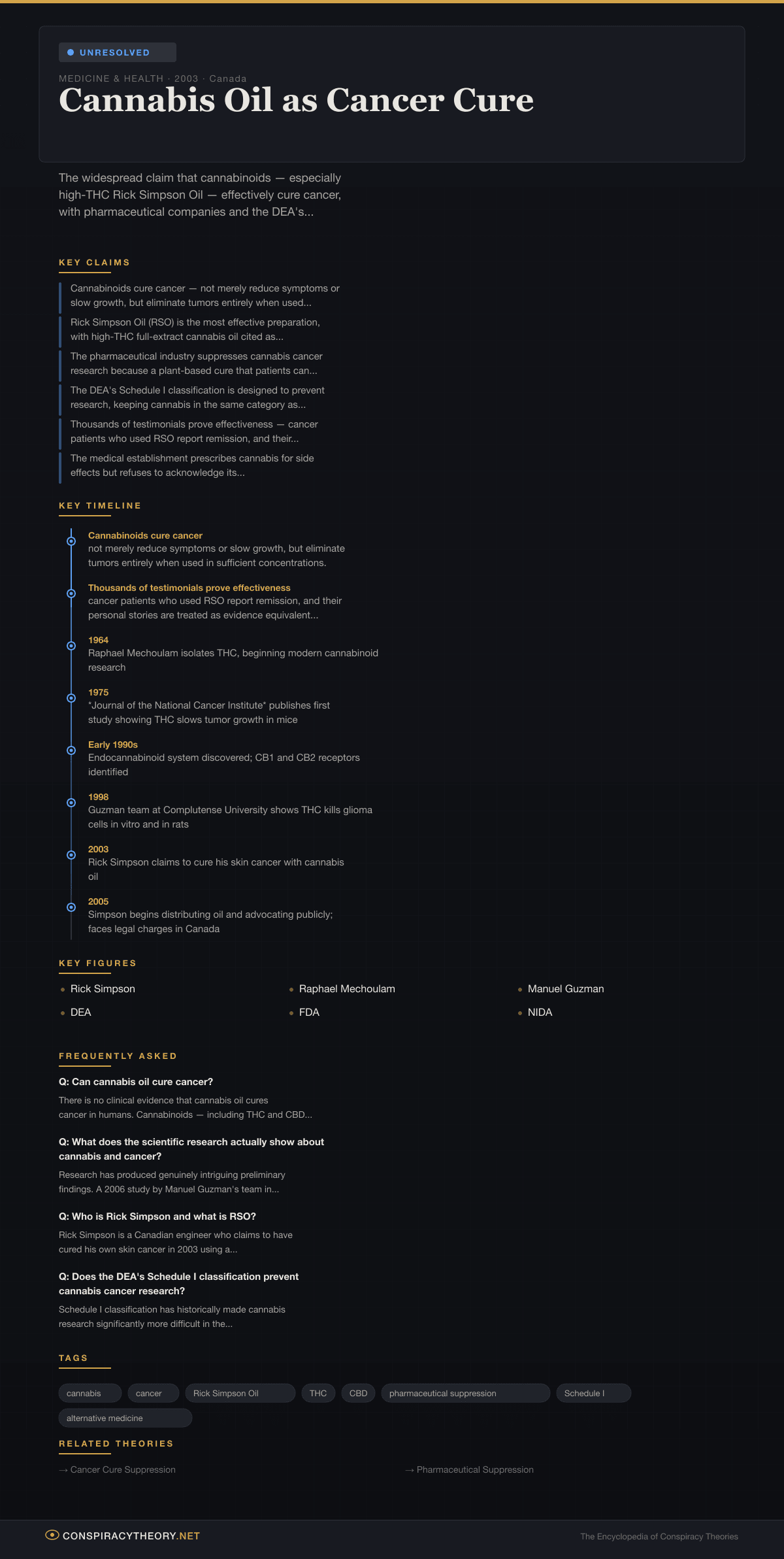
Cannabis Oil as Cancer Cure
Overview
In 2003, a Canadian maintenance engineer named Rick Simpson looked at a cluster of basal cell carcinomas on his forearm and decided not to listen to his doctor. He had recently read a 1975 study from the Journal of the National Cancer Institute in which researchers found that THC and CBN slowed the growth of Lewis lung adenocarcinoma in mice. Simpson made a concentrated cannabis oil extract, applied it directly to the lesions, covered them with bandages, and waited.
Four days later, he says, the cancers were gone.
Simpson became an evangelist. He produced a documentary, Run from the Cure, that has been viewed millions of times. He gave away cannabis oil to anyone who asked. He attracted the attention of Canadian law enforcement, fled to Europe, and became one of the most polarizing figures in the alternative medicine world. His name became a brand — “Rick Simpson Oil” (RSO) is now a product category in legal cannabis dispensaries across North America.
Simpson’s story is powerful. It is also unverified, scientifically uncontrolled, and limited to the most treatable form of skin cancer — a disease with a near-100% cure rate using conventional methods. But the story resonated because it tapped into something real: the frustration of cancer patients and their families with a medical establishment that often cannot save them, the genuine (if preliminary) scientific evidence that cannabinoids interact with cancer cells in interesting ways, and the deep suspicion that pharmaceutical companies would rather sell expensive chemotherapy drugs than allow a plant to compete.
The cannabis-cures-cancer narrative sits in an unusual position. It is not a clear-cut conspiracy theory like flat earth or moon landing denial. The underlying science is genuinely interesting. Cannabinoids really do kill cancer cells in lab settings. The DEA’s Schedule I classification really did make research more difficult for decades. And the pharmaceutical industry really does have financial incentives that can distort research priorities. But the leap from “cannabinoids show anti-cancer properties in a petri dish” to “cannabis oil cures cancer and Big Pharma is hiding it” is a canyon, and the people making that leap are building bridges out of anecdotes.
Origins & History
The Endocannabinoid System Discovery
The scientific foundation of the cannabis-cancer claim begins not with Rick Simpson but with Raphael Mechoulam, an Israeli organic chemist who first isolated THC in 1964 and later discovered the endocannabinoid system — a network of receptors and naturally produced compounds that regulate pain, mood, appetite, immune function, and cell growth throughout the human body.
Mechoulam’s discovery was revolutionary. The endocannabinoid system, identified in the early 1990s, revealed that the human body produces its own cannabis-like chemicals (anandamide and 2-AG) and has receptors specifically designed to respond to them (CB1 and CB2). These receptors are expressed throughout the body, including in the immune system and, crucially, in tumor tissue.
The discovery opened a legitimate avenue of cancer research. If the endocannabinoid system regulates cell growth and death, and if external cannabinoids (from cannabis) can activate that system, then cannabinoids might — in theory — be able to influence tumor growth. This was a reasonable scientific hypothesis, and researchers began testing it.
The Early Laboratory Evidence
The laboratory evidence is real, and it is important to describe it accurately because the conspiracy theory exploits legitimate science.
In 1998, a team at Complutense University in Madrid, led by Manuel Guzman, demonstrated that THC induced apoptosis (programmed cell death) in glioma cells in vitro and reduced tumor volume in rats. This was not the first such finding — the 1975 study Simpson had read showed similar results — but it was methodologically rigorous and published in a respected journal.
Subsequent studies expanded the findings. Cannabinoids were shown to kill cancer cells through multiple mechanisms: triggering apoptosis, inhibiting angiogenesis (the formation of blood vessels that feed tumors), preventing metastasis (the spread of cancer to other organs), and stimulating autophagy (a process by which cells digest their own damaged components). These effects were demonstrated in cell cultures and animal models for multiple cancer types, including brain, breast, prostate, colorectal, and lung cancer.
In 2006, Guzman’s team published a small pilot study — the first human clinical trial — in which THC was administered directly into the tumors of nine patients with recurrent glioblastoma, one of the deadliest forms of brain cancer. Two of the nine patients showed a measurable response. The study was small, uncontrolled, and inconclusive, but it demonstrated that THC could be administered safely to human brain cancer patients and showed potential biological activity.
These are genuine scientific findings. They are not fabricated, they are not trivial, and they are not the product of fringe science. They are published in peer-reviewed journals by credentialed researchers at major universities.
The Petri Dish Problem
Here is where the conspiracy theory departs from science. There is a vast difference between killing cancer cells in a laboratory and curing cancer in a human being. The gap is so large and so well-understood by cancer researchers that it has become a dark joke in oncology: “Everything cures cancer in a petri dish.”
In vitro studies (cell cultures) eliminate almost every variable that makes cancer treatment difficult in living humans. There is no immune system. There is no tumor microenvironment. There is no blood-brain barrier. There is no question of drug delivery, dosing, or toxicity to healthy tissue. You can kill cancer cells in a dish with hand sanitizer. That does not make hand sanitizer a cancer treatment.
The progression from petri dish to mouse to human clinical trial is long, expensive, and has an extremely high failure rate. Approximately 95% of cancer drugs that show promise in preclinical studies fail in human trials. This is not because of pharmaceutical suppression — it is because biology is complicated, and living organisms are not petri dishes.
Cannabinoids face all the same challenges that any candidate cancer drug faces, plus some unique ones. THC has psychoactive effects that limit dosing. Cannabinoids are metabolized rapidly. Tumor penetration is uncertain. And the anti-cancer mechanisms demonstrated in vitro may or may not operate the same way in a living human body with its own endocannabinoid system constantly in play.
Rick Simpson and the RSO Movement
Rick Simpson’s story, whatever its merits as a personal anecdote, became the foundation of a global movement. After his Canadian legal troubles (he was charged with cannabis possession and manufacturing in 2005 and 2009), Simpson moved to Europe and continued advocating from Croatia and later other locations.
Simpson’s message was simple and absolute: cannabis oil cures cancer. Not “might help.” Not “shows promise in some studies.” Cures. All cancers. The only reason the world does not know this, he argued, is that the pharmaceutical industry, the DEA, and the medical establishment suppress the evidence because a plant-based cure would destroy the $200 billion global cancer treatment market.
The RSO movement grew through YouTube videos, Facebook groups, and word-of-mouth testimonials. Cancer patients who used RSO alongside conventional treatment and went into remission credited the oil. Patients who used RSO instead of conventional treatment and died were less visible — their stories rarely made it to the testimonial pages.
This survivorship bias is the testimonial movement’s critical flaw. You hear from the people who got better. You do not hear from the people who declined chemotherapy, used oil, and died — because dead people do not post YouTube testimonials.
Key Claims
-
Cannabinoids cure cancer — not merely reduce symptoms or slow growth, but eliminate tumors entirely when used in sufficient concentrations.
-
Rick Simpson Oil (RSO) is the most effective preparation, with high-THC full-extract cannabis oil cited as superior to isolated cannabinoids or CBD-only products.
-
The pharmaceutical industry suppresses cannabis cancer research because a plant-based cure that patients can grow themselves would eliminate the need for expensive patented drugs.
-
The DEA’s Schedule I classification is designed to prevent research, keeping cannabis in the same category as heroin to block the studies that would prove it works.
-
Thousands of testimonials prove effectiveness — cancer patients who used RSO report remission, and their personal stories are treated as evidence equivalent to clinical trials.
-
The medical establishment prescribes cannabis for side effects but refuses to acknowledge its curative properties, using it for nausea and pain but suppressing evidence of its ability to kill tumors.
Evidence & Debunking
What the Science Supports
The scientific evidence for cannabinoids’ anti-cancer properties is real but limited:
- In vitro evidence: Strong. Dozens of studies show cannabinoids kill cancer cells through multiple mechanisms.
- Animal model evidence: Moderate. Some rodent studies show tumor reduction, but others show no effect or even tumor promotion (a 2004 study found THC accelerated the growth of some lung tumors in mice).
- Human clinical evidence: Minimal. One small pilot study (Guzman, 2006) and a handful of case reports. No randomized controlled trial has demonstrated that cannabis cures any cancer.
The gap between the preclinical evidence and the claims made by RSO advocates is enormous. Science does not work by extrapolating from petri dishes to cure claims. It works by testing each step — and the human testing step has barely begun, let alone been completed.
The Suppression Argument
The claim that cannabis cancer research is suppressed by the pharmaceutical industry and the DEA requires scrutiny.
Schedule I classification. The DEA’s classification of cannabis as Schedule I (high potential for abuse, no accepted medical use) did create significant bureaucratic barriers to research. Researchers needed DEA licenses, FDA approval, and could only obtain research-grade cannabis from a single federally authorized farm at the University of Mississippi. This was a real obstacle, and scientists have criticized it for decades. In 2024, the DEA reclassified cannabis to Schedule III, largely removing these barriers.
However, the suppression narrative overstates the case. Despite the barriers, hundreds of studies on cannabis and cancer have been conducted in the United States and thousands worldwide. The National Institutes of Health has funded cannabis research continuously. Countries with no Schedule I equivalent — Israel, Spain, the Netherlands, the United Kingdom — have also conducted cannabis cancer research and have also not found evidence that cannabis cures cancer.
Pharmaceutical industry incentives. The idea that Big Pharma would suppress a cancer cure to protect profits misunderstands how the industry works. Pharmaceutical companies patent and sell cannabis-derived medicines when they can. GW Pharmaceuticals developed Epidiolex (CBD) for epilepsy and Sativex (THC/CBD) for multiple sclerosis spasticity. Both are FDA- or EMA-approved. If a cannabis-based compound showed genuine anti-cancer activity in clinical trials, pharmaceutical companies would race to patent formulations, delivery methods, and synthetic analogs — as they have with every other promising compound in history.
The suppression theory also ignores the fact that a proven cancer cure would be worth vastly more than any existing chemotherapy drug. The company that developed it would dominate the most valuable pharmaceutical market on Earth.
The Testimonial Problem
Anecdotal testimonials are the primary “evidence” cited by RSO advocates, and they are scientifically worthless for several well-understood reasons:
Survivorship bias. People who use RSO and improve tell their stories. People who use RSO and die do not. This creates a dataset consisting entirely of positive outcomes, which is not evidence of effectiveness but evidence of selection bias.
Concurrent conventional treatment. Many RSO users also undergo surgery, chemotherapy, and radiation. When they go into remission, they credit the oil rather than the conventional treatment. Without controlled comparison, it is impossible to determine which treatment was responsible.
Spontaneous remission. Cancer occasionally goes into remission without treatment. This is rare but well-documented, occurring in approximately 1 in 80,000-100,000 cancer cases. In a world where millions of people use cannabis products, some of those spontaneous remissions will coincidentally follow cannabis use.
Confirmation bias. People seeking cannabis cancer cures are predisposed to interpret any improvement as evidence of the oil’s effectiveness and to attribute any decline to the disease rather than the treatment’s failure.
Cultural Impact
The cannabis-cancer narrative has had significant real-world effects, some harmful and some constructive.
On the harmful side, it has led some cancer patients to delay or forgo proven conventional treatments in favor of cannabis oil alone. While documenting specific cases is difficult (patient privacy, family reluctance to publicize negative outcomes), oncologists have reported patients declining surgery or chemotherapy after being convinced by online testimonials that RSO would cure them. In some cases, treatable cancers became untreatable during the delay.
On the constructive side, the movement has contributed to pressure for cannabis research reform. The persistent public interest in cannabis as medicine — driven partly by cancer cure claims — helped build political support for rescheduling cannabis, expanding research access, and integrating cannabis-based medicines into mainstream healthcare. Legitimate researchers acknowledge that public demand, even when based on exaggerated claims, has helped unlock research funding and regulatory pathways.
The narrative has also highlighted genuine deficiencies in the cancer research establishment. The cost of clinical trials — often $50-100 million for a Phase 3 trial — means that unpatentable natural compounds receive less research investment than synthetic drugs. This is a real structural problem in pharmaceutical research, and it affects not just cannabis but every natural substance with potential medical applications. Acknowledging this problem, however, is different from concluding that a cure exists and is being hidden.
Cannabis is now FDA-approved for managing chemotherapy-induced nausea (dronabinol, nabilone) and is widely used by cancer patients for pain, appetite stimulation, and quality of life. The irony is that cannabis genuinely helps cancer patients in documented, proven ways — just not by curing their cancer.
Timeline
- 1964 — Raphael Mechoulam isolates THC, beginning modern cannabinoid research
- 1975 — Journal of the National Cancer Institute publishes first study showing THC slows tumor growth in mice
- Early 1990s — Endocannabinoid system discovered; CB1 and CB2 receptors identified
- 1998 — Guzman team at Complutense University shows THC kills glioma cells in vitro and in rats
- 2003 — Rick Simpson claims to cure his skin cancer with cannabis oil
- 2005 — Simpson begins distributing oil and advocating publicly; faces legal charges in Canada
- 2006 — Guzman publishes first human pilot study: THC administered to nine glioblastoma patients
- 2008 — Simpson releases documentary Run from the Cure
- 2010s — RSO movement grows globally through social media; thousands of testimonials circulate
- 2018 — FDA approves Epidiolex (CBD) for epilepsy, demonstrating cannabis-based drug approval is possible
- 2019 — World Health Organization recommends reclassifying cannabis under international drug treaties
- 2024 — DEA reclassifies cannabis from Schedule I to Schedule III, easing research barriers
- Ongoing — Multiple clinical trials investigating cannabinoids for cancer treatment are registered with the NIH
Sources & Further Reading
- Guzman, Manuel, et al. “A Pilot Clinical Study of Delta-9-Tetrahydrocannabinol in Patients with Recurrent Glioblastoma Multiforme.” British Journal of Cancer, 2006
- Velasco, Guillermo, et al. “Cannabinoids and Cancer: Therapeutic Implications.” Nature Reviews Cancer, 2012
- Mechoulam, Raphael, and Lumir Hanus. “A Historical Overview of Chemical Research on Cannabinoids.” Chemistry and Physics of Lipids, 2000
- National Academies of Sciences, Engineering, and Medicine. The Health Effects of Cannabis and Cannabinoids. National Academies Press, 2017
- Munson, A.E., et al. “Antineoplastic Activity of Cannabinoids.” Journal of the National Cancer Institute, 1975
- Whiting, Penny F., et al. “Cannabinoids for Medical Use: A Systematic Review and Meta-analysis.” JAMA, 2015
- Simpson, Rick. Phoenix Tears: The Rick Simpson Story. Simpson RamaDur, 2017
Related Theories
- Cancer Cure Suppression — the broader theory that effective cancer treatments are being hidden from the public
- Pharmaceutical Suppression — claims that the pharmaceutical industry suppresses natural or low-cost treatments to protect profits
Frequently Asked Questions
Can cannabis oil cure cancer?
What does the scientific research actually show about cannabis and cancer?
Who is Rick Simpson and what is RSO?
Does the DEA's Schedule I classification prevent cannabis cancer research?
Infographic
Share this visual summary. Right-click to save.