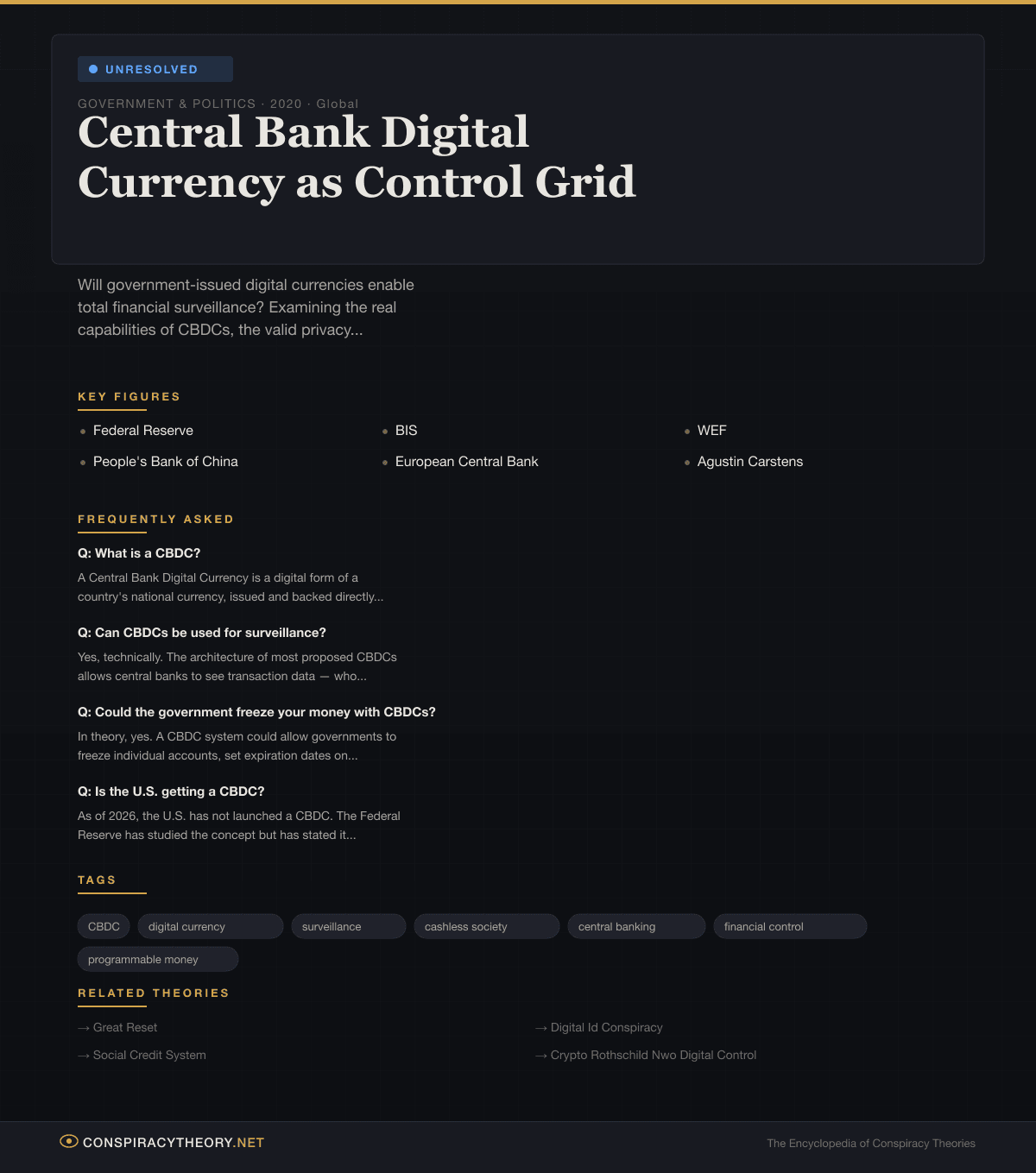
Central Bank Digital Currency as Control Grid

Overview
In October 2020, Agustin Carstens — the head of the Bank for International Settlements, the central bank of central banks — said something that conspiracy theorists would quote for the next five years. In a panel discussion about digital currencies, Carstens explained the difference between cash and CBDCs:
“We don’t know who’s using a $100 bill today, and we don’t know who’s using a 1,000 peso bill today. The key difference with the CBDC is the central bank will have absolute control on the rules and regulations that will determine the use of that expression of central bank liability, and also we will have the technology to enforce that.”
Absolute control. The technology to enforce that.
Carstens wasn’t making a threat. He was describing a technical capability — the same way an engineer might explain what a system can do versus what it will do. But in the context of a global pandemic that had just demonstrated governments’ willingness to lock down economies, restrict movement, and mandate medical procedures, “absolute control” over money landed differently than Carstens probably intended.
The CBDC conspiracy theory occupies unusual territory because it’s simultaneously a legitimate policy concern and a conspiracy theory, depending on which version you encounter. The cautious version — “CBDCs create surveillance capabilities that could be abused” — is shared by the ACLU, the Electronic Frontier Foundation, Republican senators, and civil liberties organizations worldwide. The conspiratorial version — “CBDCs are being developed as a component of a planned totalitarian world government” — slides from policy critique into New World Order territory.
The distance between these two versions is smaller than you might think, and that’s precisely what makes CBDCs such a politically potent issue.
What CBDCs Actually Are
The Technical Reality
A Central Bank Digital Currency is, at its simplest, a digital version of cash issued directly by a country’s central bank. Currently, the money in your bank account isn’t “government money” — it’s a commercial bank’s promise to give you government money. If your bank fails, that promise might not be honored (beyond FDIC insurance limits). A CBDC would be a direct liability of the central bank, like a digital dollar bill.
As of 2026, over 130 countries representing 98% of global GDP are exploring, developing, piloting, or have already launched CBDCs. The most advanced implementation in a major economy is China’s digital yuan (e-CNY), which has been piloted in multiple cities since 2020 and processed hundreds of billions of dollars in transactions.
The Design Spectrum
Not all CBDCs are created equal. The design choices matter enormously:
Account-based vs. token-based: Account-based CBDCs link transactions to identified users (like a bank account). Token-based CBDCs can function more like digital cash, with some degree of anonymity for small transactions.
Wholesale vs. retail: Wholesale CBDCs are for banks and financial institutions only. Retail CBDCs are for the general public. The surveillance concerns apply primarily to retail CBDCs.
Centralized vs. intermediated: Some designs have the central bank managing all accounts directly (maximum surveillance capability). Others use commercial banks as intermediaries, with the central bank seeing only aggregate data.
Programmable vs. non-programmable: This is the big one. Programmable CBDCs can have conditions attached to the money itself — expiration dates, spending restrictions, geographic limitations. Non-programmable CBDCs function like digital cash without restrictions.
The conspiracy fears center on the worst-case design: a centralized, account-based, fully programmable retail CBDC where the government can see every transaction, freeze any account, and program spending restrictions into the money itself.
The Legitimate Concerns
Financial Surveillance
Even without a CBDC, the modern financial system is highly surveilled. Banks report suspicious transactions. The IRS tracks large cash deposits. Credit card companies know everything you buy. But CBDCs could take surveillance to a qualitatively different level:
- Real-time transaction monitoring: Every purchase, transfer, and payment visible to the central bank
- No cash alternative: If physical cash is phased out alongside CBDC introduction, there would be no way to transact privately
- Data aggregation: Combined with digital ID systems, CBDCs could create a comprehensive picture of every citizen’s economic life
These aren’t conspiracy theories — they’re architectural capabilities that central banks themselves have described. The question is whether governments would use these capabilities for mass surveillance. The answer, based on history, is that governments tend to use surveillance capabilities once they have them.
Programmable Money
The concept of programmable money — money with built-in conditions — is where the conspiracy theory and legitimate policy concerns overlap most directly:
Potential uses described by CBDC proponents:
- Stimulus payments that expire if unspent within 90 days (China has tested this)
- Welfare payments restricted to food and essential goods
- Geographic restrictions (money usable only in certain regions to support local economies)
- Automatic tax collection at the point of transaction
Potential uses feared by critics:
- Freezing accounts of political dissidents or protesters
- Restricting purchases of disfavored goods (ammunition, certain books, alcohol)
- Imposing negative interest rates that force spending
- Implementing social credit-style systems linking behavior to financial access
The Canada Precedent
In February 2022, the Canadian government invoked the Emergencies Act to freeze the bank accounts of people associated with the Freedom Convoy truck driver protests. Banks were directed to freeze accounts without court orders. Crowdfunding platforms were ordered to freeze donations.
The Canada precedent is critical to the CBDC debate because it demonstrated three things:
- Governments will freeze bank accounts of protesters: This isn’t hypothetical. It happened in a Western democracy.
- The current banking system already enables this: You don’t need CBDCs to freeze accounts. Banks already comply with government orders.
- CBDCs could make it faster and easier: Without bank intermediaries, a government could freeze accounts with a keystroke rather than through bank compliance departments.
CBDC opponents cite Canada constantly. CBDC proponents note that the existing system already enabled the same action — CBDCs don’t create a new capability so much as streamline an existing one.
The Conspiracy Theory Version
The New World Order Integration
In the full conspiracy version, CBDCs aren’t just a surveillance concern — they’re a key component of a planned totalitarian world government. The narrative typically links CBDCs to:
- The Great Reset: Klaus Schwab and the World Economic Forum are building a system where “you will own nothing and be happy,” and CBDCs are the mechanism for controlling property and spending
- Digital ID: CBDCs combined with digital identity systems create a comprehensive control grid where every aspect of life is monitored and regulated
- Social credit systems: China’s social credit experiment is treated as the prototype for a global system where CBDC access is tied to behavioral compliance
- Depopulation: Some theorists connect CBDCs to broader depopulation agendas, arguing that programmable money could restrict food purchases for targeted populations
What the Theory Gets Wrong
The conspiratorial version fails where conspiracy theories typically fail — in attributing coordinated, unified intent to what are actually fragmented, competing, and often incompetent bureaucracies:
- Central banks disagree with each other: The Federal Reserve, ECB, Bank of England, and People’s Bank of China have very different CBDC approaches. There is no unified global plan.
- Political opposition is real: In the United States, CBDC opposition has become a bipartisan issue. Multiple bills have been introduced to ban or restrict CBDCs. This opposition isn’t theater — it reflects genuine political resistance.
- Technical challenges are enormous: Building a CBDC that handles the transaction volume of a major economy is a massive engineering challenge that no country has fully solved.
- The existing system already surveils: If the goal is financial surveillance, governments don’t need CBDCs. They already have the PATRIOT Act, bank reporting requirements, and cooperative commercial banks. CBDCs are an incremental change, not a revolutionary one.
Where Things Stand
China’s Digital Yuan
China’s e-CNY is the most advanced CBDC in a major economy. It has been piloted in over 25 cities, processed over $250 billion in transactions, and is integrated with major Chinese payment platforms. The system includes “controlled anonymity” — small transactions can be somewhat private, but larger ones require identification.
Critics note that China’s e-CNY fits neatly with its existing social credit system and internet censorship infrastructure. Supporters note that China’s existing digital payment ecosystem (Alipay, WeChat Pay) was already fully surveilled — the CBDC doesn’t meaningfully change the surveillance picture.
The European Digital Euro
The European Central Bank is developing a digital euro, currently in the “preparation phase.” The ECB has made privacy a central design feature, proposing offline transactions with cash-like anonymity for small amounts. Whether these privacy features survive implementation is an open question.
The U.S. Position
The U.S. CBDC situation has been shaped more by political opposition than technical development. The Federal Reserve published a discussion paper in 2022 but has made no move toward implementation. Executive orders from both Biden (pro-research) and Trump (anti-CBDC) reflect the partisan divide. Multiple congressional bills have proposed banning a U.S. CBDC outright.
The irony is that the U.S. dollar’s global dominance may actually be threatened by not developing a CBDC, as other countries’ digital currencies gain traction in international trade.
The Reasonable Middle Ground
The CBDC debate is one of the few areas where the conspiracy theory and the policy concern share significant overlap. The reasonable position — held by most privacy advocates, civil liberties organizations, and even some central bankers — is:
- CBDCs have legitimate potential benefits (financial inclusion, more efficient payments, reduced transaction costs)
- CBDCs also have genuine surveillance risks that must be addressed in the design phase
- Privacy protections must be built into the architecture, not bolted on later
- Cash should remain available as a private alternative
- Government power over individual accounts must be constrained by law and judicial oversight
This isn’t a conspiracy theory. It’s a policy position. The conspiracy theory begins when you remove the possibility that CBDCs could be well-designed, remove the possibility that political opposition could succeed, and conclude that a totalitarian outcome is inevitable and planned.
Timeline
| Date | Event |
|---|---|
| 2014 | China’s People’s Bank begins CBDC research |
| 2019 | Facebook announces Libra (later Diem), spurring central bank urgency |
| 2020 | China begins digital yuan pilots in four cities |
| October 2020 | BIS head Carstens makes “absolute control” statement |
| 2021 | Nigeria launches eNaira, first CBDC in a major African economy |
| January 2022 | Federal Reserve publishes CBDC discussion paper |
| February 2022 | Canada freezes Freedom Convoy bank accounts without court orders |
| March 2022 | Biden executive order encouraging CBDC research |
| 2023 | Over 130 countries exploring CBDCs |
| 2023-2024 | ECB begins digital euro preparation phase |
| 2024 | Multiple U.S. congressional bills proposed to ban CBDCs |
| 2025 | Trump executive order opposing U.S. CBDC development |
| 2026 | China’s e-CNY exceeds $250B in cumulative transactions |
Sources & Further Reading
- Bank for International Settlements. “CBDCs: an opportunity for the monetary system.” Annual Economic Report, 2021.
- Atlantic Council. “Central Bank Digital Currency Tracker.” cbdctracker.org, updated regularly.
- Federal Reserve. “Money and Payments: The U.S. Dollar in the Age of Digital Transformation.” January 2022.
- Carstens, Agustin. Panel discussion, IMF Cross-Border Payments conference, October 2020.
- ACLU. “Central Bank Digital Currency and Civil Liberties.” Policy paper, 2022.
- Auer, Raphael, and Rainer Bohme. “The technology of retail central bank digital currency.” BIS Quarterly Review, March 2020.
Related Theories
- The Great Reset — The WEF agenda CBDCs are alleged to serve
- Digital ID Conspiracy — The complementary identification system
- Social Credit System — China’s behavioral scoring system
- Cashless Society — The end of physical money

Frequently Asked Questions
What is a CBDC?
Can CBDCs be used for surveillance?
Could the government freeze your money with CBDCs?
Is the U.S. getting a CBDC?
Infographic
Share this visual summary. Right-click to save.