Censored News Stories

Overview
The claim that major news stories are systematically censored or suppressed by mainstream media outlets is one of the few conspiracy-adjacent theories that has been extensively documented by academics, press freedom organizations, and journalists themselves. Unlike most conspiracy theories, which allege secret coordination behind closed doors, the censored news phenomenon has been tracked, catalogued, and analyzed by institutional researchers for nearly five decades.
The most prominent effort in this area is Project Censored, a media research program founded at Sonoma State University in 1976, which publishes annual lists of the most significant news stories that received little or no coverage from major American media outlets. The stories identified by Project Censored are not fabrications or fringe claims — they are typically sourced from smaller independent outlets, academic journals, government reports, and foreign press, and are vetted by panels of journalists and academics before publication.
The theory is classified as confirmed because the underlying phenomenon — that important, well-sourced stories routinely fail to reach mass audiences through major media channels — is well-documented and widely acknowledged even by mainstream media professionals. Where disagreement exists is over whether this pattern reflects deliberate suppression, structural incentives within media organizations, or simply the practical limitations of news judgment in a complex information environment.
Origins & History
The Founding of Project Censored
In 1976, Carl Jensen, a professor of communications at Sonoma State University in Rohnert Park, California, launched what he initially called a “censored news” seminar. Jensen’s motivation was straightforward: he observed that critically important stories — affecting public health, government accountability, corporate behavior, and civil liberties — were being published by small outlets and academic researchers but failing to penetrate the editorial filters of major newspapers and television networks.
Jensen established a systematic methodology. Each year, his students and faculty colleagues would solicit nominations for underreported stories from journalists, researchers, and members of the public. A panel of judges — typically comprising working journalists, editors, and media scholars — would evaluate the nominations and select the 25 most significant stories that had been ignored or underreported by mainstream outlets. The resulting list was published annually, eventually forming the basis for a series of books and an ongoing media literacy program.
The project’s early years coincided with a period of significant media consolidation in the United States. In the late 1970s and 1980s, the number of corporations controlling the majority of American media began to shrink dramatically. Ben Bagdikian’s landmark 1983 book The Media Monopoly documented that fifty corporations controlled the majority of American media; by subsequent editions, that number had fallen to fewer than ten. This consolidation provided a structural context for the patterns Project Censored was identifying.
The Propaganda Model
The intellectual framework for understanding systematic media censorship received its most influential academic treatment in 1988, when Noam Chomsky and Edward S. Herman published Manufacturing Consent: The Political Economy of the Mass Media. Chomsky and Herman proposed a “propaganda model” identifying five filters through which news passes before reaching the public: ownership concentration, advertising dependence, sourcing from official channels, “flak” (organized pressure campaigns against unfavorable coverage), and ideological framing.
The propaganda model argued that media censorship is primarily structural rather than conspiratorial. Editors and journalists do not need to receive direct orders to suppress stories; the economic incentives of corporate ownership, the need to maintain advertising revenue, and the professional pressures of access journalism produce self-censorship as a natural byproduct of the system’s design. This framework has been both widely influential and widely criticized — supporters consider it an essential lens for understanding media behavior, while detractors argue it underestimates the diversity and independence of journalistic practice.
Press Freedom Organizations
Beyond Project Censored, numerous organizations have documented patterns of news suppression and press restriction. Reporters Without Borders (Reporters Sans Frontieres), founded in France in 1985, publishes an annual World Press Freedom Index ranking countries on their treatment of journalists and the openness of their media environments. The Committee to Protect Journalists, founded in 1981, tracks attacks on press freedom worldwide. Freedom House, the American Civil Liberties Union, and the Electronic Frontier Foundation have all documented cases where government action, corporate pressure, or legal threats have resulted in the suppression of newsworthy information.
These organizations have demonstrated that news censorship operates on a spectrum — from outright government prohibition in authoritarian regimes to the subtler mechanisms of editorial self-censorship, advertiser pressure, and access-dependent reporting in nominally free press systems.
Key Claims
The censored news framework encompasses several distinct categories of claims about how and why important stories are suppressed. The following examples, organized by decade, illustrate the range of stories that have been identified as systematically underreported.
1970s-1980s: Early Censored Stories
- Corporate toxic waste dumping: In its earliest years, Project Censored identified widespread industrial contamination stories that received minimal national coverage, including chemical dumping at Love Canal before it became a national crisis in 1978.
- U.S. support for authoritarian regimes: American military and financial support for dictatorships in Latin America, including Guatemala, El Salvador, and Chile, received scant mainstream coverage even as human rights organizations documented systematic atrocities.
- Nuclear weapons testing health effects: Studies documenting the health consequences of atmospheric nuclear testing on downwind communities and military personnel were consistently underreported through the 1970s and 1980s.
- Media ownership consolidation: The accelerating concentration of media ownership itself was identified as a censored story — the entities that should have reported on the trend were the same entities undergoing consolidation.
1990s: Post-Cold War Suppression
- Telecommunications Act of 1996: The landmark legislation that further deregulated media ownership received minimal critical coverage from the broadcasting companies that stood to benefit from it. Project Censored ranked it among the most important underreported stories of the decade.
- NAFTA’s labor and environmental provisions: While the North American Free Trade Agreement received extensive political coverage, detailed reporting on its projected effects on labor rights and environmental standards in Mexico was largely absent from major outlets.
- Private prison industry growth: The rapid expansion of for-profit incarceration in the United States during the 1990s received little sustained investigative attention from national media until well into the 2000s.
- Depleted uranium munitions: Health effects of depleted uranium weapons used in the 1991 Gulf War on both soldiers and Iraqi civilians were documented by independent researchers but received minimal mainstream coverage during the decade.
2000s: War on Terror Era
- Pre-Iraq War intelligence dissent: Internal intelligence community disagreements about the case for Iraqi weapons of mass destruction were underreported before the 2003 invasion, despite being documented in classified assessments that some officials attempted to make public.
- Pentagon military analyst program: In 2008, the New York Times revealed that the Pentagon had recruited retired military officers serving as television news analysts to promote the administration’s war messaging. Despite winning a Pulitzer Prize, the story received almost no follow-up coverage from the television networks that had employed the compromised analysts.
- Pre-2008 financial crisis warnings: Multiple economists, regulators, and financial analysts warned about systemic risks in the housing and derivatives markets years before the 2008 crash. These warnings were largely absent from mainstream financial journalism, which continued to promote housing market optimism.
- Warrantless surveillance programs: Before Edward Snowden’s 2013 revelations, multiple sources — including AT&T technician Mark Klein in 2006 — provided evidence of mass domestic surveillance. The stories received brief coverage but failed to generate sustained public attention or political accountability.
2010s: Digital Era Censorship
- ALEC’s corporate legislation drafting: The American Legislative Exchange Council’s role in writing model legislation adopted by state legislatures across the country was extensively documented by independent media but received little national network coverage until protest campaigns forced attention.
- Trans-Pacific Partnership secrecy: The text of the TPP trade agreement was classified as a national security secret during negotiations, preventing public scrutiny of provisions that would have affected intellectual property law, pharmaceutical pricing, and environmental regulation. Mainstream coverage of the secrecy itself was sparse.
- Corporate tax avoidance at scale: While individual stories about corporate tax practices appeared periodically, the systemic scale of profit-shifting to tax havens — later revealed in detail by the Panama Papers and Paradise Papers leaks — was consistently underreported relative to its economic significance.
- Civilian drone strike casualties: Independent organizations tracking civilian casualties from U.S. drone strikes documented death tolls significantly higher than official government figures, but these findings received limited mainstream airtime compared to the coverage given to official statements.
2020s: Pandemic and Platform Era
- Pharmaceutical industry pricing mechanisms: The structural factors driving drug pricing in the United States, including the role of pharmacy benefit managers and patent evergreening, have remained underreported relative to their impact on public health and household budgets.
- Platform algorithm effects on information access: The ways in which social media algorithms shape what news reaches users — effectively creating a new layer of editorial gatekeeping — have been documented by researchers but have received less sustained coverage than individual content moderation controversies.
- Environmental regulatory rollbacks: Hundreds of environmental regulation changes affecting air quality, water safety, and chemical exposure standards have occurred with minimal individual coverage, their cumulative impact largely invisible to the general public.
Evidence
Documented Cases
The evidence supporting the existence of systematic news censorship is extensive and comes from multiple independent sources.
Project Censored’s track record provides perhaps the strongest evidence. Many stories that appeared on Project Censored’s annual lists were later confirmed by mainstream reporting — sometimes years or decades after the original suppression. The NSA mass surveillance programs, the health effects of Agent Orange, corporate pollution cover-ups, and the Pentagon’s military analyst program all appeared on censored story lists before eventually receiving mainstream attention. This pattern — independent documentation followed by a long delay before mainstream acknowledgment — is the signature of the censorship dynamic the project identifies.
Internal media admissions provide additional evidence. Numerous journalists, editors, and producers have publicly described incidents where stories were killed, watered down, or indefinitely delayed due to pressure from advertisers, corporate owners, or government officials. Former CBS News producer Kristina Borjesson compiled accounts from dozens of journalists in her 2002 book Into the Buzzsaw: Leading Journalists Expose the Myth of a Free Press, documenting specific instances where well-sourced investigative stories were suppressed by network executives.
Government censorship mechanisms have been documented through declassified records, Freedom of Information Act requests, and whistleblower testimony. These include the use of national security letters to prevent reporting on surveillance activities, the classification of information to prevent public disclosure, embedded journalist programs that traded access for editorial control, and direct White House pressure on news organizations regarding specific stories.
Comparative international coverage offers a revealing test case. Stories that receive extensive coverage in the foreign press — particularly in outlets such as the BBC, The Guardian, Der Spiegel, and Al Jazeera — but minimal coverage in American media suggest editorial choices rather than a lack of newsworthiness. The drone strike civilian casualty issue, American military operations in Africa, and corporate tax haven networks all received significantly more coverage internationally than domestically during the 2010s.
Structural Mechanisms
Research has identified several structural mechanisms through which censorship operates in nominally free media systems:
- Corporate ownership conflicts: When a media company’s parent corporation has interests in defense, pharmaceuticals, energy, or other regulated industries, coverage of those sectors may be tempered by institutional conflicts of interest.
- Advertiser pressure: Media outlets dependent on advertising revenue face implicit and sometimes explicit pressure not to publish stories that could alienate major advertisers. This dynamic has been documented in cases involving pharmaceutical advertising, fossil fuel companies, and financial institutions.
- Access journalism: Reporters who depend on access to government officials, corporate executives, or other powerful sources face professional incentives to avoid publishing stories that would result in the loss of that access.
- Legal threats: The cost of defending against defamation lawsuits, even frivolous ones, creates a chilling effect on investigative reporting, particularly for smaller outlets with limited legal resources. Strategic lawsuits against public participation (SLAPP suits) have been used by corporations and public figures to discourage critical coverage.
Debunking / Verification
What the Evidence Confirms
The core claim — that important, well-sourced news stories are systematically underreported or ignored by major media outlets — is well-supported by evidence from multiple independent sources. This is not a matter of serious dispute among media scholars, press freedom organizations, or experienced journalists. The phenomenon is real, documented, and ongoing.
The structural mechanisms that produce this outcome — corporate ownership concentration, advertiser dependence, access journalism, and legal pressure — are well-established in media studies literature and have been acknowledged by media professionals themselves.
Where the Theory Becomes Contested
The contested ground concerns the nature and degree of intentionality behind the censorship. Three competing explanations coexist:
The structural explanation, advanced by Chomsky, Herman, and most media scholars, holds that censorship is primarily a product of institutional incentives rather than deliberate coordination. Editors do not receive phone calls ordering them to suppress stories; rather, the economic structure of corporate media produces predictable patterns of omission without requiring overt conspiracy.
The deliberate suppression explanation, favored by some media critics and press freedom advocates, argues that in at least some cases, specific stories are intentionally killed by editors or executives acting on behalf of identifiable interests — corporate owners, government officials, or advertisers. Documented cases, such as CBS’s suppression of a 1995 60 Minutes interview with tobacco industry whistleblower Jeffrey Wigand due to legal threats from Brown & Williamson, support this explanation in specific instances.
The resource and judgment explanation, offered by mainstream media defenders, holds that many stories identified as “censored” were simply the product of limited newsroom resources, legitimate editorial judgment about audience interest, or the difficulty of verifying complex investigative claims. Under this view, the failure to cover a story is not evidence of censorship but of the practical constraints that every news organization faces.
The available evidence suggests that all three explanations are operative in different cases and at different scales. The structural explanation best accounts for broad patterns; deliberate suppression is documented in specific, identifiable incidents; and resource limitations play a genuine role in editorial decisions. The censored news phenomenon is best understood as a spectrum rather than a single mechanism.
Cultural Impact
Media Literacy Movement
Project Censored and related efforts have been foundational to the media literacy movement in the United States and internationally. The concept that news media may not provide a complete or unbiased picture of reality has moved from a fringe claim to a mainstream understanding over the past four decades. Media literacy curricula in universities and secondary schools now routinely incorporate analysis of news selection bias, corporate ownership effects, and the structural factors that shape coverage.
Independent Media Ecosystem
The documented failures of mainstream media to cover important stories have been a primary driver of the growth of independent and alternative media. Organizations such as ProPublica, The Intercept, Democracy Now!, and numerous smaller investigative outlets were founded in part as responses to the perceived inadequacy of corporate media coverage. The rise of digital publishing dramatically lowered the barriers to entry for independent journalism, enabling a proliferation of outlets that explicitly position themselves as covering the stories that mainstream media ignores.
Trust in Media
The censored news phenomenon has contributed to the broader decline in public trust in mainstream media. Gallup polling has tracked a steady decline in the percentage of Americans who say they have “a great deal” or “a fair amount” of trust in mass media, falling from 72% in 1976 — the year Project Censored was founded — to historic lows in recent years. While this decline has many causes, the documented reality of systematic underreporting has provided factual ammunition for critics across the political spectrum who argue that major media outlets cannot be trusted to inform the public on issues that conflict with their institutional interests.
Political Consequences
The knowledge that important stories can be suppressed has had tangible political consequences. Whistleblowers such as Daniel Ellsberg, Chelsea Manning, and Edward Snowden explicitly cited the failure of normal channels to bring critical information to public attention as a motivation for their disclosures. The existence of documented censorship has also been weaponized by political actors who invoke “media suppression” to lend credibility to claims that may not deserve it — a dynamic in which the real phenomenon of media censorship is exploited to advance misinformation.
Key Figures
-
Carl Jensen (1929-2015): Founder of Project Censored in 1976 at Sonoma State University. A former advertising executive turned communications professor, Jensen directed the project for its first 20 years, establishing its methodology and building its reputation as a credible media watchdog.
-
Peter Phillips: Sociology professor at Sonoma State University who directed Project Censored from 1996 to 2010. Under Phillips’s leadership, the project expanded its scope, deepened its academic rigor, and published several influential books compiling censored stories and media analysis.
-
Noam Chomsky: MIT linguist and political theorist whose work with Edward Herman on the propaganda model provided the most influential theoretical framework for understanding systematic media censorship in democratic societies.
-
Edward S. Herman (1925-2017): Economist and media analyst who co-authored Manufacturing Consent with Chomsky. Herman’s earlier work on corporate media and human rights reporting laid the groundwork for the propaganda model.
-
Ben Bagdikian (1920-2016): Journalist and media critic whose book The Media Monopoly (1983) documented the accelerating concentration of media ownership and its effects on news coverage. Bagdikian revised the book through multiple editions as ownership concentration intensified.
-
Reporters Without Borders: International press freedom organization founded in 1985 that tracks censorship, press restrictions, and attacks on journalists worldwide. Its annual Press Freedom Index provides a comparative measure of media openness across nations.
Timeline
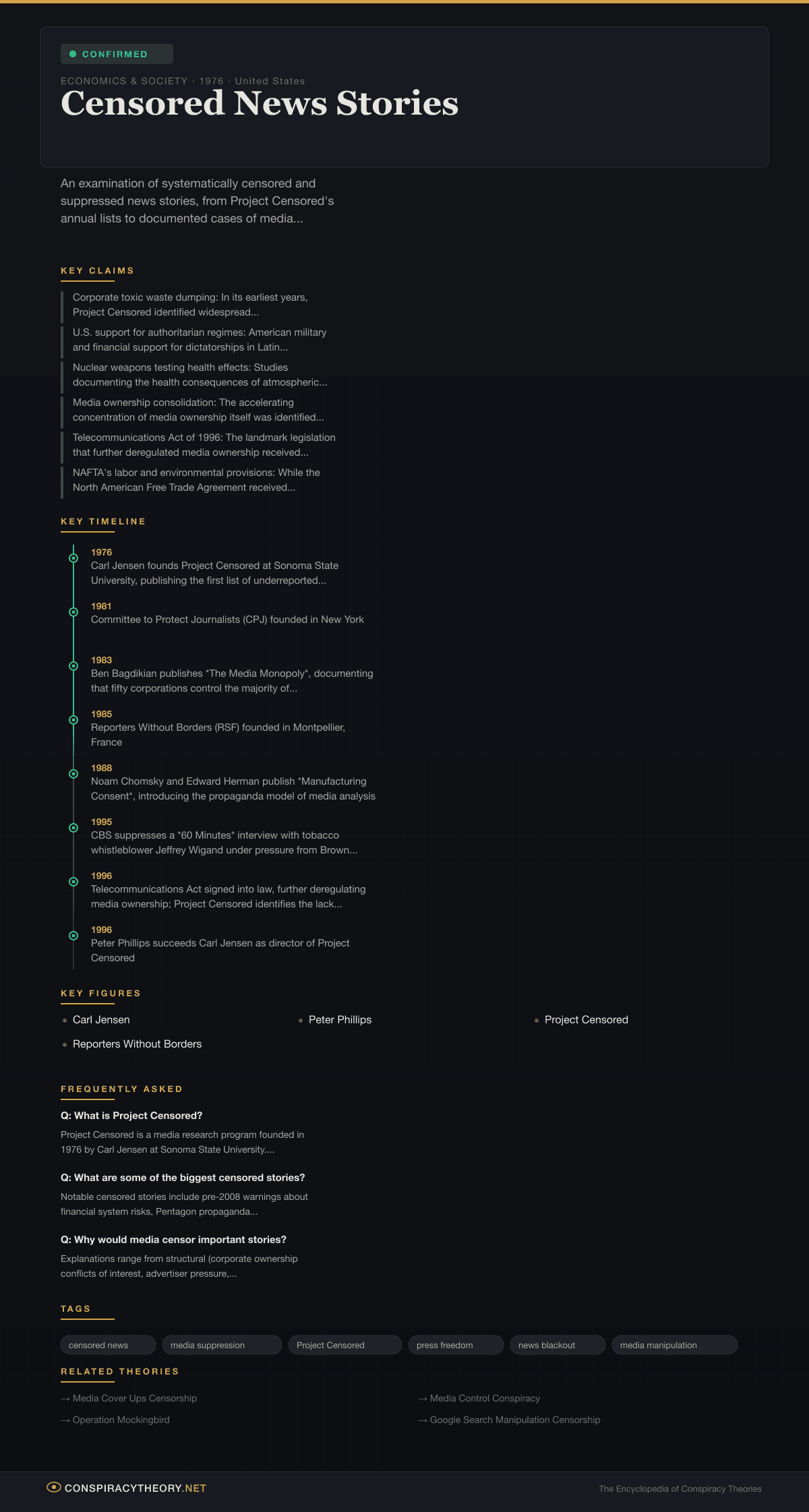
- 1976 — Carl Jensen founds Project Censored at Sonoma State University, publishing the first list of underreported news stories
- 1981 — Committee to Protect Journalists (CPJ) founded in New York
- 1983 — Ben Bagdikian publishes The Media Monopoly, documenting that fifty corporations control the majority of American media
- 1985 — Reporters Without Borders (RSF) founded in Montpellier, France
- 1988 — Noam Chomsky and Edward Herman publish Manufacturing Consent, introducing the propaganda model of media analysis
- 1995 — CBS suppresses a 60 Minutes interview with tobacco whistleblower Jeffrey Wigand under pressure from Brown & Williamson; the incident is later dramatized in the film The Insider (1999)
- 1996 — Telecommunications Act signed into law, further deregulating media ownership; Project Censored identifies the lack of critical coverage as a top censored story
- 1996 — Peter Phillips succeeds Carl Jensen as director of Project Censored
- 2002 — Kristina Borjesson publishes Into the Buzzsaw, compiling first-person accounts from journalists whose stories were suppressed by media executives
- 2004 — Project Censored identifies pre-Iraq War intelligence dissent as a top censored story
- 2008 — New York Times reveals Pentagon military analyst program; television networks that employed the compromised analysts provide virtually no follow-up coverage
- 2010 — Project Censored transitions leadership; the project continues under successive directors while expanding its media literacy initiatives
- 2013 — Edward Snowden’s disclosures confirm mass surveillance programs that had been documented but underreported for years, validating earlier censored story designations
- 2015 — Carl Jensen dies at age 86
- 2016 — Panama Papers leak reveals global network of offshore tax havens used by politicians and corporations, confirming stories previously flagged as underreported
- 2017 — Paradise Papers provide further documentation of corporate tax avoidance at scale
- 2020-2021 — COVID-19 pandemic raises new questions about media censorship as platforms implement content moderation policies on health information, blurring lines between censorship and misinformation prevention
- 2023 — Twitter Files and related disclosures reveal coordination between government agencies and social media platforms on content moderation decisions, adding a new dimension to the censored news debate
- 2025 — Project Censored continues publishing annual lists and media literacy resources, approaching its fiftieth year of operation
Sources & Further Reading
- Jensen, Carl. Censored: The News That Didn’t Make the News and Why. Seven Stories Press, published annually 1993-2016
- Chomsky, Noam, and Edward S. Herman. Manufacturing Consent: The Political Economy of the Mass Media. Pantheon Books, 1988
- Bagdikian, Ben H. The New Media Monopoly. Beacon Press, 2004 (revised edition)
- Borjesson, Kristina, ed. Into the Buzzsaw: Leading Journalists Expose the Myth of a Free Press. Prometheus Books, 2002
- Phillips, Peter, and Project Censored. Censored 2007: The Top 25 Censored Stories. Seven Stories Press, 2006
- McChesney, Robert W. The Problem of the Media: U.S. Communication Politics in the Twenty-First Century. Monthly Review Press, 2004
- Reporters Without Borders. World Press Freedom Index. Published annually at rsf.org
- Committee to Protect Journalists. Attacks on the Press. Published annually at cpj.org
- Barstow, David. “Behind TV Analysts, Pentagon’s Hidden Hand.” The New York Times, April 20, 2008
- Greenwald, Glenn. No Place to Hide: Edward Snowden, the NSA, and the U.S. Surveillance State. Metropolitan Books, 2014
- Herman, Edward S. The Real Terror Network: Terrorism in Fact and Propaganda. South End Press, 1982
Related Theories
The censored news phenomenon intersects with several other documented and alleged patterns of information control:
- Operation Mockingbird — The CIA’s Cold War-era program to influence domestic and foreign media, which demonstrated that government agencies have historically sought to shape news coverage through covert relationships with journalists and media executives.
- Media Control Conspiracy — Broader claims about coordinated control of media narratives by governments, corporations, or elite networks, which range from well-documented structural critiques to unfounded allegations of centralized conspiratorial direction.
- Google Search Manipulation & Censorship — Allegations that search engine algorithms and platform policies function as a new layer of editorial gatekeeping, determining which news stories reach audiences regardless of traditional media coverage decisions.
- Media Cover-ups & Censorship — Specific instances where media organizations have been documented suppressing or delaying stories due to external pressure, internal conflicts of interest, or editorial decisions later acknowledged as failures of journalistic responsibility.
Frequently Asked Questions
What is Project Censored?
What are some of the biggest censored stories?
Why would media censor important stories?
Infographic
Share this visual summary. Right-click to save.