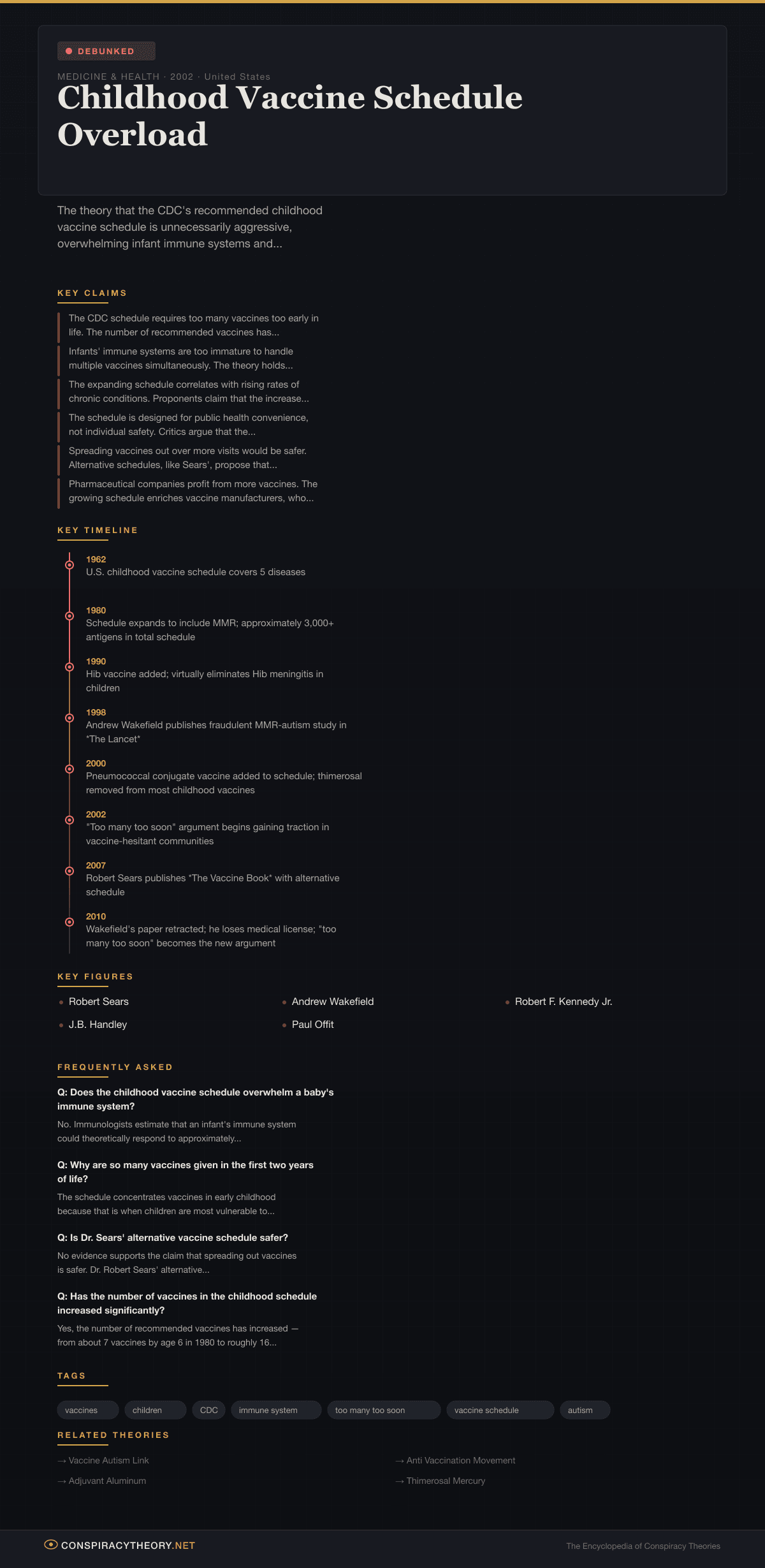
Childhood Vaccine Schedule Overload
Overview
In 2007, Dr. Robert Sears — a pediatrician from Capistrano Beach, California, and the son of the famous “Dr. Sears” parenting brand — published The Vaccine Book: Making the Right Decision for Your Child. It was not an anti-vaccine book, exactly. Sears did not claim vaccines caused autism. He did not tell parents to skip vaccination entirely. What he did was something more subtle and, in the end, more influential: he told parents that the Centers for Disease Control and Prevention’s recommended childhood vaccine schedule was too aggressive, and he offered an alternative — a gentler, slower schedule that spread vaccines out over more visits and delayed some shots until later in childhood.
The book sold hundreds of thousands of copies. It became a bible in the growing community of “vaccine-hesitant” parents — people who were not anti-vaccine in the traditional sense but who felt uneasy about the number of shots their children received. Sears gave them permission to trust their instincts over their pediatrician’s recommendations. The schedule was too much, too soon. Babies were being overloaded. Their tiny immune systems could not handle it.
The only problem was that none of this was supported by immunological science, clinical evidence, or the actual biology of how immune systems work. Sears’ alternative schedule was based not on data but on a feeling — the intuitive but incorrect sense that more vaccines must mean more risk, and that spacing them out must be safer. It was homeopathic thinking applied to pediatric medicine: dilution as safety.
The “too many too soon” argument has become the most mainstream, most socially acceptable, and arguably most dangerous strain of vaccine skepticism. It does not require believing in grand conspiracies or rejecting science entirely. It just requires believing that doctors might be wrong about the pace — and that a parent’s gut feeling about their child’s body is a better guide than decades of immunological research.
Origins & History
The Expanding Schedule
The modern childhood vaccine schedule has grown substantially over the decades, and understanding that growth is essential to understanding the conspiracy theory that emerged around it.
In 1962, American children routinely received vaccines against five diseases: diphtheria, tetanus, pertussis, polio, and smallpox. By 1980, the schedule had expanded to include measles, mumps, and rubella (combined in the MMR vaccine). By 2000, it included hepatitis B, Haemophilus influenzae type b (Hib), varicella (chickenpox), and hepatitis A. By 2024, the recommended schedule included vaccines against 16 diseases, administered in multiple doses that could mean a child receiving up to 30+ individual injections by age six.
The growth was driven by scientific advancement. Each new vaccine on the schedule represented a disease that had previously killed, disabled, or hospitalized thousands of children annually. The Hib vaccine, added in 1990, virtually eliminated a disease that had caused approximately 20,000 cases of serious illness and 1,000 deaths per year in American children. The pneumococcal conjugate vaccine, added in 2000, dramatically reduced invasive pneumococcal disease in young children.
But to parents — especially first-time parents watching their infant receive multiple injections at a single well-child visit — the experience could be distressing. The sight of a crying baby receiving four or five shots at a two-month checkup is viscerally upsetting, regardless of what the science says about safety. And as the number of recommended vaccines grew, so did parental anxiety.
The Wakefield Aftershock
The “too many too soon” argument gained momentum in the aftermath of Andrew Wakefield’s fraudulent 1998 study linking the MMR vaccine to autism. Even after Wakefield’s paper was retracted by The Lancet in 2010 and Wakefield was stripped of his medical license, the suspicion he had planted did not disappear. It evolved.
If the MMR-autism link had been debunked, perhaps the problem was not any single vaccine but the cumulative effect of multiple vaccines given in rapid succession. The immune system was being overwhelmed. Inflammation was being triggered. The developing brain was being damaged — not by mercury (the thimerosal theory had also been debunked) or by any specific ingredient, but by the sheer volume of immune stimulation.
This was a more sophisticated argument than Wakefield’s, and it was harder to debunk with a single study because it was not making a single testable claim. It was making a vague, intuitive claim about “overload” that felt true to parents who were already anxious.
Robert Sears and the Alternative Schedule
Robert Sears filled the gap between the anti-vaccine movement and mainstream pediatrics. His 2007 book acknowledged that vaccines worked and that the diseases they prevented were serious. But it questioned the timing, arguing that the CDC schedule was based more on convenience (maximizing the number of children who complete vaccination) than on optimal safety for individual children.
Sears proposed two alternative schedules: a “selective” schedule that delayed or skipped certain vaccines, and an “alternative” schedule that spread all recommended vaccines over more visits. The alternative schedule required up to 12 doctor visits in the first year of life instead of the standard 5-6, and delayed some vaccines by months or years.
The book’s appeal was its tone. Sears was not angry or conspiratorial. He presented himself as a reasonable, thoughtful physician who simply wanted to give parents more options. He acknowledged the benefits of vaccination while suggesting that the pace could be gentler. It was exactly what vaccine-hesitant parents wanted to hear.
What the book lacked was evidence. Sears did not conduct any clinical trials comparing his schedule to the CDC’s. He did not cite any research showing that spreading vaccines out was safer. His schedule was based on his personal assessment of which vaccines were most important, a subjective judgment that contradicted the CDC’s Advisory Committee on Immunization Practices (ACIP), which bases its recommendations on extensive clinical data.
The Political Dimension
The “too many too soon” argument crossed into politics in ways that the older anti-vaccine movement had not. Robert F. Kennedy Jr., who had been promoting vaccine conspiracy theories since 2005, adopted the schedule overload argument as part of his repertoire. J.B. Handley, co-founder of the autism advocacy organization Generation Rescue, made it a central claim. Jenny McCarthy, the actress and talk show host, popularized it further through her media platform.
The argument’s political appeal was its moderation. It did not require anyone to be “anti-vaccine” — a label that carried social stigma. You could be “pro-vaccine” and still believe the schedule was too aggressive. You could vaccinate your children and still demand a “safer schedule.” This rhetorical positioning made it vastly more effective at influencing mainstream parents than the hard-line anti-vaccine stance.
Key Claims
-
The CDC schedule requires too many vaccines too early in life. The number of recommended vaccines has grown dramatically, and the pace of administration — multiple shots at single visits — overwhelms the developing immune system.
-
Infants’ immune systems are too immature to handle multiple vaccines simultaneously. The theory holds that the immune system is a finite resource that can be “used up” or “overloaded” by too many challenges at once.
-
The expanding schedule correlates with rising rates of chronic conditions. Proponents claim that the increase in childhood allergies, autoimmune diseases, ADHD, and autism spectrum diagnoses corresponds to the expansion of the vaccine schedule.
-
The schedule is designed for public health convenience, not individual safety. Critics argue that the CDC optimizes for population-level vaccination rates (herd immunity) at the expense of individual children’s safety.
-
Spreading vaccines out over more visits would be safer. Alternative schedules, like Sears’, propose that giving fewer vaccines per visit and delaying certain shots would reduce the risk of adverse events.
-
Pharmaceutical companies profit from more vaccines. The growing schedule enriches vaccine manufacturers, who lobby the CDC and ACIP to add new vaccines.
Evidence & Debunking
The Immunological Capacity Argument
The “immune system overload” claim is based on a fundamental misunderstanding of how the immune system works. It is not a battery that can be drained. It is not a computer that can crash from too many inputs. It is a massively parallel processing system that routinely handles thousands of novel antigens every day.
Dr. Paul Offit, a vaccinologist at Children’s Hospital of Philadelphia and co-inventor of the rotavirus vaccine, has calculated that an infant’s immune system could theoretically respond to approximately 10,000 antigens simultaneously. The entire childhood vaccine schedule, as of 2024, contains roughly 150 antigens — fewer than 2% of the immune system’s estimated theoretical capacity.
This calculation is conservative. From the moment a baby takes its first breath, its immune system is bombarded with new antigens: bacteria on the skin, proteins in breast milk, viruses in the air, food particles in the gut. A single bacterium contains thousands of antigens. A baby swallowing a mouthful of floor dust encounters more novel immune challenges than the entire vaccine schedule combined.
The immune system does not “overload” because it is designed to handle exactly this kind of constant, simultaneous antigenic bombardment. That is its job. Vaccines are a controlled, targeted addition to an immune challenge that is already vast.
The Antigen Paradox
Here is a fact that undermines the “too many too soon” narrative so thoroughly that it deserves its own section: children today receive fewer total antigens from vaccines than children did in the 1980s.
The reason is that vaccine technology has improved dramatically. The whole-cell pertussis vaccine, used until the 1990s, contained approximately 3,000 antigens. The acellular pertussis vaccine that replaced it contains 2-5. The smallpox vaccine, which children received until 1972, contained about 200 antigens. Modern vaccines are precision instruments, targeting the minimum number of proteins necessary to generate a protective immune response.
The result is counterintuitive: a child vaccinated according to the 2024 CDC schedule receives roughly 150 total antigens. A child vaccinated according to the 1980 schedule received over 3,000. If immune overload were a genuine risk, it should have been a bigger problem forty years ago, when the antigen load was twenty times higher.
Large-Scale Safety Studies
Multiple large-scale studies have directly examined whether receiving multiple vaccines on the same day increases the risk of adverse events.
A 2013 CDC study published in The Journal of Pediatrics examined data from over 300,000 children and found no association between the number of antigens received on a single day and the risk of infection-related emergency room visits or hospitalizations in the following months. The study specifically tested the “immune overload” hypothesis and found no supporting evidence.
A 2010 study published in Pediatrics followed over 1,000 children and found no difference in neuropsychological outcomes at ages 7-10 between children who received vaccines on time and those who were delayed. If anything, the on-time group performed slightly better on some measures, though the difference was not statistically significant.
A 2018 study in JAMA examined over 95,000 children and found no association between the number of antigens received in the first two years of life and the risk of autism spectrum disorder — directly testing the most prominent claim of the “too many too soon” camp.
The Danger of Delay
What the alternative schedule proponents rarely acknowledge is that delaying vaccines creates real, measurable risk. Every day a child goes unvaccinated against a preventable disease is a day that child is vulnerable.
The consequences of delay are not theoretical. The 2019 measles outbreaks in New York and Washington state disproportionately affected communities with delayed vaccination schedules. In 2024, a measles outbreak in Chicago — the largest in the U.S. in years — was concentrated in under-vaccinated populations. Pertussis (whooping cough) kills approximately 20 infants per year in the United States, almost exclusively those too young to be fully vaccinated or whose vaccinations were delayed.
The CDC schedule is not arbitrarily front-loaded. It is designed around the biology of disease vulnerability. Pertussis is most dangerous in the first few months of life. Hib meningitis peaks between 6 and 12 months. Measles, before vaccination, killed hundreds of American children annually, with the highest mortality in children under five. The schedule vaccinates children at the earliest ages at which the vaccines are effective, precisely because that is when the children are most at risk.
Cultural Impact
The “too many too soon” argument has become the dominant strain of vaccine hesitancy in the developed world, eclipsing older conspiracy theories about specific ingredients or specific conditions. Its moderation is its power: it does not require parents to reject medicine, distrust doctors, or believe in grand conspiracies. It only requires them to believe that the pace might be wrong — a belief that feels reasonable even when the evidence contradicts it.
The impact on vaccination rates has been measurable. The CDC reported that by the 2022-2023 school year, kindergarten vaccination rates had fallen below 93% nationally — below the threshold for herd immunity against measles. The decline was driven not primarily by outright refusal but by delay: parents choosing alternative schedules, skipping “less important” vaccines, and postponing shots until their children were older.
Robert Sears himself faced professional consequences. In 2018, the Medical Board of California placed him on 35 months’ probation for writing a medical exemption letter for a toddler without performing an adequate examination. The case highlighted the tension between the individual-choice framing of the alternative schedule movement and the population-level consequences of reduced vaccination.
The cultural footprint extends beyond the United States. In the United Kingdom, MMR vaccination rates fell below 90% in 2023, driven partly by schedule anxiety. In France, the government made 11 childhood vaccines mandatory in 2018, partly in response to declining uptake linked to schedule concerns. In Australia, “No Jab, No Pay” policies tied childcare benefits to vaccination compliance.
The broader anti-vaccination movement has evolved to incorporate the schedule argument as its most palatable public-facing message, while retaining more extreme claims — about aluminum adjuvants, thimerosal, and vaccine-autism links — for audiences already sympathetic to the cause.
Timeline
- 1962 — U.S. childhood vaccine schedule covers 5 diseases
- 1980 — Schedule expands to include MMR; approximately 3,000+ antigens in total schedule
- 1990 — Hib vaccine added; virtually eliminates Hib meningitis in children
- 1998 — Andrew Wakefield publishes fraudulent MMR-autism study in The Lancet
- 2000 — Pneumococcal conjugate vaccine added to schedule; thimerosal removed from most childhood vaccines
- 2002 — “Too many too soon” argument begins gaining traction in vaccine-hesitant communities
- 2007 — Robert Sears publishes The Vaccine Book with alternative schedule
- 2010 — Wakefield’s paper retracted; he loses medical license; “too many too soon” becomes the new argument
- 2013 — CDC study of 300,000+ children finds no link between same-day antigen exposure and adverse events
- 2018 — Robert Sears placed on probation by Medical Board of California
- 2018 — JAMA study of 95,000+ children finds no link between antigen count and autism
- 2019 — Measles outbreaks in New York and Washington linked to under-vaccination
- 2022-2023 — U.S. kindergarten vaccination rates fall below 93% nationally
- 2024 — Chicago measles outbreak highlights consequences of delayed vaccination
Sources & Further Reading
- Sears, Robert W. The Vaccine Book: Making the Right Decision for Your Child. Little, Brown, 2007
- Offit, Paul A., et al. “Addressing Parents’ Concerns: Do Multiple Vaccines Overwhelm or Weaken the Infant’s Immune System?” Pediatrics, 2002
- DeStefano, Frank, et al. “Increasing Exposure to Antibody-Stimulating Proteins and Polysaccharides in Vaccines Is Not Associated with Risk of Autism.” The Journal of Pediatrics, 2013
- Smith, Michael J., and Charles R. Woods. “On-time Vaccine Receipt in the First Year Does Not Adversely Affect Neuropsychological Outcomes.” Pediatrics, 2010
- Glanz, Jason M., et al. “Association Between Estimated Cumulative Vaccine Antigen Exposure Through the First 23 Months of Life and Non-Vaccine-Targeted Infections.” JAMA, 2018
- Hotez, Peter J. Vaccines Did Not Cause Rachel’s Autism. Johns Hopkins University Press, 2018
- Offit, Paul A. Deadly Choices: How the Anti-Vaccine Movement Threatens Us All. Basic Books, 2011
Related Theories
- Vaccine-Autism Link — the debunked claim that vaccines cause autism
- Anti-Vaccination Movement — the broader movement opposing vaccination programs
- Aluminum Adjuvants — concerns about aluminum compounds used in some vaccines
- Thimerosal / Mercury — the debunked claim that thimerosal in vaccines caused harm
Frequently Asked Questions
Does the childhood vaccine schedule overwhelm a baby's immune system?
Why are so many vaccines given in the first two years of life?
Is Dr. Sears' alternative vaccine schedule safer?
Has the number of vaccines in the childhood schedule increased significantly?
Infographic
Share this visual summary. Right-click to save.