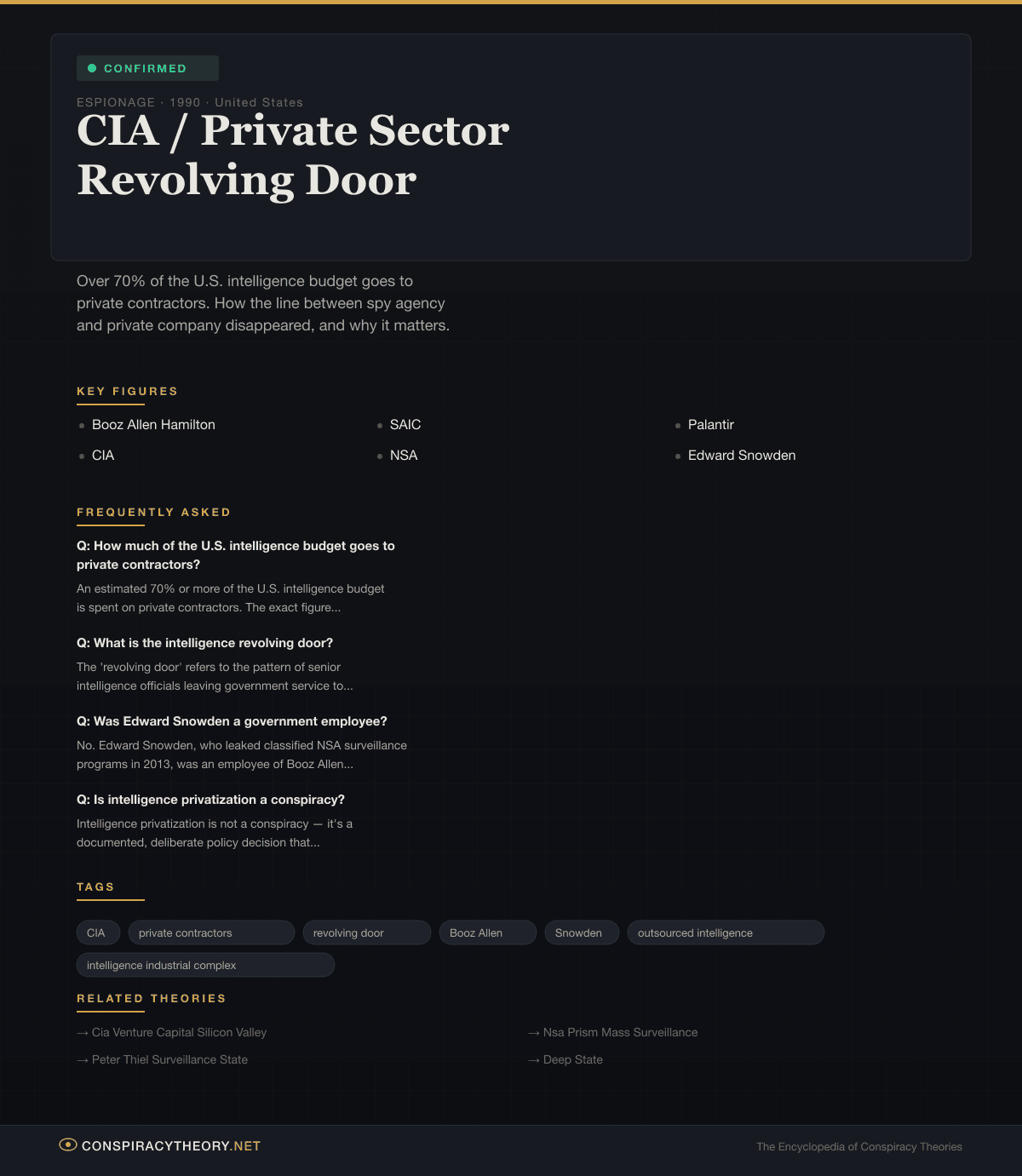
CIA / Private Sector Revolving Door

Overview
In June 2013, the most consequential intelligence leak in American history came not from a CIA officer or an NSA analyst but from an employee of Booz Allen Hamilton — a private consulting firm headquartered in McLean, Virginia, whose lobby decor probably trends toward framed mission statements rather than anything that screams “secret intelligence apparatus.”
Edward Snowden was 29 years old, had been working at Booz Allen for less than three months, and had access to some of the most classified surveillance programs in the United States government. He was a contractor. Not a spy. Not a soldier. An employee of a company that, in 2013, was pulling in approximately $5.8 billion annually from government contracts, mostly in intelligence and defense.
The Snowden affair was many things — a watershed moment in privacy debates, a diplomatic crisis, a political football. But it was also the most vivid possible demonstration of a reality that the intelligence community would have preferred to keep quiet: the majority of America’s spying is done by private companies.
This isn’t a conspiracy theory. It’s a documented feature of the American intelligence system, one that grew explosively after September 11, 2001, and has become so deeply embedded that unwinding it would require restructuring the entire national security apparatus. The private intelligence industry is a confirmed, $50+ billion-a-year operation that raises genuine questions about oversight, accountability, and whether the line between government surveillance and corporate profit has been permanently erased.
Origins & History
The Cold War Model
For most of the Cold War, intelligence work was overwhelmingly performed by government employees. The CIA, NSA, FBI, DIA, and other agencies had their own analysts, case officers, engineers, and support staff. Private contractors played supporting roles — building hardware, maintaining facilities, occasionally providing specialized technical expertise — but the core intelligence mission was a government function.
This began changing in the 1990s. After the Soviet Union collapsed, the “peace dividend” led to significant cuts in intelligence budgets and personnel. Between 1990 and 2001, the CIA lost approximately 25% of its workforce. The NSA experienced similar downsizing. Experienced intelligence professionals were pushed out — and many of them walked directly across the street to private companies that were happy to hire people with security clearances and intelligence expertise, then lease them back to the government at a markup.
The Post-9/11 Explosion
September 11, 2001, changed everything. The intelligence community that had been downsized throughout the 1990s suddenly needed to massively expand — and it needed to do so immediately. Hiring, training, and clearing government employees takes years. Contractors can start Monday.
The numbers tell the story:
- Between 2001 and 2010, the U.S. intelligence budget roughly doubled, from approximately $40 billion to over $80 billion
- An estimated 70% of this increased spending went to private contractors
- The number of private contractors with top-secret clearances grew from approximately 150,000 in 2001 to over 500,000 by 2010
- By 2010, an estimated 1,931 private companies were working on programs related to counterterrorism, homeland security, and intelligence
The Washington Post’s “Top Secret America” investigation in 2010, led by Dana Priest and William Arkin, documented this explosion in devastating detail. They found that the intelligence-industrial complex had become so vast that no one — not the President, not Congress, not the Director of National Intelligence — fully understood its scope.
The Key Players
Booz Allen Hamilton: The crown jewel of the intelligence-industrial complex. The company was founded in 1914 as a management consulting firm and gradually migrated toward government work. By the 2010s, approximately 99% of its revenue came from government contracts, and its connections to the intelligence community were so deep that it was sometimes called “the world’s most profitable spy organization.” Its McLean headquarters is literally down the road from CIA headquarters.
SAIC/Leidos: Science Applications International Corporation, now operating as Leidos after a 2013 split, is one of the largest intelligence contractors. Founded in 1969 by former Los Alamos scientist J. Robert Beyster, SAIC provides intelligence analysis, cybersecurity, and technical support to virtually every U.S. intelligence agency.
Palantir Technologies: Founded in 2003 by Peter Thiel and others with seed funding from In-Q-Tel (the CIA’s venture capital arm), Palantir provides data analytics platforms used by the CIA, NSA, FBI, DHS, and military intelligence agencies. The company’s technology enables pattern recognition across massive datasets — essentially building the surveillance tools that intelligence agencies use to track people.
In-Q-Tel: The CIA’s own venture capital firm, founded in 1999, which invests in technology companies whose products might be useful for intelligence purposes. In-Q-Tel has invested in companies including Palantir, Keyhole (which became Google Earth), and dozens of other technology firms. (See CIA Venture Capital & Silicon Valley.)
The Revolving Door
Exhibit A: Mike McConnell
No single career better illustrates the revolving door than J.M. “Mike” McConnell:
- Government: Director of the National Security Agency (1992-1996)
- Private: Senior Vice President at Booz Allen Hamilton (1996-2007), where he built the company’s intelligence practice into a multi-billion-dollar operation
- Government: Director of National Intelligence (2007-2009), the top intelligence official in the United States
- Private: Vice Chairman of Booz Allen Hamilton (2009-present)
McConnell left the NSA, built Booz Allen’s intelligence business, returned as DNI to oversee the agencies that contracted with Booz Allen, then went back to Booz Allen. At no point was this considered legally problematic, though the conflicts of interest are obvious to anyone willing to look.
Exhibit B: James Clapper
James Clapper served as Director of National Intelligence from 2010 to 2017 — the same period during which private contractors provided the majority of intelligence community services. Before becoming DNI, Clapper had been a senior executive at Booz Allen Hamilton and DIA. After leaving government, he joined various advisory boards, including CNN as a national security analyst.
Clapper became infamous for testifying before Congress in March 2013 that the NSA did not collect data on millions of Americans — a statement that Snowden’s revelations proved to be, at best, misleading and at worst, perjury. Clapper later said he gave the “least untruthful” answer he could in a public setting. The incident illustrated how the revolving door creates a culture where senior officials view their primary loyalty as being to the intelligence system rather than to the public they nominally serve.
The Pattern
The McConnell and Clapper cases are not exceptions — they’re the model:
- CIA directors routinely join defense contractors or consulting firms upon retirement
- NSA technical directors join cybersecurity firms that contract with the NSA
- DIA analysts join intelligence analysis firms that provide services to DIA
- Congressional intelligence committee staff join lobbying firms representing intelligence contractors
The revolving door creates several problems:
- Incentive corruption: Officials who anticipate lucrative private-sector careers have an incentive to expand programs and budgets that will benefit their future employers
- Insider access: Former officials bring relationships and institutional knowledge that give their companies competitive advantages in winning contracts
- Regulatory capture: The people responsible for overseeing contractors are often former or future employees of those contractors
- Classification as a business asset: Companies with cleared personnel and classified program knowledge have near-monopoly positions that make competition essentially impossible
The Accountability Gap
Who Watches the Contractors?
Government intelligence employees are subject to congressional oversight, inspector general investigations, and a web of regulations governing their behavior. Private contractors operate under a different legal framework:
- They are not subject to the same whistleblower protections (Snowden’s status as a contractor complicated his legal situation)
- They are not directly accountable to congressional oversight committees
- Their employees can be more easily fired for raising concerns
- Their corporate structures add layers of opacity to already-opaque intelligence operations
The result is a system where the most sensitive intelligence work is performed by employees of companies whose primary obligation is to shareholders, not to the public. When Booz Allen Hamilton’s stock price benefits from expanded surveillance programs, the company’s financial interests align with expanded surveillance — regardless of whether that surveillance is in the public interest.
The Snowden Lesson
Snowden’s ability to access, copy, and leak vast quantities of classified information while working as a contractor revealed the accountability gap in stark terms. A 29-year-old employee of a private company, with less than three months on the job, had access to some of the most sensitive surveillance programs in the United States. The compartmentalization that was supposed to limit access had broken down, in part because the sprawling contractor workforce made it impossible to maintain the kind of personnel oversight that existed when the intelligence community was smaller and government-staffed.
What Makes This Different from a Conspiracy Theory
Intelligence privatization isn’t a secret. It’s documented in budget reports, investigated by journalists, studied by academics, and debated (occasionally) by Congress. The Washington Post, The Wall Street Journal, and numerous books have detailed the phenomenon.
The conspiracy-adjacent questions are:
- Does the intelligence-industrial complex create its own demand? If companies profit from surveillance, do they lobby for policies that expand surveillance? Evidence suggests yes.
- Is the revolving door just networking, or is it corruption? The legal answer: it’s legal. The ethical answer: it depends on who’s answering.
- Can intelligence privatization be reversed? Almost certainly not. The expertise, infrastructure, and institutional relationships are now overwhelmingly in the private sector. The government couldn’t do this work in-house even if it wanted to.
- Does private intelligence serve the public interest or corporate interests? The official answer: both. The practical answer: follow the money.
Cultural Impact
The intelligence-industrial complex has become a significant plot element in contemporary fiction and film. Jason Bourne, Captain America: The Winter Soldier, and numerous TV series have incorporated themes of privatized intelligence gone wrong. The reality, as usual, is both less cinematic and more concerning than the fiction suggests.
The Snowden revelations generated a global conversation about surveillance, privacy, and the role of private companies in intelligence that continues to shape technology policy. The tension between national security and individual privacy — already inherent in government surveillance — becomes more acute when the surveillance is operated for profit.
Timeline
| Date | Event |
|---|---|
| 1947 | CIA established; intelligence primarily government-staffed |
| 1990s | Post-Cold War intelligence downsizing; contractors fill the gap |
| 1999 | CIA establishes In-Q-Tel venture capital arm |
| 2001 | 9/11 triggers massive intelligence expansion; contractors multiply |
| 2003 | Palantir Technologies founded with In-Q-Tel funding |
| 2007 | Mike McConnell moves from Booz Allen VP to DNI |
| 2010 | Washington Post “Top Secret America” investigation published |
| 2010 | James Clapper becomes DNI |
| 2013 | Edward Snowden (Booz Allen employee) leaks NSA programs |
| 2013 | SAIC splits into SAIC and Leidos |
| 2020 | Palantir goes public; valued at $22 billion |
| 2024 | Palantir market cap exceeds $100 billion |
Sources & Further Reading
- Priest, Dana, and William M. Arkin. Top Secret America: The Rise of the New American Security State. Little, Brown, 2011.
- Shorrock, Tim. Spies for Hire: The Secret World of Intelligence Outsourcing. Simon & Schuster, 2008.
- Mazzetti, Mark. The Way of the Knife: The CIA, a Secret Army, and a War at the Ends of the Earth. Penguin, 2013.
- Greenwald, Glenn. No Place to Hide: Edward Snowden, the NSA, and the U.S. Surveillance State. Metropolitan Books, 2014.
- Office of the Director of National Intelligence. Annual budget disclosures (aggregate figures).
Related Theories
- CIA Venture Capital & Silicon Valley — The CIA’s investment arm
- NSA Mass Surveillance — The Snowden revelations
- Peter Thiel & the Surveillance State — Palantir and government surveillance
- Deep State — The broader theory of entrenched bureaucratic power

Frequently Asked Questions
How much of the U.S. intelligence budget goes to private contractors?
What is the intelligence revolving door?
Was Edward Snowden a government employee?
Is intelligence privatization a conspiracy?

Infographic
Share this visual summary. Right-click to save.