CIA Drug Trafficking
Overview
The Central Intelligence Agency’s connections to international drug trafficking represent one of the most extensively documented and consequential intelligence scandals in American history. Across multiple decades and continents — from the opium fields of Southeast Asia in the 1950s and 1960s, through the cocaine corridors of Central America in the 1980s, to the poppy farms of Afghanistan — a consistent pattern has emerged: the CIA formed alliances with drug traffickers, protected their operations from law enforcement, and in some cases actively facilitated the transport of narcotics, all in service of broader foreign policy and intelligence objectives.
This is not a single conspiracy theory but a documented pattern of behavior confirmed through congressional investigations, CIA Inspector General reports, federal court proceedings, and declassified government documents. The 1989 Kerry Committee report, the 1998 CIA Inspector General investigation prompted by journalist Gary Webb’s reporting, and extensive academic research by scholars including Alfred McCoy have established the essential facts beyond reasonable dispute. The CIA’s involvement was not necessarily one of agents personally running drug shipments — though some evidence suggests even that — but rather a systematic willingness to partner with, protect, and look the other way from drug traffickers who served American geopolitical interests.
The consequences of these operations extended far beyond intelligence circles. The flood of cocaine into American cities during the 1980s, fueled in part by Contra-connected trafficking networks, devastated communities and contributed to the crack epidemic that ravaged predominantly Black urban neighborhoods. The human cost of the CIA’s partnerships with drug traffickers has been enormous, and the full scope of these operations remains a subject of ongoing investigation and debate.
Origins & History
The CIA’s entanglement with drug trafficking dates to the earliest years of the Cold War. In the late 1940s and early 1950s, the agency formed alliances with Corsican organized crime figures in Marseille, France, to break Communist-led labor unions that threatened to disrupt Marshall Plan shipments. These Corsican allies operated heroin laboratories that processed opium from Turkey into heroin destined for the American market — the so-called “French Connection.” The CIA’s support for these groups helped establish one of the most profitable heroin trafficking routes of the twentieth century.
In Southeast Asia, the pattern deepened. During the 1950s and 1960s, the CIA recruited Hmong tribesmen in Laos to fight a secret war against Communist Pathet Lao forces. The Hmong, led by General Vang Pao, were deeply involved in opium cultivation, which was their primary cash crop. The CIA’s proprietary airline, Air America, transported supplies to remote Hmong bases in the mountains of Laos. Multiple sources, including former Air America pilots and historian Alfred McCoy, documented that Air America aircraft carried opium on return flights. McCoy’s landmark 1972 book The Politics of Heroin in Southeast Asia detailed how CIA support for anti-Communist forces throughout the region facilitated the growth of the Golden Triangle heroin trade.
The most thoroughly investigated chapter of CIA drug involvement centers on the Contra war in Nicaragua during the 1980s. When Congress cut off funding to the Contra rebels fighting the Sandinista government through the Boland Amendment, the Reagan administration — particularly National Security Council staffer Oliver North — organized covert supply operations. Multiple Contra leaders and supply network figures were involved in cocaine trafficking, using the same planes and routes that delivered weapons to the Contras to transport cocaine back to the United States.
In 1996, journalist Gary Webb of the San Jose Mercury News published “Dark Alliance,” a series linking the Contra cocaine pipeline to the crack epidemic in Los Angeles. Webb reported that Nicaraguan traffickers Danilo Blandon and Norwin Meneses, who had connections to the Contra movement, supplied massive quantities of cheap cocaine to dealer Ricky “Freeway” Ross, whose distribution network spread crack throughout South Central Los Angeles and other cities. The series provoked intense controversy, and Webb was subjected to a coordinated counterattack by major newspapers including the Los Angeles Times, Washington Post, and New York Times. Webb was eventually pushed out of journalism and died by suicide in 2004.
Key Claims
The documented and alleged connections between the CIA and drug trafficking include:
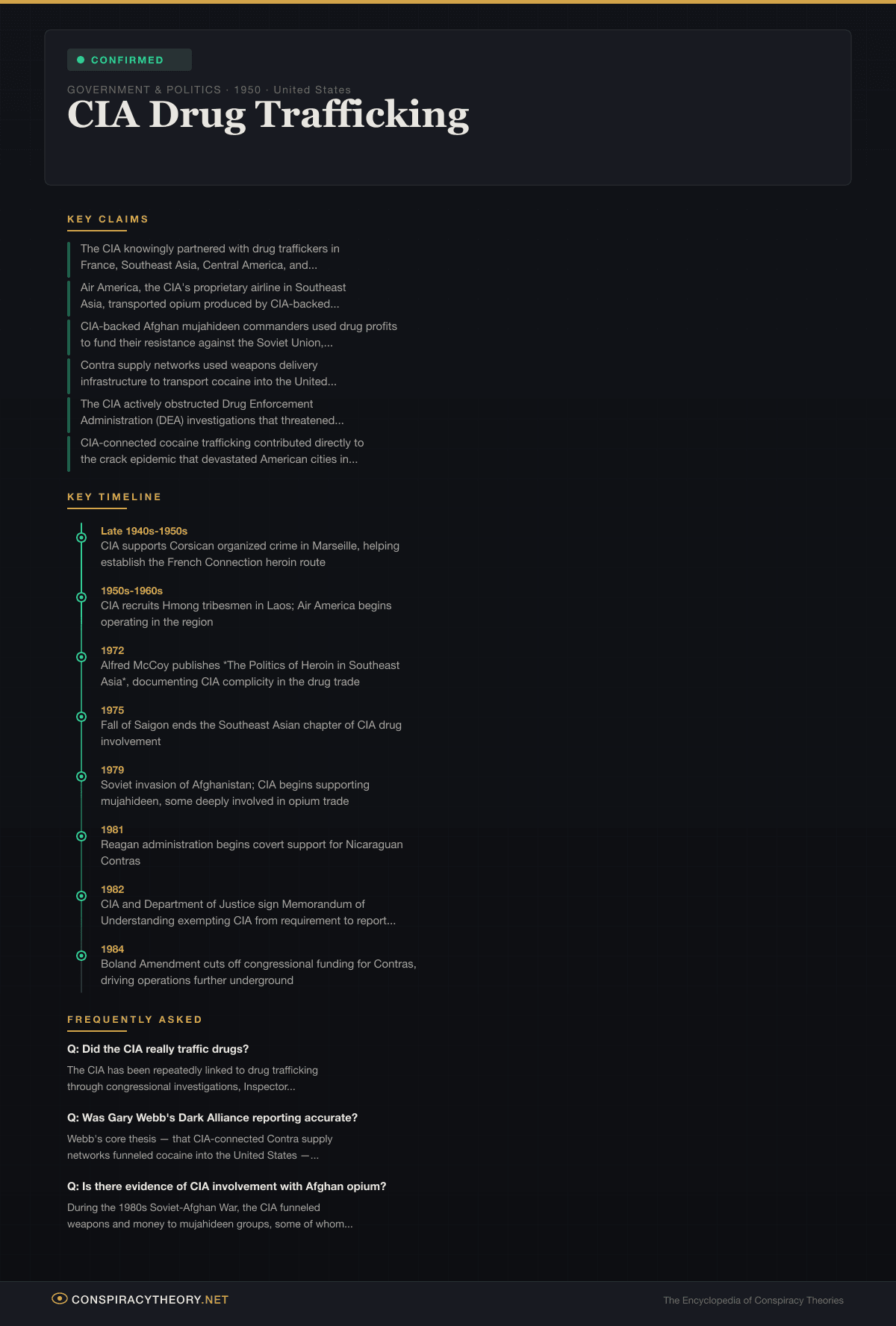
- The CIA knowingly partnered with drug traffickers in France, Southeast Asia, Central America, and Afghanistan when those traffickers served U.S. intelligence or foreign policy interests
- Air America, the CIA’s proprietary airline in Southeast Asia, transported opium produced by CIA-backed Hmong forces in Laos
- CIA-backed Afghan mujahideen commanders used drug profits to fund their resistance against the Soviet Union, with CIA knowledge and acquiescence
- Contra supply networks used weapons delivery infrastructure to transport cocaine into the United States during the 1980s
- The CIA actively obstructed Drug Enforcement Administration (DEA) investigations that threatened to expose its assets’ drug trafficking activities
- CIA-connected cocaine trafficking contributed directly to the crack epidemic that devastated American cities in the 1980s and 1990s
- Pilot Barry Seal, who became one of the most prolific drug smugglers in American history, worked simultaneously for the CIA and the DEA while trafficking cocaine for the Medellin Cartel
- The CIA maintained a formal policy of not reporting drug trafficking by its assets to law enforcement, codified in a 1982 Memorandum of Understanding with the Department of Justice
- Manuel Noriega, the Panamanian dictator who was on the CIA payroll for years, was deeply involved in drug trafficking with the agency’s knowledge
Evidence
The evidence for CIA involvement in drug trafficking comes from an unusually robust combination of sources:
Congressional investigations. The most significant was the investigation led by Senator John Kerry (D-MA), whose Subcommittee on Terrorism, Narcotics, and International Operations published its findings in 1989. The “Kerry Committee Report” concluded that “it is clear that individuals who provided support for the Contras were involved in drug trafficking” and that “U.S. officials involved in Central America failed to address the drug issue for fear of jeopardizing the war efforts against Nicaragua.” The report documented cases where the State Department paid known drug traffickers with funds from the Nicaraguan Humanitarian Assistance Office.
CIA Inspector General reports. Following Gary Webb’s “Dark Alliance” series, CIA Director John Deutch ordered an Inspector General investigation. The resulting 1998 report, authored by IG Frederick Hitz, was devastating. It confirmed that the CIA had maintained relationships with Contra organizations and individuals involved in drug trafficking, that the agency had received allegations of Contra drug trafficking and failed to investigate them, and that a 1982 Memorandum of Understanding between the CIA and the Department of Justice explicitly exempted the CIA from requirements to report drug trafficking by its assets. This last finding was particularly damning — it meant the CIA had negotiated a formal legal exemption from reporting drug crimes committed by its partners.
Court proceedings. Federal court cases provided additional confirmation. During the trial of Norwin Meneses, the prosecution’s own evidence showed Contra connections to drug trafficking. In the case of CIA asset and Contra supporter John Hull, Costa Rican authorities charged Hull with drug trafficking based on evidence from his ranch, which was used as a Contra supply base. Hull fled Costa Rica before trial.
DEA records and testimony. Former DEA agents, including Celerino Castillo III, who was stationed in Central America during the 1980s, reported that they documented drug trafficking by Contra supply network figures operating from Ilopango Air Base in El Salvador, and that their reports were ignored or suppressed by superiors.
Academic research. Alfred McCoy’s exhaustive research, published in multiple editions of The Politics of Heroin, documented CIA complicity in drug trafficking across decades and continents, drawing on interviews with participants, government documents, and secondary sources. His work has been widely cited by scholars and policymakers.
Pilot testimony. Multiple pilots involved in Contra supply operations testified or made sworn statements about carrying drugs on return flights from Central America. Michael Tolliver testified that he flew weapons to the Contras and marijuana back to the United States with the knowledge of U.S. government officials.
Debunking / Verification
As a confirmed pattern of behavior, the core claims of CIA involvement with drug traffickers are not seriously in dispute. However, several important distinctions and contested points should be noted:
Direct versus indirect involvement. The CIA has consistently denied that it directly trafficked drugs as an institutional policy. The evidence more clearly supports the characterization that the CIA partnered with, protected, and turned a blind eye to drug traffickers rather than that CIA officers personally organized drug shipments. However, the line between facilitation and direct involvement is a matter of interpretation, and some evidence — such as Air America transport of opium — suggests more direct participation in certain operations.
The crack epidemic question. Gary Webb’s most controversial claim — that the CIA bore significant responsibility for the crack epidemic — remains a subject of debate. The 1998 CIA IG report confirmed that CIA-connected traffickers supplied cocaine that ended up as crack, but the report did not conclude that the CIA intentionally created or promoted the crack epidemic. Critics argue the crack epidemic had multiple causes and that no single trafficking pipeline could account for it. Supporters counter that the CIA’s protection of major trafficking networks removed a critical barrier that would have otherwise limited cocaine supply.
Scale of operations. While the pattern of CIA drug complicity is well documented, estimates of the volume of drugs moved through CIA-connected networks vary widely and are inherently difficult to verify. Some claims about the scale of CIA involvement may be exaggerated, while the agency’s own investigations suggest the problem was more pervasive than initially acknowledged.
Webb’s reporting. While the thrust of Webb’s reporting was vindicated by the CIA IG report, his original series contained some overstatements and insufficiently supported claims, particularly regarding the directness of the connection between CIA decision-making and crack distribution in Los Angeles. These weaknesses were exploited by critics to discredit the entire investigation.
Cultural Impact
The CIA drug trafficking story has had a profound and lasting impact on American politics, culture, and race relations. In African American communities, the knowledge that government-connected actors had flooded their neighborhoods with cocaine while the government simultaneously launched a punitive “War on Drugs” generated deep and enduring distrust of federal institutions. This distrust is not merely anecdotal — it has been documented in surveys and studies and has affected public health efforts, criminal justice debates, and political participation.
The story contributed to broader skepticism about the War on Drugs itself. If the government’s own intelligence agency was facilitating drug trafficking while the criminal justice system was imprisoning millions of Americans — disproportionately Black and Latino — for drug offenses, the entire framework of drug prohibition appeared hypocritical. This critique gained mainstream traction and influenced the growing movement for drug policy reform.
Gary Webb’s story became emblematic of the dangers faced by journalists who challenge powerful institutions. His professional destruction and death became a cautionary tale cited in discussions of press freedom, institutional retaliation, and the failure of mainstream media to support investigative reporters pursuing politically inconvenient stories.
In Popular Culture
The CIA drug trafficking narrative has inspired numerous films, books, and television productions. The 2014 film Kill the Messenger, starring Jeremy Renner, told the story of Gary Webb’s investigation and its aftermath. American Made (2017), starring Tom Cruise, dramatized the life of Barry Seal. Snowfall (2017-2023), the FX television series, explored the origins of the crack epidemic in Los Angeles with storylines directly inspired by the CIA-Contra-cocaine connection.
The documentary Freeway: Crack in the System (2015) examined the career of Ricky Ross and his connections to Contra-linked cocaine suppliers. Netflix’s Narcos series, while focused primarily on Colombian cartels, touched on CIA connections to the drug trade.
Alfred McCoy’s The Politics of Heroin remains the definitive academic work on the subject. Webb’s own book, Dark Alliance: The CIA, the Contras, and the Crack Cocaine Explosion (1998), provided the full account of his investigation and findings.
Key Figures
Gary Webb — San Jose Mercury News journalist whose 1996 “Dark Alliance” series documented connections between Contra-linked traffickers and the crack epidemic in Los Angeles. Subjected to intense professional criticism, left journalism, and died by suicide in 2004. Key findings were later substantiated by the CIA Inspector General.
Alfred McCoy — Historian and professor whose 1972 book The Politics of Heroin in Southeast Asia (later expanded as The Politics of Heroin) documented CIA complicity in the Southeast Asian drug trade.
Oliver North — National Security Council staffer who coordinated covert Contra supply operations. His notebooks, released during the Iran-Contra investigation, contained numerous references to drug trafficking by Contra supply figures.
John Kerry — U.S. Senator who chaired the subcommittee investigation into Contra drug links, producing the landmark 1989 report documenting government complicity.
Barry Seal — Pilot and drug smuggler who worked simultaneously for the CIA, the DEA, and the Medellin Cartel. Assassinated in 1986.
Manuel Noriega — Panamanian dictator and longtime CIA asset who facilitated drug trafficking and money laundering. Eventually indicted and invaded by U.S. forces in 1989.
Ricky “Freeway” Ross — Los Angeles crack dealer supplied by Contra-connected Nicaraguan traffickers Danilo Blandon and Norwin Meneses. His distribution network was central to the spread of crack in South Central Los Angeles.
Vang Pao — Hmong military leader in Laos who led CIA-backed forces while involved in opium trafficking. Resettled in the United States after the Communist victory in Laos.
Celerino Castillo III — DEA agent stationed in Central America who documented Contra-connected drug trafficking from Ilopango Air Base and found his reports ignored by superiors.
William Casey — CIA Director during the Reagan administration who oversaw covert Contra support operations and is alleged to have known about drug trafficking within the supply networks.
Timeline
- Late 1940s-1950s — CIA supports Corsican organized crime in Marseille, helping establish the French Connection heroin route
- 1950s-1960s — CIA recruits Hmong tribesmen in Laos; Air America begins operating in the region
- 1972 — Alfred McCoy publishes The Politics of Heroin in Southeast Asia, documenting CIA complicity in the drug trade
- 1975 — Fall of Saigon ends the Southeast Asian chapter of CIA drug involvement
- 1979 — Soviet invasion of Afghanistan; CIA begins supporting mujahideen, some deeply involved in opium trade
- 1981 — Reagan administration begins covert support for Nicaraguan Contras
- 1982 — CIA and Department of Justice sign Memorandum of Understanding exempting CIA from requirement to report drug trafficking by its assets
- 1984 — Boland Amendment cuts off congressional funding for Contras, driving operations further underground
- 1986 — Barry Seal assassinated in Baton Rouge; Iran-Contra scandal begins to unravel
- 1986-1987 — Iran-Contra hearings expose covert operations including Oliver North’s network
- 1989 — Kerry Committee publishes report documenting Contra drug connections; U.S. invades Panama and arrests Manuel Noriega
- 1996 — Gary Webb publishes “Dark Alliance” series in San Jose Mercury News
- 1997 — Major newspapers publish critical stories challenging Webb’s reporting; Mercury News editor apologizes for the series
- 1998 — CIA Inspector General publishes two-volume report largely substantiating Webb’s core findings about CIA relationships with drug traffickers
- 1998 — Gary Webb publishes expanded book Dark Alliance
- 2001 — U.S. invasion of Afghanistan; opium production, suppressed by Taliban, surges dramatically in subsequent years
- 2004 — Gary Webb dies by suicide
- 2014 — Film Kill the Messenger tells Webb’s story
- 2017 — American Made dramatizes Barry Seal’s career
Sources & Further Reading
- McCoy, Alfred W. The Politics of Heroin: CIA Complicity in the Global Drug Trade. Lawrence Hill Books, revised edition, 2003.
- Webb, Gary. Dark Alliance: The CIA, the Contras, and the Crack Cocaine Explosion. Seven Stories Press, 1998.
- Kerry, John, and Hank Brown. “Drugs, Law Enforcement, and Foreign Policy.” Report of the Senate Subcommittee on Terrorism, Narcotics, and International Operations, 1989.
- Central Intelligence Agency, Office of Inspector General. “Report of Investigation: Allegations of Connections Between CIA and the Contras in Cocaine Trafficking to the United States.” Volumes I and II, 1998.
- Scott, Peter Dale, and Jonathan Marshall. Cocaine Politics: Drugs, Armies, and the CIA in Central America. University of California Press, 1991.
- Castillo, Celerino III, and Dave Harmon. Powderburns: Cocaine, Contras and the Drug War. Mosaic Press, 1994.
- Cockburn, Alexander, and Jeffrey St. Clair. Whiteout: The CIA, Drugs, and the Press. Verso, 1998.
- Schou, Nick. Kill the Messenger: How the CIA’s Crack-Cocaine Controversy Destroyed Journalist Gary Webb. Nation Books, 2006.
Related Theories
- CIA Drug Trafficking — Detailed examination of specific confirmed CIA drug trafficking operations
- Crack Epidemic Conspiracy — The theory that the crack epidemic was deliberately engineered or facilitated by government agencies
- Iran-Contra Affair — The arms-for-hostages scandal that exposed covert Contra supply operations
- Mena, Arkansas Drug Trafficking — Allegations of CIA-connected drug smuggling through a small Arkansas airport
- Journalist and Whistleblower Suppression — The pattern of retaliation against reporters and insiders who expose government wrongdoing
Frequently Asked Questions
Did the CIA really traffic drugs?
Was Gary Webb's Dark Alliance reporting accurate?
Is there evidence of CIA involvement with Afghan opium?
Infographic
Share this visual summary. Right-click to save.