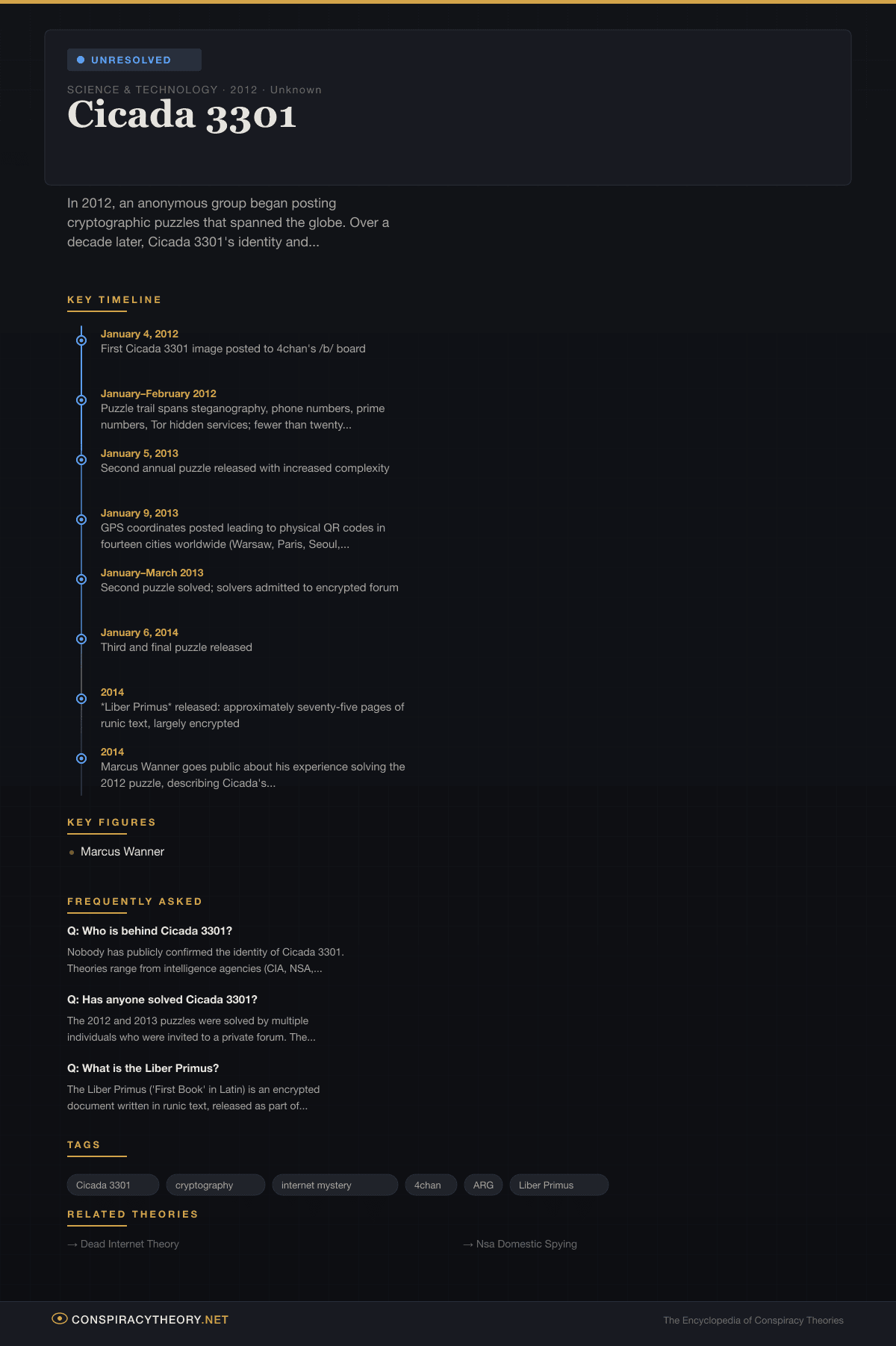
Cicada 3301
Overview
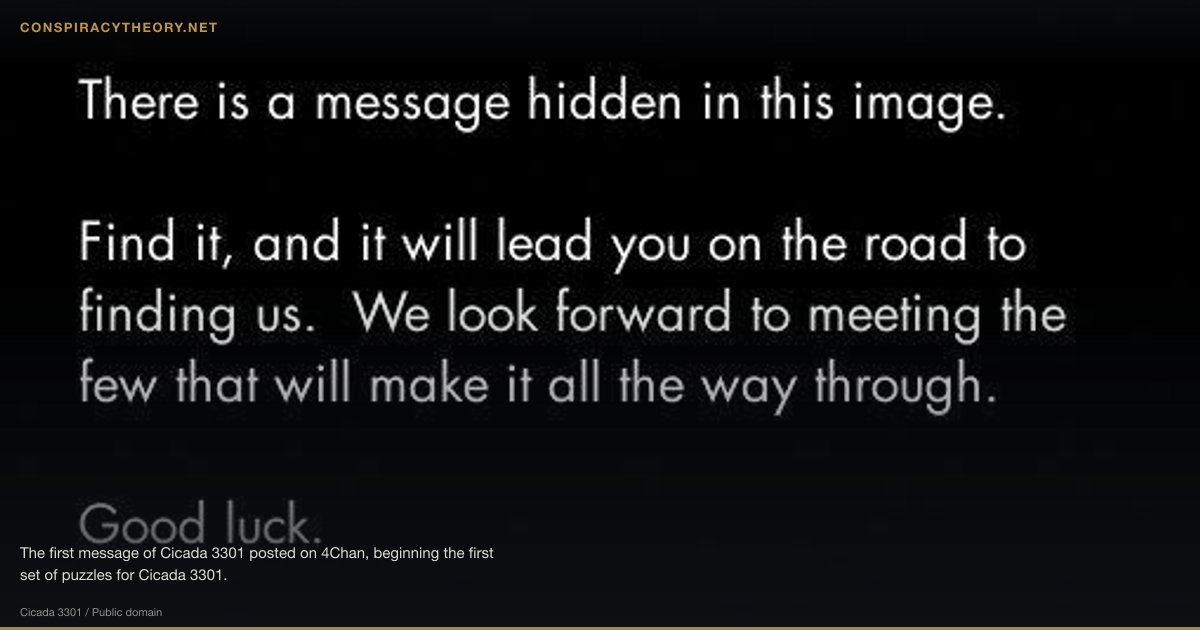
On January 4, 2012, someone — or something, or some group of someones — posted an image to 4chan’s /b/ board. It was plain white text on a black background, the kind of thing that would normally get buried under an avalanche of memes and shitposts within seconds. But this one stuck. It read:
“Hello. We are looking for highly intelligent individuals. To find them, we have devised a test. There is a message hidden in this image. Find it, and it will lead you on the road to finding us. We look forward to meeting the few that will make it all the way through. Good luck.”
It was signed with a symbol: a cicada. Not a name, not a pseudonym, not a tripcode — just the image of an insect that spends years underground before emerging, screaming, into the light.
What followed was one of the most elaborate, intellectually demanding, and genuinely baffling puzzle sequences in the history of the internet. Over three years — 2012, 2013, and 2014 — the entity known as Cicada 3301 released cryptographic challenges that spanned continents, required knowledge of number theory, classical literature, Anglo-Saxon runes, steganography, Tor hidden services, and physical clues posted on lamp posts in fourteen cities across five continents. Then, just as mysteriously as it began, it stopped.
More than a decade later, no one has publicly confirmed who Cicada 3301 is. No organization has claimed credit. The final puzzle — an encrypted runic text called the Liber Primus — remains largely unsolved. And the internet, a place that usually ruins every mystery within forty-eight hours, has been left genuinely, maddeningly stumped.
The First Puzzle: January 2012
The Image That Started Everything
The 4chan image looked like nothing. If you just opened it in a browser, you saw the message quoted above and nothing else. But the text told you a message was hidden in the image — not in the text, in the file itself. This was the first filter. If you didn’t know what steganography was, you were already out.
Steganography — the practice of hiding data within other data — is older than computers. People have been hiding messages in images, music, and innocuous-looking documents for centuries. In the digital age, it means embedding information in the least-significant bits of an image file, invisible to the naked eye but recoverable with the right tools. The 4chan image contained a hidden message encoded using a program called OutGuess.
Extracting the hidden data revealed a URL. The URL led to an image of a duck with the text: “WOOPS. Just decoys this way. Looks like you can’t guess how to get the message out.” Most people would have stopped there. The message seemed to say the trail was cold. But “guess” was deliberately capitalized — a hint pointing back to OutGuess. Running OutGuess on the duck image revealed another hidden message: a URL leading to a subreddit.
This was the pattern. Every answer was a door to another door. Every solution opened a new problem. Every hint was buried inside something that looked like a dead end.
Down the Rabbit Hole
The subreddit contained a series of encoded messages using a Caesar cipher — one of the oldest encryption methods, named after Julius Caesar, who allegedly used it to communicate with his generals. Decoding these messages revealed phone numbers. Actual, working phone numbers in Texas and Washington state. Calling them played recorded messages containing yet more encoded data.
The phone messages led to more images, more steganography, more ciphers. The trail wound through prime number sequences, Mayan numerology, a William Gibson poem, and references to the medieval Welsh text The Mabinogion. It was as if someone had designed an intelligence test by raiding a university library and a hacker convention simultaneously.
At each stage, the puzzles required a different skill set. Brute-force coding wouldn’t save you. Neither would raw mathematical ability. You needed breadth — the ability to recognize a classical reference one moment and implement a custom decryption algorithm the next. You needed the kind of eclectic, lateral-thinking intelligence that doesn’t fit neatly into any academic discipline.
The final stage of the 2012 puzzle led to a Tor hidden service — a website accessible only through the anonymity network. The site displayed a countdown timer and a message congratulating those who had made it this far. When the timer expired, the first group of solvers — reportedly fewer than twenty people worldwide — were given access to a private, encrypted communication channel.
And then silence. No press conference, no reveal, no “congratulations, you’ve been recruited by the CIA.” Just a closed door and a long, strange quiet.
The Second Puzzle: January 2013
Raising the Stakes
Almost exactly one year later, on January 5, 2013, a new image appeared. Same black background, same white text, same cicada symbol. The message confirmed what many had suspected: this wasn’t a one-time stunt. It was a recurring event, an annual recruitment drive by an organization that existed nowhere and communicated only through puzzles.
The 2013 puzzle was harder. Much harder. It incorporated everything from the previous year and added new layers: book codes referencing specific pages of specific editions of specific texts, musical cryptography, and — in a twist that electrified the global puzzle-solving community — physical clues.
The Posters
On January 9, 2013, Cicada 3301 posted a set of GPS coordinates. Fourteen of them, scattered across the globe: Warsaw, Paris, Seoul, Sydney, Hawaii, Miami, New Orleans, Seattle, and more. At each location, someone had physically posted a QR code on a public surface — a lamp post, a wall, a phone booth. The QR codes led to URLs, which led to more puzzles.
Think about what that means for a moment. Whoever was behind Cicada 3301 had operatives — or at the very least, cooperative individuals — in fourteen cities across five continents, all posting physical clues in public spaces within the same narrow time window. This wasn’t some bored teenager in a basement. This was coordination. This was infrastructure. This was the kind of thing that costs money and requires planning.
The physical clues sent puzzle solvers scrambling to the locations, photographing QR codes, and racing each other to decode the next stage. It was like a global scavenger hunt designed by someone who had read too much Neal Stephenson and had the operational budget to make it real.
The Book Code and the Anglo-Saxon Runes
The 2013 puzzle introduced one of Cicada 3301’s most enduring motifs: the Anglo-Saxon runic alphabet. Messages were encoded using runes from the Old English Rune Poem, a ninth-century text describing the twenty-nine runes of the Anglo-Saxon futhorc. Each rune has a name, a phonetic value, and a stanza in the poem — all of which became keys for increasingly complex ciphers.
The puzzle also employed a book cipher — a technique where each word or letter in the plaintext is encoded as a reference to its position in a specific book. Cicada’s book ciphers referenced texts as varied as The Lady of the Fountain (from The Mabinogion), the works of William Blake, and various cryptographic papers. If you hadn’t read widely, you were going to have a bad time.
The 2013 puzzle culminated in another Tor hidden service, another countdown timer, and another handful of successful solvers being admitted to the inner sanctum. But this time, something leaked out.
Marcus Wanner and the Inner Circle
Marcus Wanner was fifteen years old when he solved the 2012 Cicada puzzle. A high school student from Virginia, he was one of the few solvers who eventually went public about the experience, giving interviews in 2014 that pulled back the curtain — just slightly — on what waited at the end of the trail.
According to Wanner, the final stage wasn’t a job offer. It wasn’t a government recruitment pitch. It wasn’t anything as clean or dramatic as the theories suggested. Instead, solvers were invited to join an encrypted forum where they were told about Cicada 3301’s ideology: a commitment to privacy, information freedom, and resistance to censorship. The group described itself in terms that sounded broadly libertarian and crypto-anarchist — suspicious of government surveillance, hostile to corporate data collection, and committed to building tools that would protect individual privacy.
Wanner described being disappointed. After the thrill of the puzzle — months of cryptographic rabbit holes, each more intricate than the last — the endgame felt anticlimactic. There was no grand revelation, no secret society initiation rite, no meeting with shadowy intelligence operatives in a parking garage. There was a forum, a philosophy, and a vague sense of purpose.
But Wanner also described something else: the group appeared to be working on a software project. Some former participants have independently claimed that Cicada 3301 was building a decentralized, censorship-resistant communication platform — a kind of encrypted, peer-to-peer network that would be resistant to surveillance and shutdown by governments or corporations. The puzzles, in this framing, weren’t just recruitment tools. They were filters, designed to identify the specific kind of intelligence — technically skilled, intellectually curious, ideologically sympathetic — that would be needed to build and maintain such a system.
Whether this platform was ever completed, partially built, or existed only as an aspiration remains unknown. Wanner and other public solvers have been notably vague on the details, suggesting either that they don’t know much more or that they were asked — and agreed — not to share.
The Third Puzzle and the Liber Primus
2014: The Final Round
The third and final Cicada 3301 puzzle appeared on January 6, 2014. By this point, the mystery had graduated from 4chan curiosity to international news. The Guardian, Vice, Wired, and dozens of other outlets had covered the story. Thousands of people worldwide were actively working on the puzzles, collaborating in dedicated forums and IRC channels.
The 2014 puzzle followed the established pattern — steganography, ciphers, runes, Tor hidden services — but introduced something that changed the game entirely: the Liber Primus.
The Unsolved Book
The Liber Primus — Latin for “First Book” — is a document of approximately seventy-five pages, written almost entirely in Anglo-Saxon runes. Some pages contain illustrations: geometric patterns, biological diagrams, and abstract art that wouldn’t look out of place in an occult manuscript. The whole thing has the aesthetic of a medieval grimoire rewritten by a mathematician.
A handful of pages have been decrypted. The decoded sections contain philosophical text that reads like a manifesto — discussions of privacy, consciousness, prime numbers, and the nature of reality. One decoded passage reads: “An organism’s prime directive is to consume, replicate, and evolve. The highest form of existence is one that has transcended biological imperatives and achieved pure information.” Another instructs the reader: “Do not believe anything without question. Do not follow leaders. Question everything.”
The decoded passages are dense with references to libertarian philosophy, information theory, and what might be called techno-mysticism — a blend of mathematical rigor and spiritual language that treats cryptography as something between a science and a sacrament. The runes aren’t just an encoding method; they seem to be a deliberate aesthetic choice, connecting the digital puzzles to ancient traditions of hidden knowledge and initiation.
But here’s the thing: the majority of the Liber Primus remains encrypted. Despite more than a decade of sustained effort by thousands of skilled cryptographers, mathematicians, and amateur puzzle solvers, no one has cracked the encryption method used for the remaining pages. Entire subreddits and Discord servers are dedicated to the problem. People have thrown every technique in the cryptanalytic arsenal at it — frequency analysis, known-plaintext attacks, brute-force computing, machine learning, even quantum computing approaches. Nothing has worked.
The Liber Primus sits there, unreadable, like a locked door in the middle of the internet. And no one has found the key.
Who Is Cicada 3301? The Theories
Intelligence Agency Recruitment
The most persistent theory is that Cicada 3301 is a recruitment tool for an intelligence agency — the CIA, NSA, MI6, or Mossad. The reasoning is straightforward: the puzzles test exactly the kind of skills that signals intelligence agencies need. Cryptanalysis, steganography, lateral thinking, fluency with anonymity tools, the ability to work under pressure on ambiguous problems with no clear instructions. The global physical infrastructure (posters in fourteen countries) suggests the resources of a state actor. And intelligence agencies have a long, documented history of using unconventional recruitment methods to find people who think differently.
The British intelligence agency GCHQ, for instance, publicly ran a puzzle-based recruitment campaign called “Can You Crack It?” in 2011 — just a year before Cicada’s first appearance. The NSA has historically recruited at hacker conferences and through university math departments. The idea that an agency would post a puzzle on 4chan to find talented cryptographers isn’t far-fetched at all. In fact, 4chan’s /b/ board — chaotic, anonymous, and populated by exactly the kind of technically skilled, authority-skeptical minds that intelligence agencies crave — is arguably a better recruiting ground than any campus career fair.
Against this theory: Marcus Wanner and other solvers describe an ideology that is actively hostile to government surveillance. If Cicada is a state actor, they’re doing an excellent job of pretending not to be. It’s also worth noting that intelligence agencies, when they do recruit unconventionally, tend to eventually acknowledge the recruitment — GCHQ proudly publicized its puzzle campaign. Over a decade of silence is unusual for a government program.
Hacktivist Collective
Another theory positions Cicada 3301 as a hacktivist group in the mold of Anonymous or the Cypherpunks — privacy advocates using the puzzles to identify and recruit technically skilled individuals for activist purposes. The libertarian, anti-surveillance ideology described by Wanner fits this profile perfectly. So does the emphasis on Tor, encryption, and decentralized communication.
The Cypherpunk movement of the 1990s — which included figures like Julian Assange, Phil Zimmermann (creator of PGP encryption), and John Gilmore — laid the intellectual groundwork for much of what Cicada 3301 appears to believe. The movement held that strong cryptography was a tool of individual liberation, that privacy was a fundamental right, and that governments would inevitably try to suppress encryption to maintain surveillance capabilities. These ideas are echoed in the decoded portions of the Liber Primus and in the accounts of participants who made it to the inner circle.
If Cicada is a hacktivist project, the puzzles serve a dual purpose: they identify people with the right technical skills, and they filter for individuals who share the right ideological commitments. By the time you’ve spent months solving cryptographic puzzles wrapped in Anglo-Saxon runes and libertarian philosophy, you’re already self-selected for a particular worldview.
A Private Company or Think Tank
Some observers have speculated that Cicada 3301 might be a private company, a tech startup, or a research organization using the puzzles to identify and recruit exceptional talent. Silicon Valley has a long history of using unconventional hiring methods — Google famously posted mathematical puzzles on billboards — and the puzzles’ emphasis on diverse technical skills aligns with what a cutting-edge technology company might need.
This theory is harder to evaluate because it’s so vague. Which company? What product? If Cicada was building a decentralized communication platform, as some participants have claimed, there are hundreds of organizations and projects that might have had such a goal. The Tor Project, the Signal Foundation, various blockchain startups — the privacy-tech ecosystem is crowded with groups that share Cicada’s stated values. None has claimed a connection.
An Elaborate ARG (Alternate Reality Game)
The least conspiratorial explanation is that Cicada 3301 is simply an ARG — an alternate reality game designed for entertainment rather than any practical purpose. ARGs are collaborative narrative experiences that unfold across multiple media and platforms, using puzzles, websites, and real-world interactions to tell a story. They have a rich history in internet culture, from the “I Love Bees” campaign for Halo 2 to the elaborate games run by companies like Nonchalance.
If Cicada is an ARG, it’s the most ambitious one ever created — and it’s notable for having no apparent commercial purpose. Every other major ARG has eventually been revealed as marketing for something: a movie, a video game, a product launch. Cicada 3301 has never been connected to any commercial product. No one has come forward to take credit. There is no sponsoring corporation, no narrative resolution, no final act where the curtain is pulled back and you’re told it was all a promotion for a new mobile game.
The ARG theory also struggles to explain the Liber Primus. If this is a game, the game has been stuck on the same level for over a decade. That’s not a game. That’s a statement.
The Silence: 2015 to Present
After the 2014 puzzle and the release of the Liber Primus, Cicada 3301 went quiet. There have been no new puzzles. No new images on 4chan. No new posters on lamp posts in far-flung cities. The Tor hidden services associated with previous puzzles have gone offline. The PGP key associated with Cicada 3301 — used to cryptographically sign messages and prove their authenticity — has been used only once since 2014, to issue a warning about imposters posting fake puzzles in Cicada’s name.
The silence has done nothing to diminish interest. If anything, it has intensified the mystery. The Cicada 3301 community — spread across Reddit, Discord, and dedicated forums — continues to work on the Liber Primus. New decryption techniques are proposed, tested, and discarded on a regular basis. Theories about the group’s identity are debated with theological intensity.
Some interpret the silence as evidence that Cicada achieved its goal — that the recruits were found, the project was completed, and the puzzles served their purpose. Others believe the Liber Primus is itself the final puzzle, and that solving it will reveal the next stage. A few grimmer interpretations suggest that the project collapsed, that its organizers were arrested or compromised, or that internal disagreements tore the group apart.
The only thing everyone agrees on is that no one knows. And in an age when every secret seems to leak within days, when anonymous sources spill classified programs to journalists over encrypted chat, when even the most sophisticated intelligence operations eventually find their way onto Wikipedia — Cicada 3301 has kept its secret for over fourteen years. That alone is remarkable.
Cultural Impact and Legacy
Cicada 3301 left a mark on internet culture that far outlasted its three years of activity. It became the archetype for “the internet mystery” — the gold standard against which every subsequent online puzzle, ARG, and anonymous challenge is measured. When a mysterious puzzle appears on Reddit or 4chan, the first comment is invariably a comparison to Cicada 3301. Usually, the comparison is unflattering.
The puzzle sequence also highlighted a genuine tension in how we think about the internet. In an era of mass surveillance and eroding digital privacy, the idea of a group using the internet’s own tools — encryption, anonymity, steganography — to identify and recruit people who value those things resonated deeply. Cicada 3301 was, in a sense, the internet at its best: anonymous, meritocratic, intellectually demanding, and utterly resistant to the forces (corporate, governmental, cultural) that were rapidly taming and monetizing everything else online.
The Liber Primus has become a kind of folk artifact — a digital Dead Sea Scroll that anyone can download but no one can read. It exists at the intersection of cryptography and mythology, a modern puzzle box wrapped in ancient aesthetic language. For the community that continues to work on it, solving the book isn’t just an intellectual challenge. It’s an act of faith — faith that the effort means something, that the book contains something worth reading, that someone, somewhere, designed it to be solved.
Whether that faith is justified remains to be seen. The cicada, after all, is an insect that spends years underground, silent and invisible, before emerging all at once in a deafening chorus. The entomological metaphor is almost too perfect to be accidental. If Cicada 3301 is truly gone, they picked the right symbol for a very different reason: some things sing their song and then disappear, and you’re left wondering whether you dreamed the whole thing.
Timeline
- January 4, 2012 — First Cicada 3301 image posted to 4chan’s /b/ board
- January–February 2012 — Puzzle trail spans steganography, phone numbers, prime numbers, Tor hidden services; fewer than twenty solvers reach the final stage
- January 5, 2013 — Second annual puzzle released with increased complexity
- January 9, 2013 — GPS coordinates posted leading to physical QR codes in fourteen cities worldwide (Warsaw, Paris, Seoul, Sydney, Hawaii, Miami, and more)
- January–March 2013 — Second puzzle solved; solvers admitted to encrypted forum
- January 6, 2014 — Third and final puzzle released
- 2014 — Liber Primus released: approximately seventy-five pages of runic text, largely encrypted
- 2014 — Marcus Wanner goes public about his experience solving the 2012 puzzle, describing Cicada’s libertarian, privacy-focused ideology
- 2014–2015 — Partial decryption of several Liber Primus pages reveals philosophical and manifesto-like content
- April 2017 — Cicada’s PGP key used to warn about fake puzzles being posted by imposters
- 2015–present — No new puzzles released; community continues working on Liber Primus; majority of the book remains undeciphered
Sources & Further Reading
- Kushner, David. “The Hardest Puzzle on the Internet.” Rolling Stone, October 15, 2015.
- Bell, Chris. “The Internet Mystery That Has the World Baffled.” The Telegraph, November 25, 2013.
- Bartlett, Jamie. The Dark Net: Inside the Digital Underworld. London: William Heinemann, 2014.
- Wanner, Marcus. Various interviews (2014–2015) regarding his experience solving the 2012 Cicada 3301 puzzle.
- r/cicada — Reddit community dedicated to solving the Liber Primus and documenting Cicada 3301 history.
- Uncovering Cicada Wiki — Community-maintained archive of puzzle solutions, analysis, and documentation.
- Matei, Adrienne. “Cicada 3301: The Internet’s Most Enduring Puzzle.” Vice, 2014.
- Singh, Simon. The Code Book: The Science of Secrecy from Ancient Egypt to Quantum Cryptography. New York: Anchor, 2000.

Frequently Asked Questions
Who is behind Cicada 3301?
Has anyone solved Cicada 3301?
What is the Liber Primus?

Infographic
Share this visual summary. Right-click to save.