Committee of 300

Overview
In 1992, a man calling himself Dr. John Coleman published a book with a title that doesn’t exactly undersell its thesis: Conspirators’ Hierarchy: The Story of the Committee of 300. The book claimed that 300 of the world’s most powerful families — an inner circle Coleman called “The Olympians” — form a governing body that sits above all national governments, controlling the global drug trade, engineering wars, managing economic crises, and steering humanity toward a totalitarian one-world government with a dramatically reduced population.
If this sounds like someone fed every conspiracy theory ever written into a blender and hit puree, that’s because it essentially is. Coleman’s Committee of 300 is a meta-conspiracy — a grand unified theory that incorporates the Illuminati, the Freemasons, the Bilderberg Group, the Club of Rome, the Tavistock Institute, the Royal Institute of International Affairs, the British monarchy, the Venetian Black Nobility, the opium trade, the Beatles, and Theodor Adorno into a single, impossibly comprehensive narrative.
The theory has never achieved mainstream recognition, but it has been enormously influential within conspiracy theory culture. It provided a framework that subsequent theorists have borrowed from, remixed, and repackaged. Its specific claims — particularly about the Tavistock Institute and the Club of Rome — have become conspiracy staples that circulate independently of Coleman’s original work.
Origins & History
Who Is John Coleman?
John Coleman claims to be a former British intelligence officer (MI6) who discovered the existence of the Committee of 300 during his career in intelligence. According to Coleman, his access to classified information revealed the existence of a supranational governing body that controlled the intelligence agencies themselves.
Here’s the problem: none of this can be verified. MI6 — which didn’t even officially acknowledge its own existence until 1994 — does not confirm or deny former officers. No independent source has corroborated Coleman’s intelligence background. His academic credentials (“Dr.”) are similarly unverified. He appeared on the conspiracy theory circuit in the early 1990s as a fully formed theorist with an elaborate worldview and began publishing prolifically.
This isn’t necessarily proof that he’s lying — intelligence agencies genuinely do maintain secrecy about former personnel. But it means that his primary credential — “I know this because I was in intelligence” — rests entirely on his own word.
The Book
Conspirators’ Hierarchy is a sprawling, 400-page document that reads like a conspiracy theorist’s fever dream organized into chapters. Coleman’s writing style oscillates between clinical intelligence-report language (lending an air of professional credibility) and breathless proclamation (undermining it).
The book’s central thesis is that the Committee of 300 has existed in some form for centuries, evolving from the British East India Company’s opium trade into a modern governing body that uses the same methods — drug trafficking, financial manipulation, cultural warfare, and controlled violence — to maintain power.
Coleman names specific families and institutions as Committee members and instruments, creating a taxonomy of evil that conspiracy theorists have been referencing for three decades.
Key Claims
The Global Drug Trade
Coleman’s most specific claim is that the Committee of 300 controls the global drug trade as both a revenue source and a population control mechanism. He traces this back to the British East India Company’s opium trade with China in the 18th and 19th centuries, arguing that the same families who profited from the Opium Wars still control narcotics trafficking today.
There’s a kernel of historical truth here — the Opium Wars are real, they were driven by British commercial interests, and the families who profited from them did become part of the British establishment. Where Coleman goes off the rails is in claiming an unbroken line of control from the 1840s East India Company to modern drug cartels.
The Tavistock Institute
Coleman identifies the Tavistock Institute of Human Relations in London as the Committee’s primary mechanism for social engineering and mind control. According to Coleman, Tavistock — founded in 1946 to apply psychoanalytic and social science theory to social problems — is actually the central planning agency for a global program of psychological manipulation.
In reality, the Tavistock Institute is a small organizational consultancy that advises companies and governments on social science issues. It publishes academic papers. It employs a few dozen people. Its annual budget would not cover the catering costs of the conspiracy it’s alleged to run.
But the Tavistock theory has taken on a life far beyond Coleman’s book. The idea that a mysterious London institute is engineering social change through psychological manipulation has become a standalone conspiracy theory, cited by everyone from Alex Jones to QAnon researchers.
The Club of Rome and Population Control
Coleman claims that the Club of Rome — an international think tank founded in 1968 — is a Committee of 300 instrument for promoting population reduction. He specifically targets the Club’s 1972 report The Limits to Growth, which used computer models to project that exponential population and economic growth would eventually exhaust Earth’s resources.
The Limits to Growth was controversial when published and has been criticized by economists for decades. But Coleman’s claim goes further: he alleges that the report was not a warning about future resource constraints but a blueprint for planned depopulation through wars, famines, diseases, and reduced birth rates — all orchestrated by the Committee.
Cultural Warfare: The Beatles and Theodor Adorno
In what may be the theory’s most memorable claim, Coleman argues that the Beatles were a creation of the Tavistock Institute, designed to introduce a new “cultural paradigm” that would destabilize Western youth. He claims that Theodor Adorno — the German philosopher and music theorist of the Frankfurt School — wrote the Beatles’ music as part of a social engineering program.
The evidence for this: none whatsoever. Adorno, who died in 1969, was a notoriously elitist cultural critic who despised popular music in all its forms. The idea that he secretly wrote “I Want to Hold Your Hand” would have horrified him. The claim appears to originate from Coleman’s conflation of two unrelated facts: Adorno studied the social effects of music, and the Beatles changed popular culture. From this, Coleman concluded that one must have caused the other.
The 21 Goals of the Committee
Coleman lists 21 specific goals of the Committee of 300, which have been widely reproduced on conspiracy websites:
- A one-world government with a unified church and monetary system
- Destruction of national identity and national pride
- Destruction of religion, especially Christianity
- Control of each individual through mind control and “technotronics”
- An end to industrialization (except for computers and services)
- Legalization of drugs and pornography
- Depopulation of large cities (the Cambodia model of Pol Pot)
- Suppression of scientific development except for the benefit of the Committee
- Cause the death of 3 billion people by 2050 through “limited wars” and organized famine
- Various other goals involving economic collapse, social disruption, and authoritarian control
This list has been endlessly copied and shared, often separated from Coleman’s book entirely. Many people who cite the “21 goals” have no idea they originated with Coleman.
Why It Persists
The Grand Unification Appeal
The Committee of 300 theory appeals because it offers a single explanation for everything. Drug trafficking, war, economic inequality, cultural decline, disease, environmental policy — all are explained as products of a single, identifiable group with a clear agenda. For people overwhelmed by the complexity and apparent randomness of world events, this is psychologically satisfying in a way that nuanced analysis can never be.
Real Institutions, Imagined Coordination
Coleman’s genius — if we can call it that — was in referencing real institutions. The Club of Rome, the Tavistock Institute, the Royal Institute of International Affairs, the Bilderberg Group — these all exist. They all have real influence. By weaving them into his narrative, Coleman gave his theory an appearance of verifiability. A reader could look up the Club of Rome and confirm that it exists and that it published The Limits to Growth. This confirmed a “fact” from Coleman’s book, lending credibility to the rest.
The technique is common in conspiracy writing: establish trust through verifiable claims, then use that trust to sell unverifiable ones.
The Conspiracy Theory’s Conspiracy Theory
The Committee of 300 functions as a meta-conspiracy — a theory about who’s really behind all the other conspiracy theories’ villains. If you believe in the Illuminati but wonder who controls the Illuminati, Coleman has your answer. If you believe in the Bilderberg Group but suspect it’s merely a front, Coleman explains what it’s a front for.
This “one level deeper” quality makes the theory attractive to conspiracy enthusiasts who have exhausted other theories and are looking for a more comprehensive framework.
Cultural Impact
Coleman’s work has had outsized influence within conspiracy culture relative to its mainstream visibility. Key concepts from his work — particularly the alleged role of the Tavistock Institute, the Club of Rome depopulation agenda, and the 21 goals list — circulate independently across conspiracy websites, YouTube channels, and social media.
The theory has also been adopted and adapted by other conspiracy theorists, including David Icke, who incorporates elements of the Committee of 300 narrative into his reptilian bloodline theory. Alex Jones has referenced Coleman’s work on his show. The theory has been translated into multiple languages and has followings in Russia, the Middle East, and Latin America.
Timeline
| Date | Event |
|---|---|
| 1840s | British East India Company’s opium trade (Coleman’s claimed origin of the Committee) |
| 1946 | Tavistock Institute of Human Relations founded |
| 1968 | Club of Rome founded |
| 1972 | Club of Rome publishes The Limits to Growth |
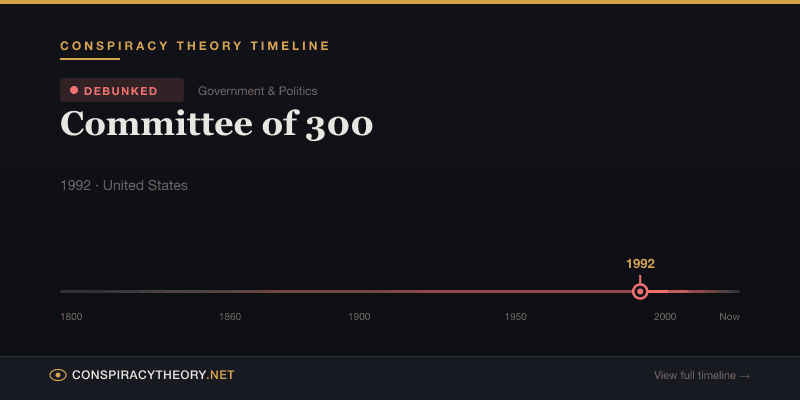
| 1992 | John Coleman publishes Conspirators’ Hierarchy: The Story of the Committee of 300 |
| 1990s | Theory circulates through conspiracy book market and early internet |
| 2000s | Theory adapted and referenced by other conspiracy theorists |
| 2010s | ”21 Goals” list goes viral on social media, often without attribution to Coleman |
| 2020s | Theory referenced in COVID-era conspiracy content about depopulation agendas |
Sources & Further Reading
- Coleman, John. Conspirators’ Hierarchy: The Story of the Committee of 300. World Intelligence Review, 1992. (Primary source for the theory.)
- Barkun, Michael. A Culture of Conspiracy: Apocalyptic Visions in Contemporary America. University of California Press, 2003.
- Meadows, Donella H., et al. The Limits to Growth. Universe Books, 1972. (The actual Club of Rome report.)
- Dicks, Henry V. Fifty Years of the Tavistock Clinic. Routledge, 1970. (Actual history of the Tavistock organization.)
Related Theories
- New World Order — The one-world government conspiracy
- Bilderberg Group — Annual elite conference alleged to serve the Committee
- Illuminati — The historical secret society the Committee allegedly supersedes
- Council on Foreign Relations — Another alleged instrument of the Committee
- Trilateral Commission — The Rockefeller-founded organization

Frequently Asked Questions
What is the Committee of 300?
Who is John Coleman?
Is the Committee of 300 real?
Infographic
Share this visual summary. Right-click to save.