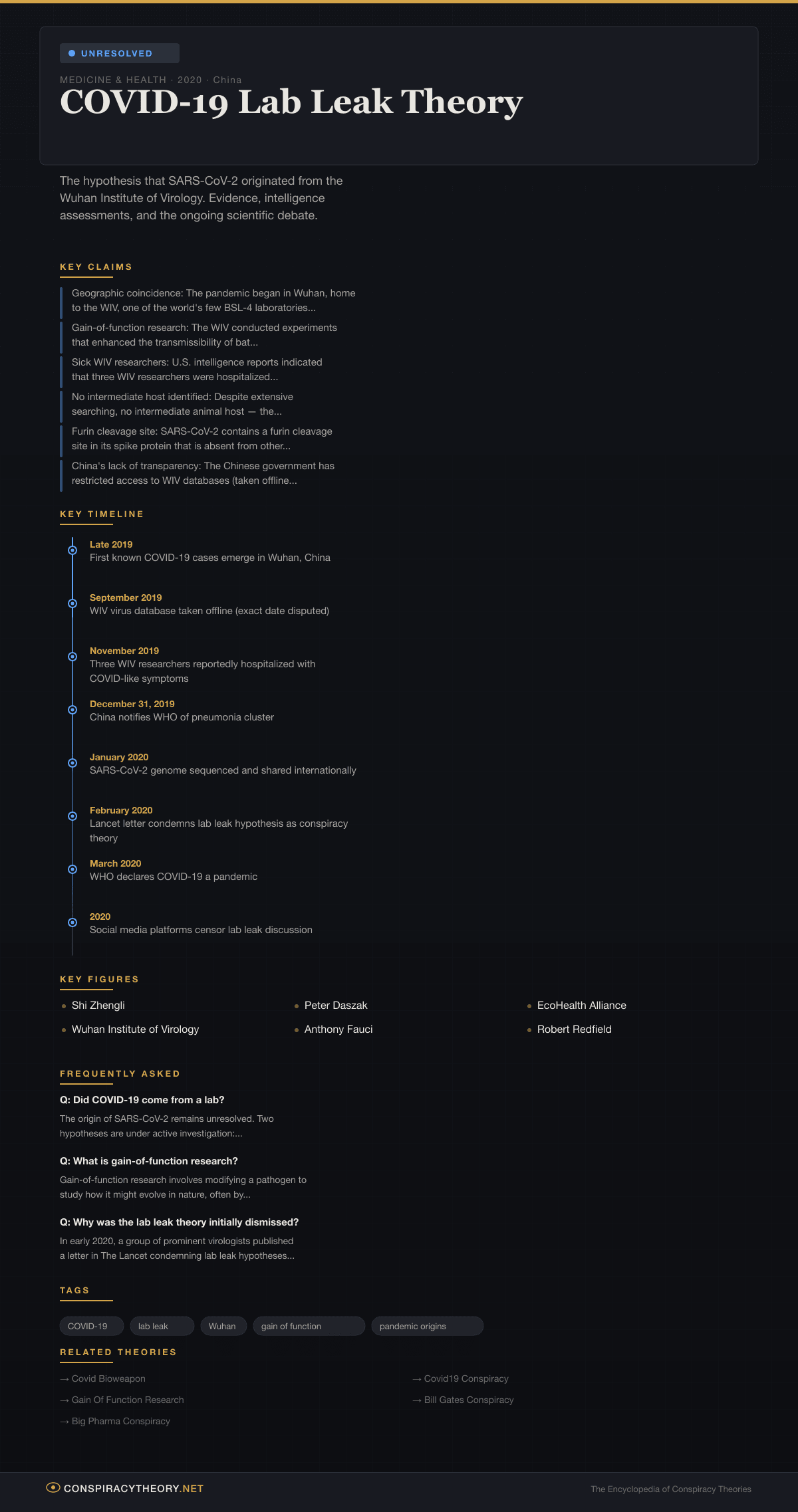
COVID-19 Lab Leak Theory
Overview
The COVID-19 lab leak theory proposes that SARS-CoV-2, the virus responsible for the COVID-19 pandemic that has killed millions of people worldwide, originated not from natural zoonotic transmission but from an incident at the Wuhan Institute of Virology (WIV), a biosafety level 4 laboratory located in the same city where the first known cases of the disease appeared in late 2019.
The hypothesis exists along a spectrum: the most modest version suggests an accidental laboratory leak during research on naturally collected bat coronaviruses; a middle version proposes that a virus being studied or modified through gain-of-function research escaped; and the most extreme version — more properly classified as a separate theory — alleges the virus was deliberately engineered as a bioweapon.
This theory occupies a unique position in the taxonomy of conspiracy theories because it was initially treated as fringe misinformation, actively censored by social media platforms, and condemned by a group of prominent scientists — only to be subsequently acknowledged by those same institutions as a legitimate and unresolved scientific question. Multiple U.S. intelligence agencies have assessed that a laboratory origin is plausible, though the intelligence community remains divided. The theory is classified as unresolved because neither the natural spillover nor the laboratory origin hypothesis has been conclusively proven or disproven.
Origins & History
The first known cluster of COVID-19 cases emerged in Wuhan, China in December 2019. From the earliest days of the pandemic, observers noted the proximity of the Wuhan Institute of Virology — one of the world’s leading centers for coronavirus research — to the Huanan Seafood Market, initially identified as a potential origin point. The WIV, under the direction of virologist Shi Zhengli (known as “Bat Woman” for her extensive fieldwork collecting coronaviruses from bat caves), had published extensive research on SARS-related bat coronaviruses, including gain-of-function experiments that enhanced viral properties to study pandemic potential.
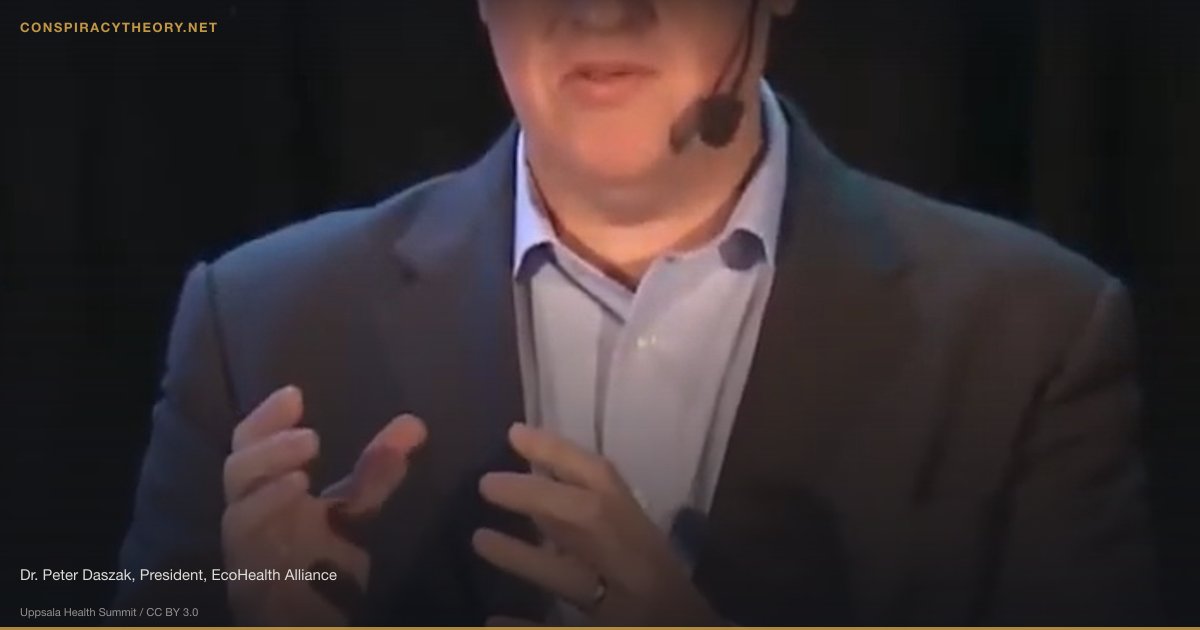
In February 2020, a group of 27 public health scientists published a letter in The Lancet stating: “We stand together to strongly condemn conspiracy theories suggesting that COVID-19 does not have a natural origin.” The letter, organized by Peter Daszak, president of EcoHealth Alliance — an organization that had funded coronavirus research at the WIV through NIH grants — did not disclose this conflict of interest. The letter was influential in shaping media coverage and platform moderation policies.
Throughout 2020, major social media platforms including Facebook and YouTube removed or restricted content discussing a potential lab origin. Mainstream media outlets broadly characterized the lab leak hypothesis as a debunked conspiracy theory, often conflating the accidental leak hypothesis with the more extreme bioweapon claim.
The tide began turning in early 2021. In January, a State Department fact sheet released in the final days of the Trump administration disclosed that several researchers at the WIV had become ill with symptoms consistent with COVID-19 in autumn 2019 — before the officially recognized outbreak. In May 2021, a group of 18 scientists published a letter in Science calling for a thorough investigation of both the natural origin and lab leak hypotheses, stating that both remained viable. President Biden ordered a 90-day intelligence review.
By mid-2021, Facebook reversed its policy of removing lab leak claims, and major media outlets including The Washington Post, The New York Times, and CNN published reassessments acknowledging the hypothesis as legitimate. The shift was widely cited as an example of how premature scientific consensus and social media censorship could suppress legitimate inquiry.
Key Claims
Circumstantial Evidence for Lab Origin
Proponents of the lab leak hypothesis cite several circumstantial factors:
-
Geographic coincidence: The pandemic began in Wuhan, home to the WIV, one of the world’s few BSL-4 laboratories and the foremost center for bat coronavirus research. No natural bat coronavirus reservoir has been identified near Wuhan; the bat caves studied by WIV researchers are over 1,000 miles away in Yunnan Province.
-
Gain-of-function research: The WIV conducted experiments that enhanced the transmissibility of bat coronaviruses, including creating chimeric viruses that could infect human airway cells. This research was partially funded by U.S. NIH grants through EcoHealth Alliance.
-
Sick WIV researchers: U.S. intelligence reports indicated that three WIV researchers were hospitalized with COVID-like symptoms in November 2019, weeks before China officially acknowledged the outbreak.
-
No intermediate host identified: Despite extensive searching, no intermediate animal host — the species through which the virus would have jumped from bats to humans — has been identified, unlike in the SARS-1 (2003) and MERS outbreaks, where intermediate hosts (civets and camels, respectively) were identified relatively quickly.
-
Furin cleavage site: SARS-CoV-2 contains a furin cleavage site in its spike protein that is absent from other known SARS-related bat coronaviruses. Some virologists have argued this feature is more consistent with laboratory insertion than natural evolution, though others counter that similar features have evolved naturally in other coronaviruses.
-
China’s lack of transparency: The Chinese government has restricted access to WIV databases (taken offline in September 2019), denied independent investigators access to laboratory records and samples, and limited the scope of the WHO-led investigation in early 2021.
The Natural Origin Hypothesis
The competing natural spillover hypothesis — favored by a plurality of virologists and four U.S. intelligence agencies — holds that SARS-CoV-2 evolved in wild animal populations and transmitted to humans through direct contact or through an intermediate host, potentially at a wildlife market. Supporters cite:
-
Historical precedent: Most novel infectious diseases, including SARS-1, MERS, Ebola, and HIV, originated through natural zoonotic spillover.
-
Early case clustering: Several early COVID-19 cases were linked to the Huanan Seafood Market, which sold live wildlife. Environmental samples from the market tested positive for SARS-CoV-2.
-
Viral genomics: Multiple analyses of SARS-CoV-2’s genome have found no evidence of deliberate engineering, and its closest known relatives are naturally occurring bat coronaviruses.
-
Wildlife trade: China’s extensive wildlife trade, including farming and selling of species known to be susceptible to coronaviruses, provides ample opportunity for zoonotic transmission.
Evidence
Intelligence Assessments
In 2023, the U.S. intelligence community released a declassified report summarizing agency assessments:
- The FBI assessed with “moderate confidence” that the pandemic originated from a laboratory incident
- The Department of Energy assessed with “low confidence” that a lab leak was the most likely origin
- Four other agencies and the National Intelligence Council assessed with “low confidence” that natural exposure to an infected animal was the most likely origin
- The CIA and one other agency remained unable to determine the origin
The intelligence community unanimously assessed that SARS-CoV-2 was not developed as a biological weapon.
Scientific Investigations
The WHO-convened study team that visited Wuhan in January-February 2021 concluded that a lab leak was “extremely unlikely” — a finding that WHO Director-General Tedros Adhanom Ghebreyesus himself later disavowed, stating that the investigation had been insufficient and calling for further study. A subsequent WHO Scientific Advisory Group for the Origins of Novel Pathogens (SAGO) report in 2022 stated that both hypotheses required further investigation.
Multiple independent scientific analyses have reached conflicting conclusions, reflecting genuine uncertainty rather than consensus in either direction.
Congressional Investigations
The U.S. House Select Subcommittee on the Coronavirus Pandemic conducted extensive investigations beginning in 2023, examining EcoHealth Alliance’s grant management, NIH’s oversight of gain-of-function research, and the origins of the Lancet letter. The investigation produced evidence that NIH officials were aware of concerns about EcoHealth’s compliance with grant conditions and that the Lancet letter’s organization involved significant undisclosed conflicts of interest.
Cultural Impact
The COVID-19 lab leak debate has had profound effects on scientific communication, media credibility, and public trust in institutions. The initial dismissal of the hypothesis as a “conspiracy theory” — followed by its rehabilitation as a legitimate scientific question — has been cited as a cautionary example of how institutional authority can suppress legitimate inquiry.
The episode intensified existing debates about:
- Social media censorship: Platform decisions to remove lab leak content were later reversed, raising questions about the role of technology companies in adjudicating scientific disputes
- Scientific conflicts of interest: The Lancet letter revealed how researchers with direct financial ties to the research in question could shape public discourse
- Gain-of-function research oversight: The controversy prompted congressional hearings and policy reviews about the regulation of dangerous pathogen research
- U.S.-China scientific cooperation: The controversy strained bilateral scientific relationships and raised questions about transparency in international research collaborations
The lab leak debate also demonstrated how the “conspiracy theory” label can be weaponized to dismiss legitimate questions, potentially undermining public willingness to accept genuine conspiracy theory debunking in other contexts.
Timeline
- Late 2019 — First known COVID-19 cases emerge in Wuhan, China
- September 2019 — WIV virus database taken offline (exact date disputed)
- November 2019 — Three WIV researchers reportedly hospitalized with COVID-like symptoms
- December 31, 2019 — China notifies WHO of pneumonia cluster
- January 2020 — SARS-CoV-2 genome sequenced and shared internationally
- February 2020 — Lancet letter condemns lab leak hypothesis as conspiracy theory
- March 2020 — WHO declares COVID-19 a pandemic
- 2020 — Social media platforms censor lab leak discussion
- January 2021 — State Department fact sheet discloses sick WIV researchers
- January–February 2021 — WHO team visits Wuhan; rates lab leak “extremely unlikely”
- May 2021 — 18 scientists publish Science letter calling for investigation of both hypotheses
- May 2021 — Biden orders 90-day intelligence review
- June 2021 — Facebook stops removing lab leak claims
- August 2021 — Intelligence review inconclusive; agencies split
- February 2023 — DOE assesses lab leak with “low confidence”
- 2023 — Congressional investigations into EcoHealth Alliance and NIH oversight
- June 2023 — Declassified IC assessment confirms agencies remain divided
- December 2024 — House Select Subcommittee releases 500+ page final report concluding lab leak most likely origin
- January 2025 — CIA shifts assessment, concluding lab leak is the likely origin (low confidence)
- March 2025 — German BND intelligence findings revealed: estimated 80–95% probability of lab origin
- April 2025 — White House creates official “Lab Leak” page on COVID origins
- November–December 2025 — Court-ordered DIA records released via FOIA lawsuit
- January 2026 — Additional intelligence documents released revealing early DIA lab leak assessment from March 2020
Latest Developments (2024–2026)
House Investigation Final Report (2024)
After a two-year investigation involving more than 30 interviews, numerous hearings, and over one million pages of documents, the House Select Subcommittee on the Coronavirus Pandemic released its final report concluding that SARS-CoV-2 most likely originated from a research-related incident at the Wuhan Institute of Virology.
CIA Reassessment (January 2025)
In January 2025, the CIA reversed its previous “inconclusive” position, assessing with low confidence that a research-related origin is more likely than a natural origin. This marked a significant shift — the CIA had previously been among the agencies that declined to favor either hypothesis.
German Intelligence Revelation (2025)
In one of the most striking revelations, it emerged that Germany’s Bundesnachrichtendienst (BND) had assessed the probability of COVID-19 having been created in the Wuhan lab at approximately 80–95% — but was not permitted to share these findings with U.S. intelligence agencies until December 2024, following President Trump’s election victory. The revelation raised questions about intelligence-sharing barriers during the pandemic.
Defense Intelligence Agency Records
Court-ordered FOIA releases in late 2025 and early 2026 revealed that the Defense Intelligence Agency had considered the lab leak scenario as early as March 2020 — far earlier than publicly acknowledged. These never-before-published records provide new insight into how the U.S. intelligence community assessed COVID origins in real time during the early days of the pandemic.
Status Shift
The lab leak hypothesis has undergone a dramatic status transformation: from a theory censored by social media platforms and dismissed as a conspiracy theory in 2020, to a mainstream scientific hypothesis in 2021–2023, to the assessed most-likely explanation by multiple U.S. government agencies in 2025. The theory’s journey illustrates how the line between “conspiracy theory” and “legitimate hypothesis” can shift rapidly as new evidence emerges.
Sources & Further Reading
- Bloom, Jesse D., et al. “Investigate the Origins of COVID-19.” Science 372, no. 6543 (2021): 694
- Worobey, Michael, et al. “The Huanan Seafood Wholesale Market in Wuhan Was the Early Epicenter of the COVID-19 Pandemic.” Science 377, no. 6609 (2022): 951-959
- Office of the Director of National Intelligence. Declassified Assessment on COVID-19 Origins. 2023
- WHO-convened Global Study of Origins of SARS-CoV-2. Joint Report. 2021
- Calisher, Charles, et al. “Statement in Support of the Scientists, Public Health Professionals, and Medical Professionals of China.” The Lancet 395, no. E42-E43 (2020)
- U.S. House Select Subcommittee on the Coronavirus Pandemic. Hearing records, 2023
- Baker, Nicholson. “The Lab-Leak Hypothesis.” New York Magazine, January 2021
Frequently Asked Questions
Did COVID-19 come from a lab?
What is gain-of-function research?
Why was the lab leak theory initially dismissed?
Infographic
Share this visual summary. Right-click to save.