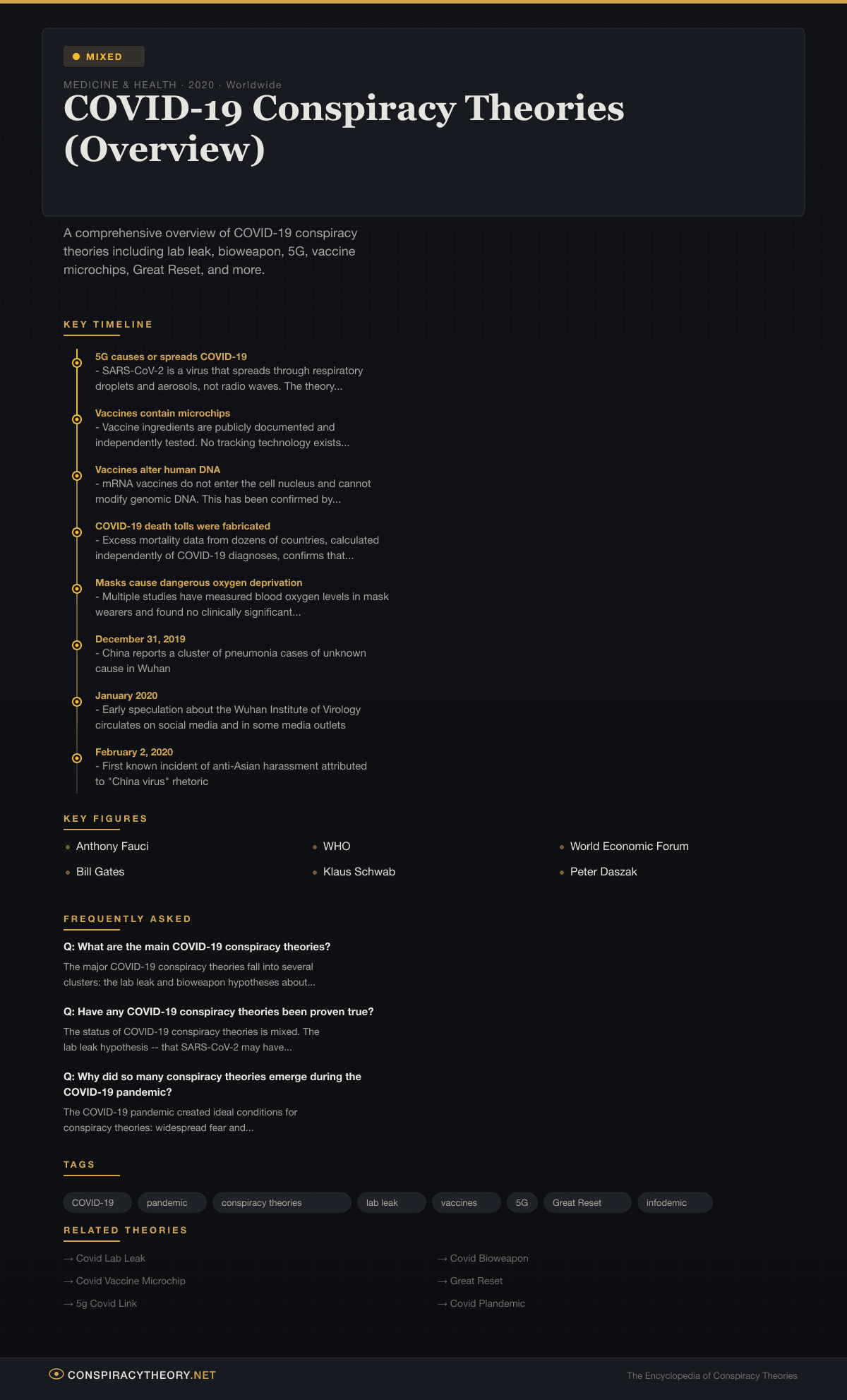
COVID-19 Conspiracy Theories (Overview)

Overview
The COVID-19 pandemic, which began in late 2019 and was declared a global emergency by the World Health Organization (WHO) in January 2020, generated what is arguably the largest and most complex ecosystem of conspiracy theories in modern history. Spanning questions about the virus’s origin, the legitimacy of public health measures, the safety of vaccines, and the political motivations behind pandemic responses, COVID-19 conspiracy theories proliferated across every continent and in virtually every language. They influenced public behavior, shaped political movements, contributed to vaccine hesitancy, and in some documented cases, led directly to acts of violence.
The WHO coined the term “infodemic” to describe the parallel epidemic of misinformation that accompanied the biological pandemic. By April 2020, the organization had identified what it called a “massive infodemic” that was undermining public health responses worldwide. Studies published in journals including The Lancet, Nature, and the British Medical Journal documented the measurable impact of conspiracy theories on vaccine uptake, mask compliance, and trust in healthcare institutions.
The status of COVID-19 conspiracy theories is classified as mixed because the landscape is not monolithic. Some claims — such as the hypothesis that SARS-CoV-2 originated from a laboratory incident at the Wuhan Institute of Virology — remain under legitimate scientific and intelligence investigation. Others, such as the assertion that 5G wireless networks cause or spread the virus, have been comprehensively debunked. The sheer range of claims, from the plausible to the fantastical, makes COVID-19 conspiracy theories a uniquely instructive case study in how misinformation operates at scale.
Origins: How Conspiracy Theories Emerged Alongside the Pandemic
Conspiracy theories about the novel coronavirus began circulating almost immediately after reports of a mysterious pneumonia cluster in Wuhan, China, reached international media in late December 2019 and early January 2020. Several factors created fertile ground for their rapid development.
Uncertainty and Information Vacuums
In the earliest weeks of the outbreak, fundamental facts about SARS-CoV-2 were unknown: its precise origin, its transmissibility, its fatality rate, and whether asymptomatic transmission was possible. Public health guidance shifted repeatedly as new data emerged — most notably regarding the efficacy of face masks, which U.S. authorities initially discouraged for the general public before reversing course in April 2020. These reversals, though scientifically appropriate responses to evolving evidence, eroded public trust and provided ammunition for those claiming that authorities were either incompetent or deliberately deceptive.
The Proximity of the Wuhan Institute of Virology
The fact that the initial outbreak was centered in Wuhan, the same city that housed China’s only Biosafety Level 4 laboratory and a major center for bat coronavirus research, immediately generated suspicion. While proximity alone does not constitute evidence, it provided an intuitively compelling foundation for lab-origin theories. China’s lack of transparency — including restrictions on international investigators, delayed sharing of viral genome data, and the reported disappearance of the WIV’s virus database in September 2019 — further fueled speculation.
Political Polarization
The pandemic struck during a period of extreme political polarization, particularly in the United States ahead of the 2020 presidential election. COVID-19 quickly became politicized, with attitudes toward masks, lockdowns, and vaccines aligning along partisan lines. Political figures amplified conspiracy narratives: then-President Donald Trump repeatedly referred to SARS-CoV-2 as the “China virus” and publicly speculated about the lab leak hypothesis, while figures on both sides of the political spectrum accused their opponents of exploiting the pandemic for political gain.
Social Media Amplification
Billions of people confined to their homes during lockdowns turned to social media for information and community. Algorithmic recommendation systems on platforms including YouTube, Facebook, and TikTok promoted sensational and conspiratorial content because it generated high engagement. Encrypted messaging platforms like WhatsApp and Telegram facilitated the spread of misinformation in private channels that were difficult for fact-checkers or platform moderators to monitor.
Major Theory Clusters
COVID-19 conspiracy theories are not a single narrative but rather a constellation of interconnected claims. The following sections summarize the major clusters. Many of these are covered in greater detail in their own dedicated articles on this wiki.
Lab Leak Hypothesis
The lab leak hypothesis posits that SARS-CoV-2 accidentally escaped from the Wuhan Institute of Virology (WIV), possibly during gain-of-function research on bat coronaviruses. This is the most scientifically credible of the COVID-19 origin theories and is treated separately from the more conspiratorial narratives because multiple U.S. intelligence agencies and prominent scientists have deemed it a legitimate possibility.
As of 2025, the U.S. intelligence community remains divided: the FBI and the Department of Energy favor a lab origin (with low to moderate confidence), while four other agencies favor natural zoonotic spillover. The question is formally unresolved. A key complicating factor is that the Lancet letter of February 2020, organized by Peter Daszak of EcoHealth Alliance (whose organization funded WIV research), condemned lab leak speculation as conspiracy theorizing — a position later widely criticized for undisclosed conflicts of interest.
Bioweapon Theory
A more extreme variant of the lab leak hypothesis claims that SARS-CoV-2 was not an accidental release but a deliberately engineered biological weapon. Different versions attribute the weapon to China (as a tool of geopolitical warfare), to the United States (with Fort Detrick sometimes named as the origin), or to a shadowy global cabal. No credible scientific evidence supports the claim that SARS-CoV-2 was engineered as a weapon. Genomic analyses published in Nature Medicine (2020) found that the virus’s receptor binding domain arose through natural selection, not deliberate manipulation. However, the bioweapon narrative persists, particularly in geopolitical propaganda where nations accuse each other of responsibility.
See: COVID-19 Bioweapon Theory
5G-COVID Connection
One of the most widely circulated early pandemic conspiracy theories claimed that 5G wireless network technology either caused COVID-19, weakened immune systems to make people susceptible to the virus, or served as the means of viral transmission. This theory appears to have originated from a January 2020 Belgian newspaper article linking 5G to health concerns, which was subsequently combined with preexisting anti-5G activism.
The theory was comprehensively debunked: viruses cannot travel on radio waves, COVID-19 spread widely in countries with no 5G infrastructure, and the radio frequencies used by 5G are non-ionizing and have been studied extensively for health effects. Despite this, the theory led to real-world consequences: in the United Kingdom alone, at least 77 cell phone towers were vandalized or set on fire between March and May 2020, and telecommunications workers reported receiving threats and verbal abuse.
See: 5G-COVID Link
Vaccine Microchip Theory
The claim that COVID-19 vaccines contain microchips or nanobots for tracking and surveillance became one of the most persistent conspiracy narratives. It drew on longstanding anti-vaccination themes and was amplified by misinterpretations of a 2020 MIT research paper about dissolvable microneedle patches that could store vaccination records under the skin (a technology unrelated to COVID-19 vaccines and containing no tracking capability). Bill Gates’s involvement in vaccine funding, combined with his public advocacy for digital health records, made him a central figure in this narrative.
No COVID-19 vaccine contains a microchip, tracking device, or nanotechnology capable of surveillance. The vaccine ingredients are publicly listed and independently verified by regulatory agencies worldwide. The needles used to administer the vaccines are too small to accommodate any existing microchip technology.
See: COVID Vaccine Microchip Theory
The Great Reset
In June 2020, the World Economic Forum (WEF) launched the “Great Reset” initiative, a set of proposals for rebuilding economies more sustainably after the pandemic. WEF founder Klaus Schwab published a book titled COVID-19: The Great Reset, and Canadian Prime Minister Justin Trudeau described the pandemic as “an opportunity for a reset.” These public statements were seized upon by conspiracy theorists as evidence that global elites had planned or exploited the pandemic to restructure global governance, abolish private property (“you’ll own nothing and be happy”), and implement a system of totalitarian surveillance.
While the WEF initiative is real and publicly documented, the conspiracy theory ascribes to it powers and intentions far beyond the WEF’s actual capacity as an advisory forum with no legislative authority. The theory functions as a modern iteration of longstanding New World Order narratives, updated for the pandemic context.
See: The Great Reset Conspiracy
Depopulation Agenda
The depopulation conspiracy theory alleges that COVID-19 vaccines are a tool for reducing the global population, orchestrated by figures such as Bill Gates, the WHO, and various pharmaceutical companies. Proponents cite Gates’s 2010 TED Talk, in which he stated that improving healthcare and vaccines could lower population growth rates (a well-established demographic principle in which lower child mortality leads families to have fewer children), as a “confession” of genocidal intent.
Variants of this theory claim that vaccines cause infertility, introduce slow-acting poisons, or alter human DNA. These claims are not supported by evidence. Clinical trials and post-marketing surveillance involving billions of administered doses have not identified population-level effects on fertility or life expectancy attributable to COVID-19 vaccines, though rare adverse events (such as myocarditis associated with mRNA vaccines, primarily in young males) have been documented and publicly communicated by health authorities.
See: Depopulation Agenda
Ivermectin and Treatment Suppression
The claim that effective COVID-19 treatments — most notably the antiparasitic drug ivermectin and the antimalarial hydroxychloroquine — were deliberately suppressed by pharmaceutical companies, regulatory agencies, and the medical establishment became a major conspiracy narrative. Proponents argued that the Emergency Use Authorizations (EUAs) for COVID-19 vaccines could not legally have been granted if effective treatments already existed, giving pharmaceutical companies a financial motive for suppression.
Large-scale randomized controlled trials, including the TOGETHER trial (2022) and the ACTIV-6 trial (2023), found no clinically significant benefit of ivermectin for treating COVID-19. The FDA’s EUA framework does not, in fact, require the absence of all alternative treatments. However, the heavy-handed manner in which some platforms and institutions censored discussion of these drugs — and the later revelation that some early pro-ivermectin studies were fraudulent — created a narrative in which both sides could claim vindication regarding the suppression of open scientific debate.
See: Ivermectin COVID Conspiracy
The Infodemic
The WHO’s concept of an “infodemic” captured the unprecedented speed and scale at which COVID-19 misinformation spread. Several features distinguished this phenomenon from prior conspiracy theory ecosystems.
Speed and Scale
A study published in the American Journal of Tropical Medicine and Hygiene (2020) analyzed 2,311 reports of COVID-19-related misinformation in 25 languages across 87 countries. The researchers found that conspiracy theories accounted for the largest category at 24% of all misinformation, followed by claims about cures (18%) and transmission (14%). Misinformation spread faster than accurate information: an MIT study of social media found that false claims were 70% more likely to be retweeted than true ones.
Cross-Pollination of Theories
COVID-19 conspiracy theories did not exist in isolation. They merged with and reinforced preexisting conspiracy networks. QAnon adherents incorporated pandemic narratives into their existing framework of elite pedophile cabals. Anti-vaccination activists found their audience dramatically expanded. Sovereign citizen and anti-government movements adopted anti-lockdown positions. Religious apocalypticists interpreted the pandemic through eschatological frameworks. This cross-pollination created a “conspiracy singularity” in which adherence to one theory significantly increased the likelihood of accepting others.
The “Plandemic” Phenomenon
The 26-minute video Plandemic, featuring discredited researcher Judy Mikovits, was released on May 4, 2020, and was viewed over eight million times within a week before being removed by major platforms. Mikovits claimed that SARS-CoV-2 was manipulated in a laboratory, that masks “activate” the virus, and that the pandemic was planned by Anthony Fauci and Bill Gates for profit. Virtually every factual claim in the video was subsequently debunked. Nevertheless, the video marked a turning point in COVID-19 conspiracy culture, demonstrating that polished, documentary-style conspiracy content could achieve viral reach faster than platforms could respond.
Evidence and Debunking
The evidentiary landscape for COVID-19 conspiracy theories varies dramatically depending on the specific claim.
Claims with Legitimate Scientific Basis
The lab leak hypothesis remains under active investigation. Circumstantial evidence — including the proximity of the WIV, the nature of its bat coronavirus research, the reported illness of WIV researchers in November 2019, and China’s obstruction of investigations — provides a basis for continued inquiry. However, definitive proof for either a lab origin or a natural zoonotic spillover has not been produced as of 2025.
Claims Debunked by Scientific Evidence
The following major claims have been debunked through peer-reviewed research and empirical evidence:
- 5G causes or spreads COVID-19 — SARS-CoV-2 is a virus that spreads through respiratory droplets and aerosols, not radio waves. The theory is biologically impossible.
- Vaccines contain microchips — Vaccine ingredients are publicly documented and independently tested. No tracking technology exists that could fit through a vaccine needle.
- Vaccines alter human DNA — mRNA vaccines do not enter the cell nucleus and cannot modify genomic DNA. This has been confirmed by extensive molecular biology research.
- COVID-19 death tolls were fabricated — Excess mortality data from dozens of countries, calculated independently of COVID-19 diagnoses, confirms that the pandemic caused millions of deaths above historical baselines. If anything, official counts in many countries underestimated the true toll.
- Masks cause dangerous oxygen deprivation — Multiple studies have measured blood oxygen levels in mask wearers and found no clinically significant reduction. Surgeons routinely wear masks for hours during operations without adverse effects.
Documented Government and Institutional Failures
Some elements of COVID-19 conspiracy narratives were rooted in genuine institutional failures that deserve acknowledgment:
- The WHO’s early reluctance to declare a pandemic and its initial acceptance of China’s claims about limited human-to-human transmission
- The U.S. Surgeon General’s initial advice against mask-wearing, later reversed
- The conflict of interest in Peter Daszak’s role in the Lancet letter dismissing the lab leak hypothesis while his organization funded WIV research
- The lack of transparency regarding gain-of-function research funding
- Premature censorship of the lab leak hypothesis on social media platforms
These failures do not validate the broader conspiracy theories but illustrate how institutional missteps can fuel public distrust and provide a kernel of truth around which conspiratorial narratives crystallize.
Social Media and the Censorship Debate
The pandemic triggered an unprecedented experiment in large-scale content moderation. Major social media platforms, often in coordination with government health agencies, implemented policies to remove or label COVID-19 misinformation. This effort became one of the most contentious aspects of the pandemic, raising fundamental questions about free speech, institutional authority, and the nature of scientific consensus.
Platform Actions
Facebook, YouTube, Twitter (now X), and other platforms removed millions of posts, videos, and accounts for violating COVID-19 misinformation policies. YouTube alone reported removing over one million videos related to COVID-19 misinformation between February 2020 and September 2021. Facebook removed 20 million pieces of content with false claims about COVID-19 from the start of the pandemic through mid-2021.
The Censorship Backlash
Critics argued that content moderation constituted censorship that suppressed legitimate scientific debate. The most prominent example was the suppression of the lab leak hypothesis: Facebook labeled posts suggesting a lab origin as “false information” until May 2021, when the platform reversed its policy following a shift in mainstream scientific opinion. This reversal became a potent symbol for those arguing that “misinformation” designations were being applied based on political convenience rather than scientific evidence.
The Twitter Files disclosures in late 2022, published after Elon Musk’s acquisition of the platform, revealed internal communications between U.S. government officials and Twitter staff regarding content moderation decisions, reigniting debates about the appropriate relationship between government agencies and private platforms in managing public health information.
Legal and Political Consequences
In the United States, the censorship debate culminated in Murthy v. Missouri (2024), a Supreme Court case examining whether government officials violated the First Amendment by pressuring social media companies to moderate content. The court ruled 6-3 that the plaintiffs lacked standing, declining to address the substantive free speech questions but leaving the underlying tension unresolved.
Cultural Impact
The COVID-19 conspiracy theory ecosystem had measurable and far-reaching effects on public health, politics, and social cohesion.
Public Health Consequences
A systematic review published in The BMJ (2022) found a statistically significant association between belief in COVID-19 conspiracy theories and reduced likelihood of vaccination, mask compliance, and adherence to social distancing guidelines. The Kaiser Family Foundation estimated that approximately 234,000 COVID-19 deaths in the United States between June 2021 and March 2022 could have been prevented by vaccination, though the precise proportion attributable to conspiracy-theory-driven hesitancy versus other factors is difficult to isolate.
Political Movements
Anti-lockdown and anti-vaccine-mandate protests became significant political phenomena worldwide. In Canada, the “Freedom Convoy” of January-February 2022 blockaded the Ambassador Bridge (a critical trade route between Canada and the United States) and occupied central Ottawa for three weeks, leading Prime Minister Trudeau to invoke the Emergencies Act for the first time in Canadian history. Similar protests occurred in the Netherlands, Australia, France, Germany, and dozens of other nations.
COVID-19 conspiracy narratives also influenced electoral politics. Candidates running on anti-mandate platforms gained traction in multiple countries, and vaccine policies became defining issues in elections from the United States to Brazil to the Philippines.
Erosion of Institutional Trust
Perhaps the most enduring consequence of the COVID-19 conspiracy ecosystem has been the erosion of public trust in scientific and governmental institutions. Gallup polling showed confidence in the U.S. medical system declining from 51% in 2020 to 34% by 2024. While this decline cannot be attributed solely to conspiracy theories — genuine policy failures, political polarization, and the economic impacts of lockdowns all played roles — the infodemic environment accelerated and amplified preexisting trends toward institutional distrust.
Radicalization and Violence
In extreme cases, conspiracy beliefs led to violence. The 5G tower arsons in the United Kingdom and elsewhere are among the most documented examples. In Germany, the Querdenker (Lateral Thinkers) movement, which combined anti-lockdown sentiment with conspiracy theories, was linked to a foiled coup plot in December 2022. Threats against public health officials, including Anthony Fauci and local health department workers, increased dramatically during the pandemic.
Timeline
- December 31, 2019 — China reports a cluster of pneumonia cases of unknown cause in Wuhan
- January 2020 — Early speculation about the Wuhan Institute of Virology circulates on social media and in some media outlets
- February 2, 2020 — First known incident of anti-Asian harassment attributed to “China virus” rhetoric
- February 19, 2020 — The Lancet publishes a statement by 27 scientists condemning “conspiracy theories suggesting that COVID-19 does not have a natural origin,” organized by Peter Daszak
- March 11, 2020 — WHO declares COVID-19 a pandemic
- April 2020 — 5G-COVID conspiracy theory peaks; cell towers set on fire in the UK, Netherlands, and other countries
- April 23, 2020 — President Trump speculates about injecting disinfectant to treat COVID-19 during a press conference
- May 4, 2020 — Plandemic video featuring Judy Mikovits goes viral, accumulating eight million views in one week
- June 3, 2020 — The World Economic Forum launches the “Great Reset” initiative
- August 2020 — Plandemic: Indoctornation (full-length sequel) is released
- December 2020 — COVID-19 vaccines from Pfizer-BioNTech and Moderna receive Emergency Use Authorization in the United States; vaccine conspiracy theories surge
- January 2021 — Social media platforms begin large-scale removal of anti-vaccine accounts and content
- May 2021 — Facebook reverses its policy of removing lab leak posts, acknowledging the hypothesis as legitimate
- June 2021 — The Wall Street Journal reports that three WIV researchers were hospitalized with COVID-like symptoms in November 2019
- August 2021 — U.S. intelligence community releases inconclusive assessment on COVID-19 origins
- January-February 2022 — Canada’s Freedom Convoy protests and Ottawa occupation
- Late 2022 — Twitter Files disclosures reveal government communications with social media platforms regarding COVID content moderation
- February 2023 — FBI Director Christopher Wray states the FBI assesses COVID-19 most likely originated from a lab incident
- June 2024 — Supreme Court rules in Murthy v. Missouri, declining to address substantive free speech claims regarding government pressure on social media platforms
- 2024-2025 — Ongoing investigations into pandemic origins, gain-of-function research oversight, and social media content moderation policies continue
Sources & Further Reading
- World Health Organization. “Managing the COVID-19 Infodemic: Promoting Healthy Behaviours and Mitigating the Harm from Misinformation and Disinformation.” September 23, 2020
- Islam, Md Saiful, et al. “COVID-19-Related Infodemic and Its Impact on Public Health: A Global Social Media Analysis.” American Journal of Tropical Medicine and Hygiene, 103(4), 2020
- Andersen, Kristian G., et al. “The Proximal Origin of SARS-CoV-2.” Nature Medicine, 26, 450-452, 2020
- Douglas, Karen M., et al. “Understanding Conspiracy Theories.” Advances in Political Psychology, 40(S1), 2019
- Office of the Director of National Intelligence. “Updated Assessment on COVID-19 Origins.” October 29, 2021
- Vosoughi, Soroush, Roy, Deb, and Aral, Sinan. “The Spread of True and False News Online.” Science, 359(6380), 1146-1151, 2018
- Schwab, Klaus. COVID-19: The Great Reset. World Economic Forum, 2020
- U.S. House Select Subcommittee on the Coronavirus Pandemic. Investigative reports, 2023-2024
- Uscinski, Joseph E., et al. “Why Do People Believe COVID-19 Conspiracy Theories?” Harvard Kennedy School Misinformation Review, 1(3), 2020
- Roozenbeek, Jon, et al. “Susceptibility to Misinformation about COVID-19 around the World.” Royal Society Open Science, 7(10), 2020

Frequently Asked Questions
What are the main COVID-19 conspiracy theories?
Have any COVID-19 conspiracy theories been proven true?
Why did so many conspiracy theories emerge during the COVID-19 pandemic?

Infographic
Share this visual summary. Right-click to save.