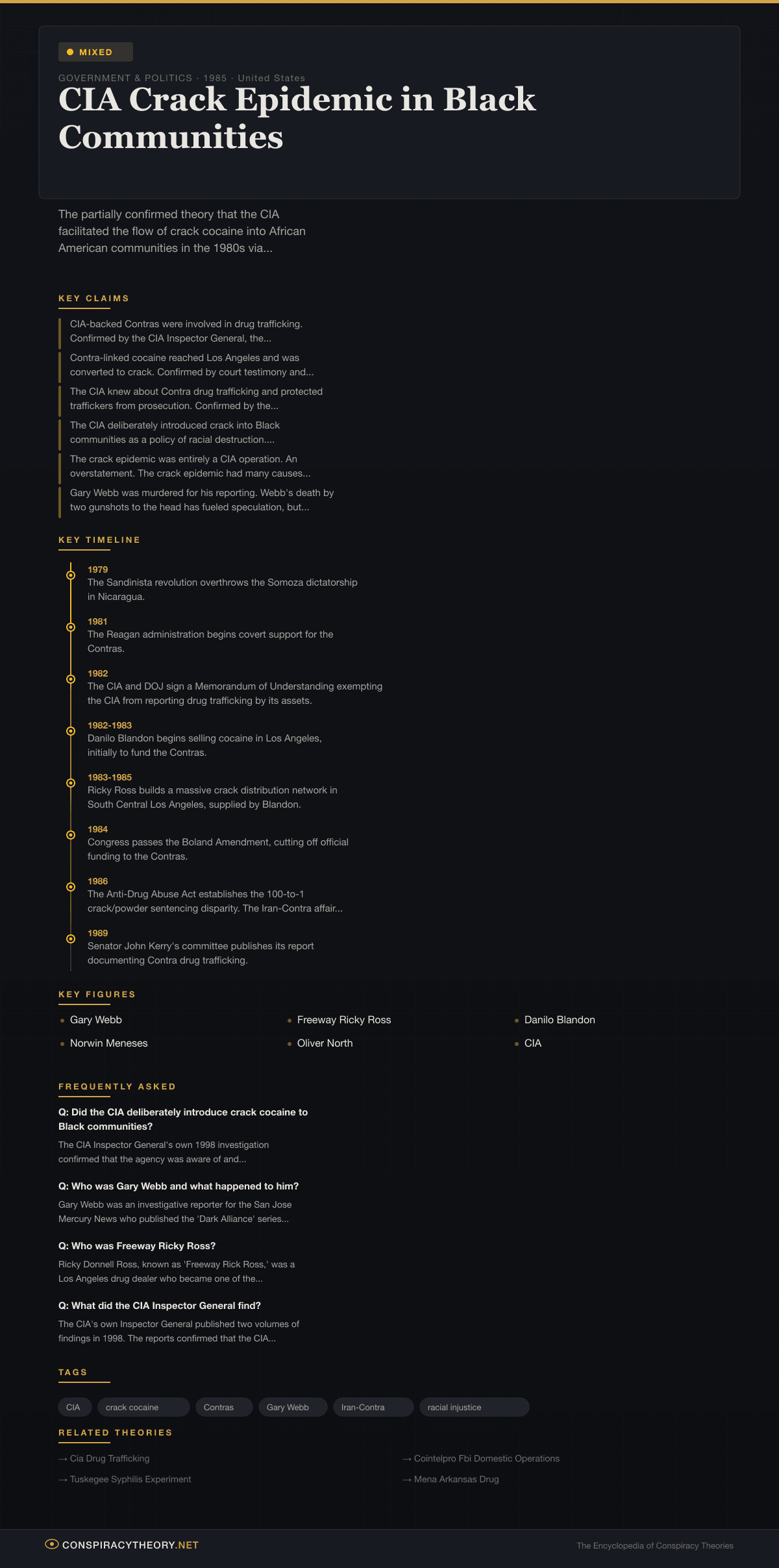
CIA Crack Epidemic in Black Communities

Overview
In 1996, a reporter at a mid-sized California newspaper published a series of articles that would destroy his career, vindicate his reporting, and leave one of the most consequential questions in American history still officially unanswered. The reporter was Gary Webb. The newspaper was the San Jose Mercury News. The series was called “Dark Alliance.” And the question it raised was this: Did the Central Intelligence Agency knowingly allow cocaine to pour into Black neighborhoods in Los Angeles, fueling the crack epidemic that devastated a generation of African Americans, in order to fund a covert war in Central America?
The answer, depending on how precisely you define “knowingly” and “allow,” is somewhere between “yes, basically” and “it’s complicated.” What is not complicated is this: CIA-backed Nicaraguan Contra rebels were involved in cocaine trafficking. Their cocaine reached the United States. It was converted into crack and sold in Los Angeles’s Black neighborhoods by a dealer named Ricky Ross, who was supplied by a Contra-connected Nicaraguan named Danilo Blandon. The CIA knew about the drug trafficking and, at minimum, looked the other way. Its own Inspector General confirmed this in a 1998 report that received a fraction of the media attention that had been devoted to attacking Webb.
The crack epidemic conspiracy is one of the rare cases where the conspiracy theory preceded the evidence — and then the evidence largely caught up. It is also one of the rare cases where the messenger was destroyed for being substantially right. Gary Webb’s story is, in many ways, as important as the story he reported: a cautionary tale about what happens when a journalist takes on the intelligence community and his own profession fails to back him up.
Origins & History
The crack epidemic hit American cities in the mid-1980s with the force of a natural disaster — except it wasn’t natural, and its devastation was not equally distributed. Crack cocaine, a smokeable form of cocaine that was cheap, intensely addictive, and easy to produce, swept through Black urban communities with particular ferocity. Between 1984 and 1990, crack-related emergency room visits exploded. Murder rates in cities with large Black populations spiked. The federal government’s response was not treatment or economic investment but punitive legislation: the Anti-Drug Abuse Act of 1986 established the infamous 100-to-1 sentencing disparity between crack and powder cocaine, meaning that possession of five grams of crack (predominantly used in Black communities) carried the same mandatory minimum sentence as 500 grams of powder cocaine (predominantly used by white users).
In Black communities, the suspicion that the crack epidemic was not an accident — that it was, at some level, engineered — was widespread and predated Webb’s reporting by years. This suspicion was rooted in historical experience. The Tuskegee syphilis experiment, in which the U.S. government deliberately left hundreds of Black men untreated for syphilis for decades, was exposed in 1972. COINTELPRO, the FBI program that surveilled, harassed, and disrupted Black political organizations, was revealed in the 1970s. The assassination of Fred Hampton by Chicago police working with the FBI had been documented. In this context, the idea that the government might have introduced drugs into Black communities was not paranoia — it was pattern recognition.
The Iran-Contra affair, which exploded into public view in 1986-1987, provided the geopolitical backdrop. The Reagan administration, barred by Congress from funding the Nicaraguan Contras (right-wing rebels fighting the leftist Sandinista government), had resorted to covert means to keep the money flowing — including, as would later be documented, facilitating arms sales to Iran and diverting the profits to the Contras. The question of whether drug trafficking was another funding mechanism was raised during the Iran-Contra hearings, but Senator John Kerry’s subcommittee investigation — which documented extensive Contra drug links — received minimal media attention.
Gary Webb and “Dark Alliance”
In August 1996, Gary Webb published “Dark Alliance” as a three-part series in the San Jose Mercury News, accompanied by an innovative (for the time) multimedia website that included scanned documents and source materials. The series traced a specific supply chain:
-
Danilo Blandon, a Nicaraguan exile from a wealthy family aligned with the Somoza regime, began dealing cocaine in Los Angeles in the early 1980s. He would later testify under oath that he was raising money for the Contras.
-
Norwin Meneses, a Nicaraguan drug lord known as the “King of Drugs” in Central America, was Blandon’s supplier. Meneses had documented ties to the Contra movement and, according to DEA files, was known to the agency as a major trafficker.
-
Ricky “Freeway Rick” Ross, a Black Los Angeles dealer who became one of the largest crack distributors in American history. Ross’s primary cocaine source was Blandon, who sold him wholesale cocaine at prices that made the crack trade enormously profitable.
-
The proceeds from these drug sales, Webb reported, flowed back to the Contras — either directly or through the network of Contra supporters who enabled the trafficking.
Webb’s reporting was painstaking. He reviewed court transcripts, DEA files, and congressional records. He interviewed Blandon, Ross, and law enforcement officials. He documented specific cases where federal prosecutors had given lenient treatment to Contra-linked drug dealers — including Blandon, who was allowed to continue dealing for years as a DEA informant despite his known trafficking activities.
The series was not perfectly executed. Its original presentation, including website graphics showing a man smoking crack superimposed on the CIA seal, implied a more direct CIA role than the evidence strictly supported. Webb’s editors at the Mercury News had pushed for a more dramatic framing, and the resulting ambiguity between “the CIA allowed this to happen” and “the CIA orchestrated this” would prove fatal to the story’s reception.
The Counterattack
What happened next is one of the most studied episodes in American journalism — and one of the most shameful.
The Los Angeles Times, the Washington Post, and the New York Times — the three most powerful newspapers in the country — did not investigate Webb’s claims. Instead, they investigated Webb. In a coordinated assault that media critic Alexander Cockburn called “one of the most venomous and factually dishonest stories in the annals of American journalism,” the major papers attacked Webb’s methodology, his sourcing, and his conclusions. They argued that he had overstated the CIA’s role, that Blandon and Meneses were not as important to the crack trade as he claimed, and that the supply chain he described was only a small part of a much larger phenomenon.
Some of these criticisms had merit. Webb’s series did sometimes imply a more direct and deliberate CIA role than his evidence strictly demonstrated. The crack epidemic had many causes and many supply chains, not just the one Webb documented. But the major papers’ coverage went far beyond legitimate critique. They treated Webb not as a journalist who had gotten some details wrong while being fundamentally right about an important story, but as a fraud who had fabricated a conspiracy theory.
Under pressure, the San Jose Mercury News reassigned Webb. The paper’s editor published a column that stopped short of a full retraction but acknowledged that the series had “shortcomings.” Webb was moved to a bureau 150 miles from San Jose, effectively ending his investigative career at the paper. He resigned in 1997. He struggled to find journalism work. On December 10, 2004, Gary Webb was found dead in his apartment from two gunshot wounds to the head. The Sacramento County coroner ruled it a suicide. (The fact of two gunshot wounds is unusual but not unprecedented in suicides involving firearms; it occurs when the first shot is not immediately fatal.)
The CIA Inspector General’s Report
In the wake of the “Dark Alliance” controversy, the CIA’s Inspector General, Frederick Hitz, launched an internal investigation. The resulting report, published in two volumes in 1998, received almost no media coverage — a stunning irony given the firestorm that had greeted Webb’s original series.
The Hitz report confirmed the central allegations of Webb’s reporting, and in some cases went further:
- The CIA had knowledge of Contra drug trafficking throughout the 1980s.
- The agency had maintained relationships with at least 58 Contra individuals or organizations that were involved in drug trafficking.
- In some cases, the CIA had intervened to prevent law enforcement agencies from investigating or prosecuting Contra drug dealers.
- A 1982 agreement between the CIA and the Department of Justice exempted the CIA from reporting drug trafficking by its agents and assets — meaning the agency had a legal framework for looking the other way.
- The CIA had “ichanneled funds to the Contras through entities that were fronts for drug trafficking operations.”
The report did not conclude that the CIA had deliberately targeted Black communities or that it had created the crack epidemic as a matter of policy. But it confirmed that the agency had, at minimum, facilitated a drug pipeline that devastated those communities — and had actively shielded the traffickers from prosecution.
Key Claims
The crack epidemic conspiracy theory exists on a spectrum from confirmed facts to unproven allegations:
-
CIA-backed Contras were involved in drug trafficking. Confirmed by the CIA Inspector General, the Kerry Committee, and multiple court proceedings.
-
Contra-linked cocaine reached Los Angeles and was converted to crack. Confirmed by court testimony and DEA records.
-
The CIA knew about Contra drug trafficking and protected traffickers from prosecution. Confirmed by the CIA Inspector General.
-
The CIA deliberately introduced crack into Black communities as a policy of racial destruction. This stronger claim — that the CIA specifically targeted Black neighborhoods — has not been proven. The evidence shows complicity and willful blindness, but not a documented plan to destroy Black communities.
-
The crack epidemic was entirely a CIA operation. An overstatement. The crack epidemic had many causes — poverty, deindustrialization, the pharmacological properties of crack itself, existing drug distribution networks — and many supply chains. The Blandon-Ross pipeline was significant but was not the sole driver.
-
Gary Webb was murdered for his reporting. Webb’s death by two gunshots to the head has fueled speculation, but the coroner’s ruling of suicide is consistent with the known circumstances, including Webb’s financial difficulties, professional setback, and documented depression.
Evidence
The evidence for CIA complicity in Contra drug trafficking is extensive and comes from multiple independent sources:
The Kerry Committee Report (1989). Senator John Kerry’s Subcommittee on Terrorism, Narcotics, and International Operations concluded that “it is clear that individuals who provided support for the Contras were involved in drug trafficking” and that “U.S. officials involved in Central American policy tolerated drug trafficking by the Contras.”
The CIA Inspector General Reports (1998). Two volumes totaling nearly 1,000 pages confirmed CIA knowledge of and complicity with Contra drug trafficking.
Court testimony. Danilo Blandon testified under oath that he was raising money for the Contras through cocaine sales. DEA agents testified about interference from intelligence agencies in drug investigations targeting Contra-linked suspects.
Oliver North’s notebooks. North, the NSC staff member at the center of Iran-Contra, kept detailed notebooks that contained references to drug trafficking by Contra allies, including the notation: “$14 million to finance [arms] came from drugs.”
The 1982 CIA-DOJ Memorandum of Understanding. This agreement, revealed during the Iran-Contra hearings, exempted the CIA from reporting drug trafficking by its assets — a legal mechanism for institutional willful blindness.
Cultural Impact
The crack epidemic conspiracy sits at the intersection of race, politics, and institutional trust in America, and its cultural impact has been enormous.
In Black communities, the story confirmed what many had long suspected: that the government was, at minimum, complicit in the destruction of their neighborhoods. The theory — and the evidence supporting its core claims — deepened an already profound distrust of federal institutions. This distrust has had tangible consequences for public health (contributing to vaccine hesitancy), criminal justice (shaping attitudes toward law enforcement), and political engagement (fueling both activism and disillusionment).
The story’s impact on journalism was equally significant. Webb’s treatment by his peers became a defining case study in the failure of mainstream media to challenge powerful institutions. The LA Times devoted more resources to investigating Webb than it did to investigating the CIA. The Washington Post and New York Times followed the same pattern. The episode demonstrated that the elite press could function as a guardian of institutional credibility rather than a check on institutional power — a dynamic that would recur during the Iraq War, when the same newspapers failed to challenge the Bush administration’s claims about weapons of mass destruction.
Webb himself became a martyr figure, particularly after his death. The 2014 film Kill the Messenger, starring Jeremy Renner, dramatized his story and brought renewed attention to both his reporting and his mistreatment. The film’s release coincided with a broader reassessment of Webb’s work, with journalists who had criticized him in the 1990s acknowledging that his core findings had been vindicated.
In hip-hop, the crack-CIA connection has been a persistent theme. Rapper Killer Mike’s “Reagan” (2012) directly addresses the theory. Jay-Z, Kanye West, Kendrick Lamar, and countless others have referenced it. The Netflix series Snowfall (2017-2023), created by John Singleton, dramatized the origins of the crack epidemic with explicit reference to CIA involvement.
The theory also connects to the broader history of U.S. government experimentation on and exploitation of Black Americans — from the Tuskegee syphilis experiment to COINTELPRO to the coerced sterilization programs of the mid-twentieth century. In this context, the crack epidemic conspiracy is not an isolated claim but part of a documented pattern, which is precisely why it resonates so powerfully and why dismissing it as mere “conspiracy theory” is intellectually dishonest.
Timeline
- 1979 — The Sandinista revolution overthrows the Somoza dictatorship in Nicaragua.
- 1981 — The Reagan administration begins covert support for the Contras.
- 1982 — The CIA and DOJ sign a Memorandum of Understanding exempting the CIA from reporting drug trafficking by its assets.
- 1982-1983 — Danilo Blandon begins selling cocaine in Los Angeles, initially to fund the Contras.
- 1983-1985 — Ricky Ross builds a massive crack distribution network in South Central Los Angeles, supplied by Blandon.
- 1984 — Congress passes the Boland Amendment, cutting off official funding to the Contras.
- 1986 — The Anti-Drug Abuse Act establishes the 100-to-1 crack/powder sentencing disparity. The Iran-Contra affair is exposed.
- 1989 — Senator John Kerry’s committee publishes its report documenting Contra drug trafficking.
- August 1996 — Gary Webb publishes “Dark Alliance” in the San Jose Mercury News.
- October-November 1996 — The Los Angeles Times, Washington Post, and New York Times publish articles attacking Webb’s series.
- 1997 — The Mercury News effectively retracts the series. Webb resigns.
- January 1998 — CIA Inspector General Frederick Hitz publishes Volume I of his investigation, confirming CIA knowledge of Contra drug trafficking.
- October 1998 — Hitz publishes Volume II, documenting dozens of additional CIA-trafficker relationships.
- December 10, 2004 — Gary Webb dies from two self-inflicted gunshot wounds. His death is ruled a suicide.
- 2014 — Kill the Messenger, a film about Webb’s story, is released, prompting reassessment of his reporting.
- 2017 — Snowfall premieres on FX, dramatizing the origins of the crack epidemic with CIA involvement as a central plotline.
Sources & Further Reading
- Webb, Gary. Dark Alliance: The CIA, the Contras, and the Crack Cocaine Explosion. Seven Stories Press, 1998.
- Kerry, John. “Drugs, Law Enforcement, and Foreign Policy.” Report of the Senate Subcommittee on Terrorism, Narcotics, and International Operations, 1989.
- CIA Inspector General. “Report of Investigation: Allegations of Connections Between CIA and the Contras in Cocaine Trafficking to the United States.” Volumes I and II, 1998.
- Schou, Nick. Kill the Messenger: How the CIA’s Crack-Cocaine Controversy Destroyed Journalist Gary Webb. Nation Books, 2006.
- Cockburn, Alexander, and Jeffrey St. Clair. Whiteout: The CIA, Drugs, and the Press. Verso, 1998.
- Scott, Peter Dale, and Jonathan Marshall. Cocaine Politics: Drugs, Armies, and the CIA in Central America. University of California Press, 1991.
- Ross, Ricky. Freeway Rick Ross: The Untold Autobiography. Freeway Studios, 2014.
Related Theories
- CIA Drug Trafficking — The broader history of CIA involvement in narcotics
- COINTELPRO — FBI programs targeting Black political organizations
- Tuskegee Syphilis Experiment — Another confirmed case of government experimentation on Black Americans
- Mena, Arkansas Drug Trafficking — Related CIA drug trafficking allegations
- Iran-Contra Affair — The covert operation that intersected with Contra drug trafficking
Frequently Asked Questions
Did the CIA deliberately introduce crack cocaine to Black communities?
Who was Gary Webb and what happened to him?
Who was Freeway Ricky Ross?
What did the CIA Inspector General find?
Infographic
Share this visual summary. Right-click to save.