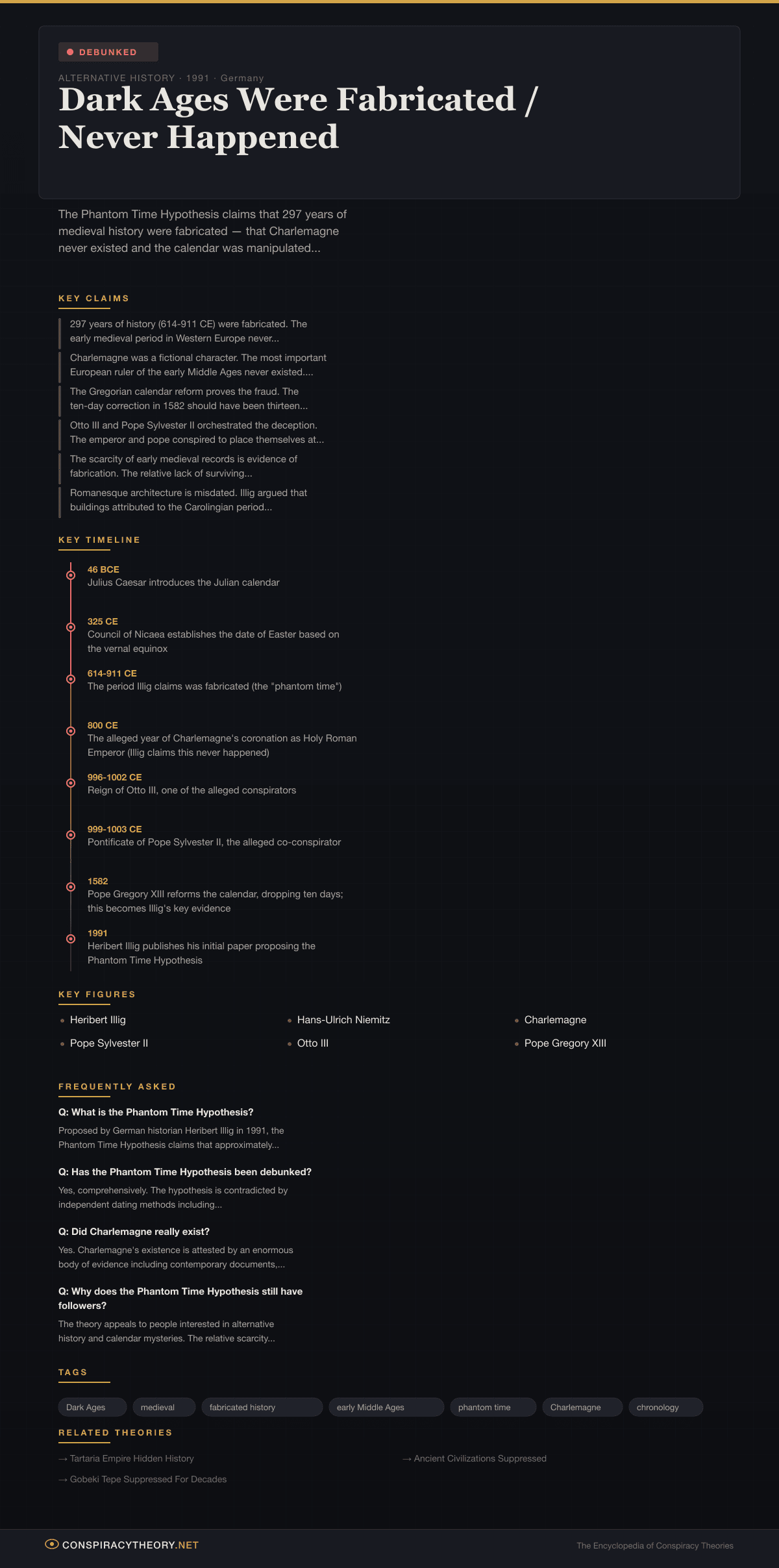
Dark Ages Were Fabricated / Never Happened
Overview
Imagine waking up tomorrow and being told that it is actually the year 1729. That everything you know about the eighteenth, nineteenth, and twentieth centuries — every war, every invention, every person — was fabricated. That three hundred years of human history were simply made up.
That is, roughly speaking, what Heribert Illig proposed in 1991. A German systems analyst and publisher with an interest in historical chronology, Illig published a paper arguing that 297 years of the early medieval period — from 614 to 911 CE — never happened. The Carolingian dynasty was fiction. Charlemagne, the emperor who united much of Western Europe and whose coronation on Christmas Day in the year 800 is one of the most famous events in medieval history, was a fairy tale. The Vikings’ great age of expansion, the golden period of Islamic scholarship, the construction of the great mosques — all invented or misdated.
The real year, according to Illig, was not what the calendar said. The Holy Roman Emperor Otto III and Pope Sylvester II had conspired to alter the calendar, inserting nearly three centuries of phantom time so that they could claim to be ruling at the symbolically potent year 1000 — the millennium of Christ’s birth. It was the greatest historical fraud ever perpetrated, and every historian, archaeologist, and scholar since had simply failed to notice.
The theory is wrong. It is wrong in ways that are comprehensive, multidisciplinary, and occasionally entertaining. But its wrongness is instructive, because the Phantom Time Hypothesis reveals how conspiracy thinking exploits genuine gaps in the historical record — and how a clever narrative can make even the most implausible ideas feel tantalizingly possible.
Origins & History
Heribert Illig and the Calendar Problem
Illig’s starting point was not unreasonable. The Gregorian calendar reform of 1582, ordered by Pope Gregory XIII, adjusted the Julian calendar by dropping ten days to correct the accumulated drift between the calendar and the solar year. The Julian calendar, introduced by Julius Caesar in 46 BCE, gained approximately one day every 128 years due to a slight overestimation of the solar year’s length.
Illig noticed something: if the Julian calendar had been in use since 46 BCE, the accumulated error by 1582 should have been approximately 13 days, not 10. Three days were missing. For Illig, this discrepancy was the smoking gun. The missing three days corresponded to approximately 297 years of phantom time — years that existed on the calendar but never actually passed.
It was a tidy observation. It was also wrong, for reasons that any astronomer could have explained. The Gregorian reform was not correcting the total accumulated error since 46 BCE. It was correcting the drift since the Council of Nicaea in 325 CE, which had established the date of Easter based on the vernal equinox’s position at that time. Pope Gregory’s astronomers were aligning the calendar to the 325 CE baseline, not to the original Julian start date. The “missing” three days were not missing at all — they represented the pre-325 CE drift that Gregory deliberately chose not to correct.
The German Alternative History Scene
Illig published his theory first in a 1991 paper and then expanded it in his 1996 book Das erfundene Mittelalter (“The Invented Middle Ages”). He found a small but enthusiastic audience in Germany’s alternative history community, which had already produced figures like Gunnar Heinsohn, who proposed his own radical revisions to ancient chronology.
Hans-Ulrich Niemitz, a professor at the Leipzig University of Applied Sciences, became the theory’s most prominent academic supporter, publishing a paper titled “Did the Early Middle Ages Really Exist?” in 1995. Niemitz’s involvement lent a veneer of academic respectability, though his field — history of technology — was far removed from medieval studies or chronology.
The theory also found traction in online communities during the early internet era. It appealed to the same audience drawn to Tartaria narratives and broader “hidden history” theories — people who found the scarcity of early medieval records not just puzzling but suspicious.
The Conspiracy Narrative
At the heart of Illig’s theory is a specific conspiracy claim: that Otto III, Holy Roman Emperor from 996 to 1002, and Pope Sylvester II (Gerbert of Aurillac), who served as pope from 999 to 1003, conspired to rewrite the calendar so that they would be the rulers at the millennium. Otto wanted the prestige of reigning at the year 1000. Sylvester, a renowned scholar and one of the most intellectually sophisticated popes in history, had the knowledge to pull it off.
To accomplish this, according to Illig, they fabricated the entire Carolingian period — creating documents, forging chronicles, inventing Charlemagne’s empire — and then inserted 297 phantom years into the calendar. Every subsequent historian was fooled because the fabricated documents were integrated seamlessly into the historical record.
It is an audacious claim. It requires not just that two men in the late tenth century rewrote several centuries of history, but that they did so with such skill that neither contemporary observers nor any subsequent scholar in the following thousand years detected the fraud.
Key Claims
-
297 years of history (614-911 CE) were fabricated. The early medieval period in Western Europe never occurred. All events, persons, and cultural developments attributed to this period are fictitious or misdated.
-
Charlemagne was a fictional character. The most important European ruler of the early Middle Ages never existed. His biography, written by Einhard, was a forgery. The Carolingian Renaissance was invented.
-
The Gregorian calendar reform proves the fraud. The ten-day correction in 1582 should have been thirteen days if the Julian calendar had run since 46 BCE, and the three “missing” days correspond to 297 phantom years.
-
Otto III and Pope Sylvester II orchestrated the deception. The emperor and pope conspired to place themselves at the year 1000 for millennial prestige, fabricating centuries of prior history to make the timeline work.
-
The scarcity of early medieval records is evidence of fabrication. The relative lack of surviving documents, buildings, and artifacts from the early Dark Ages — compared to both the Roman period and the High Middle Ages — is presented as evidence that the period never existed.
-
Romanesque architecture is misdated. Illig argued that buildings attributed to the Carolingian period are actually late Roman or post-tenth-century constructions, with their dating artificially pushed into the phantom centuries.
Evidence & Debunking
Dendrochronology: The Trees Don’t Lie
The most devastating refutation of the Phantom Time Hypothesis comes from dendrochronology — the science of dating events by analyzing tree-ring growth patterns. Trees produce one ring per year, and the width of each ring varies with climate conditions. By overlapping ring patterns from living trees, dead wood, and archaeological timber, scientists have constructed continuous chronologies stretching back thousands of years.
European dendrochronological records cover the allegedly phantom period without interruption. Oak chronologies from Ireland, Germany, and England show continuous, unbroken sequences through the seventh, eighth, and ninth centuries. If those centuries did not exist, the trees — which have no reason to participate in a medieval calendar fraud — would have to have been fabricated too.
Astronomical Evidence
Perhaps even more conclusive is the astronomical record. Solar eclipses, comets, and other celestial events can be calculated backward with extraordinary precision. Historical records from the early medieval period describe astronomical events that match modern calculations for the standard timeline.
The most famous example is Halley’s Comet, which returns approximately every 75-76 years. Chinese, Islamic, and European records of its appearances throughout history match the standard chronology perfectly. Under the Phantom Time Hypothesis, the comet’s periodicity would be thrown off by 297 years — and the Chinese and Islamic records, created by civilizations with no connection to a hypothetical European calendar conspiracy, would all have to be wrong.
Islamic astronomical observations from the seventh through ninth centuries — recorded by scholars in Baghdad, Damascus, and Cordoba — describe events that are independently verifiable and consistent with the standard timeline. These observers had no motive to support a future European chronological fraud.
The Islamic World Problem
This is perhaps the theory’s most glaring weakness. The Phantom Time Hypothesis is essentially Eurocentric — it proposes that European history was fabricated without accounting for the rest of the world. But the seventh through ninth centuries were a period of extraordinary development in the Islamic world. The Umayyad and Abbasid caliphates rose and transformed the Middle East, North Africa, and Iberia. The House of Wisdom in Baghdad became one of the greatest centers of learning in human history. The Quran was compiled and standardized.
All of this is documented not just in Islamic sources but in Byzantine, Chinese, Indian, and other independent records. For the Phantom Time Hypothesis to be correct, either all of these civilizations independently fabricated the same 297 years of history, or none of them noticed that the European calendar had jumped forward by three centuries. Neither proposition is credible.
Chinese and Japanese Records
East Asian civilizations maintained meticulous chronological records throughout the allegedly phantom period. Chinese dynastic histories cover the Tang dynasty (618-907 CE) in extraordinary detail, documenting emperors, wars, poems, inventions, and astronomical observations. Japanese records, including the earliest chronicles (Kojiki, 712 CE; Nihon Shoki, 720 CE), fall squarely within the phantom period.
These records were created by civilizations that had no contact with Otto III or Pope Sylvester II and no reason to participate in a European chronological conspiracy.
Archaeological Evidence
Radiocarbon dating of artifacts from the early medieval period consistently produces dates within the standard chronology. Viking-age settlements in Scandinavia, Anglo-Saxon sites in England, and Carolingian-era constructions in France and Germany all date to the seventh through ninth centuries using methods that are entirely independent of written historical records.
The Oseberg ship burial in Norway, one of the most spectacular Viking-age finds, has been radiocarbon-dated to approximately 834 CE — squarely within the phantom period. The ship, its contents, and the burial mound would all need to be explained away.
Charlemagne’s Physical Evidence
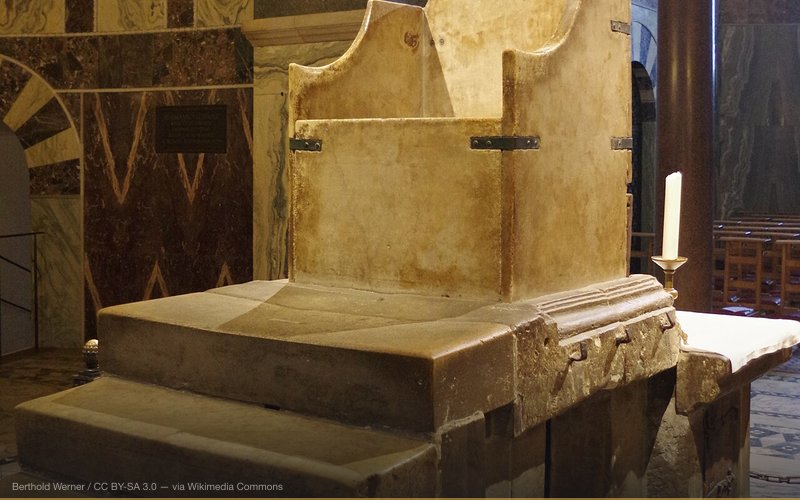
Charlemagne’s existence is attested by an overwhelming body of evidence. Coins minted during his reign have been found across Europe. The palace complex at Aachen, which he made his capital, has been excavated and dated. His biographer Einhard wrote Vita Karoli Magni within a few years of Charlemagne’s death in 814, and the text is consistent with other contemporary sources.
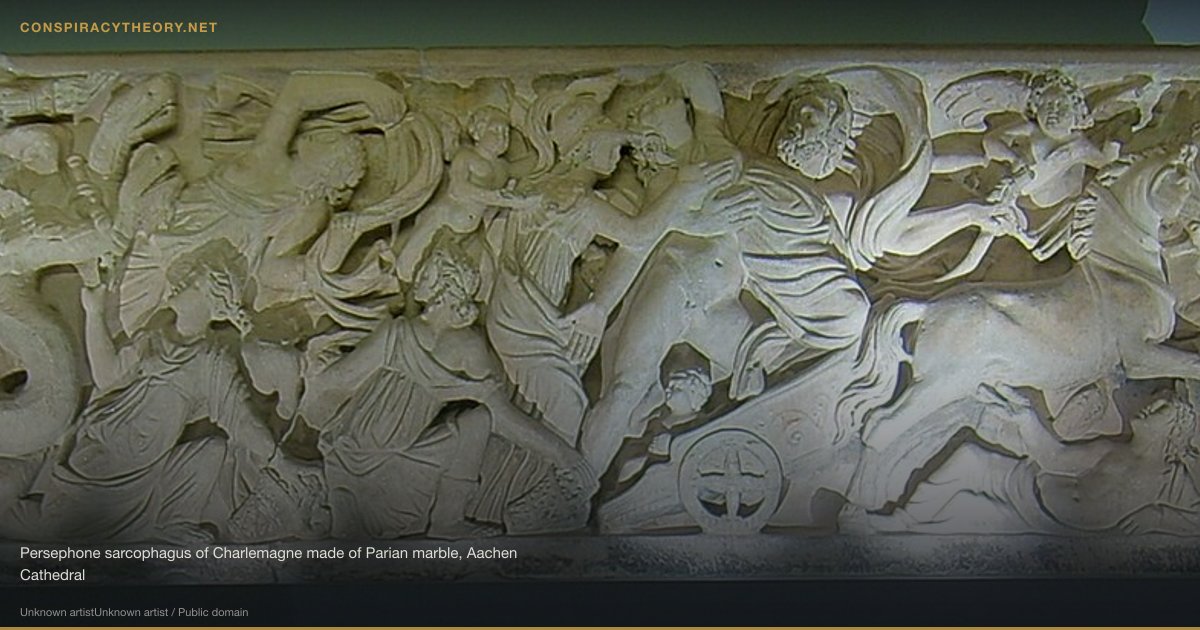
Charlemagne’s tomb at Aachen Cathedral has been opened and examined multiple times throughout history. In 1988, a scientific examination of the skeletal remains confirmed they were consistent with a tall man who died in his early seventies — matching Einhard’s description exactly.
Cultural Impact
The Phantom Time Hypothesis occupies a peculiar niche in conspiracy culture. It is too academic and arcane to achieve mass popularity — you will not find it on protest signs or in political speeches. But within the alternative history community, it has been remarkably influential, inspiring a broader genre of “fabricated history” theories.
The most prominent descendant is the Tartaria conspiracy theory, which proposes that a vast, technologically advanced civilization was erased from history in the nineteenth century. While Tartaria narratives differ significantly from Illig’s hypothesis in their specifics, they share the same core premise: that the historical timeline is a lie, and that powerful institutions have fabricated the past to serve their own interests.
The theory has also intersected with the New Chronology of Anatoly Fomenko, a Russian mathematician who has proposed far more radical revisions to world history, arguing that most of recorded history before the eleventh century is fabricated. Fomenko’s work, which has been thoroughly debunked by historians, has found a significant audience in Russia and has been promoted by various political figures.
In academic circles, the Phantom Time Hypothesis has served as a useful case study in pseudohistory. It demonstrates how a superficially logical argument (the calendar discrepancy) can seem compelling when divorced from the broader evidentiary context — and how the internet can amplify fringe ideas by connecting geographically scattered believers into communities that reinforce each other’s convictions.
The theory also raises genuine questions about how we know what we know about the early medieval period. The scarcity of written records from the European Dark Ages is real — not because those centuries did not happen, but because literacy was limited, parchment was expensive, and centuries of Viking raids, wars, and natural disasters destroyed much of what was written. Understanding why the record is thin is a legitimate historical inquiry. Concluding that the record is thin because nothing happened is not.
Timeline
- 46 BCE — Julius Caesar introduces the Julian calendar
- 325 CE — Council of Nicaea establishes the date of Easter based on the vernal equinox
- 614-911 CE — The period Illig claims was fabricated (the “phantom time”)
- 800 CE — The alleged year of Charlemagne’s coronation as Holy Roman Emperor (Illig claims this never happened)
- 996-1002 CE — Reign of Otto III, one of the alleged conspirators
- 999-1003 CE — Pontificate of Pope Sylvester II, the alleged co-conspirator
- 1582 — Pope Gregory XIII reforms the calendar, dropping ten days; this becomes Illig’s key evidence
- 1991 — Heribert Illig publishes his initial paper proposing the Phantom Time Hypothesis
- 1995 — Hans-Ulrich Niemitz publishes “Did the Early Middle Ages Really Exist?”
- 1996 — Illig publishes Das erfundene Mittelalter (“The Invented Middle Ages”)
- 2000s — Theory spreads through internet forums and alternative history communities
- 2010s — Phantom time concepts influence the emerging Tartaria conspiracy theory
- 2013 — Illig publishes a revised edition doubling down on the hypothesis despite accumulated counter-evidence
Sources & Further Reading
- Illig, Heribert. Das erfundene Mittelalter: Die größte Zeitfälschung der Geschichte. Econ Verlag, 1996
- Niemitz, Hans-Ulrich. “Did the Early Middle Ages Really Exist?” 1995
- Fomenko, Anatoly. History: Fiction or Science? Delamere Publishing, 2003
- Dutton, Paul Edward, ed. Charlemagne’s Courtier: The Complete Einhard. University of Toronto Press, 1998
- Baillie, Mike. A Slice Through Time: Dendrochronology and Precision Dating. Routledge, 1995
- Ginzel, Friedrich Karl. Handbuch der mathematischen und technischen Chronologie. J.C. Hinrichs, 1906-1914
- Yeomans, Donald K. Comets: A Chronological History of Observation, Science, Myth, and Folklore. Wiley, 1991
- Treadgold, Warren. The Middle Byzantine Historians. Palgrave Macmillan, 2013
Related Theories
- Tartaria — the theory that a vast civilization was erased from history, influenced by phantom time concepts
- Ancient Civilizations Suppressed — broader claims that advanced ancient societies have been hidden from the public
- Gobekli Tepe Suppressed — claims that archaeological discoveries challenging the timeline have been deliberately concealed
Frequently Asked Questions
What is the Phantom Time Hypothesis?
Has the Phantom Time Hypothesis been debunked?
Did Charlemagne really exist?
Why does the Phantom Time Hypothesis still have followers?
Infographic
Share this visual summary. Right-click to save.