Diamonds Are Forever — Artificial Scarcity by De Beers
Overview
The De Beers diamond conspiracy is one of the most thoroughly documented and widely acknowledged corporate conspiracies in modern history. For over a century, the De Beers company and its predecessors maintained a near-total monopoly on the global diamond supply, artificially restricting the flow of diamonds to market to create the illusion of scarcity and sustain prices far above what a competitive market would produce. Simultaneously, through one of the most successful advertising campaigns ever created, De Beers manufactured the cultural tradition of the diamond engagement ring and embedded it so deeply in Western (and eventually global) culture that most people today consider it an ancient custom rather than a 20th-century marketing invention.
What makes this conspiracy remarkable is not that it is disputed — it is essentially confirmed by all parties — but that the manipulation continues to shape consumer behavior decades after its mechanisms were publicly exposed. The 1947 slogan “A Diamond Is Forever,” rated by Advertising Age as the greatest advertising slogan of the 20th century, was designed not merely to sell diamonds but to prevent their resale, thereby keeping used diamonds off the market and maintaining the artificial scarcity. The campaign succeeded so completely that the manufactured tradition has taken on a life of its own, persisting even as De Beers’ monopoly power has diminished.
This is a confirmed conspiracy: the monopoly practices, price manipulation, stockpiling, market control, and deliberate manufacturing of cultural norms are all documented in corporate records, court proceedings, and the company’s own advertising archives.
Origins & History
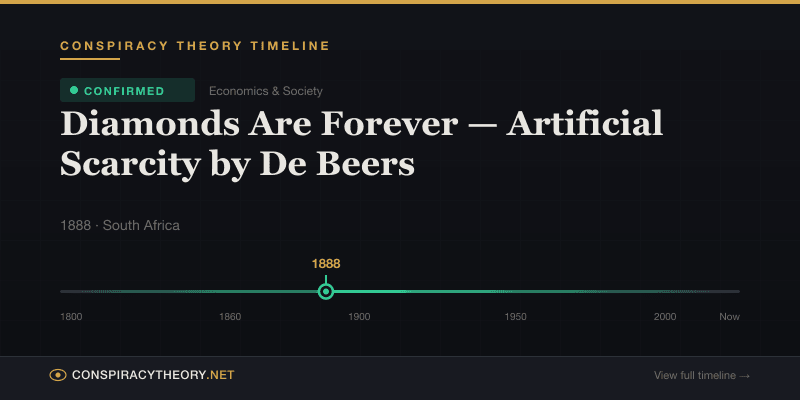
The story begins with Cecil Rhodes, the British imperialist who in 1888 consolidated the diamond mines of Kimberley, South Africa into a single entity: De Beers Consolidated Mines, Limited. Rhodes recognized that diamonds were far more abundant than the market could sustain at high prices, and that only monopoly control of supply could maintain their value. He famously remarked that the value of diamonds depended entirely on their scarcity and that flooding the market would destroy the industry.
Under Rhodes and his successors, De Beers pursued aggressive acquisition of diamond mines worldwide, buying up new discoveries before they could become competitors. When Ernest Oppenheimer took control of the company in 1927, he refined this strategy into a comprehensive system. Oppenheimer established the Central Selling Organisation (CSO, later the Diamond Trading Company), which became the single channel through which the vast majority of the world’s rough diamonds were sold. By the mid-20th century, De Beers controlled an estimated 80-90% of the global rough diamond trade.
The marketing dimension of the conspiracy began in 1938, when De Beers hired the American advertising agency N.W. Ayer & Son to address declining diamond sales during the Great Depression. The agency’s research revealed that diamond engagement rings were not a widespread tradition — fewer than 10% of American engagement rings contained diamonds. N.W. Ayer devised a campaign to change this, targeting the psychological and emotional associations of diamonds rather than their material properties.
The campaign was multifaceted and sophisticated. N.W. Ayer placed diamonds in movies, arranged for celebrities to be photographed wearing diamond jewelry, planted stories in newspapers about diamond engagement rings as symbols of romance, and worked with fashion designers and lecturers who visited high schools to promote the idea that diamond rings were an essential part of courtship. The agency specifically targeted young women as influencers who would create social pressure for men to purchase diamond engagement rings.
In 1947, copywriter Frances Gerety coined the slogan “A Diamond Is Forever.” This phrase served a dual purpose: it reinforced the romantic associations of diamonds with eternal love, and it subtly discouraged the resale of diamonds. If a diamond symbolizes a permanent bond, selling it becomes emotionally unacceptable, thus keeping used diamonds off the market and protecting De Beers’ pricing structure.
Key Claims
- De Beers deliberately restricted the supply of diamonds to create artificial scarcity and inflate prices
- The diamond engagement ring tradition was manufactured through a coordinated marketing campaign, not inherited from historical custom
- The “A Diamond Is Forever” slogan was specifically designed to discourage diamond resale, protecting the artificial pricing structure
- De Beers stockpiled diamonds in London vaults to control supply, releasing them strategically to maintain prices
- The company used the “sight” system to control distribution, forcing buyers to accept pre-selected packages of diamonds at non-negotiable prices
- De Beers expanded the manufactured tradition globally, including creating the concept of a “two months’ salary” guideline for ring purchases
- The company suppressed the development of synthetic diamonds that threatened to expose the artificial pricing
- Diamond prices in the retail market bear little relationship to actual scarcity or intrinsic value
Evidence
The evidence for the De Beers conspiracy is overwhelming and largely uncontested. Much of it comes from the company’s own records, legal proceedings, and the advertising industry’s documentation of the campaign.
N.W. Ayer’s own internal documents, revealed through various investigations and industry histories, describe the strategy of creating a cultural norm around diamond engagement rings. The agency’s memos explicitly discuss manufacturing desire and creating social pressure. One 1948 strategy document outlined plans to reach “ichool students at the ‘romance’ age,” reinforcing the association between diamonds and love.
De Beers’ monopoly practices were the subject of multiple antitrust actions. The company was indicted in the United States in 1994 for conspiring to fix prices in the industrial diamond market. For decades, De Beers executives could not enter the United States for fear of arrest. In 2004, De Beers pleaded guilty to criminal price-fixing charges and paid a $10 million fine. In 2008 and 2012, the company settled class-action lawsuits from consumers alleging price-fixing, paying a combined $295 million.
The Central Selling Organisation’s operations are well-documented. De Beers invited select diamond dealers to periodic “sights” in London, where they were presented with pre-assembled boxes of rough diamonds at non-negotiable prices. Dealers who declined a box risked being excluded from future sights. This system gave De Beers extraordinary control over both the quantity and price of diamonds entering the market.
Investigative journalism, most notably Edward Jay Epstein’s 1982 Atlantic article “Have You Ever Tried to Sell a Diamond?” and his subsequent book “The Rise and Fall of Diamonds,” exposed the mechanics of the conspiracy in detail. Epstein documented how De Beers maintained diamond vaults in London containing billions of dollars worth of stockpiled diamonds, releasing them strategically to match demand without allowing oversupply.
The “two months’ salary” guideline for engagement ring purchases — which many Americans believe is a longstanding tradition — was another De Beers marketing invention. The company initially promoted one month’s salary in the 1930s, increasing it to two months in the 1980s. In Japan, where diamond engagement rings were virtually unknown before the 1960s, De Beers’ marketing campaign was so successful that by 1981, 60% of Japanese brides wore diamonds.
Debunking / Verification
This is a confirmed conspiracy requiring no debunking. The key facts are acknowledged by De Beers itself, documented in court records, and corroborated by advertising industry archives.
De Beers has never denied its historical monopoly position, though the company characterizes its role as providing “market stability.” The criminal guilty plea in 2004 and civil settlements totaling hundreds of millions of dollars provide legal confirmation of price-fixing. The advertising campaign’s deliberate manufacturing of the engagement ring tradition is documented in N.W. Ayer’s own records and has been studied extensively in marketing textbooks as one of the most successful campaigns in advertising history.
What has changed is De Beers’ market position. Competition from Russian (ALROSA), Canadian, and Australian diamond producers eroded the company’s market share beginning in the 1990s. By the 2000s, De Beers controlled approximately 35-40% of the global rough diamond market, down from its historical 80-90%. The company shifted from controlling supply to focusing on its own branded retail operations, launching De Beers Jewellers in 2001.
The emergence of synthetic laboratory-grown diamonds, which are chemically identical to mined diamonds, has further challenged the monopoly model. De Beers initially fought synthetic diamonds aggressively, then reversed course and launched its own synthetic diamond line, Lightbox Jewellery, in 2018 — though notably at price points significantly below their mined diamonds.
Cultural Impact
The De Beers conspiracy has had extraordinary cultural impact, arguably creating one of the most deeply embedded manufactured traditions in modern society. The diamond engagement ring, which was a niche product before the 1940s, became a near-universal expectation in Western courtship within a single generation. The tradition then spread globally, penetrating markets in Japan, China, India, and the Middle East through targeted campaigns that adapted the emotional messaging to local cultural contexts.
The “two months’ salary” guideline created an expectation of significant financial expenditure on an engagement ring, linking a man’s love and commitment to his willingness to spend. This concept has influenced consumer behavior for decades, contributing to the approximately $80 billion global diamond jewelry market.
The conspiracy has also become a touchstone in discussions about consumer culture and manufactured desire. The diamond engagement ring is frequently cited as the quintessential example of how marketing can create cultural norms that feel natural and traditional. It appears in marketing textbooks, sociology courses, and popular media as a case study in corporate manipulation of culture.
The exposure of the conspiracy, particularly through Epstein’s journalism and subsequent popular articles, has generated a counter-movement. Growing numbers of consumers, particularly millennials and Gen Z, have questioned the diamond engagement ring tradition, opting for alternative gemstones, vintage rings, or lab-grown diamonds. The rise of “blood diamond” awareness, following the 2006 film and reporting on conflict diamonds from African war zones, added an ethical dimension to the critique.
Despite this growing awareness, the tradition remains remarkably durable. The emotional associations planted by decades of marketing have become self-reinforcing through social pressure, family expectations, and cultural inertia. Even consumers who intellectually understand the manufactured nature of the tradition often feel compelled to participate in it.
Timeline
- 1866 — Diamonds discovered in South Africa near the Orange River
- 1871 — Discovery of diamond-bearing kimberlite pipes at Kimberley
- 1888 — Cecil Rhodes consolidates Kimberley mines into De Beers Consolidated Mines
- 1902 — Cecil Rhodes dies; De Beers controls approximately 90% of global diamond production
- 1927 — Ernest Oppenheimer takes control of De Beers, establishes Central Selling Organisation
- 1938 — De Beers hires N.W. Ayer & Son advertising agency to boost American diamond sales
- 1939 — N.W. Ayer begins systematic campaign to associate diamonds with romance and engagement
- 1947 — Frances Gerety coins “A Diamond Is Forever” slogan
- 1948 — Strategy document outlines campaign targeting young Americans at “romance age”
- 1960s — De Beers launches campaign in Japan; diamond engagement rings virtually unknown there
- 1981 — 60% of Japanese brides wear diamond engagement rings after De Beers campaign
- 1982 — Edward Jay Epstein publishes “Have You Ever Tried to Sell a Diamond?” in The Atlantic
- 1994 — De Beers indicted in US for industrial diamond price-fixing
- 2000 — Conflict diamond awareness grows; “blood diamond” enters public lexicon
- 2001 — De Beers launches branded retail operations; market share declining from peak
- 2004 — De Beers pleads guilty to criminal price-fixing charges, pays $10 million fine
- 2008-2012 — De Beers settles consumer class-action lawsuits for $295 million combined
- 2018 — De Beers launches Lightbox Jewellery, selling lab-grown diamonds
- 2020s — Lab-grown diamonds capture growing market share; De Beers market share around 30-35%
Sources & Further Reading
- Epstein, Edward Jay. “The Rise and Fall of Diamonds: The Shattering of a Brilliant Illusion.” Simon & Schuster, 1982.
- Epstein, Edward Jay. “Have You Ever Tried to Sell a Diamond?” The Atlantic, February 1982.
- Kanfer, Stefan. “The Last Empire: De Beers, Diamonds, and the World.” Farrar, Straus and Giroux, 1993.
- Campbell, Greg. “Blood Diamonds: Tracing the Deadly Path of the World’s Most Precious Stones.” Westview Press, 2002.
- Roberts, Janine. “Glitter & Greed: The Secret World of the Diamond Cartel.” The Disinformation Company, 2003.
- Bergenstock, Donna J. and Maskulka, James M. “The De Beers Story: Are Diamonds Forever?” Business Horizons, 2001.
- “A Diamond Is Forever.” Advertising Age, 1999 (named #1 advertising slogan of the 20th century).
Frequently Asked Questions
Are diamonds actually rare?
Was the diamond engagement ring tradition invented by De Beers?
Why can't you resell a diamond for what you paid?
Infographic
Share this visual summary. Right-click to save.
