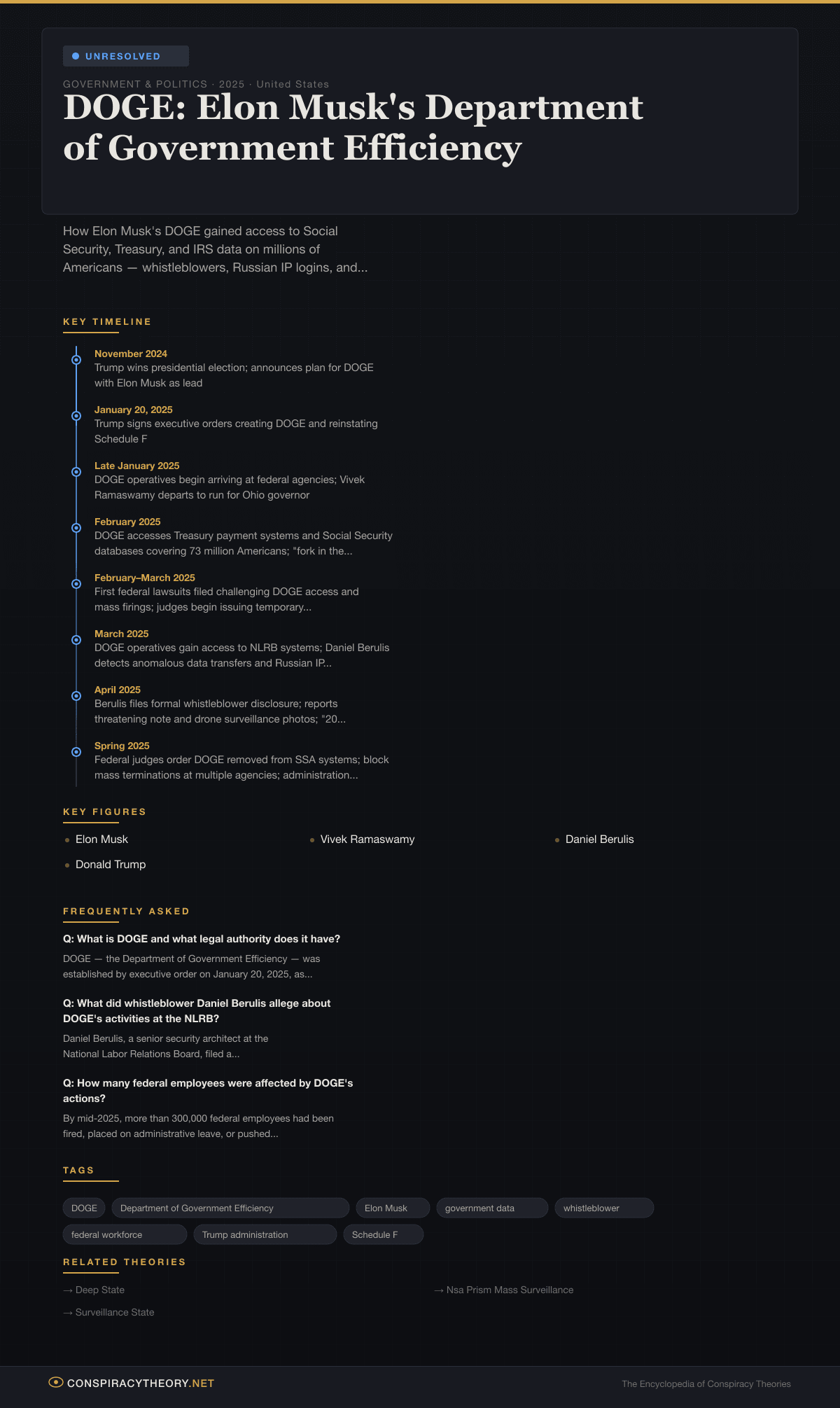
DOGE: Elon Musk's Department of Government Efficiency

Overview
On the afternoon of January 20, 2025 — hours after taking the oath of office for his second term — President Donald Trump signed an executive order creating the Department of Government Efficiency, universally known by its meme-friendly acronym DOGE. The name was no accident. It was a direct nod to the cryptocurrency Dogecoin, long championed by the man tapped to lead the initiative: Elon Musk, the richest person on the planet, a man who had just spent a quarter-billion dollars helping elect the president and who now stood to reshape the machinery of the federal government from the inside.
What followed was one of the most extraordinary episodes in modern American governance. A team of young engineers — some barely out of college, many with no government experience and no security clearances — fanned out across federal agencies armed with administrator-level access to systems containing the personal data of hundreds of millions of Americans. They walked into the Social Security Administration and accessed records covering 73 million beneficiaries. They plugged into Treasury Department payment systems that disburse trillions of dollars annually. They entered the IRS. They entered the Office of Personnel Management. They entered the National Labor Relations Board.
And then things got strange.
A career cybersecurity architect at the NLRB noticed anomalies that made his skin crawl: gigabytes of data leaving the building, audit logs being disabled, and — most alarmingly — someone in Russia attempting to log in with freshly created DOGE credentials within minutes of those credentials being set up. When he tried to blow the whistle, someone taped a note to his front door, accompanied by drone-captured photos of him walking through his neighborhood.
DOGE sits at the intersection of several colliding forces: legitimate concerns about government waste, unprecedented concentration of data access in the hands of a private citizen with massive business conflicts, a legal framework being tested to its breaking point, and the oldest question in democratic governance — who watches the watchers?
Origins and History
The Campaign Promise
The idea for DOGE crystallized during the 2024 presidential campaign. Musk, who had grown increasingly political after his acquisition of Twitter (rebranded as X), appeared alongside Trump at rallies and on podcasts, riffing about the absurdity of government bureaucracy. The pitch was simple and politically potent: the federal government was bloated, wasteful, and run by unaccountable bureaucrats. Musk would bring Silicon Valley’s move-fast-and-break-things ethos to Washington. He’d find the waste, cut the fat, and save taxpayers $2 trillion.
Vivek Ramaswamy, the biotech entrepreneur and former Republican primary candidate, was initially named co-lead. The pairing was meant to signal seriousness — Ramaswamy brought political credibility and policy fluency, while Musk brought celebrity wattage and a track record of upending industries. But Ramaswamy departed by February 2025 to pursue a run for governor of Ohio, leaving Musk as the undisputed face of the operation.
The name itself — a reference to the Shiba Inu dog meme and the cryptocurrency Musk had hyped for years — signaled from the start that this would not be a conventional government reform effort. It would be a spectacle, conducted in public, narrated through Musk’s social media feeds, and aimed as much at generating political content as at achieving fiscal savings.
The Executive Order
Trump’s January 20 executive order established DOGE as a “temporary organization” within the Executive Office of the President, tasked with modernizing federal technology, reducing waste, and eliminating unnecessary regulations. Legally, it was structured as an advisory body — not a Senate-confirmed agency — which would become a critical point of contention.
A separate executive order issued the same day reinstated and expanded Schedule F, a Trump first-term policy that reclassified tens of thousands of career civil servants in “policy-influencing” positions, stripping them of standard civil service protections and making them at-will employees who could be fired without the procedural safeguards that had governed the federal workforce since the Pendleton Civil Service Reform Act of 1883.
The combination was deliberate: DOGE would identify the cuts, and Schedule F would make the cutting legally simple. Together, they represented the most aggressive restructuring of the federal workforce since the New Deal.
The Teams Deploy
Within days of the inauguration, DOGE operatives began appearing at federal agencies. These weren’t grizzled government auditors. They were, for the most part, young software engineers recruited from Musk’s companies — Tesla, SpaceX, and the Boring Company — supplemented by hires from Silicon Valley venture capital networks. Many were in their twenties. Some were interns. Their task: get access to agency systems, pull data, and find things to cut.
At the Social Security Administration, DOGE personnel demanded and received access to master databases containing personal information on approximately 73 million Americans. At the Treasury Department, they accessed the Bureau of the Fiscal Service payment systems — the digital pipes through which Social Security checks, tax refunds, military pay, and virtually every other federal payment flows. At the IRS, they accessed taxpayer data. At the Office of Personnel Management, they accessed the personnel records of the entire federal workforce.
The speed was breathtaking. The resistance — at first — was minimal. Agency heads, most of them newly appointed Trump loyalists, waved DOGE teams through. Career officials who raised questions about security protocols, data handling procedures, or legal authority found themselves sidelined or shown the door.
Key Claims and Controversies
The Access Question
The fundamental controversy surrounding DOGE is deceptively simple: did these people have the legal right to access this data?
Federal law is dense with statutes governing who can see what. The Privacy Act of 1974 restricts disclosure of personal records. The Internal Revenue Code makes unauthorized access to taxpayer information a felony. The Social Security Act contains its own confidentiality provisions. The Computer Fraud and Abuse Act criminalizes unauthorized access to federal systems.
DOGE’s legal theory rested on the argument that its operatives were acting as presidential designees, and that the president — as head of the executive branch — has inherent authority to access any information held by executive agencies. Critics, including multiple federal judges, countered that this theory was far too broad, that specific statutes created specific restrictions, and that an advisory body of unconfirmed private citizens was not the same thing as the president himself.
The question of security clearances added another layer. Many DOGE operatives lacked the clearances that would ordinarily be required to access the systems they were entering. The administration argued that the president could grant or waive clearances at his discretion. Opponents argued that the formal clearance process existed for reasons — background checks, counterintelligence screening, foreign influence assessment — that couldn’t simply be hand-waved away, especially when the person leading the operation had extensive business dealings with foreign governments, including China and Russia.
The Conflicts of Interest
Elon Musk’s business empire creates conflicts of interest so sprawling they’re almost hard to catalog. Tesla receives federal EV tax credits and has business before the EPA, NHTSA, and the Department of Energy. SpaceX holds billions in NASA and Department of Defense contracts. Musk’s companies have been involved in disputes with the NLRB, the SEC, the FTC, and the FAA. His social media platform X has interests before the FCC and various regulatory bodies.
The idea that a man with billions of dollars in active federal contracts was simultaneously being granted root-level access to the systems of the agencies that regulate his companies struck critics as an arrangement so conflicted it bordered on the surreal. Musk’s defenders argued he was volunteering his time, that he had no personal financial interest in cutting government waste per se, and that his business success was precisely what qualified him to identify inefficiency.
But the specifics were damning. When DOGE operatives entered the NLRB — an agency that had active cases involving Musk’s companies — they accessed case management systems containing information about ongoing labor disputes. When they entered the IRS, they potentially had access to the tax records of Musk’s competitors, business partners, and adversaries. The structural incentives for abuse were enormous, whether or not abuse actually occurred.
The Misinformation Problem
DOGE’s public-facing operation — largely conducted through Musk’s X account and amplified by allied media — created its own set of problems by mixing legitimate findings with claims that fell apart under scrutiny.
The most notorious example was the “$50 million on condoms for Gaza” claim. Musk posted about it to his hundreds of millions of followers, and it rocketed through conservative media as a prime example of government waste. The underlying reality was more mundane: USAID global health programs distributed contraceptives as part of international family planning initiatives, a policy that had been in place under both Republican and Democratic administrations for decades and had nothing to do with sending prophylactics to a war zone.
Similarly, DOGE claimed to have discovered that Social Security was paying benefits to 20 million people over the age of 100, implying massive fraud. Actuaries and Social Security experts quickly pointed out that the database in question included deceased beneficiaries whose records hadn’t been purged — a known data management issue, not evidence of fraud. The actual number of living centenarians receiving benefits was a small fraction of the figure Musk publicized.
These episodes crystallized a pattern: DOGE would surface a data point, strip it of context, blast it across social media as evidence of spectacular waste, and then move on to the next claim before corrections could catch up. The strategy generated enormous engagement and reinforced the political narrative of a bloated government, but it corroded trust in the operation’s actual findings — some of which may have had merit.
The Whistleblower: Daniel Berulis
The most explosive chapter in the DOGE saga began with a man whose job was to keep networks secure.
Daniel Berulis was a senior security architect at the National Labor Relations Board, a small independent agency responsible for enforcing federal labor law. He’d spent years building and monitoring the agency’s cybersecurity infrastructure. In March 2025, he noticed something deeply troubling.
DOGE operatives had arrived at the NLRB and been granted “tenant owner” level access to the agency’s cloud computing environment — essentially, God-mode privileges that exceeded even those of the agency’s own IT leadership. What happened next, according to Berulis’s subsequent whistleblower disclosure filed with the Office of Special Counsel and presented alongside a declaration to a Senate committee, reads like something out of a cyber-thriller.
The Technical Allegations
Berulis reported that shortly after DOGE personnel gained access, outbound data transfers from NLRB systems spiked dramatically — approximately 10 gigabytes of data leaving the agency’s network over a short period. For an agency the size of the NLRB, this was an enormous and anomalous volume. The data included sensitive case information: records of ongoing labor disputes, witness statements, corporate investigations, and the personal information of workers who had filed complaints against their employers.
More concerning still, Berulis alleged that DOGE accounts were configured in ways that minimized audit trails. Standard logging mechanisms were altered or disabled. The configuration choices appeared deliberate — these weren’t the settings of people who didn’t know what they were doing. They were the settings of people who didn’t want to leave footprints.
Then came the detail that made national headlines: Berulis reported that within approximately 15 minutes of DOGE credentials being created in the NLRB system, login attempts using those same credentials were detected from an IP address geolocated to Russia. The logins were blocked by the agency’s security infrastructure, but the timing was extraordinary. How did someone in Russia obtain valid DOGE login credentials within minutes of their creation?
Berulis laid out several possible explanations, ranging from coincidence to compromise, but none of them were reassuring. Either DOGE’s own operational security was catastrophically poor, or something far more troubling was happening.
The Intimidation
What happened after Berulis began raising alarms internally turned the story from a cybersecurity incident into something darker.
On the morning he was preparing to go public with his concerns, Berulis found a handwritten note taped to his front door. The note contained language that he interpreted as a direct threat related to his whistleblowing activities. Attached to the note were printed photographs — surveillance images of Berulis walking in his neighborhood, taken from an elevated angle consistent with drone photography.
The message was unmistakable: we know where you live, we can see you, and we know what you’re about to do.
Berulis reported the incident to law enforcement and to his attorneys. His legal team, which included lawyers from the nonprofit Whistleblower Aid, presented the evidence alongside his formal disclosure. The combination — technical evidence of data exfiltration, anomalous Russian access attempts, and physical intimidation of a federal employee attempting to report potential security breaches — created a firestorm.
The NLRB, the White House, and DOGE did not provide a detailed public response to the specific technical allegations. Administration allies suggested Berulis was a disgruntled employee caught up in anti-DOGE hysteria. But no one explained the Russian IP logins, and no one explained the drone photos.
The Legal Battlefield
DOGE’s activities triggered what may be the most concentrated burst of federal litigation since the early New Deal.
By the spring of 2025, at least a dozen major lawsuits had been filed challenging various aspects of the DOGE operation. Federal employee unions sued to block mass firings. Privacy advocates sued to prevent unauthorized data access. State attorneys general sued to protect residents whose data had been accessed. Congressional Democrats referred potential violations to inspectors general.
Federal judges began issuing injunctions. A district court in Washington, D.C. ordered DOGE personnel removed from Social Security Administration systems, finding that their access likely violated the Privacy Act. Another court blocked a wave of mass terminations at several agencies, ruling that the firings had not followed required procedures. A third judge ordered Treasury to limit DOGE access to payment systems.
The administration’s response to these rulings was, at times, defiant. In several instances, compliance with court orders was slow or ambiguous. Musk publicly mocked judges who ruled against DOGE. The tension between executive action and judicial oversight became a running constitutional drama that dominated legal commentary throughout 2025.
Schedule F and the Workforce Purge
Running parallel to DOGE’s data access campaign was the mass restructuring of the federal workforce. The reinstatement of Schedule F — renamed under various administrative labels but functionally identical — stripped civil service protections from an estimated 50,000 to 100,000 federal positions.
The practical effect was devastating for the career civil service. Employees who had spent decades developing expertise in everything from food safety inspection to nuclear weapons maintenance found themselves reclassified as at-will workers and terminated with minimal process. By mid-2025, more than 300,000 federal employees had been fired, placed on leave, or pushed into “deferred resignation” programs — an arrangement in which employees were paid to stay home until their formal termination dates, which critics described as a thinly disguised buyout scheme.
The cuts were not surgical. USAID, the international development agency, was gutted almost entirely. The Consumer Financial Protection Bureau, created after the 2008 financial crisis, was reduced to a skeleton crew. The Department of Education was targeted for elimination. The IRS, which had just received an $80 billion modernization investment under the Inflation Reduction Act, saw thousands of newly hired agents dismissed.
The downstream effects were immediate and concrete. Tax refund processing slowed. Social Security offices faced longer wait times. Food inspection intervals stretched. Veterans Affairs backlogs grew. The promise of efficiency collided with the reality that many of the eliminated positions existed because someone, at some point, had determined they were necessary.
Cultural Impact
DOGE became one of the defining political phenomena of 2025, but its cultural footprint extended well beyond policy debates.
The operation became a Rorschach test for American attitudes about government, technology, and power. For supporters, DOGE was the long-overdue reckoning with a federal bureaucracy that had grown arrogant and unaccountable — finally, someone with the resources and the will to challenge the permanent government. For opponents, it was a terrifying experiment in plutocratic governance — the richest man in the world using presidential authority to access the most sensitive data systems on Earth while simultaneously running companies that depended on the government’s good graces.
The meme-ification of government restructuring was itself a cultural watershed. Musk live-tweeted firings. DOGE merch proliferated. The Dogecoin cryptocurrency spiked and crashed in correlation with DOGE headlines. Government employees — real people with mortgages and children — became characters in a social media spectacle, their terminations announced on X before they received official notice.
The episode also accelerated a preexisting debate about the role of technologists in government. Silicon Valley had long argued that government was stuck in the past, running on ancient code and antiquated processes. DOGE was the most literal test of that theory ever attempted — and the results were far more ambiguous than the disruptors had promised.
Perhaps most significantly, DOGE reshaped the conspiracy landscape. It generated conspiracies from every direction. The right saw the resistance to DOGE as proof of the deep state — entrenched bureaucrats fighting to protect their sinecures. The left saw DOGE itself as the conspiracy — an oligarch using government access to enrich himself and punish enemies. Libertarians were split between delight at the cuts and alarm at the surveillance implications. The old categories didn’t quite fit anymore.
Timeline
- November 2024 — Trump wins presidential election; announces plan for DOGE with Elon Musk as lead
- January 20, 2025 — Trump signs executive orders creating DOGE and reinstating Schedule F
- Late January 2025 — DOGE operatives begin arriving at federal agencies; Vivek Ramaswamy departs to run for Ohio governor
- February 2025 — DOGE accesses Treasury payment systems and Social Security databases covering 73 million Americans; “fork in the road” mass resignation emails sent to federal workforce
- February–March 2025 — First federal lawsuits filed challenging DOGE access and mass firings; judges begin issuing temporary restraining orders
- March 2025 — DOGE operatives gain access to NLRB systems; Daniel Berulis detects anomalous data transfers and Russian IP login attempts; Musk’s “$50 million Gaza condoms” claim debunked
- April 2025 — Berulis files formal whistleblower disclosure; reports threatening note and drone surveillance photos; “20 million centenarians” claim debunked by actuaries
- Spring 2025 — Federal judges order DOGE removed from SSA systems; block mass terminations at multiple agencies; administration slow to comply
- Mid-2025 — Over 300,000 federal employees fired or pushed out; USAID effectively dismantled; IRS modernization workforce gutted
- Summer–Fall 2025 — Congressional hearings on DOGE activities; inspector general investigations opened at multiple agencies; downstream effects on government services become visible
- Late 2025 — Multiple court rulings find DOGE access violated federal privacy statutes; appeals filed; Musk reduces day-to-day DOGE involvement
- Early 2026 — Litigation continues through federal courts; former federal employees file class action suits; long-term impacts on government capacity under assessment
- March 2026 — DOGE’s status remains legally contested; whistleblower cases pending; congressional investigations ongoing
Evidence and Assessment
What makes the DOGE controversy so resistant to simple categorization is that it contains elements that are simultaneously verified, disputed, and genuinely unknown.
What is established: DOGE operatives, many without security clearances or Senate confirmation, accessed sensitive federal databases across multiple agencies. Mass firings and restructuring displaced over 300,000 federal employees. Multiple federal courts found that specific DOGE activities exceeded legal authority. The administration’s claims about government waste included at least two high-profile assertions that were substantially false or misleading.
What is alleged but unresolved: Daniel Berulis’s claims about data exfiltration at the NLRB, the Russian IP login attempts, and the physical intimidation he experienced. The extent to which accessed data may have been shared with private entities or used for purposes beyond government efficiency. Whether Musk’s business interests benefited from information accessed through DOGE.
What remains unknown: The full scope of data accessed across all agencies. Whether the Russian login attempts reflected a genuine security compromise or a less sinister explanation. The long-term impact on government capacity and institutional knowledge. Whether the operation achieved any meaningful, lasting reduction in government waste.
The DOGE story is still being written. Courts are still ruling. Investigations are still open. The consequences — for the federal workforce, for the precedent of private citizens wielding government power, for the norms around data access and executive authority — will take years to fully resolve.
What is already clear is that DOGE tested the boundaries of American governance in ways that have no modern precedent. Whether that testing was a necessary disruption or a dangerous breach depends entirely on which side of the Rorschach test you stand on — and on facts that have not yet fully come to light.
Sources & Further Reading
- Executive Order establishing DOGE, January 20, 2025
- Daniel Berulis whistleblower disclosure to the Office of Special Counsel, April 2025
- NPR, “DOGE and the Limits of Presidential Power,” March 2025
- The New York Times, “Inside DOGE: How Musk’s Engineers Accessed America’s Data,” February 2025
- The Washington Post, “The DOGE Lawsuits: A Legal Tracker,” ongoing
- Associated Press, “Fact Check: DOGE Claims About Government Waste,” April 2025
- Wired, “The Cybersecurity Nightmare Inside DOGE,” May 2025
- The Atlantic, “What DOGE Broke,” June 2025
- Government Accountability Office reports on federal workforce reductions, 2025
- Congressional Research Service, “Schedule F and the Federal Civil Service,” 2025
Related Theories
- The Deep State — The theory DOGE was explicitly designed to combat, and which its opponents say DOGE itself now resembles
- NSA PRISM Mass Surveillance — Previous controversy over government access to private data at scale
- The Surveillance State — Broader framework for understanding data access and government overreach

Frequently Asked Questions
What is DOGE and what legal authority does it have?
What did whistleblower Daniel Berulis allege about DOGE's activities at the NLRB?
How many federal employees were affected by DOGE's actions?

Infographic
Share this visual summary. Right-click to save.