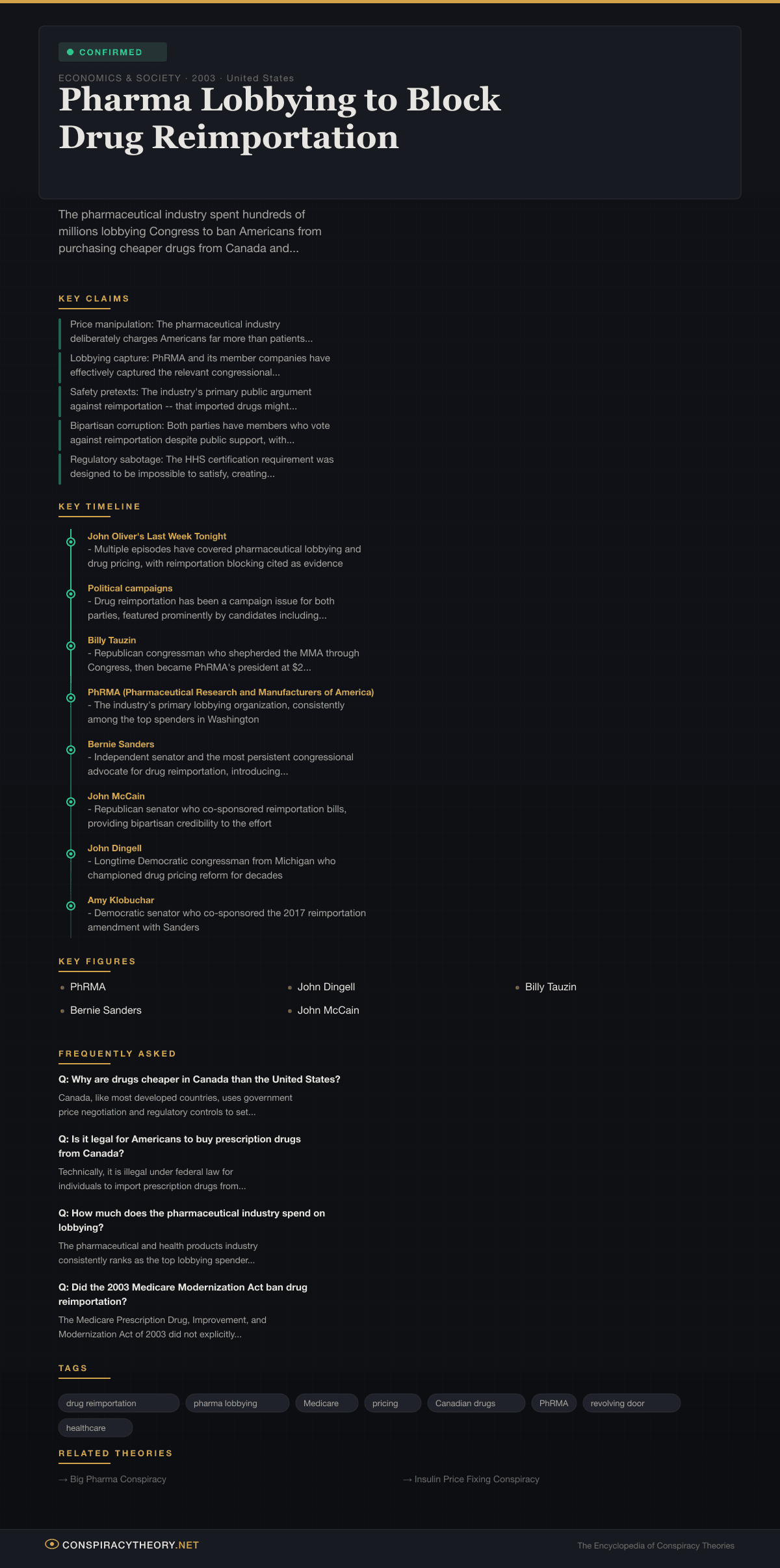
Pharma Lobbying to Block Drug Reimportation
Overview
Here is a conspiracy that is not really a conspiracy at all. It is just lobbying, operating exactly as designed.
For decades, Americans have paid the highest prescription drug prices in the developed world — often two, three, or ten times what patients in Canada, Europe, or Australia pay for identical medications manufactured by the same companies. The obvious consumer response would be to buy from abroad. And for decades, bipartisan coalitions in Congress have introduced legislation to allow exactly that: drug reimportation, permitting Americans to purchase FDA-approved medications from licensed pharmacies in countries with lower prices.
Every single time, the pharmaceutical industry has killed these bills. Not through secret machinations or shadowy backroom deals, but through the most transparent mechanism in American politics: massive, relentless, meticulously documented lobbying. The Pharmaceutical Research and Manufacturers of America (PhRMA) and its member companies have spent more money on lobbying than any other industry in the United States — over $4.7 billion since 1998, according to OpenSecrets — and blocking drug reimportation has been one of their top legislative priorities.
The result is a policy that virtually no one outside the industry defends on the merits, that majorities of both parties’ voters oppose, and that persists anyway. It is confirmed not because anyone denied it was happening, but because the sheer scale of the operation was larger than most people realized.
Origins & History
The Price Gap
The roots of the reimportation fight lie in a basic economic asymmetry. Most developed nations regulate drug prices through some combination of government negotiation, reference pricing, and cost-effectiveness review. The United Kingdom’s National Institute for Health and Care Excellence (NICE) evaluates whether drugs provide sufficient benefit to justify their cost. Canada’s Patented Medicine Prices Review Board caps prices at the median of comparator nations. Germany, France, Japan, and Australia all have their own mechanisms.
The United States does not. American drug pricing operates on a largely free-market basis, with manufacturers setting list prices and negotiating discounts with individual insurers, pharmacy benefit managers (PBMs), and hospitals. The result, predictably, is that the same pill manufactured in the same factory costs dramatically more when sold to an American than when sold to a Canadian.
By the early 2000s, the price differential had become politically untenable. Busloads of senior citizens were crossing into Canada to fill prescriptions. Internet pharmacies offered to ship Canadian medications to American doorsteps. Governors of both parties were exploring state-level importation programs. Something had to give.
The Medicare Modernization Act of 2003
The pharmaceutical industry’s masterstroke came wrapped in a gift. The Medicare Prescription Drug, Improvement, and Modernization Act of 2003 (MMA) created Medicare Part D, giving millions of seniors prescription drug coverage for the first time. It was popular and genuinely beneficial.
But the law contained two provisions that were pure PhRMA wish-list items:
-
The non-interference clause: Medicare was explicitly prohibited from using its massive purchasing power to negotiate drug prices directly with manufacturers. The Veterans Administration negotiates. Medicaid negotiates. Every other major government health program in the developed world negotiates. Medicare — the single largest purchaser of prescription drugs on Earth — was forbidden from doing so.
-
The reimportation catch-22: The law technically allowed drug reimportation, but only if the Secretary of Health and Human Services certified that imported drugs would be safe and would result in significant cost savings. This was a poison pill. No HHS Secretary — under Bush, Obama, or Trump — was willing to make that certification, because doing so would invite pharmaceutical industry litigation and political retaliation.
The bill passed the House at 3:00 AM after an unprecedented three-hour vote, during which Republican leadership held the roll call open while they pressured holdouts to switch their votes. It remains one of the most controversial procedural episodes in modern congressional history.
Billy Tauzin: The Revolving Door in Action
No single figure embodies the reimportation story more perfectly than Rep. Billy Tauzin (R-LA). As chairman of the House Energy and Commerce Committee, Tauzin was instrumental in shepherding the MMA through Congress and ensuring it included the provisions PhRMA wanted. In 2004, less than a year after the bill’s passage, Tauzin resigned from Congress to become president and CEO of PhRMA itself, at a reported salary of $2 million per year.
Tauzin’s career move was legal, widely reported, and utterly brazen. It became one of the most cited examples of the “revolving door” between Congress and K Street, and it crystallized public suspicion that the MMA had been written by and for the pharmaceutical industry.
Repeated Legislative Failures
The pattern has repeated with remarkable consistency:
- 2007: The Pharmaceutical Market Access and Drug Safety Act passed the Senate but died in the House
- 2009: During Affordable Care Act negotiations, the Obama administration reportedly struck a deal with PhRMA to cap industry costs at $80 billion in exchange for industry support — and reimportation was off the table
- 2017: An amendment by Sen. Bernie Sanders and Sen. Amy Klobuchar to allow reimportation from Canada was defeated 52-46, with 13 Democrats voting against it
- 2019: Bipartisan reimportation bills were introduced in both chambers; neither received a floor vote
- 2020: The Trump administration finalized a rule allowing states to develop importation programs from Canada. Canada responded by prohibiting bulk exports, and no state program became operational
- 2024-2025: Florida’s importation program, first authorized by state law in 2019, continued facing legal and logistical obstacles
Each failure followed the same script: bipartisan public support, bipartisan legislative introduction, and quiet death by lobbying.
Key Claims
The reimportation blocking theory, such as it is, involves these core claims — all of which are well-documented:
- Price manipulation: The pharmaceutical industry deliberately charges Americans far more than patients in other countries for the same drugs, and uses political influence to prevent market corrections
- Lobbying capture: PhRMA and its member companies have effectively captured the relevant congressional committees through campaign contributions, lobbying expenditures, and revolving-door hiring
- Safety pretexts: The industry’s primary public argument against reimportation — that imported drugs might be unsafe — is a pretext, since the drugs in question are manufactured by the same companies, in the same facilities, under FDA oversight, and are sold through licensed pharmacies in countries with rigorous regulatory systems
- Bipartisan corruption: Both parties have members who vote against reimportation despite public support, with voting patterns correlating closely with pharmaceutical industry campaign contributions
- Regulatory sabotage: The HHS certification requirement was designed to be impossible to satisfy, creating the appearance of openness while ensuring reimportation never actually occurs
Evidence
Lobbying Expenditures
The numbers are not in dispute. According to OpenSecrets (formerly the Center for Responsive Politics), the pharmaceutical and health products industry has been the top lobbying spender in Washington for more than two decades:
- Total lobbying spending since 1998: Over $4.7 billion
- Peak annual spending: $373 million (2020)
- Number of registered lobbyists (typical year): 1,500+, outnumbering members of Congress roughly 3:1
- Campaign contributions: Hundreds of millions more in direct contributions and PAC spending
PhRMA alone spent $31 million on lobbying in 2023. But PhRMA is only the trade association; individual member companies like Pfizer, Johnson & Johnson, Merck, and AbbVie each spend tens of millions more independently.
The Voting Record
Academic studies have consistently found a correlation between pharmaceutical industry contributions and congressional votes on drug pricing legislation. A 2017 analysis of the Sanders-Klobuchar reimportation amendment vote found that senators who voted against it had received, on average, significantly more pharmaceutical industry money than those who voted for it. This held across party lines.
The Revolving Door
Beyond Tauzin, dozens of former congressional staffers and members have moved to pharmaceutical industry positions. The flow moves in both directions: industry executives regularly join federal agencies that regulate drug safety and pricing, then return to industry.
International Price Comparisons
The price gap is extensively documented:
- Insulin, a century-old drug, costs roughly $300 per vial in the U.S. versus $30-50 in Canada
- Humira (adalimumab), the world’s bestselling drug, was priced at roughly $5,800 per month in the U.S. versus $1,400 in the UK
- A 2019 RAND Corporation study found that U.S. drug prices were, on average, 2.56 times higher than prices in 32 comparison nations
Canada’s Response
In a twist that underscored the power dynamics at play, when the Trump administration finalized rules allowing state-level importation from Canada in 2020, Canada’s government moved to prohibit bulk drug exports. Canada’s stated concern was that American demand would create drug shortages in Canada — a reasonable worry, given that the U.S. market is roughly ten times the size of Canada’s. But the effect was to protect the pharmaceutical industry’s pricing structure from yet another direction.
Debunking / Verification
This theory is classified as confirmed because its core claims are established facts, documented in public records:
- The pharmaceutical industry is the top lobbying spender in Washington (OpenSecrets data)
- Drug reimportation legislation has been repeatedly introduced and defeated (Congressional Record)
- The MMA’s reimportation and non-negotiation provisions were lobbied for by PhRMA (lobbying disclosures)
- Billy Tauzin moved directly from chairing the relevant committee to leading PhRMA (public record)
- American drug prices are dramatically higher than in comparable countries (RAND, Commonwealth Fund, WHO data)
- The HHS certification requirement has never been fulfilled by any administration (HHS records)
The industry’s counterargument — that reimportation would compromise drug safety and undermine pharmaceutical innovation funding — is not conspiracy material; it is a policy disagreement. But the scale and effectiveness of the lobbying campaign to maintain the status quo is a matter of public record, not speculation.
Cultural Impact
The drug reimportation fight has become one of the defining examples of lobbying power in American politics. It appears in virtually every discussion of healthcare reform, pharmaceutical pricing, and the influence of money in politics.
The issue has unusual bipartisan salience. Conservative voters frame it as a market distortion — Americans subsidizing the rest of the world’s drug costs. Progressive voters frame it as corporate capture of government. Both frames point to the same policy outcome and the same lobbying apparatus.
The “bus trip to Canada” — senior citizens crossing the border to fill prescriptions at a fraction of U.S. prices — became one of the most powerful visual symbols of American healthcare dysfunction. It was a staple of news coverage throughout the 2000s and 2010s, and it resonated precisely because it was so easily understood: the same pill, the same manufacturer, a different price, separated by an imaginary line.
The reimportation fight also helped mainstream the concept of “regulatory capture” — the idea that regulatory agencies come to serve the interests of the industries they regulate rather than the public interest. Tauzin’s career trajectory became a textbook case, cited in political science courses, journalism, and reform advocacy.
In Popular Culture
- Sicko (2007) — Michael Moore’s documentary prominently featured Americans traveling to Canada and other countries for affordable medications
- The Dallas Buyers Club (2013) — While focused on the AIDS crisis, the film dramatized the broader theme of Americans seeking medications outside approved channels
- Dopesick (2021) — Hulu series examining the pharmaceutical industry’s influence on drug policy, with reimportation as part of the broader regulatory capture narrative
- John Oliver’s Last Week Tonight — Multiple episodes have covered pharmaceutical lobbying and drug pricing, with reimportation blocking cited as evidence
- Political campaigns — Drug reimportation has been a campaign issue for both parties, featured prominently by candidates including Bernie Sanders, John McCain, Donald Trump, and numerous congressional candidates
Key Figures
- Billy Tauzin — Republican congressman who shepherded the MMA through Congress, then became PhRMA’s president at $2 million/year, becoming the poster child for the revolving door
- PhRMA (Pharmaceutical Research and Manufacturers of America) — The industry’s primary lobbying organization, consistently among the top spenders in Washington
- Bernie Sanders — Independent senator and the most persistent congressional advocate for drug reimportation, introducing legislation repeatedly over decades
- John McCain — Republican senator who co-sponsored reimportation bills, providing bipartisan credibility to the effort
- John Dingell — Longtime Democratic congressman from Michigan who championed drug pricing reform for decades
- Amy Klobuchar — Democratic senator who co-sponsored the 2017 reimportation amendment with Sanders
Timeline
| Date | Event |
|---|---|
| 1987 | Prescription Drug Marketing Act restricts drug reimportation, establishing the legal framework the industry would later exploit |
| 2000 | Medicine Equity and Drug Safety Act passes Congress, allowing reimportation, but President Clinton’s HHS Secretary Donna Shalala declines to certify safety |
| 2003 | Medicare Modernization Act passes with non-negotiation clause and reimportation certification requirement; Billy Tauzin is key architect |
| 2004 | Tauzin resigns from Congress, becomes PhRMA president and CEO |
| 2007 | Pharmaceutical Market Access and Drug Safety Act passes Senate, dies in House |
| 2009 | Obama administration reportedly cuts deal with PhRMA during ACA negotiations, taking reimportation off the table |
| 2017 | Sanders-Klobuchar reimportation amendment defeated 52-46, with 13 Democrats voting no |
| 2019 | Florida passes state law authorizing Canadian drug importation; RAND study documents U.S. prices 2.56x higher than peer nations |
| 2020 | Trump administration finalizes rule allowing state importation programs; Canada moves to block bulk exports |
| 2021 | Biden administration signals support for importation but takes no concrete action |
| 2022 | Inflation Reduction Act allows Medicare to negotiate prices on a small number of drugs for the first time, but does not address reimportation |
| 2024-2025 | Florida’s importation program continues facing legal and logistical challenges |
Sources & Further Reading
- OpenSecrets. “Pharmaceuticals / Health Products: Lobbying Profile.” Updated annually. opensecrets.org
- RAND Corporation. “International Prescription Drug Price Comparisons.” 2021.
- Angell, Marcia. The Truth About the Drug Companies: How They Deceive Us and What to Do About It. Random House, 2004.
- Oliver, Thomas R. et al. “A Political History of Medicare and Prescription Drug Coverage.” Milbank Quarterly, 2004.
- Government Accountability Office. “Prescription Drugs: FDA and USDA Could Strengthen Existing Efforts to Prepare for Potential Challenges Importing Drugs from Canada.” 2021.
- Congressional Research Service. “Prescription Drug Importation: A Legal Overview.” Updated periodically.
- Kesselheim, Aaron S. et al. “The High Cost of Prescription Drugs in the United States.” JAMA, 2016.
Related Theories
- Big Pharma Conspiracy — The broader theory of pharmaceutical industry manipulation of healthcare systems
- Medicare Part D Negotiation Ban — The companion provision prohibiting Medicare price negotiation
- Insulin Pricing Cartel — Allegations of coordinated pricing among insulin manufacturers
Frequently Asked Questions
Why are drugs cheaper in Canada than the United States?
Is it legal for Americans to buy prescription drugs from Canada?
How much does the pharmaceutical industry spend on lobbying?
Did the 2003 Medicare Modernization Act ban drug reimportation?
Infographic
Share this visual summary. Right-click to save.