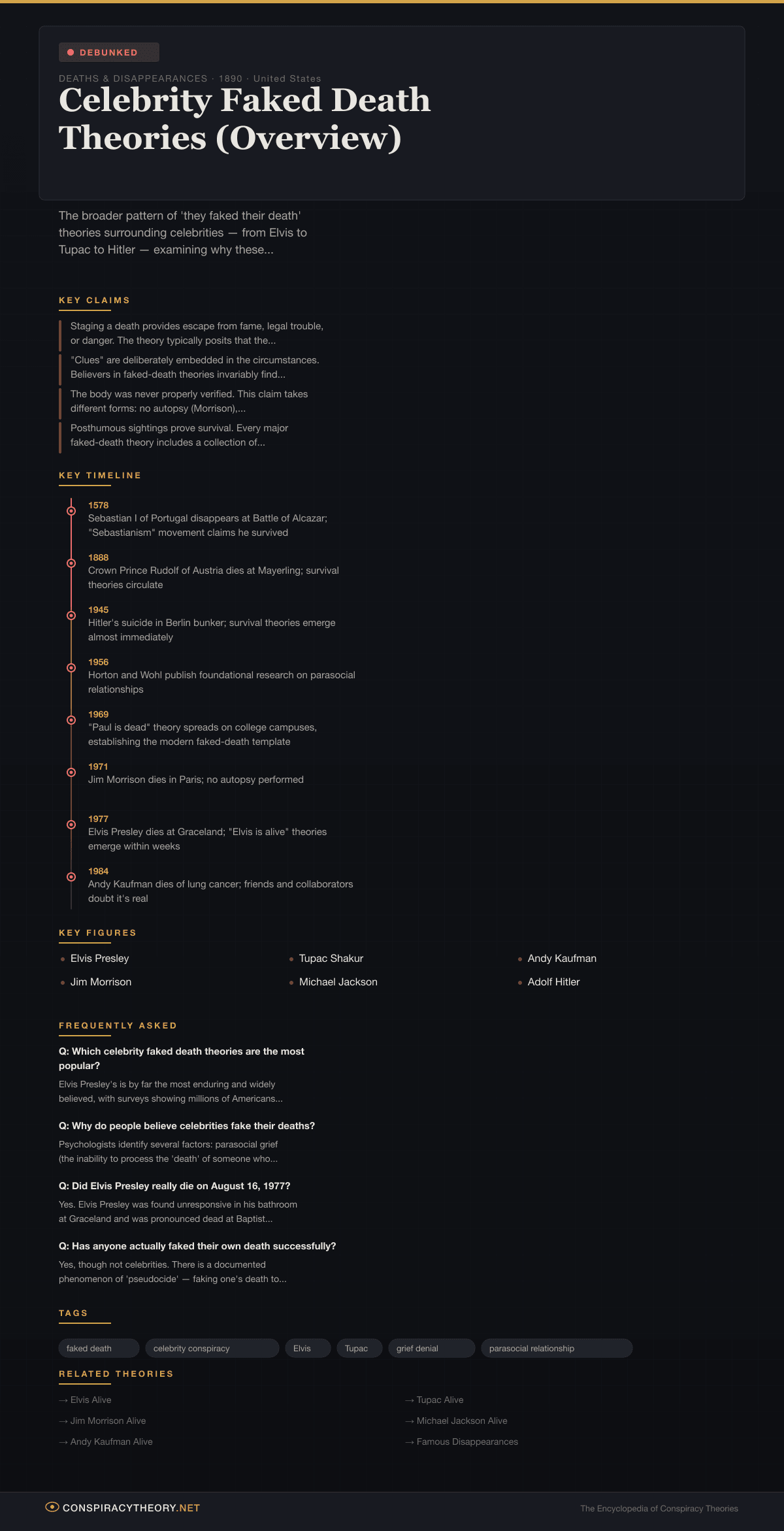
Celebrity Faked Death Theories (Overview)
Overview
On the morning of August 17, 1977 — the day after Elvis Presley was pronounced dead at Baptist Memorial Hospital in Memphis — a man reportedly walked into the Memphis airport, purchased a one-way ticket to Buenos Aires under the name “John Burrows” (an alias Elvis had been known to use), and boarded the plane. The story, which appeared in tabloids within weeks, had no verifiable source, no confirmed witnesses, and no corroborating documentation. It was, by any reasonable standard, complete fiction.
It was also the founding myth of the most durable celebrity conspiracy theory in American history. Nearly five decades after his death, Elvis Presley remains the gold standard of faked-death theories — a cottage industry of supposed sightings, “clue” analysis, and true-believer communities that has outlasted most of the cultural phenomena of its era. And Elvis is far from alone. Tupac Shakur, Jim Morrison, Andy Kaufman, Michael Jackson, Kurt Cobain, Princess Diana, JFK, and Adolf Hitler have all been subjects of theories that their deaths were staged — that they are living, somewhere, under assumed identities, having engineered their own disappearance for reasons that range from the plausible (witness protection, intelligence operations) to the fantastical (spiritual ascension, interdimensional travel).
The faked-death theory is not really a single conspiracy theory at all. It is a recurring template — a narrative structure that gets applied to different subjects with remarkably consistent mechanics. Understanding why it works, why it recurs, and what it reveals about the relationship between fame, death, and belief is more interesting than any individual case.
Origins & History
Ancient Roots: The King Who Cannot Die
The “they’re not really dead” narrative is far older than celebrity culture. It is, in fact, one of the oldest story structures in human civilization. The concept of the “sleeping king” — a great leader who did not truly die but lies dormant, waiting to return in his people’s hour of need — appears across cultures:
- King Arthur is said to sleep in Avalon, awaiting Britain’s darkest hour
- Frederick Barbarossa supposedly sleeps in a cave beneath the Kyffhäuser mountains in Germany
- Charlemagne was believed by medieval legends to await resurrection
- Sebastian I of Portugal, who disappeared at the Battle of Alcazar in 1578, spawned a messianic movement called Sebastianism; pretenders claiming to be the returned king appeared for decades
These myths served a social function: they expressed a community’s refusal to accept that a beloved figure was gone, and they kept alive the hope of rescue or redemption. Modern celebrity faked-death theories serve precisely the same function, translated into a secular context. Elvis is our sleeping king.
The Elvis Template (1977)
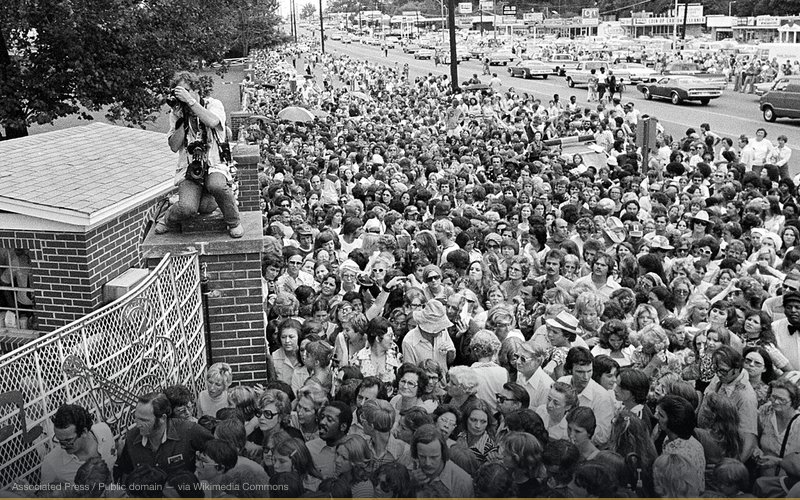
Elvis Presley died on August 16, 1977, at the age of 42. His girlfriend, Ginger Alden, found him unresponsive on his bathroom floor at Graceland. He was transported to Baptist Memorial Hospital and pronounced dead. The cause of death was cardiac arrhythmia, with contributing factors including polypharmacy — an autopsy revealed fourteen drugs in his system, ten in significant quantities.
The “Elvis is alive” theory emerged almost immediately, driven by several factors:
Inconsistencies in early reporting. Initial reports gave conflicting details about the time of death, the circumstances of discovery, and the cause of death. The original autopsy results were sealed for 50 years (they were partially released in 1994), which conspiracists interpreted as evidence of a cover-up rather than a family’s privacy request.
The misspelled tombstone. Elvis’s middle name was “Aron” (after his stillborn twin brother, Jesse Garon). His gravestone at Graceland reads “Aaron.” Believers argue this was a deliberate signal that the person buried there is not really Elvis. The more mundane explanation: Elvis had begun using “Aaron” in adult life and legally changed it in 1966.
The open casket. Thousands of mourners viewed Elvis’s body at Graceland before the funeral. Some reported that the body looked “waxy” or “not quite right” — which believers interpreted as evidence of a wax dummy rather than what a heavily embalmed body typically looks like.
The insurance policy. A widely circulated claim held that Elvis’s life insurance policy was never cashed. This claim has been debunked — the policy was indeed paid out — but it circulated for years in the pre-internet era before correction was possible.
Gail Brewer-Giorgio’s 1988 book Is Elvis Alive? became a bestseller and codified the theory for a mass audience. It included a cassette tape of a supposed phone call from Elvis made after his death, which audio analysts identified as a recording of an Elvis impersonator.
Tupac Shakur (1996)
Tupac Shakur was shot four times in a drive-by shooting on the Las Vegas Strip on September 7, 1996, and died six days later at University Medical Center. He was 25 years old. Within months, the “Tupac is alive” theory had taken hold, driven by:
Prolific posthumous releases. Seven studio albums were released after Tupac’s death, containing material recorded during an extraordinarily productive period in 1995-1996. The sheer volume of “new” Tupac music made it feel, to some fans, as if he were still recording.
Numerological “clues.” Believers found significance in numbers surrounding his death: he was shot on September 7 (7), died on September 13 (1+3=4; 7+4=11), at age 25 (2+5=7), and his last album was The 7 Day Theory, released under the name “Makaveli” — a reference to Niccolo Machiavelli, who had advocated faking one’s death to confuse enemies.
The cremation. Tupac was cremated the day after his death, which some found suspiciously fast. His former bodyguard later claimed to have smoked the ashes with marijuana, a detail both macabre and oddly credible.
Suge Knight’s ambiguity. Death Row Records CEO Suge Knight, who was in the car when Tupac was shot, made several cryptic statements over the years that believers interpreted as hints that Tupac was alive. Knight had obvious commercial reasons to maintain ambiguity.
Jim Morrison (1971)
The Doors frontman Jim Morrison was found dead in a bathtub in his Paris apartment on July 3, 1971. No autopsy was performed — French law did not require one when a doctor certified the death as heart failure. Morrison was buried in Pere Lachaise Cemetery two days later.
The absence of an autopsy is the engine of Morrison’s faked-death theory. Without one, the actual cause of death remains officially undetermined. The theory gained traction with the 1980 publication of No One Here Gets Out Alive by Jerry Hopkins and Danny Sugerman, which left the question of Morrison’s death deliberately ambiguous. Co-author Sugerman later said this was a commercial decision, not an editorial one.
Andy Kaufman (1984)
Andy Kaufman’s faked-death theory occupies a unique position because Kaufman himself repeatedly told friends and collaborators that he planned to fake his own death. The comedian, famous for blurring the line between performance and reality, reportedly outlined plans to stage his death and then reveal the hoax years later.
When Kaufman died of lung cancer on May 16, 1984, at age 35, many who knew him assumed it was the prank he had been planning. His comedy partner Bob Zmuda told audiences for years that Kaufman might still be alive. In 2014, at the Andy Kaufman Award ceremony, Kaufman’s brother Michael brought a young woman onstage and introduced her as Andy’s daughter — implying Andy was alive. It was later revealed to be a performance piece (the woman was an actress), but the incident demonstrated how deeply the faked-death narrative had embedded itself in Kaufman’s legacy.
Kaufman did, in fact, die. His death certificate, hospital records, and the testimony of his doctors and family confirm it. But because his entire career was built on making audiences question what was real, his death became his final, involuntary performance.
Adolf Hitler (1945)
The theory that Hitler survived the fall of Berlin and escaped to South America is the most historically consequential faked-death theory. Unlike the celebrity cases, this one was taken seriously at the highest levels of government.
According to established historical evidence, Hitler killed himself on April 30, 1945, in his bunker beneath the Reich Chancellery, along with Eva Braun. Their bodies were carried into the garden, doused with gasoline, and burned. Soviet forces recovered the charred remains and conducted dental identification.
However, the Soviets were deliberately ambiguous about whether they had confirmed Hitler’s death — Stalin told Truman at Potsdam that he believed Hitler was alive, possibly in Spain or Argentina. This ambiguity was likely a Soviet intelligence tactic, but it had real consequences. The FBI opened files on Hitler sightings and investigated reports of his presence in South America for decades. Declassified CIA documents from the 1950s show the agency also investigated claims of Hitler sightings in Colombia and Argentina.
The theory was revived by the History Channel series Hunting Hitler (2015-2018), which investigated alleged escape routes and supposed evidence of Hitler’s presence in South America. Historians were nearly unanimous in their criticism: the physical evidence, eyewitness testimony, and dental records leave no serious doubt that Hitler died in the bunker.
Key Claims
-
Staging a death provides escape from fame, legal trouble, or danger. The theory typically posits that the celebrity was motivated by a desire to escape the pressures of fame (Elvis, Morrison), legal or gang threats (Tupac), or criminal prosecution (Hitler).
-
“Clues” are deliberately embedded in the circumstances. Believers in faked-death theories invariably find hidden messages — in album art, in lyrics, in numerology, in spelling inconsistencies — that they interpret as the celebrity’s way of signaling the truth to those clever enough to see it.
-
The body was never properly verified. This claim takes different forms: no autopsy (Morrison), closed-casket funeral (various), rapid cremation (Tupac), or a substituted body (Elvis, Hitler).
-
Posthumous sightings prove survival. Every major faked-death theory includes a collection of reported sightings — Elvis at a gas station, Tupac in New Zealand, Morrison in a Paris cafe. These sightings are never accompanied by photographs, video, or other documentation that would be trivially easy to obtain.
Evidence & Debunking
The Forensic Reality
In every major case, the forensic evidence for the death is overwhelming:
- Elvis: Autopsy performed, death certificate issued, body viewed by thousands, buried in a marked grave at Graceland
- Tupac: Hospital records document six days of treatment, death certificate, cremation
- Morrison: Doctor’s examination, death certificate, burial in a famous and publicly accessible cemetery
- Kaufman: Hospital records, death certificate, family confirmation
- Hitler: Dental identification by his personal dentist’s assistant, Soviet forensic examination, consistent eyewitness testimony from multiple bunker survivors
The Logistics Problem
Faking a celebrity’s death would require the complicity of doctors, coroners, hospital staff, law enforcement, family members, and (in most cases) dozens of other witnesses — all of whom would need to maintain the secret indefinitely. In the case of Elvis, it would require the cooperation of the entire Memphis medical establishment, the Shelby County government, the Presley family, and everyone involved in the funeral and burial.
The probability that all of these people would maintain a perfect conspiracy of silence for decades — with no deathbed confessions, no accidental revelations, no whistleblowers — is, by any reasonable assessment, approximately zero.
Why the Theories Persist Anyway
The faked-death theory’s persistence is not really about evidence. It is about psychology. Several well-documented cognitive mechanisms are at work:
Parasocial grief. Psychologist Donald Horton and Richard Wohl identified “parasocial relationships” in 1956 — the one-sided emotional bonds people form with media figures. When a parasocial figure dies, the grief is real even though the relationship was imaginary. Faked-death theories function as a form of grief management: if Elvis is not dead, there is nothing to grieve.
Narrative dissatisfaction. Elvis dying on a bathroom floor from a drug-induced cardiac event is, from a narrative standpoint, a terrible ending. It is squalid, undignified, and random. A faked death, by contrast, is a story of agency, intelligence, and control — the hero writing his own ending. The theory transforms a tragic death into a clever escape.
The “Paul is dead” precedent. The 1969 Paul McCartney death theory — which held that McCartney had died in a 1966 car crash and been replaced by a lookalike — demonstrated that “clues” could be found in any body of creative work if you looked hard enough. Backward lyrics, album art, clothing choices: once you accept the premise that hidden messages exist, confirmation bias does the rest.
Cultural Impact
Faked-death theories have become a permanent fixture of celebrity culture, to the point where they are now anticipated — even planned for. The internet era has accelerated their creation and spread: within hours of any celebrity death, “they’re not really dead” posts appear on social media, often accompanied by elaborate “evidence” compiled from publicly available information.
The theories have also generated significant commercial activity. Elvis sighting tourism was a genuine economic phenomenon in the 1980s and 1990s. Books, documentaries, and TV shows exploring faked-death theories generate reliable audiences. The History Channel’s Hunting Hitler ran for three seasons despite the historical consensus being essentially unambiguous.
The broader cultural significance is that faked-death theories reveal the mechanics of conspiratorial thinking in their most transparent form. The psychological drivers — grief, narrative hunger, pattern recognition, community belonging — are the same ones that power political and historical conspiracy theories. But because the subject matter is celebrities rather than, say, government operations, the mechanics are easier to see and study. Faked-death theories are conspiracy theories with the covers off, and they teach us more about why people believe implausible things than any amount of political analysis.
They also raise an uncomfortable question about the relationship between fame and death. The conspiracy theory is, in a sense, the final tribute — the ultimate expression of the belief that someone was too important, too alive, too significant to die like an ordinary person. It is grief dressed up as detective work, and love disguised as suspicion.
Timeline
- 1578 — Sebastian I of Portugal disappears at Battle of Alcazar; “Sebastianism” movement claims he survived
- 1888 — Crown Prince Rudolf of Austria dies at Mayerling; survival theories circulate
- 1945 — Hitler’s suicide in Berlin bunker; survival theories emerge almost immediately
- 1956 — Horton and Wohl publish foundational research on parasocial relationships
- 1969 — “Paul is dead” theory spreads on college campuses, establishing the modern faked-death template
- 1971 — Jim Morrison dies in Paris; no autopsy performed
- 1977 — Elvis Presley dies at Graceland; “Elvis is alive” theories emerge within weeks
- 1984 — Andy Kaufman dies of lung cancer; friends and collaborators doubt it’s real
- 1988 — Is Elvis Alive? by Gail Brewer-Giorgio becomes a bestseller
- 1996 — Tupac Shakur killed in Las Vegas; posthumous albums fuel survival theories
- 2009 — Michael Jackson dies; faked-death theories appear within hours
- 2014 — Andy Kaufman’s brother stages a performance suggesting Andy is alive
- 2015-2018 — History Channel’s Hunting Hitler reinvestigates escape theories
- 2016 — David Bowie, Prince, and other celebrity deaths generate instant faked-death theories, now accelerated by social media
- 2020s — Faked-death theories become a reflexive, almost ritualistic response to any high-profile death
Sources & Further Reading
- Brewer-Giorgio, Gail. Is Elvis Alive? Tudor Publishing, 1988
- Marcus, Greil. Dead Elvis: A Chronicle of a Cultural Obsession. Harvard University Press, 1991
- Horton, Donald and Richard Wohl. “Mass Communication and Para-social Interaction.” Psychiatry, 1956
- Hopkins, Jerry and Danny Sugerman. No One Here Gets Out Alive. Warner Books, 1980
- Zirin, Dave. “Tupac and the Faked Death Industry.” The Nation, 2012
- Kershaw, Ian. The End: The Defiance and Destruction of Hitler’s Germany, 1944-45. Penguin, 2011
- Knight, Peter. Conspiracy Culture: From Kennedy to The X-Files. Routledge, 2000
- Barkun, Michael. A Culture of Conspiracy: Apocalyptic Visions in Contemporary America. University of California Press, 2003
- Zmuda, Bob and Lynne Margulies. Andy Kaufman Revealed! Little, Brown, 1999
- Greenwald, Jeff. “The Undying King.” Wired, 2003
Related Theories
- Elvis Alive — detailed examination of Elvis Presley faked-death claims
- Tupac Alive — the theory that Tupac Shakur survived the Las Vegas shooting
- Jim Morrison Alive — claims about Morrison’s continued survival in Paris
- Paul McCartney Dead — the inverse: a living celebrity supposedly replaced by a double
- Famous Unsolved Disappearances — cases where the person genuinely vanished without trace
Frequently Asked Questions
Which celebrity faked death theories are the most popular?
Why do people believe celebrities fake their deaths?
Did Elvis Presley really die on August 16, 1977?
Has anyone actually faked their own death successfully?
Infographic
Share this visual summary. Right-click to save.