FBI Entrapment Operations
Overview
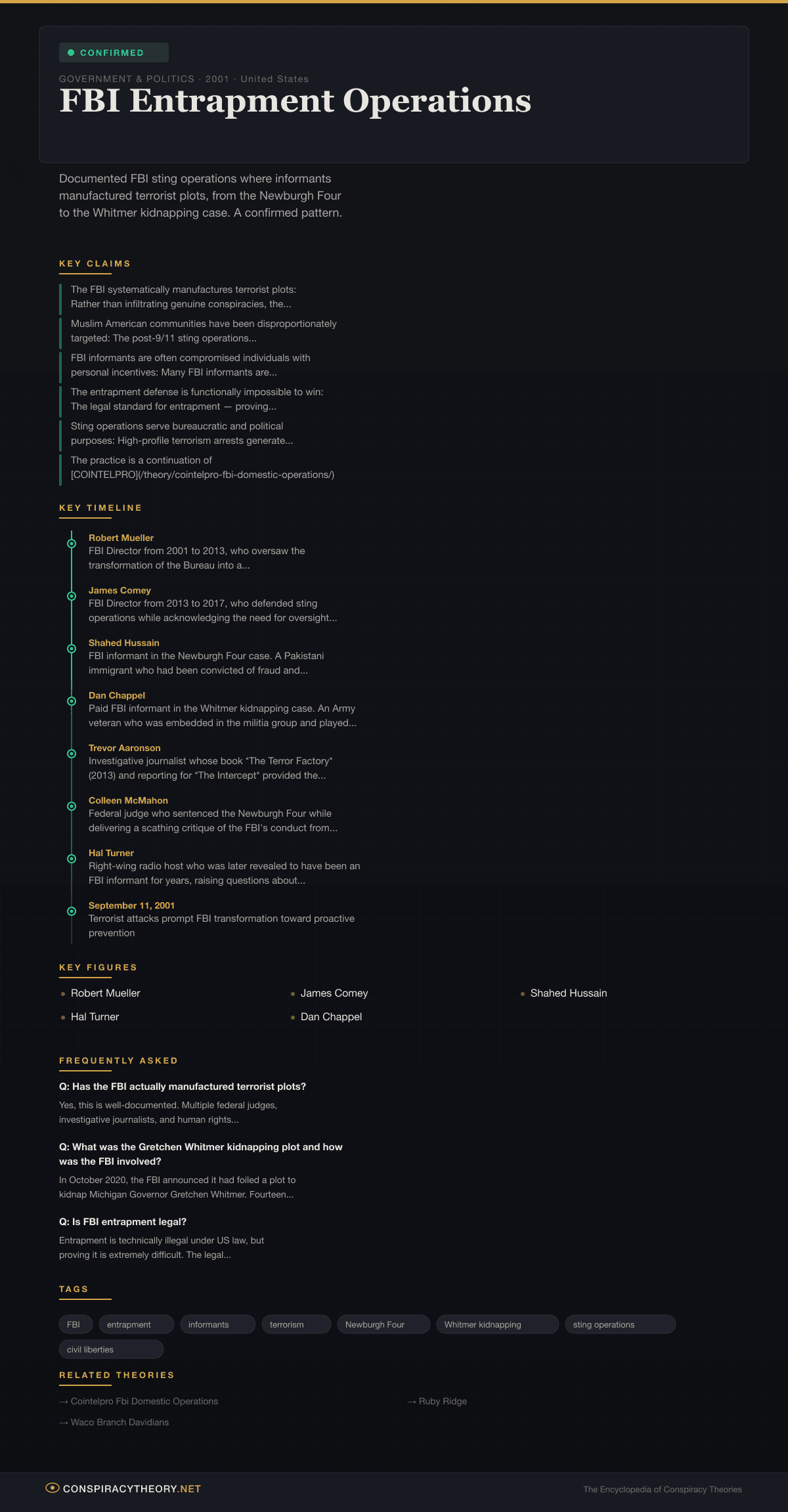
In the two decades following the September 11, 2001, terrorist attacks, the Federal Bureau of Investigation dramatically expanded its use of informants, undercover agents, and sting operations targeting individuals and groups suspected of terrorist sympathies. The stated goal was prevention — disrupting plots before they materialized. The documented reality, as revealed through court records, investigative journalism, and civil liberties reports, is more troubling: in case after case, the FBI did not infiltrate existing terrorist plots but rather manufactured them from scratch, using paid informants to identify vulnerable individuals, radicalize them, supply them with fake weapons or explosives, drive them to targets, and then arrest them in dramatic takedowns announced at press conferences. This is not a conspiracy theory in the traditional sense — it is a confirmed and extensively documented pattern of law enforcement conduct, criticized by federal judges, human rights organizations, and former FBI agents themselves. The debate is not whether it happened, but whether it constitutes legitimate crime prevention or state-manufactured terrorism.
Origins & History
The FBI’s use of informants and sting operations long predates September 11. The Bureau’s COINTELPRO program, which ran from 1956 to 1971, employed informants and agent provocateurs to infiltrate, disrupt, and discredit domestic political organizations. The ABSCAM operation of the late 1970s used an FBI-created fake Arab sheikh to ensnare members of Congress in bribery schemes. But the post-9/11 era represented a qualitative shift in both scale and methodology.
After the attacks of September 11, the FBI underwent what Director Robert Mueller described as a transformation from a primarily reactive law enforcement agency into a proactive intelligence organization focused on prevention. The Bureau’s informant network expanded dramatically. By 2011, the FBI maintained approximately 15,000 registered informants — a number that had roughly tripled since 2001. The Justice Department’s budget for confidential informants grew correspondingly, reaching hundreds of millions of dollars annually.
The new paradigm was built on a simple premise: waiting for terrorist plots to develop before intervening was unacceptable in a post-9/11 world. The FBI needed to identify potential terrorists before they acted. In practice, this meant identifying individuals who expressed extremist sympathies — often in online forums, at mosques, or in casual conversation — and then testing their willingness to act on those sympathies through elaborate sting operations.
The first major post-9/11 entrapment controversy emerged with the “Lackawanna Six” case in 2002, involving six Yemeni-American men from a suburb of Buffalo, New York, who had attended a training camp in Afghanistan before 9/11. But the cases that most clearly illustrated the entrapment pattern came later, as the FBI refined its methodology.
The Newburgh Four (2009)
The case that became a landmark in the FBI entrapment debate involved four men from Newburgh, New York — James Cromitie, David Williams, Onta Williams, and Laguerre Payen. The FBI sent a paid informant named Shahed Hussain, a Pakistani immigrant facing deportation for fraud who had agreed to work as a government informant, into a mosque in Newburgh in 2008. Hussain, who drove a BMW and flashed cash in a low-income community, befriended Cromitie and, over months of recorded conversations, repeatedly suggested attacking synagogues and shooting down military planes.
Court records and the HBO documentary The Newburgh Sting (2014) documented how Hussain provided the plot’s target selection, offered $250,000 and a new car as incentives, supplied fake C-4 explosives and Stinger missiles (all provided by the FBI), drove participants to the target sites, and overcame the defendants’ repeated hesitation. Cromitie’s own recorded statements showed him expressing reluctance and delaying action; Hussain persistently re-engaged him.
The four men were convicted and sentenced to twenty-five years each. Federal Judge Colleen McMahon, while imposing the sentences required by mandatory minimums, delivered an extraordinary critique from the bench: “The government did not have to infiltrate and foil some nefarious plot — there was no nefarious plot to foil. The government invented the plot, provided the means, and removed all obstacles. The essence of what occurred here is that the government, acting through its agent, created the crime, and then combatted it.”
The Sears Tower Plot (2006)
In June 2006, the FBI arrested seven men in Miami’s Liberty City neighborhood, announcing with considerable fanfare that they had been plotting to blow up the Sears Tower in Chicago. Attorney General Alberto Gonzales declared the group was as dangerous as any al-Qaeda cell. The reality was considerably less dramatic.
The “Liberty City Seven” were a small group led by Narseal Batiste, a construction worker who had formed a vaguely defined religious sect combining elements of Islam, Christianity, and the Moorish Science Temple. An FBI informant posing as an al-Qaeda operative had approached the group, offered money and supplies, and asked them to swear an oath to al-Qaeda and provide surveillance photographs of buildings. The group had no weapons, no explosives, no operational capacity, and no connection to any terrorist organization. They had never visited Chicago.
The first two trials ended in mistrials with jurors deadlocked. In a third trial, Batiste and five others were convicted. One defendant was acquitted in all three trials. The case was widely cited by civil liberties advocates as an example of the FBI targeting impoverished, marginally functional individuals and manufacturing plots they could never have conceived or executed independently.
The Portland Christmas Tree Bombing (2010)
Mohamed Osman Mohamud, a Somali-American teenager in Portland, Oregon, was arrested in November 2010 after attempting to detonate what he believed was a car bomb at a crowded Christmas tree-lighting ceremony. The bomb was fake, provided by undercover FBI agents who had been communicating with Mohamud for months after he expressed jihadist sympathies in online communications.
The case raised familiar questions about the line between prevention and creation. Mohamud was nineteen years old, had no prior criminal record, and had no connection to any terrorist organization. FBI agents had contacted him after monitoring his online activity, engaged him in extensive discussions about violent jihad, provided him with the means to construct a bomb, and drove him to Pioneer Courthouse Square on the night of the planned attack. Mohamud was convicted and sentenced to thirty years.
The Gretchen Whitmer Kidnapping Plot (2020)
Perhaps no case better illustrated the entrapment debate than the alleged plot to kidnap Michigan Governor Gretchen Whitmer. In October 2020, the FBI announced the arrest of thirteen men accused of planning to abduct the governor in response to her COVID-19 lockdown orders. The announcement, coming weeks before the presidential election, generated enormous media coverage.
As the case proceeded to trial, the extent of FBI involvement became staggering. At least twelve FBI informants and undercover agents had been embedded in the group — in some cases outnumbering actual suspects at meetings. Dan Chappel, a paid FBI informant and Army veteran, had organized key training exercises, driven participants to conduct surveillance of Whitmer’s vacation home, and pushed reluctant members to commit to action. Another informant, “Big Dan,” had provided tactical training.
Defense attorneys presented text messages showing FBI handlers coaching informants and directing their actions within the group. One FBI agent involved in the investigation, Richard Trask, was arrested for assaulting his wife after a swingers’ party — undermining the Bureau’s credibility. Another FBI agent was accused of perjury related to the investigation.
The results in court reflected the case’s problems. In the first trial in April 2022, two defendants — Daniel Harris and Brandon Caserta — were acquitted outright by a jury. Two others — Adam Fox and Barry Croft — received mistrials when the jury deadlocked. Fox and Croft were convicted in a second trial and sentenced to sixteen and nineteen years respectively. Other defendants took plea deals with substantially reduced sentences.
Key Claims
-
The FBI systematically manufactures terrorist plots: Rather than infiltrating genuine conspiracies, the FBI uses informants to identify vulnerable individuals, radicalize them, provide weapons and plans, and then arrest them — creating terrorism statistics rather than preventing terrorism.
-
Muslim American communities have been disproportionately targeted: The post-9/11 sting operations have overwhelmingly targeted Muslim Americans, many of them marginally employed, mentally ill, or socially isolated individuals susceptible to manipulation by charismatic informants.
-
FBI informants are often compromised individuals with personal incentives: Many FBI informants are criminals facing prosecution who agree to cooperate in exchange for leniency, immigration benefits, or cash payments — creating incentive structures that reward producing cases rather than accurately assessing threats.
-
The entrapment defense is functionally impossible to win: The legal standard for entrapment — proving both government inducement and lack of predisposition — is so demanding that even cases where FBI involvement is extensive rarely result in acquittals.
-
Sting operations serve bureaucratic and political purposes: High-profile terrorism arrests generate positive media coverage, justify budgets, and support political narratives about ongoing threats — creating institutional incentives to manufacture cases regardless of their relationship to genuine security concerns.
-
The practice is a continuation of COINTELPRO methodology: The techniques of infiltration, manipulation, and provocation used in post-9/11 stings are direct descendants of the tactics the FBI developed during COINTELPRO.
Evidence
The evidence for FBI entrapment operations is not circumstantial or speculative — it consists primarily of the FBI’s own recordings, court transcripts, and judicial findings.
Human Rights Watch Report (2014): In July 2014, Human Rights Watch published “Illusion of Justice: Human Rights Abuses in US Terrorism Prosecutions,” a 214-page report examining 494 federal terrorism-related cases since September 11, 2001. The report found that the FBI “may have created terrorists out of law-abiding individuals by suggesting the idea of committing terrorist acts, and providing the means to carry out the acts.” It documented cases where the FBI provided weapons, selected targets, overcame defendants’ reluctance, and targeted individuals with mental disabilities or cognitive impairments.
The Intercept reporting: Trevor Aaronson’s investigative reporting, published through The Intercept and his 2013 book The Terror Factory, documented that of the approximately 500 terrorism-related cases prosecuted since 9/11, nearly half involved FBI informants, and in many of those cases the informants played a central role in developing the plots. Aaronson’s research found that FBI informants were paid a total of more than $500 million between 2001 and 2013.
Judicial criticism: Multiple federal judges have criticized FBI sting operations from the bench. In addition to Judge McMahon’s statements in the Newburgh case, Judge Martin Feldman, sentencing a defendant in a New Orleans sting case, stated that “the government’s informant was the sine qua non of this crime.” Judge James Cohn, in a Fort Dix case, expressed concern about “the government’s role in germinating this conspiracy.”
The Whitmer case trial record: Court filings in the Whitmer kidnapping case documented extensive FBI direction of the alleged plot, including text messages between FBI handlers and informants showing coordination, coaching, and strategic planning. The acquittals and mistrials in the case reflected jurors’ conclusions that the FBI had crossed the line from investigation to instigation.
Government Accountability Office (GAO) reports: Multiple GAO reviews have found deficiencies in the FBI’s oversight of confidential informants, including inadequate monitoring of informant conduct, failure to report crimes committed by informants, and insufficient documentation of informant activities.
Debunking / Verification
Defenders of FBI sting operations — including current and former Bureau officials — make several arguments.
First, they contend that prevention requires proactive operations. After 9/11, the cost of waiting for a plot to develop before intervening became unacceptable. Sting operations test whether individuals who express violent intentions would actually follow through, and those who do represent genuine threats regardless of who provided the opportunity.
Second, they argue that the “predisposition” of defendants is demonstrated by their willingness to proceed with violent plans. If someone agrees to bomb a building or shoot people, the argument goes, they have revealed a genuine capacity for violence that law enforcement is right to neutralize — even if the specific plot was FBI-facilitated.
Third, officials point to cases where FBI stings appear to have prevented genuinely dangerous individuals from eventually acting on their own. The argument is inherently counterfactual — it is impossible to know what any individual defendant would have done without FBI involvement — but defenders maintain that the stakes are too high to take chances.
These arguments have some merit. Not every FBI sting involves hapless dupes manipulated by aggressive informants. Some defendants had genuine connections to extremist networks, actively sought out violent opportunities, or demonstrated independent initiative. The Mohamud case in Portland, for example, began when Mohamud independently attempted to contact overseas extremists.
However, the pattern documented across hundreds of cases reveals a systemic problem. When the FBI deploys informants who are more sophisticated, better funded, and more operationally capable than the targets they recruit — and when those informants provide the ideology, the weapons, the transportation, and the plans — the Bureau is not preventing terrorism. It is commissioning it.
Cultural Impact
FBI entrapment operations have become a defining issue in American civil liberties discourse. The practice has united critics across the political spectrum — from the American Civil Liberties Union and the Council on American-Islamic Relations on the left to libertarian organizations and some conservative voices on the right who see the operations as government overreach.
The Whitmer kidnapping case became a flashpoint in American political polarization. For some, the case demonstrated the danger of right-wing extremism and the FBI’s role in protecting public officials. For others, particularly in conservative media, the extensive FBI involvement suggested a political weaponization of federal law enforcement. The case became a recurring reference point in debates about January 6, with some commentators questioning whether FBI informants and agents may have played a provocative role in the Capitol breach — a claim the FBI has denied.
The issue has generated significant legal scholarship. Law professors including Wadie Said (University of South Carolina), Karen Greenberg (Fordham University), and David Cole (Georgetown, later ACLU national legal director) have written extensively about the constitutional implications of FBI sting operations and the inadequacy of existing entrapment doctrine.
In popular culture, HBO’s The Newburgh Sting (2014), directed by Kate Davis and David Heilbroner, brought the issue to mainstream audiences. The documentary received an Emmy nomination and was widely praised for its balanced examination of the tension between security and civil liberties. The Informant podcast (2022) and multiple investigative series in The Intercept, The New York Times, and BuzzFeed News have sustained public attention to the issue.
The practice has had a particularly corrosive effect on trust within Muslim American communities. The deployment of informants in mosques, community centers, and social gatherings has created an atmosphere of surveillance and suspicion that community leaders say has chilled free speech, religious practice, and civic engagement. Young Muslim men, in particular, report being cautious about political discussions or religious expression out of fear that an informant may be present.
Key Figures
-
Robert Mueller — FBI Director from 2001 to 2013, who oversaw the transformation of the Bureau into a prevention-focused organization and the dramatic expansion of the informant program.
-
James Comey — FBI Director from 2013 to 2017, who defended sting operations while acknowledging the need for oversight of informant conduct.
-
Shahed Hussain — FBI informant in the Newburgh Four case. A Pakistani immigrant who had been convicted of fraud and faced deportation before agreeing to work for the FBI. Later implicated in a 2018 limousine crash in Schoharie, New York, that killed twenty people — the deadliest US transportation disaster in a decade.
-
Dan Chappel — Paid FBI informant in the Whitmer kidnapping case. An Army veteran who was embedded in the militia group and played a central organizational role in the alleged plot.
-
Trevor Aaronson — Investigative journalist whose book The Terror Factory (2013) and reporting for The Intercept provided the most comprehensive documentation of FBI sting operations.
-
Colleen McMahon — Federal judge who sentenced the Newburgh Four while delivering a scathing critique of the FBI’s conduct from the bench.
-
Hal Turner — Right-wing radio host who was later revealed to have been an FBI informant for years, raising questions about the Bureau’s relationships with extremist media figures.
Timeline
- September 11, 2001 — Terrorist attacks prompt FBI transformation toward proactive prevention
- 2002 — Lackawanna Six case; FBI informant network expansion begins
- June 2006 — Liberty City Seven arrested for alleged Sears Tower plot
- 2006-2008 — First two Liberty City Seven trials end in mistrials
- May 2009 — Newburgh Four arrested for alleged synagogue bombing plot
- November 2010 — Mohamed Mohamud arrested in Portland Christmas tree bomb sting
- 2011 — Newburgh Four convicted; Judge McMahon delivers critique of FBI conduct
- 2013 — Trevor Aaronson publishes The Terror Factory
- July 2014 — Human Rights Watch publishes “Illusion of Justice” report
- 2014 — HBO’s The Newburgh Sting documentary airs
- October 2020 — FBI announces arrest of thirteen men in alleged Whitmer kidnapping plot
- April 2022 — Two Whitmer defendants acquitted; two mistrials declared
- August 2022 — Adam Fox and Barry Croft convicted in second trial
- 2023 — Continued debate over FBI informant involvement in January 6 Capitol breach
Sources & Further Reading
- Aaronson, Trevor. The Terror Factory: Inside the FBI’s Manufactured War on Terrorism. Ig Publishing, 2013.
- Human Rights Watch. “Illusion of Justice: Human Rights Abuses in US Terrorism Prosecutions.” July 2014.
- Downs, Ray. “The Sting: How the FBI Created a Terrorist.” The Intercept, multiple investigations, 2015-2022.
- Norris, Jesse J. and Hanna Grol-Prokopczyk. “Estimating the Prevalence of Entrapment in Post-9/11 Terrorism Cases.” Journal of Criminal Law and Criminology, 2015.
- Said, Wadie. Crimes of Terror: The Legal and Political Implications of Federal Terrorism Prosecutions. Oxford University Press, 2015.
- Davis, Kate, and David Heilbroner, directors. The Newburgh Sting. HBO Documentary Films, 2014.
- Levine, Mike. Deep Cover: The Inside Story of How DEA Infighting, Incompetence, and Subterfuge Lost Us the Biggest Battle of the Drug War. iUniverse, 2003.
- Greenberg, Karen J. Rogue Justice: The Making of the Security State. Crown, 2016.
Related Theories
- COINTELPRO — FBI Domestic Operations — The historical predecessor: FBI infiltration and disruption of domestic organizations from 1956 to 1971
- Ruby Ridge — Federal law enforcement overreach and the killing of Randy Weaver’s family
- Waco / Branch Davidians — The ATF and FBI siege that killed 76 people and became a symbol of government aggression

Frequently Asked Questions
Has the FBI actually manufactured terrorist plots?
What was the Gretchen Whitmer kidnapping plot and how was the FBI involved?
Is FBI entrapment legal?

Infographic
Share this visual summary. Right-click to save.