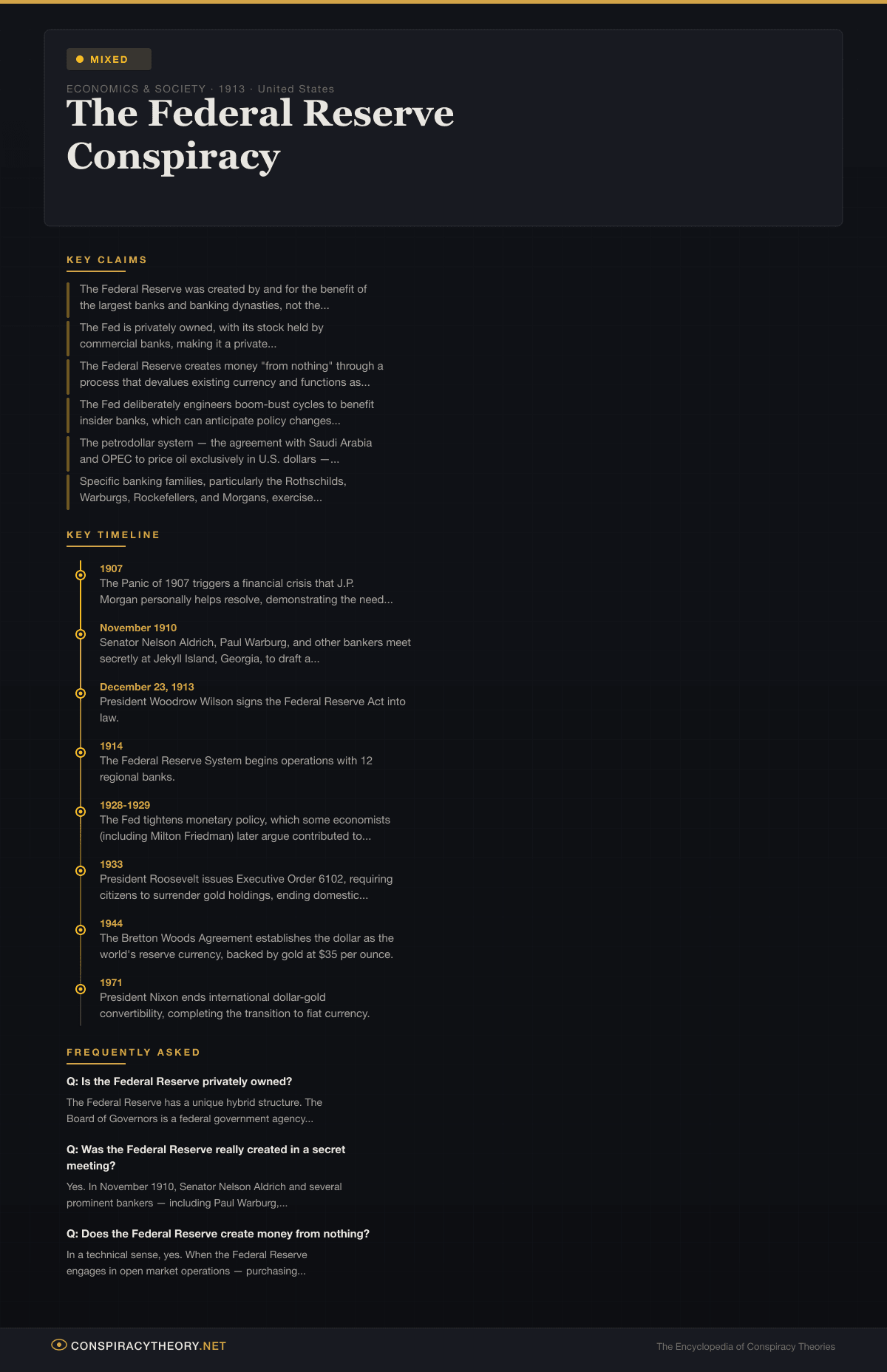
The Federal Reserve Conspiracy
Overview
The Federal Reserve System, established by the Federal Reserve Act of 1913, is the central bank of the United States and one of the most powerful financial institutions in the world. It sets interest rates, regulates banks, manages the money supply, and serves as the lender of last resort during financial crises. It is also the subject of one of the most persistent and multifaceted conspiracy theories in American history.
Conspiracy theories about the Federal Reserve range from well-documented historical facts — such as the secretive Jekyll Island meeting where the central bank’s framework was drafted — to elaborate claims involving global banking dynasties, the deliberate engineering of economic crises, and the systematic impoverishment of the American public through inflation and debt. The theories have been promoted by figures across the political spectrum, from progressive populists opposing Wall Street power to libertarian advocates of the gold standard to antisemitic extremists who overlay the narrative with claims about Jewish banking families.
The theory’s “mixed” status reflects this range. Some claims are historically verified: the Jekyll Island meeting was indeed secret; the Fed does create money through mechanisms unfamiliar to most citizens; the institution does operate with significant independence from democratic accountability; and its policies have sometimes benefited financial institutions at the expense of ordinary citizens. Other claims — such as the assertion that the Fed is controlled by the Rothschild family, that it deliberately engineers recessions for profit, or that it is part of a global conspiracy to establish a one-world currency — range from unsubstantiated to demonstrably false.
Understanding the Federal Reserve conspiracy theory requires separating legitimate critiques of central banking from conspiratorial narratives, which is complicated by the Fed’s genuinely unusual institutional structure and the opacity of its operations.
Origins & History
Opposition to central banking in the United States predates the Federal Reserve itself. The country’s first two central banks — the First Bank of the United States (1791-1811) and the Second Bank of the United States (1816-1836) — were both subjects of intense political controversy. President Andrew Jackson’s campaign to destroy the Second Bank, which he called a “monster” institution that concentrated financial power in the hands of a few, established the template for populist opposition to central banking that continues to the present day.
After the demise of the Second Bank, the United States operated without a central bank for more than 75 years. The financial panics of 1893 and particularly 1907 — during which J.P. Morgan personally organized a private bailout of the banking system — demonstrated the instability of an economy without a central banking backstop and generated support for reform.
The pivotal event in Federal Reserve conspiracy lore is the Jekyll Island meeting of November 1910. Senator Nelson Aldrich of Rhode Island — whose daughter married John D. Rockefeller Jr., linking him by marriage to the nation’s wealthiest family — organized a secret gathering at the Jekyll Island Club, an exclusive resort off the coast of Georgia. The participants included Paul Warburg of the investment bank Kuhn, Loeb & Co.; Frank Vanderlip, president of National City Bank (predecessor to Citibank); Henry P. Davison, senior partner at J.P. Morgan & Co.; Charles D. Norton, president of the First National Bank of New York; and Benjamin Strong, an associate of J.P. Morgan who would become the first governor of the Federal Reserve Bank of New York.
The secrecy was deliberate and has been confirmed by the participants themselves. Frank Vanderlip wrote in the Saturday Evening Post in 1935: “I was as secretive — indeed, as furtive — as any conspirator… We were told to leave our last names behind us. We were told, further, that we should avoid dining together on the night of our departure.” The participants feared that public knowledge of Wall Street bankers drafting banking legislation would doom the effort politically.
The group drafted what became known as the Aldrich Plan, a framework for a central banking system. After significant modification — the final Federal Reserve Act differed from the Aldrich Plan in important ways, particularly in establishing greater government oversight — the legislation was signed by President Woodrow Wilson on December 23, 1913. Critics have noted the timing, claiming the bill was passed while many legislators were away for the holidays, though the record shows robust congressional debate over the preceding two years.
Opposition was immediate. Congressman Charles Lindbergh Sr. (father of the aviator) declared on the House floor that the Federal Reserve Act established “the most gigantic trust on earth” and that the “invisible government by the money power” would be legalized. These themes — invisible power, banker control, betrayal of the public — would characterize Fed conspiracy theories for the next century.
The 1920s and 1930s intensified suspicion. The Fed’s monetary tightening in 1928-1929 has been blamed by some economists, including Milton Friedman and Anna Schwartz, for contributing to the severity of the Great Depression. Congressman Louis McFadden, chairman of the House Banking Committee, made a series of inflammatory speeches in the early 1930s accusing the Federal Reserve of deliberately causing the Depression and of being controlled by international bankers. McFadden’s speeches contained explicitly antisemitic elements and became foundational texts for later conspiracy theorists.
The modern era of Federal Reserve conspiracy theory was largely defined by two developments. First, G. Edward Griffin’s 1994 book The Creature from Jekyll Island provided a comprehensive conspiratorial history of the Fed that became enormously popular, selling hundreds of thousands of copies. Griffin argued that the Fed was a banking cartel designed to cartelize the banking industry, monetize government debt, and enable unlimited government expansion — all at the expense of ordinary citizens through inflation.
Second, Congressman Ron Paul’s presidential campaigns in 2008 and 2012 brought the “End the Fed” movement into mainstream political discourse. Paul, a libertarian Republican from Texas, argued that the Federal Reserve was unconstitutional, that it systematically devalued the currency, that it served the interests of big banks over ordinary Americans, and that it should be audited and ultimately abolished. His “Audit the Fed” legislation gained significant bipartisan support, passing the House in 2012 and 2014 but failing to advance in the Senate.
Key Claims
- The Federal Reserve was created by and for the benefit of the largest banks and banking dynasties, not the American public. The Jekyll Island meeting proves that the institution was designed by the very interests it was supposed to regulate.
- The Fed is privately owned, with its stock held by commercial banks, making it a private corporation masquerading as a government agency. Its independence from democratic oversight allows it to serve private interests.
- The Federal Reserve creates money “from nothing” through a process that devalues existing currency and functions as a hidden tax on the public through inflation, transferring wealth from savers and wage-earners to financial institutions and the government.
- The Fed deliberately engineers boom-bust cycles to benefit insider banks, which can anticipate policy changes and position themselves accordingly. The 2008 financial crisis and subsequent bank bailouts are cited as prime examples.
- The petrodollar system — the agreement with Saudi Arabia and OPEC to price oil exclusively in U.S. dollars — was established to maintain global demand for dollars, prop up the Fed’s ability to create money, and justify American military intervention in oil-producing nations.
- Specific banking families, particularly the Rothschilds, Warburgs, Rockefellers, and Morgans, exercise hidden control over the Federal Reserve and through it, the global economy. (This claim frequently shades into antisemitic conspiracy theory.)
- The Federal Reserve’s response to the 2008 crisis — including quantitative easing, zero-interest-rate policy, and emergency lending to banks — constituted the largest wealth transfer in history, from taxpayers and savers to Wall Street.
- A genuine audit of the Federal Reserve would reveal conflicts of interest, self-dealing, and policy decisions made for the benefit of connected insiders rather than the general public.
Evidence
Confirmed Facts
The Jekyll Island Meeting: The secret meeting occurred exactly as described. Participants confirmed it in their own writings. The fact that the nation’s central banking framework was drafted in secret by representatives of the largest banks is not disputed, though its significance is debated.
The Fed’s Hybrid Structure: The Federal Reserve System does have private elements. The 12 regional Federal Reserve Banks are organized as corporations with stock owned by member banks. Member banks elect six of the nine directors of each regional bank. The Fed does not receive congressional appropriations and funds itself from interest on securities and fees for services. These structural features are documented in the Federal Reserve Act and the Fed’s own publications.
Money Creation: The Fed does create money through open market operations and other mechanisms. When the Fed purchases Treasury securities, it credits the seller’s reserve account with newly created funds. This process — sometimes called “creating money from thin air” — is a standard feature of all modern central banking systems and is described in economics textbooks and the Fed’s own educational materials.
Quantitative Easing Scale: Between 2008 and 2014, the Federal Reserve’s balance sheet expanded from approximately $900 billion to $4.5 trillion through three rounds of quantitative easing. In response to the COVID-19 pandemic, the balance sheet expanded further to nearly $9 trillion by 2022. These programs involved the Fed purchasing trillions in government bonds and mortgage-backed securities, directly supporting asset prices and benefiting holders of financial assets.
The 2008 Bailout and Emergency Lending: A partial audit of the Fed’s emergency lending facilities, mandated by the Dodd-Frank Act and released in 2011, revealed that the Fed had extended approximately $16.1 trillion in emergency loans to financial institutions during the 2008 crisis. While these were loans that were repaid with interest, the scale of support — and the fact that it was not publicly known at the time — fueled conspiracy claims.
The Petrodollar System: The arrangement by which Saudi Arabia agreed to price oil in U.S. dollars and invest surplus revenues in U.S. Treasury securities, in exchange for American military protection, has been documented by multiple historians and former officials. The system, established in the 1970s after the Nixon administration ended dollar-gold convertibility, did help maintain global demand for dollars.
Revolving Door: The movement of personnel between the Federal Reserve, Wall Street banks, and Treasury Department is well-documented. Notable examples include Henry Paulson (Goldman Sachs CEO to Treasury Secretary), Timothy Geithner (New York Fed President to Treasury Secretary), and numerous Fed officials who moved to or from the financial industry.
Contested Claims
Deliberate Crisis Engineering: While Fed policies have contributed to economic instability — a point acknowledged even by Fed chair Ben Bernanke regarding the Great Depression — there is no evidence that crises are deliberately engineered for profit. Fed officials face career incentives to avoid economic catastrophe on their watch.
Banking Family Control: Claims that the Rothschilds, Rockefellers, or other families secretly control the Fed lack documentary evidence. While these families were influential in early twentieth-century banking and the Rockefeller and Morgan interests were represented at Jekyll Island, the modern Fed’s governance structure involves presidential appointment, Senate confirmation, and a complex institutional framework that does not map neatly onto claims of dynastic control.
Constitutional Illegitimacy: The claim that the Federal Reserve is unconstitutional has been repeatedly rejected by federal courts. The Supreme Court upheld the constitutionality of the national banking system in multiple cases, and Congress’s power to regulate currency is explicitly granted in Article I, Section 8 of the Constitution.
Debunking / Verification
What is accurate: The Federal Reserve was created with significant input from the banking industry. Its structure does include private elements that are unusual for a government institution. It does create money through processes that are opaque to most citizens. Its policies have disproportionately benefited the financial sector, particularly during crises. Its operations are subject to less democratic oversight than most government functions. The Jekyll Island meeting was genuinely secretive.
What is misleading: Describing the Fed as “privately owned” overstates the private elements of its structure. The Board of Governors — the most powerful component — is a federal agency. Member banks’ “ownership” of regional Fed stock does not convey meaningful control, as they cannot sell it, its dividends are capped, and policy decisions are made by presidentially appointed governors. The Fed remits its profits to the U.S. Treasury — over $100 billion annually in profitable years — which is inconsistent with the claim that it operates purely for private benefit.
What is false: Claims that the Fed has never been audited are incorrect. The Fed undergoes annual financial audits by an independent accounting firm, and the Government Accountability Office (GAO) conducts audits of Fed operations. What advocates like Ron Paul sought was a more expansive audit of monetary policy decisions and international agreements, which the Fed argues would compromise its independence. Claims that specific families “control” the Fed through hidden mechanisms are unsupported by evidence.
The inflation argument: Critics correctly note that the dollar has lost approximately 96% of its purchasing power since the Fed’s creation in 1913. However, economists point out that this inflation has accompanied enormous growth in real GDP, real wages, and living standards. The gold standard that preceded the Fed was associated with severe deflationary spirals, bank runs, and financial crises that imposed their own costs on ordinary citizens. The debate about whether mild inflation or a fixed money supply better serves the public interest is a legitimate economic question, not one with a clear conspiratorial answer.
The antisemitism problem: Federal Reserve conspiracy theories have historically been intertwined with antisemitism, particularly through claims about the Rothschild family and other Jewish banking figures. While legitimate critiques of central banking exist, the conspiracy theory ecosystem frequently crosses the line into antisemitic tropes about Jewish financial control. Paul Warburg’s Judaism, for instance, is irrelevant to an analysis of Federal Reserve policy, but it features prominently in conspiratorial accounts. This conflation has led some legitimate Fed critics to explicitly distance themselves from the antisemitic elements of the tradition.
Cultural Impact
The Federal Reserve conspiracy theory has been one of the most politically consequential conspiracy theories in American history, influencing national campaigns, legislation, and public attitudes toward financial institutions.
Ron Paul’s “End the Fed” movement transformed the Federal Reserve from an obscure institution understood mainly by economists and financial professionals into a subject of mainstream political debate. His 2008 and 2012 presidential campaigns, which centered on Federal Reserve abolition, sound money, and anti-interventionism, built an enthusiastic following — particularly among younger voters — and influenced the broader libertarian and populist movements. Paul’s book End the Fed (2009) became a New York Times bestseller.
The 2008 financial crisis dramatically amplified public suspicion of the Fed. The institution’s emergency lending to Wall Street banks — the full scale of which was not publicly known until a partial audit was mandated by the Dodd-Frank Act — seemed to confirm claims that the Fed existed to protect the banking industry. The combination of bank bailouts and the subsequent foreclosure crisis produced widespread public anger that expressed itself in both the Tea Party movement on the right and the Occupy Wall Street movement on the left.
G. Edward Griffin’s The Creature from Jekyll Island has remained in continuous print since 1994 and has sold hundreds of thousands of copies. The book has been particularly influential in libertarian, gold-bug, and cryptocurrency communities, and its arguments are frequently encountered in online discussions of monetary policy.
The Federal Reserve conspiracy theory has also influenced the cryptocurrency movement. Bitcoin was created in 2008-2009, during the height of the financial crisis, and its creator (or creators), using the pseudonym Satoshi Nakamoto, embedded a reference to bank bailouts in Bitcoin’s genesis block. The cryptocurrency’s fixed supply and decentralized structure were explicitly designed as alternatives to central bank-controlled fiat currency. Many early Bitcoin adopters and advocates were motivated by Fed conspiracy beliefs.
In popular culture, the Federal Reserve has appeared in films, television series, and documentaries. The documentaries Zeitgeist (2007) and Money as Debt (2006) presented conspiratorial accounts of the Fed and monetary system to millions of online viewers. The Fed has been depicted in numerous financial thrillers and appears as a shadowy institution in various fictional works.
The “Audit the Fed” movement achieved substantial legislative traction. The Federal Reserve Transparency Act passed the House of Representatives in 2012 (327-98) and 2014 (333-92) with strong bipartisan support, though it did not advance through the Senate. The movement demonstrated that Federal Reserve conspiracy theory could translate into mainstream legislative action.
Key Figures
Paul Warburg — German-born banker at Kuhn, Loeb & Co. who was the primary intellectual architect of the Federal Reserve System. He attended the Jekyll Island meeting and served on the first Federal Reserve Board.
Nelson Aldrich — Republican senator from Rhode Island who organized the Jekyll Island meeting and sponsored the initial version of central banking legislation. His daughter married John D. Rockefeller Jr., connecting him to the Rockefeller financial empire.
J.P. Morgan — The dominant American banker of the late nineteenth and early twentieth centuries whose firm was represented at Jekyll Island by Henry Davison. The Panic of 1907, which Morgan personally helped resolve, provided the immediate impetus for central bank creation.
G. Edward Griffin — Author of The Creature from Jekyll Island (1994), the most influential conspiratorial account of the Federal Reserve. Griffin has been active in libertarian and constitutionalist movements and has promoted various other conspiracy theories.
Ron Paul — Libertarian Republican congressman from Texas who served from 1976 to 2013. His “End the Fed” campaign and presidential runs made Federal Reserve criticism a mainstream political position. He authored End the Fed (2009) and introduced the Federal Reserve Transparency Act.
Woodrow Wilson — 28th President, who signed the Federal Reserve Act on December 23, 1913. Conspiracy theorists often cite an apocryphal quote attributed to Wilson expressing regret for having “unwittingly ruined my country,” though the actual source and context of the quote are disputed.
Louis McFadden — Republican congressman from Pennsylvania who chaired the House Banking Committee and delivered speeches in the 1930s accusing the Federal Reserve of deliberately causing the Depression and serving international banking interests. His speeches contained antisemitic elements.
Charles Lindbergh Sr. — Republican congressman from Minnesota (father of the aviator) who opposed the Federal Reserve Act, calling it a vehicle for the “money trust” to control the economy.
Ben Bernanke — Federal Reserve chair during the 2008 financial crisis whose emergency lending programs became central to the modern Fed conspiracy narrative. Won the Nobel Prize in Economics in 2022 for his research on bank runs and financial crises.
Timeline
- 1907 — The Panic of 1907 triggers a financial crisis that J.P. Morgan personally helps resolve, demonstrating the need for a central banking system.
- November 1910 — Senator Nelson Aldrich, Paul Warburg, and other bankers meet secretly at Jekyll Island, Georgia, to draft a central banking framework.
- December 23, 1913 — President Woodrow Wilson signs the Federal Reserve Act into law.
- 1914 — The Federal Reserve System begins operations with 12 regional banks.
- 1928-1929 — The Fed tightens monetary policy, which some economists (including Milton Friedman) later argue contributed to the severity of the Great Depression.
- 1933 — President Roosevelt issues Executive Order 6102, requiring citizens to surrender gold holdings, ending domestic gold convertibility.
- 1944 — The Bretton Woods Agreement establishes the dollar as the world’s reserve currency, backed by gold at $35 per ounce.
- 1971 — President Nixon ends international dollar-gold convertibility, completing the transition to fiat currency.
- 1974-1975 — The petrodollar system is established through agreements with Saudi Arabia to price oil in dollars and invest surplus in U.S. Treasuries.
- 1994 — G. Edward Griffin publishes The Creature from Jekyll Island, the most influential conspiratorial account of the Fed.
- 2007-2008 — The Federal Reserve provides emergency lending and purchases toxic assets during the financial crisis, dramatically expanding its balance sheet.
- 2008 — Ron Paul’s presidential campaign popularizes “End the Fed” as a political movement. Bitcoin is conceived as an alternative to central bank-controlled money.
- 2009 — Ron Paul publishes End the Fed. The Fed begins quantitative easing (QE1).
- 2010 — The Dodd-Frank Act mandates a partial audit of the Fed’s emergency lending facilities.
- 2011 — GAO releases audit results showing $16.1 trillion in emergency loans during the crisis. The Fed’s balance sheet reaches $2.9 trillion.
- 2012 — Ron Paul’s Federal Reserve Transparency Act passes the House 327-98 but does not advance in the Senate.
- 2020 — The Fed responds to COVID-19 with unprecedented monetary expansion, cutting interest rates to zero and purchasing trillions in securities. The balance sheet eventually approaches $9 trillion.
- 2022-2023 — The Fed raises interest rates aggressively to combat inflation, triggering banking stress including the failures of Silicon Valley Bank and Signature Bank.
- 2025 — Debates over Fed independence intensify amid political pressure on monetary policy decisions.
Sources & Further Reading
- Griffin, G. Edward. The Creature from Jekyll Island: A Second Look at the Federal Reserve. Westlake Village, CA: American Media, 1994.
- Paul, Ron. End the Fed. New York: Grand Central Publishing, 2009.
- Meltzer, Allan H. A History of the Federal Reserve. 2 vols. Chicago: University of Chicago Press, 2003-2009.
- Friedman, Milton and Anna Jacobson Schwartz. A Monetary History of the United States, 1867-1960. Princeton: Princeton University Press, 1963.
- Greider, William. Secrets of the Temple: How the Federal Reserve Runs the Country. New York: Simon & Schuster, 1987.
- Vanderlip, Frank A. “From Farm Boy to Financier.” Saturday Evening Post, February 9, 1935.
- Bernanke, Ben S. “Money, Gold and the Great Depression.” Remarks at the H. Parker Willis Lecture in Economic Policy, March 2, 2004.
- Government Accountability Office. “Federal Reserve System: Opportunities Exist to Strengthen Policies and Processes for Managing Emergency Assistance.” GAO-11-696, July 2011.
- Board of Governors of the Federal Reserve System. “The Federal Reserve System: Purposes and Functions.” 10th ed., 2016.
- Lowenstein, Roger. America’s Bank: The Epic Struggle to Create the Federal Reserve. New York: Penguin, 2015.
- Spross, Jeff. “How the Federal Reserve Works — And Why It Needs an Overhaul.” The Week, 2020.
Related Theories
- Federal Reserve Private Ownership — Specific claims focusing on the private ownership structure of the Federal Reserve Banks and what this means for democratic accountability.
- Jekyll Island and the Creation of the Fed — Detailed examination of the secret 1910 meeting and the participants’ motivations.
- Rothschild Federal Reserve Control — Claims that the Rothschild banking family secretly controls the Federal Reserve and global monetary system.
- End the Fed Movement — The political movement to abolish the Federal Reserve, primarily associated with Ron Paul and libertarian economics.
- Banking Corruption Conspiracy — Broader claims about systemic corruption in the global banking system.
Frequently Asked Questions
Is the Federal Reserve privately owned?
Was the Federal Reserve really created in a secret meeting?
Does the Federal Reserve create money from nothing?

Infographic
Share this visual summary. Right-click to save.