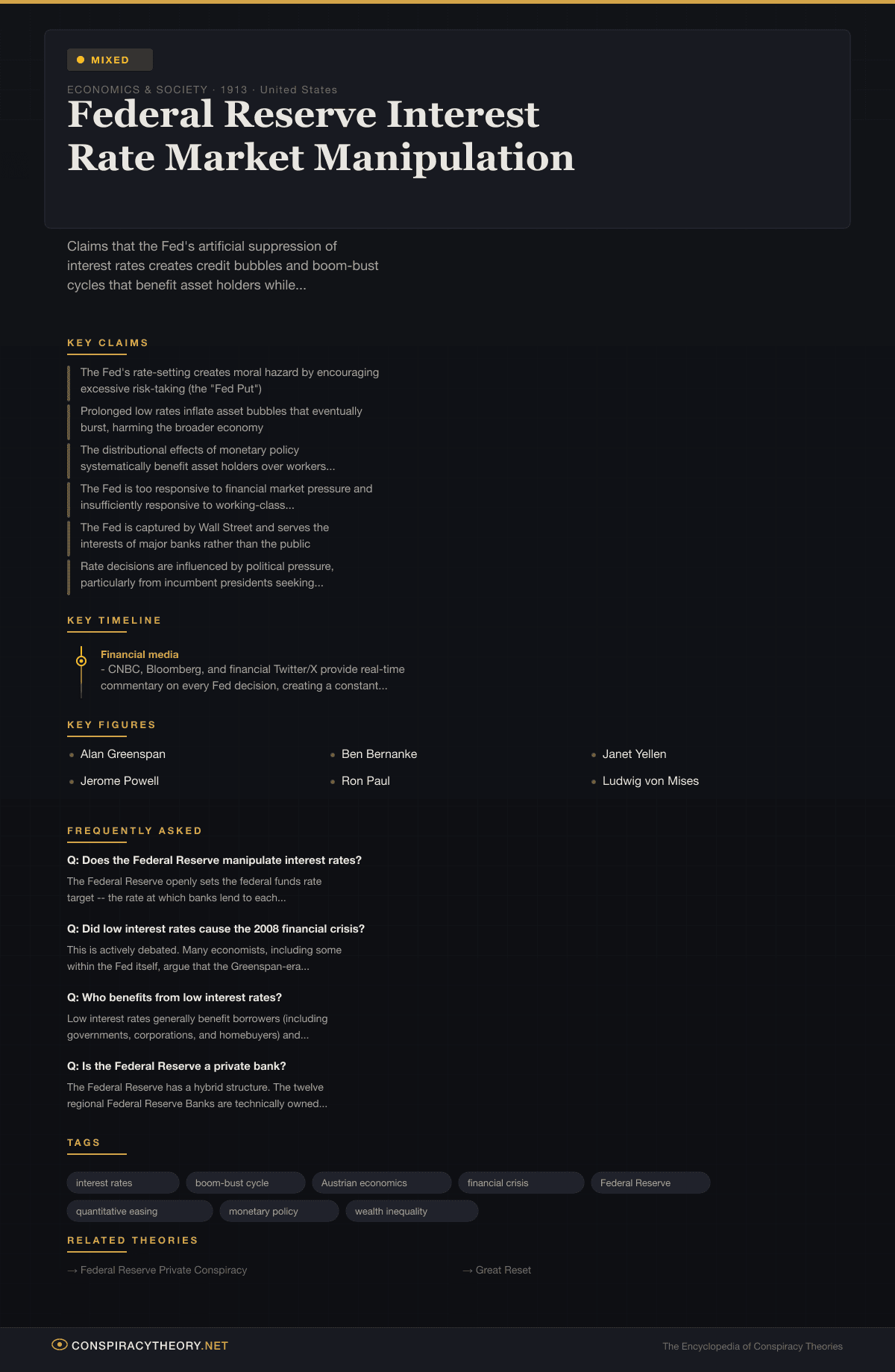
Federal Reserve Interest Rate Market Manipulation

Overview
The Federal Reserve sets interest rates. This is not a secret. After every meeting of the Federal Open Market Committee, the Fed chair holds a press conference, explains the decision, takes questions from reporters, and publishes detailed minutes. It is one of the most transparent monetary policy operations in the world.
And yet the accusation persists: the Fed manipulates interest rates — not merely adjusts them, but distorts them in ways that systematically benefit financial elites, inflate asset bubbles, and trap ordinary Americans in boom-bust cycles that strip them of wealth and stability. The theory comes in varying degrees of intensity, from the measured critiques of Austrian-school economists who argue that any centrally-set interest rate is inherently distortive, to the populist fury of “End the Fed” movements that see the central bank as a corrupt instrument of oligarchic power, to the more elaborate conspiracy theories that tie the Fed to shadowy banking dynasties and global financial cabals.
What makes this theory particularly slippery is that it occupies a genuine gray zone. The Fed does set interest rates. Those rates do have distributional consequences. The 2008 financial crisis was preceded by a prolonged period of low rates. The post-2008 era of near-zero rates and quantitative easing did inflate asset prices in ways that disproportionately benefited the wealthy. These are not conspiracy claims; they are mainstream economic observations. The question is whether these outcomes represent policy errors, structural features of modern capitalism, or something more intentional.
Origins & History
The Creation of the Fed
The Federal Reserve System was established by the Federal Reserve Act of 1913, and controversy has surrounded it from birth. The act was shaped in part by meetings at Jekyll Island, Georgia, in November 1910, where a group of bankers and government officials — including Senator Nelson Aldrich, Paul Warburg, Henry Davison, and Benjamin Strong — secretly drafted the framework for what would become the central bank.
The secrecy was real. Participants traveled under assumed names. The meeting’s existence was not publicly confirmed until years later. For Fed critics, Jekyll Island is Exhibit A: the central bank was literally conceived in secret by the financial elite it would later serve.
Fed defenders counter that the secrecy was political, not conspiratorial. Aldrich knew that any plan associated with Wall Street bankers would face populist opposition. The resulting legislation went through extensive public congressional debate and was signed by President Woodrow Wilson. But the optics of a central bank designed by bankers in a private resort have never stopped haunting the institution.
The Mandate
The Fed operates under a dual mandate established by the Federal Reserve Reform Act of 1977: maximum employment and stable prices. Setting the federal funds rate — the interest rate at which banks lend reserves to each other overnight — is the primary tool for pursuing these goals. Lower rates stimulate borrowing and spending; higher rates cool the economy and control inflation.
This is monetary policy as practiced by virtually every central bank in the world. The Bank of England, the European Central Bank, the Bank of Japan, and others all set benchmark interest rates. The question is not whether this happens but whether it should, and who benefits when it does.
The Greenspan Put
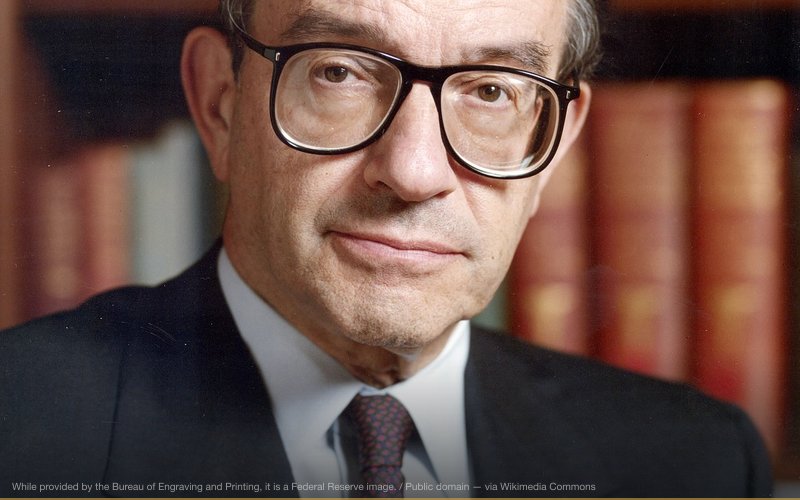
The conspiracy narrative gained enormous momentum during the tenure of Alan Greenspan, who served as Fed chair from 1987 to 2006 — nearly two decades that spanned the dot-com boom, the 1998 Long-Term Capital Management crisis, and the early stages of the housing bubble.
Greenspan’s approach became known as the “Greenspan Put” — the market’s perception that whenever asset prices fell significantly, the Fed would cut rates to arrest the decline. This created a perceived asymmetry: the Fed would intervene to prevent crashes but would not raise rates to prevent bubbles, effectively providing a one-way bet for risk-taking.
The Greenspan Put was not a formal policy, but it functioned as one. After the 1998 crisis, the Fed cut rates aggressively. After the 2001 recession and the dot-com bust, the Fed pushed the federal funds rate to 1% — its lowest level in 40 years — and held it there for over a year. This period of ultra-low rates is widely cited as a contributing factor to the housing bubble that inflated through 2005-2007.
Whether Greenspan’s policies constituted “manipulation” or “reasonable crisis management” depends entirely on your analytical framework. But the distributional effects were clear: low rates inflated asset prices, benefiting those who owned assets. Those who did not — disproportionately younger, poorer, and more marginalized — faced rising housing costs and stagnant wages.
2008 and the Age of Extraordinary Measures
The 2008 financial crisis and its aftermath became the defining chapter in the Fed rate manipulation narrative. In response to the worst financial crisis since the Great Depression, the Fed:
- Cut rates to near zero (0-0.25%) in December 2008 and held them there for seven years, until December 2015
- Launched quantitative easing (QE): The Fed purchased trillions of dollars in Treasury bonds and mortgage-backed securities to push down long-term interest rates. Three rounds of QE between 2008 and 2014 expanded the Fed’s balance sheet from approximately $900 billion to $4.5 trillion
- Provided forward guidance: The Fed explicitly communicated its intention to keep rates low for an extended period, shaping market expectations and reducing uncertainty
These policies were designed to stimulate economic recovery by making borrowing cheap and encouraging investment. In mainstream economics, they are generally viewed as necessary, if imperfect, responses to an extraordinary crisis. Many economists argue the Fed should have done more, not less.
But the distributional consequences were stark:
- Asset prices soared: The S&P 500 rose from approximately 680 in March 2009 to over 4,700 by late 2021. Real estate prices recovered and then exceeded pre-crisis levels. Bond prices rose as yields fell
- Wealth concentration increased: Because asset ownership is concentrated among the wealthy, rising asset prices disproportionately benefited the top 10% — and especially the top 1% — of the wealth distribution
- Savers were punished: Interest rates on savings accounts fell to near zero, devastating retirees and others who depended on fixed-income investments
- Housing affordability declined: Low mortgage rates initially made homes more affordable, but the resulting demand pushed prices up, ultimately making homeownership less accessible for first-time buyers
The COVID-19 Response
The pattern repeated, at even greater scale, during the COVID-19 pandemic. In March 2020, the Fed cut rates back to near zero and launched a new round of asset purchases that expanded the balance sheet to approximately $9 trillion by early 2022. The resulting asset inflation was unprecedented:
- U.S. home prices rose approximately 40% between 2020 and 2022
- The S&P 500 roughly doubled between March 2020 and January 2022
- Cryptocurrency, meme stocks, and speculative assets experienced explosive growth
When inflation surged in 2021-2022 — driven by supply chain disruptions, fiscal stimulus, and the Fed’s own monetary expansion — the central bank was forced to reverse course with the most aggressive rate-hiking campaign in decades, pushing the federal funds rate from near zero to over 5% between March 2022 and mid-2023.
The whiplash was extreme. Asset prices declined. Silicon Valley Bank and several other regional banks collapsed. The housing market froze. Critics argued the Fed had created the very inflation it was now fighting, having kept rates too low for too long.
Key Claims
The Fed rate manipulation theory encompasses a spectrum of claims:
Mainstream Critiques (widely shared by professional economists)
- The Fed’s rate-setting creates moral hazard by encouraging excessive risk-taking (the “Fed Put”)
- Prolonged low rates inflate asset bubbles that eventually burst, harming the broader economy
- The distributional effects of monetary policy systematically benefit asset holders over workers and savers
- The Fed is too responsive to financial market pressure and insufficiently responsive to working-class economic conditions
Populist Critiques
- The Fed is captured by Wall Street and serves the interests of major banks rather than the public
- Rate decisions are influenced by political pressure, particularly from incumbent presidents seeking favorable economic conditions before elections
- The revolving door between the Fed, Treasury Department, and Wall Street creates conflicts of interest
- The Fed deliberately creates boom-bust cycles that allow financial elites to buy distressed assets cheaply
Conspiracy Theory Territory
- The Fed is a private bank owned by banking dynasties (Rothschilds, Rockefellers) who profit from interest rate manipulation
- Rate decisions are coordinated with other central banks as part of a global financial control system
- The ultimate goal is the elimination of cash and the establishment of central bank digital currencies for total financial surveillance
- The 2008 crisis was deliberately engineered to consolidate banking power
Evidence
Supporting the Critique
- The Greenspan Put is documented: Financial research has confirmed that market participants priced in Fed intervention during downturns, creating the asymmetric risk-taking pattern critics describe
- Distributional effects are measured: Fed researchers themselves have published studies showing that QE disproportionately benefited wealthier households
- The revolving door is real: Fed chairs and governors frequently move to or from financial industry positions (Greenspan became a consultant to hedge funds; multiple Fed presidents came from Goldman Sachs or similar firms)
- Political pressure is documented: Presidents of both parties have publicly pressured Fed chairs to lower rates. Trump’s unprecedented public attacks on Jerome Powell from 2018-2019 made this dynamic impossible to ignore
- Rate decisions have predictable beneficiaries: Low rates benefit leveraged investors, real estate developers, and private equity firms. These are among the wealthiest actors in the economy
- The 2008 crisis connection: The Financial Crisis Inquiry Commission’s 2011 report identified Fed monetary policy as one contributing factor (though not the sole cause) of the housing bubble
Against the Conspiracy Version
- Transparency: Fed decisions are made by a committee (the FOMC), announced publicly, accompanied by detailed explanations, and scrutinized by thousands of economists, journalists, and market participants
- The Fed remits profits to the Treasury: In most years, the Fed returns tens of billions of dollars to the U.S. government, undermining the “private bank” narrative
- Rate-setting is universal: Every major central bank in the world sets interest rates. If this constitutes manipulation, it is a global policy choice, not a uniquely American conspiracy
- Disagreement within the Fed: FOMC meeting minutes reveal extensive internal debate, with dissenting votes and published disagreements. This is not the behavior of a monolithic conspiracy
- Counterfactual difficulty: Critics must demonstrate not only that low rates had negative consequences but that the alternative (higher rates during a crisis) would have produced better outcomes. This counterfactual is genuinely difficult to evaluate
Debunking / Verification
This theory is classified as mixed because it spans a wide range of claims with varying evidentiary support:
Confirmed: The Fed sets interest rates. Rate-setting has distributional consequences. Low rates inflate asset prices. The revolving door between the Fed and Wall Street exists. Political pressure on the Fed is documented. The 2008 crisis was preceded by a prolonged period of low rates.
Debatable: Whether the Fed’s rate-setting constitutes “manipulation” versus legitimate policy management. Whether the Fed is captured by financial interests or genuinely pursues its dual mandate. Whether alternative policies would produce better outcomes.
Unsubstantiated: Claims that the Fed is owned by specific banking families. Claims that boom-bust cycles are deliberately engineered. Claims of coordination with other central banks for conspiratorial purposes.
Cultural Impact
The Fed rate manipulation narrative has had enormous political impact:
Ron Paul and “End the Fed”: Rep. Ron Paul (R-TX) made opposition to the Federal Reserve a central plank of his 2008 and 2012 presidential campaigns, publishing End the Fed in 2009. His movement brought anti-Fed sentiment from the libertarian fringe to mainstream Republican politics and influenced a generation of political activists.
Occupy Wall Street: The 2011 Occupy movement, while focused on inequality broadly, drew heavily on the narrative that Fed policies benefited the “1%” at the expense of everyone else. The movement’s framing — “We are the 99%” — implicitly indicted the distributional effects of monetary policy.
Bipartisan populism: Anti-Fed sentiment exists on both the left (focusing on inequality and Wall Street capture) and the right (focusing on sound money, inflation, and federal overreach). This rare bipartisan agreement reflects the theory’s breadth and flexibility.
Bitcoin and cryptocurrency: The creation of Bitcoin in 2009 was explicitly motivated by dissatisfaction with central banking. Satoshi Nakamoto’s first block included a Times headline about bank bailouts. The entire cryptocurrency movement can be understood, in part, as an attempt to build a financial system outside central bank control.
In Popular Culture
- The Big Short (2015) — Film about the 2008 crisis that, while not directly about the Fed, dramatized the consequences of the low-rate environment
- Too Big to Fail (2011) — HBO film depicting the 2008 bailout decisions, including Fed Chair Ben Bernanke’s role
- Ron Paul’s End the Fed (2009) — Bestselling book that became the manifesto of the anti-Fed movement
- Money Masters (1996) — Documentary tracing the history of central banking with a conspiracy-oriented framing
- Zeitgeist: Addendum (2008) — Documentary that includes anti-Fed content alongside broader conspiracy narratives
- Financial media — CNBC, Bloomberg, and financial Twitter/X provide real-time commentary on every Fed decision, creating a constant stream of analysis and speculation
Key Figures
- Alan Greenspan (b. 1926) — Fed Chair 1987-2006, whose low-rate policies became the template for the “Fed Put” critique
- Ben Bernanke (b. 1953) — Fed Chair 2006-2014, who presided over the 2008 crisis response and launched quantitative easing. Nobel Prize in Economics, 2022
- Janet Yellen (b. 1946) — Fed Chair 2014-2018, later Treasury Secretary, who oversaw the first post-crisis rate increases
- Jerome Powell (b. 1953) — Fed Chair 2018-present, who navigated the COVID-19 response and subsequent inflation crisis
- Ron Paul (b. 1935) — Republican congressman and presidential candidate who made “End the Fed” a mainstream political position
- Ludwig von Mises (1881-1973) — Austrian economist whose business cycle theory provides the intellectual foundation for much anti-Fed criticism
Timeline
| Date | Event |
|---|---|
| Nov. 1910 | Jekyll Island meeting secretly drafts framework for Federal Reserve System |
| Dec. 1913 | Federal Reserve Act signed by President Wilson |
| 1977 | Federal Reserve Reform Act establishes dual mandate (maximum employment, stable prices) |
| 1987 | Alan Greenspan becomes Fed Chair; “Greenspan Put” era begins |
| 1998 | Fed cuts rates after LTCM crisis; moral hazard concerns increase |
| 2001 | Fed cuts rates to 1% after dot-com bust and 9/11 |
| 2004-2006 | Fed raises rates from 1% to 5.25%; housing market begins to slow |
| 2007-2008 | Housing bubble bursts; financial crisis unfolds |
| Dec. 2008 | Fed cuts rates to near zero (0-0.25%); launches QE1 |
| 2009 | Ron Paul publishes End the Fed; Bitcoin launches |
| 2010-2014 | QE2 and QE3 expand Fed balance sheet to $4.5 trillion |
| Dec. 2015 | First post-crisis rate hike |
| 2018-2019 | Trump publicly attacks Powell for raising rates |
| Mar. 2020 | Fed cuts rates to near zero again for COVID-19; launches massive QE |
| 2021-2022 | Inflation surges to 9.1%; Fed begins aggressive rate-hiking cycle |
| 2023 | Silicon Valley Bank and other regional banks collapse amid rising rates |
| 2024-2025 | Fed begins cautious rate cuts as inflation moderates |
Sources & Further Reading
- Bernanke, Ben S. The Courage to Act: A Memoir of a Crisis and Its Aftermath. W.W. Norton, 2015.
- Paul, Ron. End the Fed. Grand Central Publishing, 2009.
- Meltzer, Allan H. A History of the Federal Reserve. University of Chicago Press, 2003-2009 (2 volumes).
- Mehrling, Perry. The New Lombard Street: How the Fed Became the Dealer of Last Resort. Princeton University Press, 2011.
- Tooze, Adam. Crashed: How a Decade of Financial Crises Changed the World. Viking, 2018.
- Financial Crisis Inquiry Commission. The Financial Crisis Inquiry Report. 2011.
- Federal Reserve. FOMC meeting minutes, statements, and press conferences. federalreserve.gov
Related Theories
- Federal Reserve as Private Bank — The theory that the Fed is privately owned and controlled by banking dynasties
- Gold Standard Suppression — Claims that the abandonment of the gold standard enables unlimited monetary manipulation
- The Great Reset — The theory that global financial institutions are engineering a new economic order
Frequently Asked Questions
Does the Federal Reserve manipulate interest rates?
Did low interest rates cause the 2008 financial crisis?
Who benefits from low interest rates?
Is the Federal Reserve a private bank?
Infographic
Share this visual summary. Right-click to save.