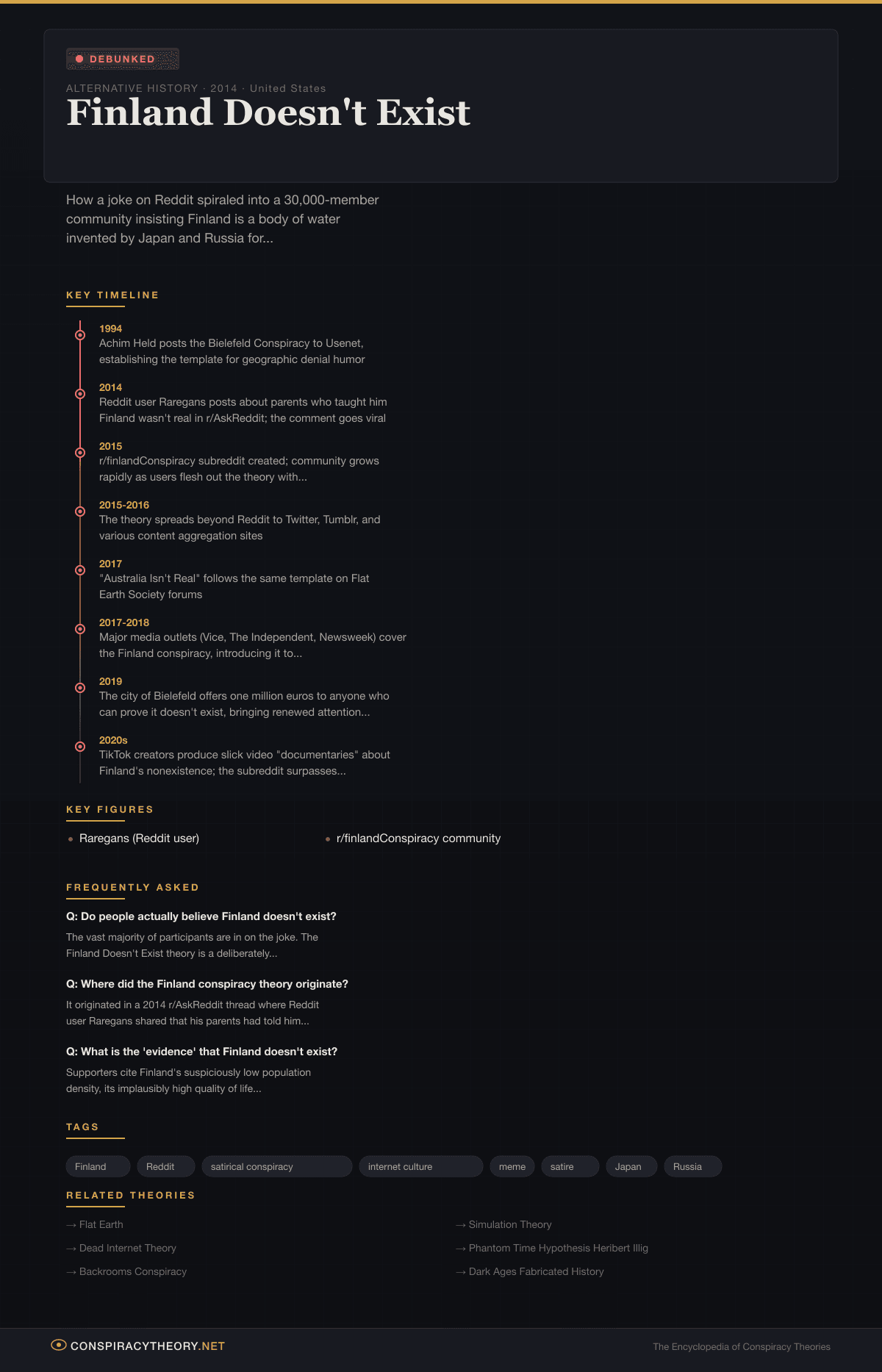
Finland Doesn't Exist
The Post That Deleted a Country
In 2014, somewhere in the vast hive of r/AskReddit — that infinite scroll of strangers asking other strangers increasingly unhinged questions — a user named Raregans dropped a comment that would go on to achieve a very specific kind of internet immortality. The question was something along the lines of “What did your parents teach you that turned out to be completely wrong?” Raregans’ answer: his parents had raised him to believe that Finland was not a real country.
Not that Finland was bad, or overrated, or suspiciously good at ice hockey for a nation of five million. That it simply did not exist. The landmass on the map? Water. The people who claim to be Finnish? Either in on the conspiracy or confused Swedes. The entire country, according to Raregans’ parents, was an elaborate fiction maintained by Japan and the Soviet Union (later Russia) for reasons that — and this is the part that elevated it from shitpost to art form — were explained in meticulous, internally consistent detail.
The post went viral. And then, because this is the internet and the internet cannot leave well enough alone, it became a movement.
The Theory: An Appreciation
Here’s the thing about the Finland Doesn’t Exist conspiracy: it is, per word, one of the most beautifully constructed pieces of absurdist reasoning the internet has ever produced. The “theory” goes like this.
The Japanese-Russian Fishing Pact
During the Cold War, Japan and the Soviet Union secretly agreed to carve out a section of the Baltic Sea for unrestricted fishing. International maritime law imposed strict quotas and territorial boundaries on ocean fishing, but if a convenient landmass happened to be sitting on top of the fishing grounds — a landmass that appeared on every map but that nobody ever really went to — then those waters would fall under the jurisdiction of a fictional nation and therefore outside international regulatory oversight.
That fictional nation was Finland.
The two superpowers allegedly created Finland as a cartographic fiction in the aftermath of World War II. The Soviets got a buffer “country” on their western border that made NATO nervous enough to leave it alone, and Japan got effectively unlimited fishing access to prime Baltic waters, with catches shipped via the Trans-Siberian Railway to Japanese markets. It was, the theory posits, one of the most successful geopolitical hoaxes in human history.
Nokia: The Laundering Machine
If Finland doesn’t exist, how do you explain its exports? Easy: Nokia. The Finnish telecommunications giant, which at its peak manufactured roughly 40% of the world’s mobile phones, was — according to the theory — a front operation. Nokia’s supposed Finnish manufacturing was actually Japanese fishing revenue laundered through a corporate entity registered in a country that didn’t exist, making the money trail effectively untraceable.
The name itself? “Nokia” is suspiciously close to “noki,” a Japanese word that the theory’s proponents have creatively translated in various ways (the actual Japanese word 残 means “remaining” or “left behind,” which truthers interpret as a winking reference to the scheme). The fact that Nokia’s headquarters are in Espoo, a city that conspiracy supporters argue nobody can confirm actually visiting, only deepens the mystery.
The Trans-Siberian Connection
The Trans-Siberian Railway, one of the longest rail lines in the world, connects Moscow to the Russian Far East. The Finland conspiracy holds that this railway’s actual primary purpose wasn’t passenger transport or general freight — it was a conveyor belt for fish. Massive quantities of Baltic Sea catch, harvested from the “Finnish” waters, were loaded onto trains and shipped across the entirety of Russia to Japan. The sheer logistical audacity of this claim is part of what makes it so entertaining.
The Population Problem
Finland’s population — roughly 5.5 million — is suspiciously small for a country of its geographic size. At approximately 18 people per square kilometer, Finland has one of Europe’s lowest population densities. The conspiracy takes this genuine statistic and runs with it: of course the population is low, because those people don’t actually exist. The “Finnish” people who do appear on the world stage — racing drivers, metal bands, mobile game developers — are actually Eastern Swedes, Western Russians, or Estonians who have been persuaded (or paid) to maintain the fiction.
The theory also points out that most people alive today have never personally visited Finland. Have you been to Finland? Do you know anyone who has been to Finland? And if your friend claims they visited Helsinki, how do you know they weren’t actually in a specially designated section of Stockholm or St. Petersburg built to look like what a Finnish city “should” look like?
r/finlandConspiracy: The Community
What elevated Finland Doesn’t Exist from a single Reddit comment to a genuine internet phenomenon was the subreddit r/finlandConspiracy, which at its peak gathered over 30,000 subscribers — a number that, as community members love to point out, represents a statistically significant percentage of “Finland’s” total population.
The subreddit operates on a strict commitment to the bit. Posts are written in deadly earnest tones. Users share “evidence” — satellite imagery that supposedly shows ocean where Finland should be, tourism advertisements that look “too perfect to be real,” interviews with “Finnish” people whose accents are “clearly Swedish.” New members who wander in confused are gently educated. Actual Finnish people who show up to object are met with sympathetic concern for their delusion.
The community developed an elaborate internal mythology. Finland’s famous sauna culture? A cover story to explain why “Finnish” people always seem flushed and overheated (it’s actually from the stress of maintaining the lie). The Finnish language, with its 15 grammatical cases and seemingly impossible words like lentokonesuihkuturbiinimoottoriapumekaanikkoaliupseerioppilas? Obviously invented — no real language would do that to itself. Finnish heavy metal, which produces more metal bands per capita than any other country? Clearly an attempt to make Finland seem too weird to be fake.
Why It Works: The Anatomy of a Conspiracy Theory
The genius of Finland Doesn’t Exist isn’t the joke itself — it’s the structural commentary embedded in the joke. The theory is a near-perfect parody of how actual conspiracy theories function, and it works as a teaching tool precisely because it’s so obviously absurd.
Cherry-Picking Data Points
Every real conspiracy theory begins with a handful of genuine, verifiable facts and then weaves them into a narrative that supports a predetermined conclusion. Finland’s low population density is real. Japan’s fishing industry is enormous. The Trans-Siberian Railway exists. Nokia was a Finnish company. None of these facts, individually, suggest that Finland is fictional — but arranged in the right order with the right connective tissue, they create something that sounds coherent if you squint hard enough.
This is exactly how flat earth proponents operate: take real observations (horizons look flat, water finds its level) and construct an alternative framework that technically accounts for them while ignoring the mountain of evidence that doesn’t fit. It’s how phantom time hypothesis advocates argue that 297 years of history were fabricated, and how Tartaria believers claim an advanced empire was erased from the record books.
Unfalsifiability
The Finland conspiracy is unfalsifiable by design — exactly like its real-world counterparts. Been to Finland? You were actually in a staged zone. Met a Finnish person? They’re in on it. Seen Finland on a map? Maps are part of the conspiracy. Every piece of counter-evidence becomes proof of how deep the coverup goes. This is the same logical trap that makes simulation theory impossible to disprove: any evidence against it can be reframed as evidence for it.
The Appeal of Secret Knowledge
There’s a thrill to believing you’ve figured out something the masses haven’t. Even in a satirical conspiracy, participating in r/finlandConspiracy gives members the experience of being “in the know” — part of an initiated community that sees through the veil. This mirrors the genuine psychological appeal documented in conspiracy theory research: the desire for epistemic superiority, the comfort of a world that’s controlled (even by shadowy forces) rather than chaotic, and the community bonds formed around shared heterodox beliefs.
The Wider Genre: Countries That “Don’t Exist”
Finland Doesn’t Exist didn’t emerge in a vacuum. It belongs to a proud tradition of geographic denial that spans countries, continents, and decades.
The Bielefeld Conspiracy (Germany, 1994)
Twenty years before Finland got deleted, German computer science student Achim Held posted to the Usenet group de.talk.bizarre claiming that the city of Bielefeld — population 340,000, located in North Rhine-Westphalia — did not exist. The “Bielefeld Conspiracy” (Bielefeldverschwörung) became one of Germany’s most enduring internet jokes. It follows the same structure: have you been to Bielefeld? Do you know anyone from Bielefeld? Anyone who claims otherwise is part of “THEM.” In 2019, the city of Bielefeld itself offered a one-million-euro prize to anyone who could “prove” the city doesn’t exist. (Nobody won.)
Australia Isn’t Real (2017)
A Flat Earth Society post (later amplified on various social media platforms) argued that Australia was invented by the British to cover up the mass murder of convicts who were supposedly sent there. The 25 million “Australians” are paid actors, and anyone who flies to Australia actually lands in parts of South America. Like the Finland conspiracy, it gained traction as obvious satire that also served as commentary on conspiratorial logic — but it attracted somewhat less affection, largely because it was harder to maintain the bit without also sounding like you were trivializing a genocide.
Acre Doesn’t Exist (Brazil)
In Brazil, the state of Acre — remote, sparsely populated, tucked in the far western Amazon — has been the subject of its own “doesn’t exist” meme since at least the early 2000s. The joke follows the same beats: nobody goes there, nobody’s from there, it’s clearly a placeholder on the map.
Wyoming Doesn’t Exist (United States)
The American version targets Wyoming, the least-populated U.S. state, with fewer than 600,000 residents spread across 97,000 square miles. Reddit’s r/wyomingdoesntexist community applies the same satirical framework to the Cowboy State.
Finnish Reactions
The actual nation of Finland — which, for the record, very much exists, with its 5.5 million residents, 188,000 lakes, internationally ranked education system, and alarmingly dedicated sauna culture — has responded to the conspiracy with the kind of dry, understated humor that is itself stereotypically Finnish.
Finnish social media users regularly engage with the theory, often “admitting” to the conspiracy with deadpan sincerity. Finnish tourism accounts have occasionally played along. The Finnish embassy in various countries has acknowledged the meme with wry amusement. In a country where kalsarikännit (the practice of drinking at home in your underwear with no intention of going out) is a recognized cultural concept, a conspiracy theory claiming your entire nation is fake barely registers as unusual.
Some Finnish commentators have noted the irony that the conspiracy theory has probably done more for Finland’s international name recognition than decades of legitimate tourism marketing. Before the meme, many non-Europeans might have struggled to place Finland on a map. Now they can’t place it on a map for entirely different reasons.
The Meme Evolves
Like all successful internet phenomena, Finland Doesn’t Exist has mutated over the years. The original Reddit theory focused narrowly on Japanese-Russian fishing rights, but subsequent iterations have expanded the mythology considerably.
Some versions incorporate the Dead Internet Theory, suggesting that “Finnish” internet traffic is actually generated by bots to simulate a population that doesn’t exist. Others tie it to broader alternative history narratives, claiming that the entire map of Northern Europe has been falsified and that Scandinavia itself is substantially smaller than depicted. A few particularly ambitious posts have attempted to connect the Finland conspiracy to Nokia’s collapse in the smartphone era — arguing that the fishing revenue dried up and the front company was no longer needed, which is why Nokia lost its mobile phone business to Apple and Samsung.
The theory has also jumped platforms, spreading from Reddit to Twitter, TikTok, YouTube, and beyond. Short-form video creators have produced slickly edited “documentaries” presenting the case against Finland’s existence, complete with ominous music, red-string diagrams, and concerned narration. These videos consistently pull strong engagement, because the format — a well-produced conspiracy video that’s actually satire — appeals both to conspiracy enthusiasts and to people who enjoy watching conspiracy tropes get skewered.
What Finland Teaches Us About Conspiracy Thinking
Beneath the laughter, Finland Doesn’t Exist is arguably one of the internet’s most effective pieces of media literacy education. It demonstrates, in a low-stakes and entertaining way, several critical features of conspiratorial reasoning.
Pattern recognition gone haywire: Humans are pattern-seeking creatures. Give us a few coincidences and a narrative frame, and we’ll connect dots that aren’t there. The Finland theory exploits this by presenting genuinely unrelated facts (Japan fishes a lot, Finland has few people, Nokia exists) as a coherent pattern.
Confirmation bias in action: Once you accept the premise that Finland is fake, everything confirms it. Low population? Fake country. High quality of life? Too good to be true. Finnish people objecting? They would say that. This is the same cognitive trap that fuels real-world conspiracy beliefs from flat earth to phantom time.
The social dynamics of belief: r/finlandConspiracy shows how communities form around shared narratives, develop internal norms and hierarchies, create gatekeeping mechanisms, and reward members who contribute the most elaborate “evidence.” These are the same community dynamics observed in genuine conspiracy movements like QAnon — just without the real-world harm.
The gap between “plausible-sounding” and “true”: The single most important lesson of the Finland conspiracy is that sounding plausible is embarrassingly easy. Any motivated person with basic research skills and a talent for narrative can construct a superficially convincing conspiracy theory about literally anything. The existence of a convincing-sounding argument is not, by itself, evidence that the argument is correct.
Timeline
- 1994 — Achim Held posts the Bielefeld Conspiracy to Usenet, establishing the template for geographic denial humor
- 2014 — Reddit user Raregans posts about parents who taught him Finland wasn’t real in r/AskReddit; the comment goes viral
- 2015 — r/finlandConspiracy subreddit created; community grows rapidly as users flesh out the theory with elaborate “evidence”
- 2015-2016 — The theory spreads beyond Reddit to Twitter, Tumblr, and various content aggregation sites
- 2017 — “Australia Isn’t Real” follows the same template on Flat Earth Society forums
- 2017-2018 — Major media outlets (Vice, The Independent, Newsweek) cover the Finland conspiracy, introducing it to mainstream audiences
- 2019 — The city of Bielefeld offers one million euros to anyone who can prove it doesn’t exist, bringing renewed attention to geographic denial memes
- 2020s — TikTok creators produce slick video “documentaries” about Finland’s nonexistence; the subreddit surpasses 30,000 members
- 2024-2025 — The meme continues to evolve, incorporating AI-generated “evidence” and cross-pollinating with Dead Internet Theory discourse
Sources & Further Reading
- Raregans’ original Reddit post (r/AskReddit, 2014) — the foundational text
- r/finlandConspiracy subreddit — the community hub, with years of elaborate satirical posts
- Jack Stuef, “There Are People Who Believe Finland Is Not Real,” Vice, 2016
- “The Finland Conspiracy Theory,” The Independent, 2017
- Barkun, Michael. A Culture of Conspiracy: Apocalyptic Visions in Contemporary America. University of California Press, 2013 — academic framework for understanding conspiracy culture
- “Bielefeld Conspiracy,” The Guardian, 2019 — coverage of the million-euro challenge
- Douglas, Karen M., et al. “Understanding Conspiracy Theories,” Political Psychology, 2019 — the psychology of conspiratorial belief
- r/wyomingdoesntexist subreddit — the American counterpart
Related Theories
- Flat Earth Theory — the gold standard of “debunked but immortal” conspiracy theories, sharing the Finland meme’s core mechanism of reinterpreting obvious evidence
- Simulation Theory — another unfalsifiable framework where every counter-argument becomes supporting evidence
- Dead Internet Theory — internet-born conspiracy thinking about what’s “real” online, occasionally cross-referenced with Finland trutherism
- Phantom Time Hypothesis — a “serious” historical conspiracy that argues 297 years were fabricated, using the same cherry-picking methodology the Finland theory satirizes
- Tartaria — hidden history conspiracy claiming an advanced civilization was erased from records, another example of geographic and historical denial
- The Backrooms — internet-born lore that blurs the line between fiction and belief, sharing the Finland conspiracy’s DNA as a community-built mythology
Frequently Asked Questions
Do people actually believe Finland doesn't exist?
Where did the Finland conspiracy theory originate?
What is the 'evidence' that Finland doesn't exist?
Infographic
Share this visual summary. Right-click to save.