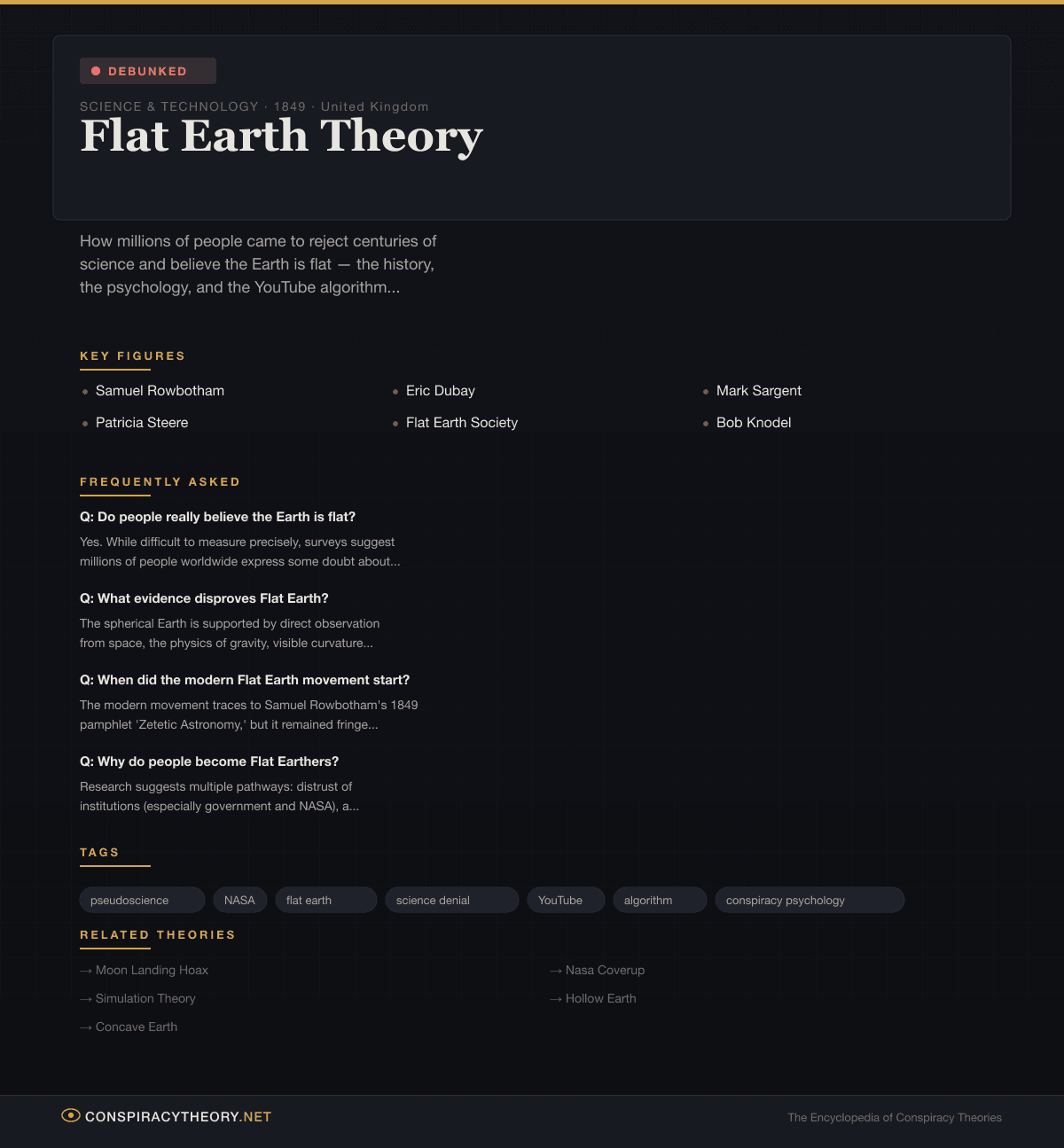
Flat Earth Theory

Overview
Here’s the thing about the Flat Earth theory: it shouldn’t exist. Not in 2026. Not after Magellan circumnavigated the globe in 1522, not after Yuri Gagarin saw the curvature from orbit in 1961, not after thousands of photographs from space, and certainly not after one of the movement’s own leaders accidentally proved the Earth rotates using a laser gyroscope on camera.
And yet it does exist. Not as a joke, not as performance art, but as a genuine belief held by millions of people worldwide. The Flat Earth movement has its own conferences (attracting hundreds of attendees), its own celebrities, its own internal power struggles, and a surprisingly sophisticated — if entirely wrong — counter-narrative to virtually every piece of evidence for a spherical Earth. Walk into any Flat Earth convention and you’ll find engineers, teachers, former military, and small business owners — not the drooling conspiracy caricature you might expect.
Understanding how this happened — how a belief conclusively disproven by the ancient Greeks gained millions of adherents in the age of satellite imagery — tells us less about the shape of the Earth (which is, to be absolutely clear, an oblate spheroid) and more about the shape of our information ecosystem, the psychology of belief, and what happens when an algorithm decides that “people who watch science videos would love to watch someone deny science.”
Origins & History
The Ancient World Already Figured This Out
Let’s dispense with one myth before diving into another: the popular idea that medieval Europeans believed in a flat Earth is itself historically wrong. The ancient Greeks established that the Earth was spherical by around 500 BC. Eratosthenes calculated its circumference with remarkable accuracy around 240 BC using nothing more than shadows, geometry, and a guy in another city. Throughout the medieval period, educated Europeans understood the Earth was round. The “Columbus proved the Earth was round” story is a 19th-century fabrication by Washington Irving.
Which makes the modern Flat Earth movement not a survival of ancient ignorance but a deliberate rejection of established knowledge — a fundamentally different and far more interesting phenomenon.
Samuel Rowbotham and Zetetic Astronomy
The modern movement begins with Samuel Birley Rowbotham, a 19th-century English inventor and lecturer who, in 1849, conducted what he called the “Bedford Level Experiment.” He stood at one end of a six-mile straight canal in Norfolk, England, and claimed he could see a boat at the other end that should have been hidden by the Earth’s curvature.
Rowbotham published his findings as Zetetic Astronomy: Earth Not a Globe and spent decades lecturing across Britain. He was, by all accounts, a charismatic and persuasive speaker — audiences frequently left his lectures more confused about the Earth’s shape than when they’d arrived.
His core mistake was straightforward: he failed to account for atmospheric refraction, which bends light over water and can make objects visible beyond the geometric horizon. When Alfred Russel Wallace (yes, the co-discoverer of evolution) repeated the experiment in 1870 with proper controls, the curvature was clearly demonstrated. Rowbotham’s followers refused to accept the results and demanded their money back from the bet.
This pattern — conduct an experiment, get the wrong answer due to methodological error, refuse to accept correction — would repeat throughout the movement’s history.
The Flat Earth Society
After Rowbotham’s death, Lady Elizabeth Blount founded the Universal Zetetic Society in 1893. It puttered along as a curiosity. In 1956, Samuel Shenton revived the concept as the International Flat Earth Research Society. When shown photographs from space, Shenton’s response was magnificent in its stubbornness: “It’s easy to see how a photograph like that could fool the untrained eye.”
Under Charles K. Johnson, who took over in 1972, the society peaked at about 3,500 members. Johnson ran it from his home in Lancaster, California, until his death in 2001. The society was reorganized in 2004 as an online forum, but remained a small oddity — a punchline more than a movement.
Then YouTube happened.
The Algorithm That Changed Everything
Between 2014 and 2017, something remarkable occurred. The Flat Earth movement exploded from a few thousand enthusiasts to a global phenomenon. The catalyst wasn’t a new piece of evidence or a compelling new argument. It was YouTube’s recommendation algorithm.
Researchers at Texas Tech University, UC Berkeley, and other institutions have documented what happened: YouTube’s AI, designed to maximize watch time, discovered that people who watched science and space content were likely to click on Flat Earth videos. Not because they believed, but because the titles were outrageous enough to generate curiosity clicks. But curiosity clicks led to watch time. Watch time led to more recommendations. More recommendations led to more clicks.
The algorithm didn’t care whether the content was true. It cared that people watched it. And they did — often starting as skeptics, then watching hours of content, then starting to doubt. Asheley Landrum, a researcher at Texas Tech, surveyed attendees at the 2017 Flat Earth International Conference and found that virtually all of them had been converted by YouTube videos.
YouTube eventually changed its algorithm in 2019 to reduce recommendations of “borderline” conspiracy content. By then, the movement had achieved self-sustaining critical mass.
The Flat Earth Model
What Flat Earthers Actually Believe
The most common Flat Earth model:
The Disc: The Earth is a flat, circular disc. The North Pole sits at the center. What we call “Antarctica” is actually a wall of ice around the perimeter — a 150-foot-tall barrier that holds the oceans in. (Some models have Antarctica extending infinitely as an ice plane.)
The Dome: Many Flat Earthers believe in a “firmament” — a solid or semi-solid dome over the disc. This draws from a literal reading of Genesis, which describes God creating a “firmament” to separate the waters above from the waters below.
The Sun and Moon: Both are much smaller and closer than mainstream science claims — perhaps 30 miles across and 3,000 miles up. They circle above the disc like spotlights, illuminating different areas as they move. This is why it’s daytime in some places and nighttime in others.
Gravity: Doesn’t exist as described by Newton or Einstein. Objects fall because the disc accelerates upward at 9.8 m/s² (in some models, pushed by a mysterious force called “dark energy” — which is, ironically, a real astrophysics concept they’ve repurposed). In other models, objects fall due to “density and buoyancy” alone, which is not how density and buoyancy work.
Space: Doesn’t exist. The stars are lights embedded in the firmament, or possibly holes in it. Planets are “wandering stars.” Nothing has ever left the Earth’s atmosphere.
NASA: A fraud organization that exists to perpetuate the globe deception. Its $25 billion annual budget funds the production of fake images, fake missions, and the employment of thousands of actors and engineers who are all in on the conspiracy. Every other space agency in the world — Russia’s, China’s, Japan’s, India’s, the ESA’s — is also in on it.
The Problems (And They Know It)
To their credit, some Flat Earthers have engaged seriously with the model’s contradictions, even if their solutions don’t hold up:
Flight paths: Direct flights in the Southern Hemisphere (Sydney to Santiago, Johannesburg to Perth) would require impossible detours on a flat disc. Flat Earthers respond by claiming these flights don’t actually follow the routes advertised, or that airline companies are in on the conspiracy.
24-hour Antarctic daylight: During the Antarctic summer, the sun doesn’t set for months. On the standard flat Earth model, this is impossible — the spotlight sun circling above a disc can’t illuminate the outer rim for 24 hours. This remains one of the model’s most intractable problems.
Southern star rotation: Observers in the Southern Hemisphere see stars rotating around the south celestial pole. On a flat disc, this would require every Southern Hemisphere observer to be looking outward in different directions and somehow seeing the same rotation, which is geometrically impossible.
Eclipses: The flat Earth model cannot coherently explain lunar or solar eclipses. Various ad hoc explanations have been proposed (a “shadow object,” the moon generating its own light) but none are self-consistent.
Key Figures
Eric Dubay
A yoga instructor living in Thailand, Dubay is credited with kickstarting the modern movement with his 2014 video “200 Proofs Earth is Not a Spinning Ball.” The video is a rapid-fire gish gallop of claims, each requiring far more time to debunk than to state — a rhetorical strategy as old as debate itself. Dubay is also a Holocaust denier and antisemite, which has caused schisms within the movement as other Flat Earthers distance themselves from his broader ideology.
Mark Sargent
A former software analyst from Seattle, Sargent created the popular “Flat Earth Clues” video series in 2015 and became the movement’s most recognizable public face. He was prominently featured in the Netflix documentary Behind the Curve (2018). Sargent’s approach is less confrontational than Dubay’s — he frames Flat Earth as a thought experiment and community, emphasizing the social bonds over the science.
Bob Knodel and Jeran Campanella
Co-hosts of the YouTube show “Globebusters,” these two provided the documentary Behind the Curve with its most memorable moment. Knodel purchased a $20,000 laser ring gyroscope to prove that the Earth doesn’t rotate. The gyroscope detected exactly 15 degrees of rotation per hour — precisely what a spinning globe predicts. Knodel’s on-camera response — “That’s interesting. That’s a problem” — followed by his continued refusal to accept the result, became a viral illustration of motivated reasoning.
In a separate experiment filmed for the documentary, Campanella set up lights and a camera across a large body of water to test for curvature. The experiment clearly showed the curvature. He, too, did not change his mind.
Patricia Steere
A prominent Flat Earth YouTuber and conference organizer who became the movement’s most visible female figure. Steere’s story illustrates the community aspect of Flat Earth — she has described finding belonging and purpose in the movement after a difficult personal period. She left the movement in 2018 amid accusations from other Flat Earthers that she was a CIA plant — a common fate for prominent conspiracy community members.
”Mad” Mike Hughes
A limousine driver and daredevil who built homemade steam-powered rockets to launch himself into the sky and “prove” the Earth was flat. Hughes reached altitudes of approximately 1,800 feet in his launches — nowhere near high enough to see curvature. He was killed on February 22, 2020, when his rocket crashed in the Mojave Desert after a parachute failed to deploy. He was 64. His death raised serious questions about the real-world consequences of conspiracy belief.
The Psychology
Why Smart People Believe Impossible Things
The most common question about Flat Earth is: “But how can they really believe it?” Research has identified several interacting factors:
Distrust of authority: For many Flat Earthers, the shape of the Earth is secondary to a deeper conviction that governments, scientists, and media lie about everything. Flat Earth is the logical endpoint of total institutional distrust — if they’ll lie about weapons of mass destruction, what else will they lie about?
Epistemic learned helplessness: In a world of information overload, many people have essentially given up on evaluating truth claims through evidence. Instead, they choose who to trust. If your trusted community says the Earth is flat, you believe the Earth is flat.
Community and identity: Flat Earth conferences are, by all accounts, warm and welcoming spaces. Attendees describe finding friendship, purpose, and a sense of being part of something important. Leaving the movement means losing your community — a powerful incentive to stay.
The seduction of secret knowledge: Gnosticism — the belief that you possess hidden knowledge unknown to the masses — is psychologically intoxicating. Flat Earthers describe a “waking up” experience that feels profound and transformative, similar to religious conversion.
The gateway effect: Researchers have documented that Flat Earth rarely exists in isolation. It’s typically adopted after — or alongside — other conspiracy beliefs. It functions as a terminal point on a conspiracy belief trajectory: once you believe the shape of the planet is a lie, everything else falls into place.
YouTube as teacher: For people without strong science education, a well-produced YouTube video can be more convincing than a textbook. Flat Earth videos use compelling visuals, emotional music, and charismatic presenters. They also use a technique called “just asking questions” — framing demonstrably false claims as innocent inquiry.
The Irony of Empiricism
Perhaps the most fascinating aspect of the Flat Earth movement is that its rhetoric is deeply empiricist. “Trust your senses.” “Do your own research.” “Don’t believe what they tell you — look for yourself.” These are, in the abstract, reasonable epistemological principles. The movement has perverted them into weapons against science, but the impulse toward personal verification is not inherently unreasonable.
The problem is that personal observation at human scale can be misleading. The Earth looks flat from the ground. Water does appear to find its level. The horizon does seem to stretch in a straight line. Without instruments, mathematics, or an understanding of scale, raw sensory experience supports a flat Earth. The movement exploits this gap between everyday experience and scientific reality.
Cultural Impact
The Canary in the Information Mine
Flat Earth matters not because anyone is going to redesign airplane navigation around a disc model, but because it reveals something profound about our information ecosystem. If YouTube’s algorithm can convert people to Flat Earth — one of the most thoroughly debunked claims in human history — what else can it do?
Researchers who study Flat Earth aren’t primarily interested in the shape of the Earth. They’re interested in:
- How recommendation algorithms radicalize
- How communities form around demonstrably false beliefs
- How social identity becomes intertwined with factual claims
- What happens when “do your own research” replaces institutional knowledge
- How conspiracy belief scales in the social media age
Science Education’s Wake-Up Call
The movement has prompted soul-searching in science education. If millions of people can be convinced the Earth is flat despite centuries of evidence, something has gone wrong in how science is taught and communicated. Science education has historically focused on conclusions (the Earth is round) rather than methods (here’s how we know, and here’s how you can verify it yourself). The Flat Earth movement suggests that conclusions without understanding are fragile.
Gateway to Everything Else
Flat Earth functions as what researchers call a “gateway conspiracy.” Data shows strong correlations between Flat Earth belief and belief in anti-vaccination claims, QAnon, chemtrails, and other conspiracy theories. For many, Flat Earth is the entry point into a broader conspiratorial worldview. This makes it a public health and political concern, not just a scientific curiosity.
In Popular Culture
- Behind the Curve (2018) — Netflix documentary following prominent Flat Earthers, including the infamous gyroscope experiment
- Flat Earth: The Musical — stage production satirizing the movement
- Logan Paul attended the 2018 Flat Earth International Conference, bringing mainstream attention (and controversy)
- The movement has been referenced in shows from Last Week Tonight to It’s Always Sunny in Philadelphia
- Multiple rappers (B.o.B most prominently) have publicly endorsed Flat Earth, sparking high-profile debates with astrophysicist Neil deGrasse Tyson
- The phrase “Do your own research” — once associated with Flat Earth — became a broader cultural meme during COVID-19
Timeline
| Date | Event |
|---|---|
| ~500 BC | Ancient Greeks establish spherical Earth through observation |
| ~240 BC | Eratosthenes calculates Earth’s circumference |
| 1522 | Magellan’s expedition completes circumnavigation |
| 1849 | Samuel Rowbotham publishes Zetetic Astronomy |
| 1870 | Alfred Russel Wallace demonstrates curvature in Bedford Level experiment |
| 1893 | Universal Zetetic Society founded |
| 1956 | Flat Earth Society founded by Samuel Shenton |
| 1961 | Yuri Gagarin sees curvature from orbit |
| 1968 | Apollo 8 takes “Earthrise” photo |
| 1972 | Apollo 17 takes “Blue Marble” photo |
| 2004 | Flat Earth Society relaunched online |
| 2014 | Eric Dubay’s “200 Proofs” video goes viral |
| 2015 | Mark Sargent’s “Flat Earth Clues” series explodes on YouTube |
| 2017 | First Flat Earth International Conference (Raleigh, NC) |
| 2018 | Netflix documentary Behind the Curve released |
| 2019 | YouTube changes algorithm to reduce conspiracy recommendations |
| 2020 | ”Mad” Mike Hughes dies in homemade rocket crash |
| 2020-2025 | Movement fragments but persists; merges with other conspiracy communities |
Sources & Further Reading
- Garwood, Christine. Flat Earth: The History of an Infamous Idea. Thomas Dunne Books, 2007.
- Landrum, Asheley R., et al. “Differential Susceptibility to Misleading Flat Earth Arguments on YouTube.” Media Psychology, 2021.
- Paolillo, John C. “The Flat Earth Phenomenon on YouTube.” First Monday, 2018.
- Olshansky, Alex, et al. “Flat-Smacked! Converting to Flat Earthism.” Journal of Media and Religion, 2020.
- Netflix. Behind the Curve. Directed by Daniel J. Clark, 2018.
- Uscinski, Joseph, and Joseph Parent. American Conspiracy Theories. Oxford University Press, 2014.
- Brotherton, Rob. Suspicious Minds: Why We Believe Conspiracy Theories. Bloomsbury Sigma, 2015.
Related Theories
- Moon Landing Hoax — NASA deception theory frequently co-held with Flat Earth
- Hollow Earth — Alternative Earth structure theory
- Concave Earth — The inverse — we live on the inside of a sphere
- Simulation Theory — Another theory questioning perceived reality
Frequently Asked Questions
Do people really believe the Earth is flat?
What evidence disproves Flat Earth?
When did the modern Flat Earth movement start?
Why do people become Flat Earthers?
Has a Flat Earther ever accidentally proved the Earth is round?
Infographic
Share this visual summary. Right-click to save.