Fomenko New Chronology — Russian History Revision
Overview
Imagine someone told you that Jesus Christ, the Prophet Muhammad, and Pope Gregory VII were all the same person. That ancient Rome and medieval Constantinople were the same city described by different chroniclers. That the entire chronological framework of human history — the dates, the dynasties, the sequence of civilizations — was fabricated in the sixteenth and seventeenth centuries by Jesuit scholars who invented over a thousand years of fictional past.
This is not a thought experiment. It is the New Chronology, a theory developed by Anatoly Fomenko, one of Russia’s most distinguished mathematicians, and it has sold millions of books, attracted a devoted global following, and driven historians to the verge of collective apoplexy for four decades.
Fomenko’s theory is audacious in a way that makes flat Earth look timid by comparison. He does not merely question specific historical events or dates. He dismantles the entire chronological framework of human civilization and rebuilds it, arguing that what we call “ancient history” is a distorted mirror of the medieval period, that the historical record has been systematically falsified, and that the true timeline of human civilization is roughly 1,000 years shorter than conventionally believed.
The theory is, by every standard of historical evidence, wrong. Dendrochronology (tree-ring dating), radiocarbon dating, ice core data, astronomical records, archaeological stratigraphy, and the independent convergence of multiple documentary traditions from different civilizations all confirm the conventional chronological framework. But Fomenko’s New Chronology endures, particularly in Russia, where it taps into deep currents of national identity, post-Soviet disillusionment, and distrust of Western-dominated academic institutions.
Origins & History
Fomenko the Mathematician
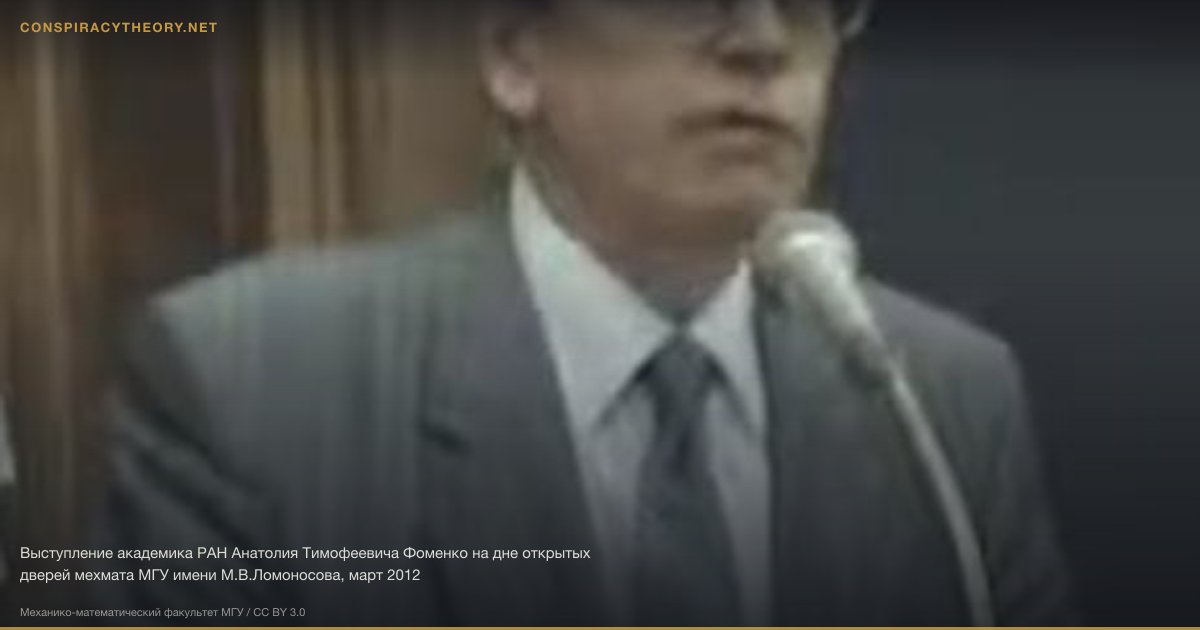
Anatoly Timofeevich Fomenko (born 1945) is not a crank in the usual sense. He is a full Academician of the Russian Academy of Sciences — one of the highest honors in Russian science — and a professor at Moscow State University. His contributions to topology and symplectic geometry are genuine and recognized internationally. He is the author of dozens of mathematical papers and several respected textbooks.
This pedigree is central to the theory’s appeal. Fomenko is not an amateur conspiracy theorist working from a basement. He is a credentialed scientist applying (he claims) rigorous mathematical methods to historical data. The implicit argument is: if a mathematician this accomplished says the chronology is wrong, surely there must be something to it.
The counterargument is straightforward: expertise in mathematics does not confer expertise in history, archaeology, or dating science. Fomenko’s mathematical abilities are not in question. His understanding of how historical evidence works — the convergence of multiple independent dating methods, the constraints of archaeological stratigraphy, the internal consistency of documentary traditions — is.
Nikolai Morozov: The Precursor
Fomenko did not invent chronological revisionism. His most important predecessor was Nikolai Morozov (1854-1946), a Russian revolutionary, polymath, and prisoner who spent 25 years in Tsarist jails, during which he taught himself multiple languages and developed an obsession with historical chronology.
Morozov argued that ancient astronomical observations had been misdated and that much of ancient history was fictional. His multi-volume Christ (published 1924-1932) proposed that Jesus Christ lived in the fourth century, not the first, and that the entire framework of ancient history needed revision.
Morozov’s work was largely ignored by historians but fascinated Fomenko, who encountered it in the 1970s and saw an opportunity to apply modern mathematical and statistical techniques to Morozov’s intuitions.
The Statistical Method
Fomenko’s signature contribution is the application of statistical pattern-matching to historical chronicles. His methodology works roughly as follows:
- Take two historical dynasties — say, the kings of ancient Israel and the medieval Holy Roman Empire
- Create numerical sequences from each: reign lengths, gaps between rulers, major events
- Compare these sequences statistically
- If the sequences are sufficiently similar, conclude that the two dynasties are actually the same dynasty, recorded by different chroniclers under different names
Fomenko found numerous such “parallelisms” across ancient and medieval history. The kings of ancient Israel, he claimed, were actually medieval European rulers. The ancient Roman Empire was actually the medieval Byzantine Empire described under a different name. Alexander the Great and Genghis Khan were the same person (or at least, their recorded histories are garbled reflections of the same events).
The method is superficially impressive — the statistical correlations Fomenko identifies are real, in the sense that the numbers do match. The problem is that they match because short numerical sequences drawn from large datasets will inevitably produce spurious correlations. This is the same statistical fallacy that allows people to find “Bible codes” or predict stock markets from sunspot data. Given enough data and enough flexibility in selecting comparison pairs, you can find “parallels” between anything.
Professional statisticians and historians have demonstrated this repeatedly. In one famous reductio, critics used Fomenko’s own methods to “prove” that the medieval rulers of Russia were actually twentieth-century Soviet leaders.
Publication and Reception
Fomenko published his first chronological papers in the early 1980s in Soviet academic journals. The ideas attracted curiosity but were not taken seriously by historians. His first book-length treatment, Methods of Statistical Analysis of Historical Texts (1990), laid out the mathematical framework. Through the 1990s and 2000s, he and his collaborator Gleb Nosovsky published dozens of volumes under the “New Chronology” banner, eventually reaching over 40 books.
In Russia, the books became bestsellers. In the chaotic 1990s, with the Soviet Union collapsed, national identity in crisis, and Western-backed economic “reforms” producing oligarchs and poverty, a theory that claimed Russia’s history was far grander and more central than Western historians acknowledged found a receptive audience.
Outside Russia, the theory has attracted a smaller but enthusiastic following, particularly in online alternative history communities where it cross-pollinates with other chronological revision theories.
Key Claims
Fomenko’s New Chronology makes the following core claims:
- Compressed timeline: Conventional history is approximately 1,000 years too long. Events attributed to antiquity (before roughly 1000 AD) actually occurred in the medieval period
- Phantom duplications: “Ancient” civilizations are phantom reflections of medieval ones. Ancient Rome is actually medieval Rome or Constantinople. Ancient Greece is a literary construct based on medieval Mediterranean culture
- Christ redated: Jesus Christ lived in the twelfth century, not the first, and was possibly the same person as Pope Gregory VII or the Byzantine Emperor Andronikos I Komnenos
- Deliberate falsification: The conventional chronology was fabricated in the sixteenth and seventeenth centuries, primarily by Jesuit scholars (especially Joseph Scaliger and Dionysius Petavius), who created a false deep past for ideological and political reasons
- Russian greatness: In Fomenko’s revised timeline, medieval Russia (the “Russian Horde”) was a vast empire that encompassed much of Eurasia, and its central role in world history has been deliberately obscured by Western historians
- Troy is Constantinople: Ancient Troy was not in modern Turkey (or rather, it was — but it was actually Constantinople/Istanbul, described under a different name)
- Astronomical redating: Ancient astronomical records (eclipses, comet sightings, planetary conjunctions) have been incorrectly dated and, when properly analyzed, support a compressed chronology
Evidence
What Fomenko Presents
Fomenko’s arguments draw on several types of evidence:
- Statistical parallelisms: Numerical correlations between dynasty sequences across different historical periods
- Astronomical analysis: Re-examination of ancient eclipse records, the Almagest star catalog, and other astronomical data, arguing that conventional dating of these observations is incorrect
- Textual analysis: Arguments that ancient texts contain anachronisms or errors consistent with medieval authorship
- Cartographic evidence: Claims that medieval maps show geographical knowledge inconsistent with the conventional timeline
- Architectural evidence: Arguments that certain “ancient” structures were actually built in the medieval period
Why It Does Not Hold Up
The scientific case against New Chronology is overwhelming and comes from multiple independent disciplines:
Dendrochronology: Tree-ring dating provides a continuous, independently verifiable chronological record extending back over 10,000 years in some regions. The tree-ring record is consistent with conventional chronology and cannot be fabricated.
Radiocarbon dating: Carbon-14 dating, calibrated against dendrochronology, consistently produces dates consistent with the conventional timeline. Fomenko has questioned the reliability of radiocarbon dating, but his objections have been addressed by physicists and do not withstand technical scrutiny.
Ice core data: Ice cores from Greenland and Antarctica provide continuous climate records extending back hundreds of thousands of years, with annual layers that can be counted. These records are consistent with the conventional chronology.
Archaeological stratigraphy: The physical layering of archaeological deposits — with older material consistently below newer material — confirms the sequence and approximate timing of historical events independently of any written record.
Independent documentary traditions: Chinese, Indian, Islamic, and European historical traditions were developed independently by cultures with limited contact. Their chronologies are broadly consistent with each other and with the conventional framework. Fomenko’s theory requires that all of these traditions were simultaneously falsified — an operation of impossible complexity.
The statistical critique: Professional statisticians have shown that Fomenko’s parallelisms are the product of cherry-picking and the inevitable appearance of spurious correlations in large datasets. The method fails basic statistical controls and does not produce consistent results when applied rigorously.
Astronomical verification: Fomenko’s re-dating of astronomical events has been examined by astronomers, who have found systematic errors in his calculations. Modern computation allows precise retrodiction of eclipses and other events, and these calculations overwhelmingly confirm conventional dating.
Debunking / Verification
New Chronology is classified as debunked because:
- Multiple independent dating methods (dendrochronology, radiocarbon, ice cores, stratigraphy) confirm the conventional chronological framework
- Fomenko’s statistical methods have been shown to produce spurious correlations and fail basic controls
- His astronomical re-dating contains calculation errors identified by professional astronomers
- The theory requires the simultaneous falsification of independent documentary traditions across multiple continents — a logistical impossibility
- No credible historian, archaeologist, or dating scientist accepts the theory
- The Russian Academy of Sciences’ historical division has explicitly rejected it
Cultural Impact
New Chronology’s impact has been primarily felt in Russia and in online alternative history communities:
Russian identity: The theory’s implication that Russia was historically far more important than Western historians acknowledge resonates with post-Soviet national identity anxieties. In a period when Russia’s global status was diminished, the idea that “true” history reveals a vast Russian empire was psychologically appealing.
Publishing phenomenon: Fomenko and Nosovsky have published over 40 books, many of them bestsellers in Russia. The series has generated a cottage industry of lectures, websites, YouTube channels, and study groups.
Alternative history pipeline: New Chronology has become a gateway to other alternative history theories, including Tartaria, the mud flood hypothesis, and various phantom time theories. Online communities frequently mix elements from all of these.
Academic controversy: The theory has generated heated debate within Russian academia, with some mathematicians defending Fomenko’s right to apply statistical methods to history and historians denouncing the work as pseudoscience. The debate has occasionally taken on political dimensions, with accusations that historians who dismiss New Chronology are defending Western intellectual hegemony.
International spread: Through translated books and internet communities, New Chronology has attracted followers in Europe, the Americas, and Asia, though its base remains overwhelmingly Russian-speaking.
In Popular Culture
- Fomenko’s book series — Over 40 volumes published, with titles like History: Fiction or Science?, illustrated with Fomenko’s own mathematical diagrams and artwork
- YouTube and online media — Extensive Russian-language video content explaining and debating New Chronology
- Chess grandmaster Garry Kasparov — Expressed sympathy with aspects of New Chronology in the early 2000s, generating international attention (he later distanced himself from the theory)
- Russian internet culture — New Chronology has generated extensive meme culture in Russian-language internet spaces
- Connection to Tartaria — The theory has influenced and overlapped with the Tartaria community, which posits a vast erased civilization
Key Figures
- Anatoly Fomenko (b. 1945) — Russian mathematician, Academician, and the theory’s creator. His genuine mathematical accomplishments make him one of the most credentialed pseudohistorians in history
- Gleb Nosovsky (b. 1958) — Fomenko’s primary collaborator and co-author, also a mathematician at Moscow State University
- Nikolai Morozov (1854-1946) — Russian revolutionary and polymath who pioneered chronological revisionism and inspired Fomenko’s work
- Joseph Scaliger (1540-1609) — French scholar who established the conventional chronological framework; cast as the chief villain in Fomenko’s narrative
- Garry Kasparov (b. 1963) — Chess world champion who briefly endorsed aspects of New Chronology, lending it international credibility
Timeline
| Date | Event |
|---|---|
| 1854-1946 | Life of Nikolai Morozov, precursor to New Chronology |
| 1924-1932 | Morozov publishes multi-volume Christ, arguing for chronological revision |
| 1945 | Anatoly Fomenko born in Donetsk, Soviet Union |
| 1970s | Fomenko encounters Morozov’s work and begins developing statistical methods for chronological analysis |
| 1981 | Fomenko publishes first papers on chronological revisionism in Soviet academic journals |
| 1990 | Methods of Statistical Analysis of Historical Texts published |
| 1993-present | Fomenko and Nosovsky begin publishing the “New Chronology” book series; dozens of volumes follow |
| 1999 | Russian Academy of Sciences’ history division formally denounces New Chronology |
| 2001-2004 | Garry Kasparov expresses sympathy with aspects of the theory, generating international attention |
| 2003 | English translations of Fomenko’s work begin appearing, spreading the theory to international audiences |
| 2010s | New Chronology influences the growing Tartaria and phantom time online communities |
| 2020s | The theory maintains a substantial following in Russian-speaking internet communities |
Sources & Further Reading
- Fomenko, Anatoly T. History: Fiction or Science? Delamere Publishing (English translation), 2003-2007 (multiple volumes).
- Fomenko, Anatoly T. Nosovsky, Gleb V. New Chronology of Russia. Moscow, 2004.
- Morozov, Nikolai. Christ (Христос). Moscow, 1924-1932.
- Sheynin, Oscar. “On Fomenko’s ‘New Chronology.’” Historia Scientiarum, 2000.
- Efimov, Andrei. “Debunking Fomenko: A Historian’s Perspective.” Moscow, 2005.
- Colavito, Jason. “Who Lost the Middle Ages?” Skeptic Magazine, 2004.
- Goldstein, Bernard R. “Astronomical Evidence for the Dating of Ancient Texts.” Journal for the History of Astronomy, 2003.
Related Theories
- Phantom Time Hypothesis — Heribert Illig’s related claim that the early medieval period was fabricated
- Tartaria — The theory of an erased civilization, influenced by and overlapping with New Chronology
- Mud Flood — The hypothesis that a catastrophic mud flood erased evidence of a previous civilization
Frequently Asked Questions
What is Fomenko's New Chronology?
How does Fomenko support his claims?
Is Fomenko a real mathematician?
How popular is New Chronology in Russia?

Infographic
Share this visual summary. Right-click to save.
