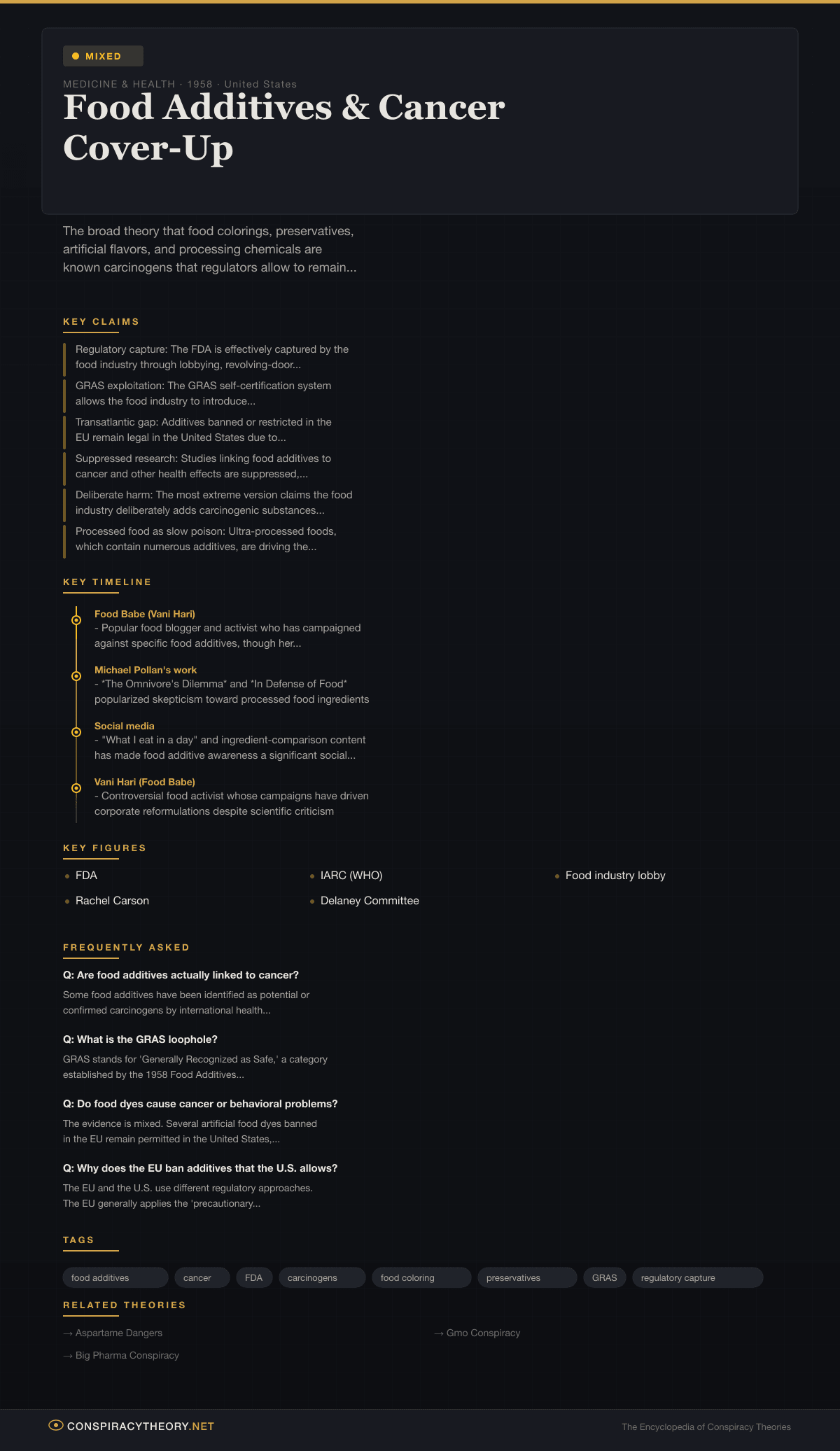
Food Additives & Cancer Cover-Up
Overview
Here is a number that should keep you up at night: there are more than 10,000 chemical substances allowed in the American food supply, and the FDA has directly reviewed the safety of only a fraction of them. The rest were approved through a self-certification process in which the food industry itself determines whether its own additives are safe.
This is not hyperbole. It is not conspiracy. It is the GRAS (Generally Recognized as Safe) system, established in 1958 and running on an honor system ever since. Companies can introduce new chemicals into the food supply without even notifying the FDA, provided they have assembled a panel of experts — often selected and paid by the company itself — who agree the substance is safe. The FDA may never learn that your cereal contains a new synthetic compound until it shows up in a consumer complaint.
The food additives and cancer conspiracy theory occupies an unusually complicated space on the spectrum between paranoia and legitimate concern. On one end, there are people who believe the entire processed food industry is a deliberate cancer delivery system, designed to create customers for the pharmaceutical industry (a theory that is not supported by evidence and requires implausibly vast coordination). On the other end, there are well-documented cases of the food industry lobbying against regulation, funding favorable research, and exploiting regulatory gaps to keep profitable but potentially harmful substances in the food supply.
The truth, as is often the case, involves both legitimate science and legitimate grievance. Some food additives have genuine safety concerns backed by peer-reviewed research. The regulatory system designed to protect consumers has real structural weaknesses. And the food industry’s lobbying and self-regulation create genuine conflicts of interest. None of this requires a conspiracy. But the cumulative effect is a system in which the question “Is this safe to eat?” is harder to answer than it should be.
Origins & History
The Delaney Clause and the Birth of Food Additive Regulation
Modern American food additive regulation begins with the 1958 Food Additives Amendment to the Federal Food, Drug, and Cosmetic Act. The amendment included the Delaney Clause, named after Rep. James Delaney of New York, which contained one of the most absolute regulatory standards ever written: no food additive could be approved if it was found to cause cancer in humans or animals at any dose.
The Delaney Clause was revolutionary in its simplicity. Zero tolerance. No cost-benefit analysis. No “acceptable risk levels.” If a substance caused cancer in lab rats at any dose, it could not be added to food. Period.
The food industry hated it from the start. As analytical chemistry improved and scientists could detect ever-smaller traces of substances, the zero-tolerance standard became increasingly difficult to meet. A chemical that caused tumors in rats given massive doses might be perfectly safe at the trace levels found in food — but under the Delaney Clause, it was still banned.
The clause was effectively weakened in 1996 by the Food Quality Protection Act, which replaced zero tolerance with a “reasonable certainty of no harm” standard for pesticide residues. For food additives, the GRAS system had already created a massive workaround.
The GRAS System
The 1958 amendment exempted substances that were “generally recognized as safe” — either because they had a long history of common use in food before 1958, or because scientific evidence established their safety. This was the GRAS category, and it was intended to cover things like salt, sugar, and vinegar — substances so obviously safe that requiring FDA review would be absurd.
But the GRAS category became something very different from what Congress intended. In 1997, the FDA proposed a system allowing companies to voluntarily notify the agency of new GRAS determinations. The key word was “voluntarily.” Companies could — and routinely did — make GRAS determinations without telling the FDA at all.
A landmark 2014 study by the Natural Resources Defense Council (NRDC) found that of approximately 10,000 additives in the U.S. food supply, the FDA had directly reviewed only about 43%. The rest were either grandfathered in under the 1958 exemption or approved through company-driven GRAS determinations. An estimated 1,000 substances had been classified as GRAS without any FDA notification whatsoever.
The GRAS system essentially allows the food industry to self-regulate. Companies select their own expert panels, fund the safety reviews, and make their own determinations about whether their products are safe. The FDA, perpetually understaffed and underfunded, cannot independently verify these determinations at any meaningful scale.
The Color Additive Controversy
Food colorings have been a flashpoint in the additive safety debate for decades. The United States currently permits seven synthetic food dyes, including Red 40, Yellow 5, Yellow 6, Blue 1, Blue 2, Green 3, and Red 3. Several of these dyes have been the subject of safety concerns:
Red 3 (erythrosine): The FDA acknowledged in 1990 that Red 3 caused thyroid tumors in male rats and banned it from cosmetics and externally applied drugs. However, it remained legal in food and ingested drugs. This contradictory status — too dangerous for lipstick, safe for candy — became one of the most cited examples of regulatory inconsistency. In 2024, California passed the Food Safety Act banning Red 3 from food sold in the state, effective 2027.
Red 40, Yellow 5, Yellow 6: These dyes, which account for approximately 90% of all food dye consumed in the United States, have been linked in some studies to hyperactivity in children. The European Union requires warning labels on products containing these dyes. The FDA reviewed the evidence and concluded the link was not established, though its advisory committee acknowledged that some susceptible children might be affected.
Titanium dioxide: Widely used as a whitening agent in everything from candy to salad dressing, titanium dioxide was banned as a food additive by the European Union in 2022 based on concerns about genotoxicity (DNA damage). It remains legal in the United States.
The Processed Meat Classification
In 2015, the World Health Organization’s International Agency for Research on Cancer (IARC) classified processed meat as a Group 1 carcinogen — the same category as tobacco and asbestos. Red meat was classified as Group 2A (probably carcinogenic). The classifications were based on extensive epidemiological evidence linking processed meat consumption to colorectal cancer.
The reaction from the meat industry was immediate and furious. The North American Meat Institute called the classification “dramatic and alarmist.” Industry groups funded counter-studies and lobbied to discredit the IARC’s methodology. The episode became a case study in how industry responds to unfavorable scientific findings.
It is worth noting that “Group 1 carcinogen” means the evidence for carcinogenicity is strong, not that the substance is as dangerous as tobacco. The relative risk from processed meat consumption is far lower than from smoking. But the classification highlighted the gap between scientific evidence and regulatory action: despite the IARC’s finding, no country banned processed meat, and industry marketing continued uninterrupted.
Key Claims
The food additives conspiracy encompasses several distinct claims of varying credibility:
- Regulatory capture: The FDA is effectively captured by the food industry through lobbying, revolving-door employment, and industry-funded research, preventing meaningful regulation of harmful additives
- GRAS exploitation: The GRAS self-certification system allows the food industry to introduce potentially dangerous substances without adequate safety review
- Transatlantic gap: Additives banned or restricted in the EU remain legal in the United States due to industry lobbying, not scientific evidence
- Suppressed research: Studies linking food additives to cancer and other health effects are suppressed, defunded, or discredited by industry-funded counter-research
- Deliberate harm: The most extreme version claims the food industry deliberately adds carcinogenic substances to create a sick population that generates profits for the pharmaceutical industry
- Processed food as slow poison: Ultra-processed foods, which contain numerous additives, are driving the obesity and cancer epidemics by design
Evidence
Documented Concerns
Several specific additive safety issues are well-documented:
- BHA and BHT: Common preservatives classified by IARC as “possibly carcinogenic to humans” (Group 2B). Remain legal and widely used in the U.S.
- Potassium bromate: Used as a flour improver, classified by IARC as Group 2B. Banned in the EU, Canada, China, Brazil, and many other countries. Legal in the United States
- Sodium nitrite/nitrate: Used in processed meats. Associated with increased colorectal cancer risk. The IARC classified processed meat as a Group 1 carcinogen partly based on these compounds
- BPA (bisphenol A): Used in food packaging (can linings, plastic containers). Endocrine disruptor linked to various health concerns. Banned from baby bottles in the EU and U.S., but still permitted in other food contact materials
- PFAS (“forever chemicals”): Used in food packaging. Associated with cancer, liver damage, and immune system effects. Increasingly restricted but still present in food contact materials
The Regulatory Gap
The gap between EU and U.S. food additive regulation is real and documented:
- The EU has banned or restricted over 1,300 substances in food, cosmetics, and consumer products that remain legal in the United States
- The EU applies the precautionary principle; the U.S. requires more definitive evidence of harm
- EU EFSA (European Food Safety Authority) conducts its own safety reviews; the U.S. relies more heavily on industry-supplied data
- Several substances banned in the EU (titanium dioxide, potassium bromate, certain azo dyes) remain legal and widely used in U.S. food
Industry Influence
The food industry’s lobbying influence on FDA regulation is documented:
- The food and beverage industry spent over $30 million on lobbying in 2023, according to OpenSecrets
- Industry-funded studies are more likely to find food additives safe than independently funded studies (a pattern documented in meta-analyses)
- The revolving door between FDA and industry is well-established
- Industry groups have successfully delayed or weakened proposed regulations on multiple occasions
What Does Not Hold Up
The most extreme version of the theory — that the food industry deliberately adds carcinogens to create pharmaceutical customers — lacks evidence and requires implausibly vast coordination between different industries. Food companies have no incentive to sicken their own customers, and the competitive dynamics of the industry (companies competing for health-conscious consumers) work against deliberate harm.
Additionally, many “natural” foods contain naturally occurring carcinogens (acrylamide in coffee and toast, heterocyclic amines in grilled meat, aflatoxins in peanuts) at levels comparable to or exceeding those found in synthetic additives. The distinction between “natural” and “artificial” does not map neatly onto “safe” and “dangerous.”
Debunking / Verification
This theory is classified as mixed because:
Confirmed elements:
- The GRAS self-certification system has genuine structural weaknesses
- Some additives permitted in the U.S. are banned elsewhere based on legitimate safety concerns
- Industry lobbying influences FDA regulatory decisions
- Several specific additives have documented links to cancer in animal studies
- The regulatory gap between the EU and U.S. reflects different approaches to precaution
Unsubstantiated elements:
- The claim that the food industry deliberately adds carcinogens is not supported by evidence
- Most additives, at the levels present in food, have not been shown to pose significant cancer risk to humans
- The “food industry creates patients for pharma” narrative requires implausible cross-industry coordination
- Many additive safety concerns are based on animal studies at doses far exceeding human exposure
Important context: The dose makes the poison. Many substances are carcinogenic at high doses in animal studies but present negligible risk at the trace levels found in food. Regulatory decisions necessarily involve judgment about acceptable risk levels, not binary safe/dangerous determinations.
Cultural Impact
The food additives debate has driven significant cultural and commercial shifts:
Clean label movement: Consumer demand for “clean” ingredient lists — short, recognizable, free of synthetic additives — has become one of the most powerful forces in the food industry. Major brands have reformulated products to remove artificial colors, flavors, and preservatives, driven by consumer perception as much as scientific evidence.
Organic and natural food market: The organic food market has grown to over $60 billion annually in the United States, driven partly by consumer desire to avoid synthetic additives and pesticides.
State-level action: California’s 2024 Food Safety Act, banning Red 3, potassium bromate, brominated vegetable oil, and propylparaben, represented the most significant state-level food additive regulation in decades and may be replicated by other states.
International pressure: The EU’s stricter approach has created market pressure on American food companies, many of which produce different formulations for European and American markets — using natural colorings in Europe and synthetic ones in the United States for identical products. This practice has become a powerful rhetorical tool for reformers.
In Popular Culture
- Food Babe (Vani Hari) — Popular food blogger and activist who has campaigned against specific food additives, though her scientific claims have been criticized for inaccuracy
- Fed Up (2014) — Documentary examining the food industry’s role in the obesity epidemic, touching on additive concerns
- Super Size Me (2004) — Morgan Spurlock’s documentary, while focused on fast food, raised broader questions about processed food ingredients
- The Poison Squad by Deborah Blum (2018) — History of Harvey Wiley and the early fight for food safety regulation in the United States
- Michael Pollan’s work — The Omnivore’s Dilemma and In Defense of Food popularized skepticism toward processed food ingredients
- Social media — “What I eat in a day” and ingredient-comparison content has made food additive awareness a significant social media genre
Key Figures
- Harvey Wiley (1844-1930) — Chief chemist of the USDA who led the “Poison Squad” experiments and championed the 1906 Pure Food and Drug Act
- James Delaney (1901-1987) — U.S. congressman whose Delaney Clause established the zero-tolerance standard for carcinogenic food additives
- Rachel Carson (1907-1964) — Author of Silent Spring, whose work on pesticide dangers influenced broader food safety consciousness
- Michael Jacobson (b. 1943) — Co-founder of the Center for Science in the Public Interest (CSPI), a leading food safety advocacy organization
- Vani Hari (Food Babe) — Controversial food activist whose campaigns have driven corporate reformulations despite scientific criticism
Timeline
| Date | Event |
|---|---|
| 1906 | Pure Food and Drug Act passed, establishing federal food safety regulation |
| 1938 | Federal Food, Drug, and Cosmetic Act expands FDA authority |
| 1958 | Food Additives Amendment establishes GRAS system and Delaney Clause |
| 1962 | Rachel Carson publishes Silent Spring, raising awareness of chemical safety |
| 1969 | FDA bans cyclamate artificial sweetener based on cancer studies |
| 1976 | Red No. 2 dye banned by FDA based on cancer concerns |
| 1990 | FDA acknowledges Red 3 causes thyroid tumors in rats; bans it from cosmetics but not food |
| 1996 | Food Quality Protection Act effectively weakens Delaney Clause for pesticides |
| 1997 | FDA proposes voluntary GRAS notification system |
| 2007 | EU begins requiring warning labels on foods containing certain synthetic dyes |
| 2014 | NRDC study reveals approximately 1,000 GRAS substances approved without FDA notification |
| 2015 | IARC classifies processed meat as Group 1 carcinogen |
| 2022 | EU bans titanium dioxide as a food additive; it remains legal in the U.S. |
| 2024 | California Food Safety Act bans Red 3, potassium bromate, brominated vegetable oil, and propylparaben |
| 2025 | FDA announces plans to revoke authorization for Red 3 in food nationwide |
Sources & Further Reading
- Neltner, Thomas G. et al. “Navigating the U.S. Food Additive Regulatory Program.” Comprehensive Reviews in Food Science and Food Safety, 2011.
- Natural Resources Defense Council. “Generally Recognized as Secret: Chemicals Added to Food in the United States.” 2014.
- IARC. “Red Meat and Processed Meat.” IARC Monographs on the Evaluation of Carcinogenic Risks to Humans, Vol. 114, 2018.
- Blum, Deborah. The Poison Squad: One Chemist’s Single-Minded Crusade for Food Safety at the Turn of the Twentieth Century. Penguin, 2018.
- Center for Science in the Public Interest. “Chemical Cuisine: CSPI’s Guide to Food Additives.” Updated regularly.
- Pollan, Michael. In Defense of Food: An Eater’s Manifesto. Penguin, 2008.
- FDA. “Everything Added to Food in the United States (EAFUS).” Database.
Related Theories
- Aspartame Dangers — Specific claims about the artificial sweetener’s health risks
- GMO Conspiracy — Overlapping concerns about the safety of genetically modified food
- Big Pharma Conspiracy — The claim that the medical industry profits from food-caused illness
Frequently Asked Questions
Are food additives actually linked to cancer?
What is the GRAS loophole?
Do food dyes cause cancer or behavioral problems?
Why does the EU ban additives that the U.S. allows?
Infographic
Share this visual summary. Right-click to save.