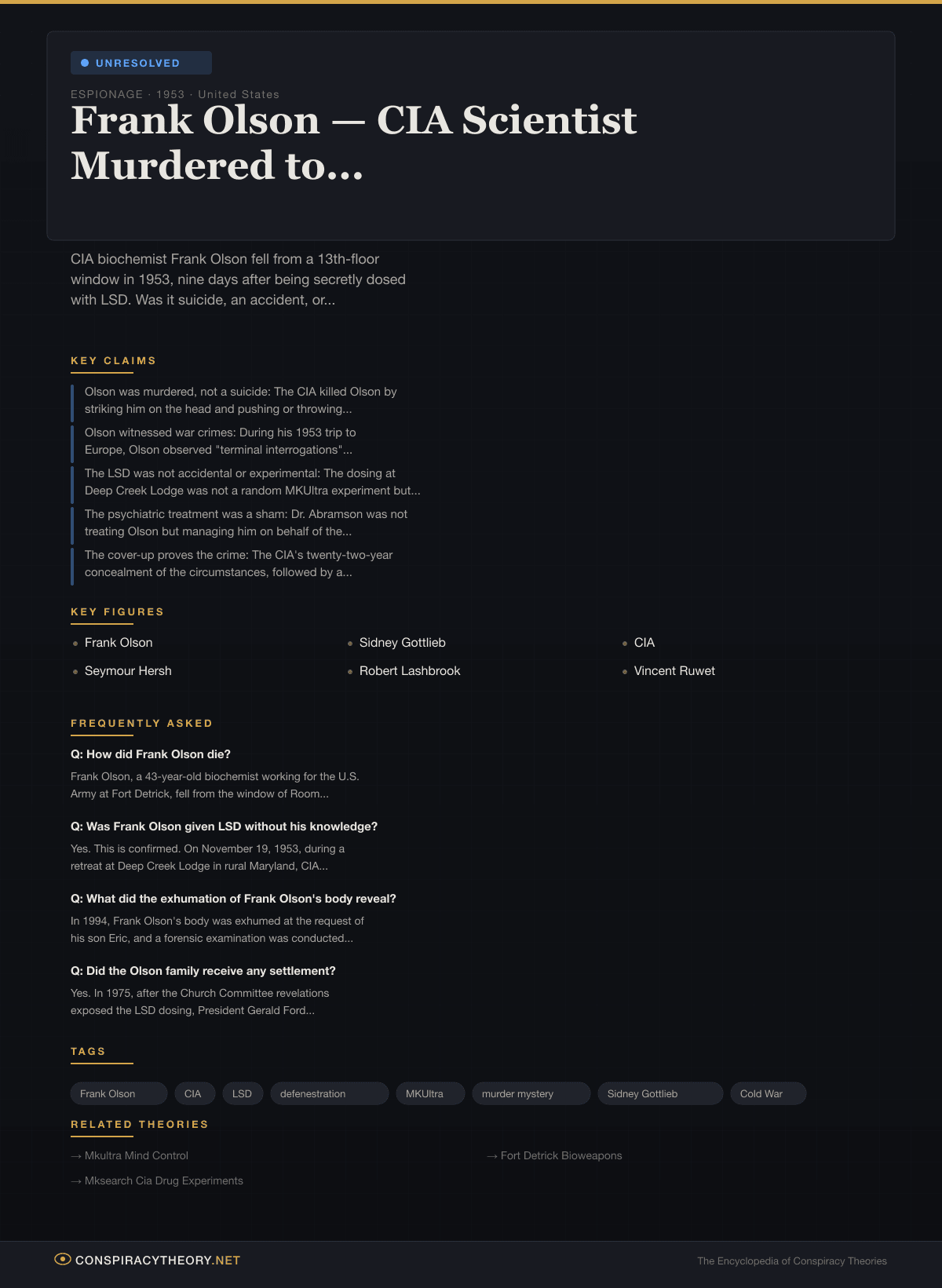
Frank Olson — CIA Scientist Murdered to Prevent Disclosure

Overview
On the morning of November 28, 1953, a hotel night manager named Armand Pastore heard a crash and ran outside the Hotel Statler in midtown Manhattan to find a man’s broken body on the sidewalk. The man had fallen from the thirteenth floor, smashing through a closed window and its lowered shade. He was still alive when Pastore reached him. He tried to speak but could not form words. Within minutes, he was dead.
The dead man was Frank Rudolph Olson, a 43-year-old biochemist employed by the U.S. Army’s Special Operations Division at Fort Detrick, Maryland. His death was initially recorded as a suicide. It would take more than two decades for the public to learn that Olson had been secretly dosed with LSD by the CIA nine days before his death. It would take four decades more for a forensic examination to suggest he might not have jumped at all — that someone may have struck him on the head and pushed him through the window.
The Frank Olson case sits at the intersection of confirmed conspiracy and unresolved mystery. The confirmed elements are extraordinary enough on their own: a U.S. government scientist was drugged without his knowledge or consent as part of MKUltra, the CIA’s illegal mind-control program. He experienced a severe psychological crisis. He was dead within ten days. The CIA covered up the circumstances for over twenty years. These facts are not in dispute. What remains unresolved — and may never be definitively settled — is whether Olson jumped, fell, or was pushed.
Origins & History
Fort Detrick and the Special Operations Division
To understand why Frank Olson might have been considered a security risk worth eliminating, you need to understand what he knew. Olson was not a low-level technician; he was a senior biochemist in the Special Operations Division (SOD) at Fort Detrick, the headquarters of the U.S. biological weapons program. The SOD was the unit that worked most closely with the CIA, developing biological agents for covert operations — assassination weapons, incapacitating agents, and aerosol delivery systems.
Olson held a top-secret security clearance and had traveled to Europe in the summer of 1953, visiting biological warfare facilities in Britain, including Porton Down, and reportedly observing “terminal interrogations” — interrogations using extreme techniques, possibly including biological agents, that resulted in the deaths of the subjects. According to his colleagues, Olson returned from this trip deeply disturbed by what he had witnessed.
The Deep Creek Lodge Incident (November 19, 1953)
On November 19, 1953, Olson attended a joint CIA-SOD retreat at Deep Creek Lodge, a rural cabin in western Maryland. The retreat was organized by Sidney Gottlieb, the head of the CIA’s Technical Services Staff and the architect of MKUltra. On the second evening, after dinner, Gottlieb spiked a bottle of Cointreau with LSD and served it to the group. Approximately twenty minutes later, Gottlieb informed the men that they had been drugged.
Several of the men experienced relatively mild effects. Olson did not. By multiple accounts, the LSD triggered a severe psychological crisis. He became anxious, paranoid, and convinced that he had embarrassed himself. In the days following the retreat, his condition worsened. His supervisor, Lieutenant Colonel Vincent Ruwet, became concerned enough to notify the CIA.
The Week Before the Fall (November 20-27, 1953)
Over the next nine days, Olson was shuttled between Fort Detrick and New York City in a series of moves that, viewed charitably, represented attempts to get him psychiatric help and, viewed suspiciously, look like an effort to isolate him from his family and colleagues while the CIA figured out what to do with him.
Olson was brought to New York twice to see Dr. Harold Abramson, an allergist (not a psychiatrist) who was also a CIA contractor and LSD researcher. Abramson prescribed bourbon and Nembutal — an odd treatment for someone in apparent psychological distress, and one that some researchers have noted could have made Olson more vulnerable and disoriented. Olson expressed a desire to leave the program and reportedly spoke of confessing what he knew to the press.
On November 24, Ruwet and CIA officer Robert Lashbrook accompanied Olson back to New York. The plan, reportedly, was for Olson to see a physician the following day and possibly be admitted to a psychiatric facility. But on November 27, Lashbrook called Ruwet to say that Olson seemed better and that they had decided to return to Washington the next day. That night, Olson and Lashbrook shared Room 1018A at the Hotel Statler.
The Fall (November 28, 1953)
According to Lashbrook’s account, he was awakened at approximately 2:30 a.m. by the sound of crashing glass. He said he saw Olson’s empty bed and the shattered window. He called the hotel switchboard and then called his CIA supervisor, not the police and not an ambulance.
Armand Pastore, the night manager who reached Olson on the sidewalk, later told investigators that he found the scene odd. Olson had crashed through the window shade as well as the glass, which was unusual for a jumper — the shade, which was pulled down, would have been the first thing to obstruct someone deliberately leaping. Pastore also noted that Lashbrook, when he arrived downstairs, seemed remarkably calm and made a phone call in which he said only: “Well, he’s gone.”
The death was ruled a suicide. No autopsy was conducted. Olson’s family was told he had died of a fall during a work-related trip to New York. They were not told about the LSD, the CIA, or MKUltra.
The 1975 Revelations
The Olson family lived with the official story for twenty-two years. Then, in June 1975, the Rockefeller Commission, established to investigate CIA abuses, published a report referencing an unnamed Army scientist who had been given LSD without his knowledge and had subsequently committed suicide by jumping from a New York hotel window. Simultaneously, Seymour Hersh of the New York Times was preparing a story on the same case. The Olson family recognized the description immediately.
President Gerald Ford invited the family to the White House and personally apologized. CIA Director William Colby met with the family and provided them with a file of documents about the case. In 1977, Congress awarded the family $750,000 in compensation.
But the revelation of the LSD dosing raised more questions than it answered. If the CIA had been willing to lie about the circumstances of Olson’s death for twenty-two years, what else might they be concealing?
Eric Olson’s Crusade
Frank Olson’s son Eric, who was nine years old when his father died, devoted much of his adult life to investigating the case. Eric Olson became convinced that his father had not committed suicide but had been murdered by the CIA to prevent him from revealing what he knew about the biological weapons program and the interrogation techniques he had witnessed in Europe.
Eric Olson’s case was built on several pillars: his father’s known distress about what he had witnessed in Europe, the CIA’s well-documented willingness to use extreme measures to protect secrets, the suspicious circumstances of the death (the closed shade, Lashbrook’s calm demeanor, the failure to call emergency services), and the government’s decades-long cover-up.
The 1994 Exhumation and Forensic Analysis
In 1994, Eric Olson arranged for his father’s body to be exhumed and examined by James Starrs, a forensic pathologist at George Washington University. Starrs’s team discovered a previously undetected cranial injury: a hematoma on the left side of Olson’s skull that Starrs concluded was inconsistent with the fall and instead was “indicative of a blow received before the fall.” The injury, Starrs argued, suggested that Olson had been struck on the head — perhaps to incapacitate him — before being pushed or thrown through the window.
Starrs’s conclusion was dramatic: the evidence was “rankly and starkly suggestive of homicide.” However, other forensic experts disputed Starrs’s interpretation, noting that the skull injury could have been caused by the fall itself or by the window frame during the exit.
In 1996, the Manhattan District Attorney’s office opened a homicide investigation based on Starrs’s findings. The investigation continued for several years but was ultimately closed without charges, the DA’s office citing insufficient evidence to sustain a prosecution decades after the event.
Seymour Hersh’s Unpublished Reporting
In 2012, investigative journalist Seymour Hersh revealed in an interview that he had been told by multiple CIA sources that Frank Olson had been murdered because he had witnessed the CIA’s use of biological agents in interrogations — possibly fatal interrogations — and was considered a security risk. Hersh said he had been unable to confirm the claims sufficiently for publication, but he believed Olson was “pushed out of that window.”
Key Claims
-
Olson was murdered, not a suicide: The CIA killed Olson by striking him on the head and pushing or throwing him through the hotel window because he posed a security threat.
-
Olson witnessed war crimes: During his 1953 trip to Europe, Olson observed “terminal interrogations” using biological agents — experiments on human subjects that resulted in deaths — and was traumatized by what he saw.
-
The LSD was not accidental or experimental: The dosing at Deep Creek Lodge was not a random MKUltra experiment but a deliberate attempt to destabilize Olson psychologically, either to discredit any disclosures he might make or to create a pretext for his death.
-
The psychiatric treatment was a sham: Dr. Abramson was not treating Olson but managing him on behalf of the CIA, keeping him isolated and compliant while the agency determined its course of action.
-
The cover-up proves the crime: The CIA’s twenty-two-year concealment of the circumstances, followed by a carefully managed partial disclosure designed to frame the death as an unfortunate side effect of the LSD experiment rather than a deliberate killing, is itself evidence of murder.
Evidence
Evidence Supporting Murder
The forensic findings from the 1994 exhumation represent the most significant physical evidence. The cranial hematoma identified by Starrs, if correctly interpreted as a pre-fall injury, is consistent with Olson being struck before going through the window.
The circumstances of the fall are suspicious on multiple levels. The closed window shade suggests Olson did not deliberately jump — a suicidal person would presumably open or push aside the shade before leaping. The window itself was small and positioned in a way that would require considerable effort to exit, particularly for someone supposedly in a state of psychological crisis.
Lashbrook’s behavior after the fall — calling his CIA supervisor before calling for medical help — suggests a mindset focused on operational security rather than humanitarian response. Armand Pastore’s account of Lashbrook’s eerie calm further supports this interpretation.
The CIA’s documented willingness to eliminate security risks, its extensive cover-up capabilities, and the confirmed existence of assassination programs during this period (later revealed by the Church Committee) provide contextual plausibility.
Evidence Against Murder
The alternative explanation — that Olson, in a state of severe psychological distress triggered by the LSD dosing, committed suicide or fell from the window during a psychotic episode — is also consistent with the known facts. LSD can trigger severe anxiety, paranoia, and psychotic episodes, particularly in someone already under stress. Olson had exhibited clear signs of psychological deterioration in the nine days preceding his death.
The cranial injury identified by Starrs has been disputed by other forensic experts. Injuries sustained during a thirteen-story fall onto a concrete sidewalk can produce a wide range of cranial trauma, and attributing a specific hematoma to a pre-fall blow rather than the fall itself requires a level of certainty that forensic science may not be able to provide in this case.
No eyewitness to a physical assault has ever come forward. No CIA operative has confessed to participating in a murder. No document definitively ordering or describing Olson’s assassination has been found, despite extensive declassification.
Cultural Impact
The Frank Olson case has become one of the most frequently cited examples of suspected CIA assassination of an American citizen on American soil. It has served as a cautionary tale about the dangers of government secrecy, the vulnerability of individuals caught up in classified programs, and the limits of posthumous justice.
The case played a direct role in the political fallout from the Church Committee investigations, contributing to the public perception that the CIA was an organization capable of extreme violence against its own people. It strengthened the case for intelligence oversight reform and helped create the political conditions for the Intelligence Oversight Act of 1980.
Eric Olson’s decades-long quest for the truth became itself a significant cultural narrative — the story of a son who refused to accept the official account of his father’s death and spent his life seeking accountability. Eric Olson’s investigation was the subject of numerous documentaries, articles, and eventually the Netflix series Wormwood.
In Popular Culture
The Frank Olson case has been the subject of extensive artistic and journalistic treatment. Errol Morris’s 2017 Netflix series Wormwood is a six-part hybrid documentary and dramatic reenactment starring Peter Sarsgaard as Frank Olson and combining interviews with Eric Olson with dramatized sequences. The series was widely acclaimed for its exploration of what happens when a family’s private grief becomes entangled with state secrecy.
The 2002 documentary Code Name: Artichoke explored the CIA interrogation programs that Olson was involved with and the circumstances of his death. The television series The Americans referenced the Olson case in its depiction of Cold War espionage. Numerous books have covered the case, most notably H.P. Albarelli Jr.’s A Terrible Mistake: The Murder of Frank Olson and the CIA’s Secret Cold War Experiments (2009), which argued at length for the murder theory.
Key Figures
- Frank Olson (1910-1953): U.S. Army biochemist at Fort Detrick’s Special Operations Division; the victim
- Sidney Gottlieb (1918-1999): Head of CIA Technical Services Staff and architect of MKUltra; administered the LSD
- Robert Lashbrook: CIA officer who shared the hotel room with Olson on the night of his death
- Vincent Ruwet: Olson’s supervisor at Fort Detrick who accompanied him in his final days
- Harold Abramson: CIA-affiliated allergist who treated Olson in New York
- Eric Olson (1944-present): Frank Olson’s son; spent decades investigating his father’s death
- James Starrs: George Washington University forensic pathologist who conducted the 1994 exhumation
- Seymour Hersh: Investigative journalist who reported CIA sources confirmed murder
- Armand Pastore: Hotel Statler night manager who was first to reach Olson’s body
Timeline
| Date | Event |
|---|---|
| July 7, 1910 | Frank Olson born in Hurley, Wisconsin |
| 1943 | Olson begins work at Camp Detrick (later Fort Detrick) |
| Summer 1953 | Olson travels to Europe, visits Porton Down and reportedly witnesses terminal interrogations |
| November 19, 1953 | Sidney Gottlieb doses Olson with LSD at Deep Creek Lodge, Maryland |
| November 20-27, 1953 | Olson exhibits severe psychological distress; brought to New York twice to see CIA-affiliated doctor |
| November 28, 1953 | Olson falls to his death from the 13th floor of the Hotel Statler, New York City |
| 1953-1975 | Death ruled a suicide; CIA conceals circumstances for 22 years |
| June 1975 | Rockefeller Commission report references unnamed scientist dosed with LSD |
| July 1975 | President Ford apologizes to Olson family; CIA Director Colby provides documents |
| 1977 | Congress awards Olson family $750,000 in compensation |
| 1994 | Body exhumed; forensic pathologist James Starrs finds evidence suggestive of homicide |
| 1996 | Manhattan District Attorney opens homicide investigation |
| Early 2000s | DA investigation closed without charges |
| 2009 | H.P. Albarelli Jr. publishes A Terrible Mistake, arguing Olson was murdered |
| 2012 | Seymour Hersh reveals CIA sources told him Olson was murdered |
| 2017 | Errol Morris’s Wormwood premieres on Netflix |
Sources & Further Reading
- Albarelli, H.P., Jr. A Terrible Mistake: The Murder of Frank Olson and the CIA’s Secret Cold War Experiments. Trine Day, 2009.
- Olson, Eric. “Frank Olson Project.” frankolsonproject.org.
- Morris, Errol, director. Wormwood. Netflix, 2017.
- Kinzer, Stephen. Poisoner in Chief: Sidney Gottlieb and the CIA Search for Mind Control. Henry Holt and Company, 2019.
- Starrs, James. “The Exhumation and Reexamination of Frank Olson.” Forensic Science Report, 1994.
- Rockefeller Commission. Report to the President by the Commission on CIA Activities Within the United States. 1975.
- Church Committee. Final Report of the Select Committee to Study Governmental Operations with Respect to Intelligence Activities. U.S. Senate, 1976.
- Hersh, Seymour. Interview with Democracy Now!, 2012.
- Marks, John. The Search for the “Manchurian Candidate”: The CIA and Mind Control. W.W. Norton, 1979.
Related Theories
- MKUltra — The CIA mind-control program under which Olson was dosed with LSD
- Fort Detrick Bioweapons — The biological weapons program where Olson worked
- MKSEARCH — The successor program to MKUltra that continued drug experiments
Frequently Asked Questions
How did Frank Olson die?
Was Frank Olson given LSD without his knowledge?
What did the exhumation of Frank Olson's body reveal?
Did the Olson family receive any settlement?
Infographic
Share this visual summary. Right-click to save.