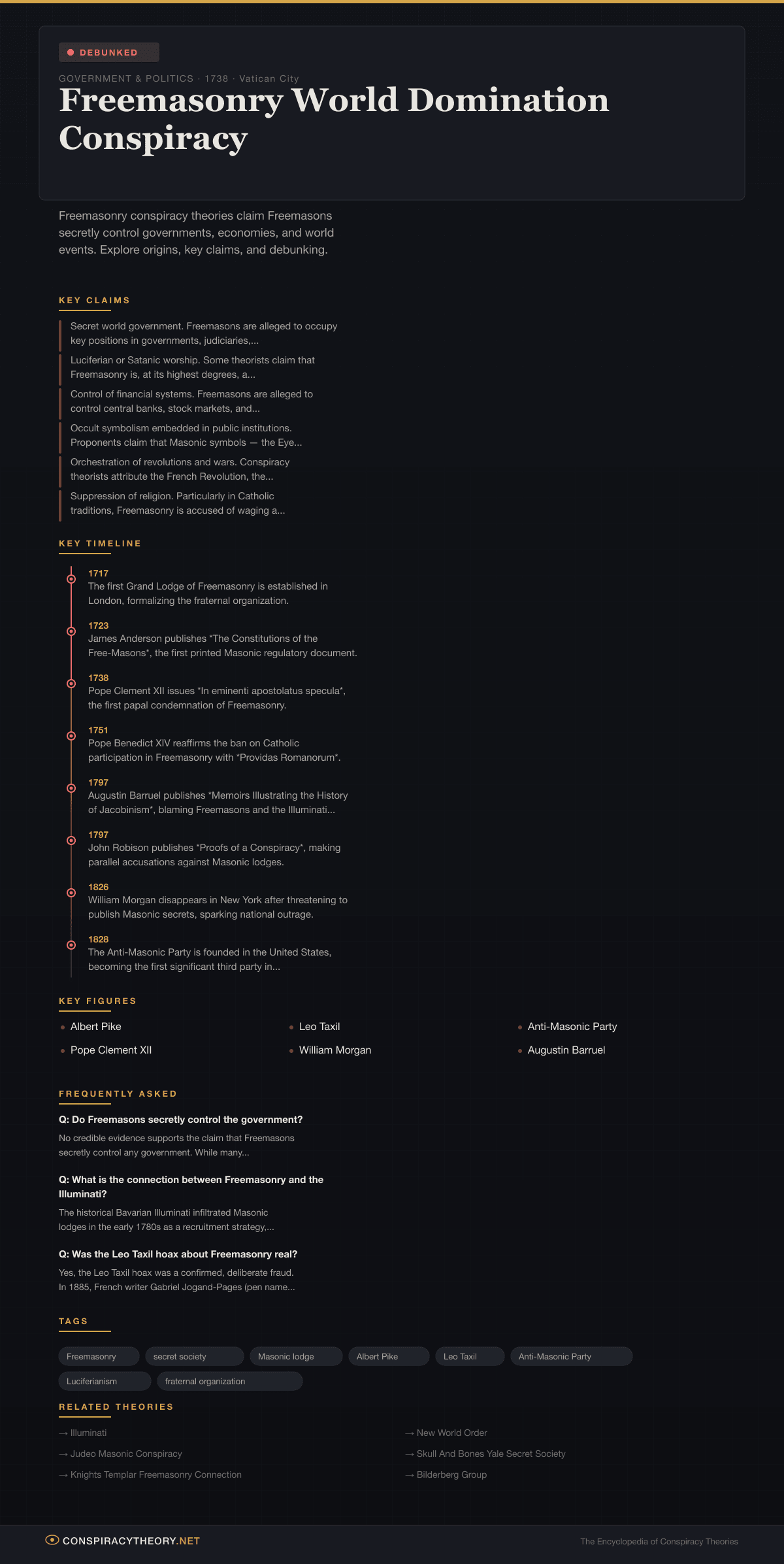
Freemasonry World Domination Conspiracy
Overview
Freemasonry conspiracy theories constitute one of the oldest and most persistent strands of conspiratorial thinking in the Western world. At their core, these theories allege that Freemasonry — the world’s largest and most widely recognized fraternal organization — is not merely a charitable brotherhood but a covert power structure that secretly controls governments, manipulates economies, orchestrates wars, and directs the course of world events from behind the scenes. In various formulations, Freemasons are accused of practicing Satanism or Luciferian worship, plotting to establish a godless world government, conspiring against organized religion, and embedding occult symbols into architecture, currency, and public institutions as markers of their hidden authority.
The reality documented by historians is considerably more prosaic. Freemasonry traces its origins to medieval stonemason guilds in Britain and evolved during the seventeenth and eighteenth centuries into a fraternal society centered on moral philosophy, charitable work, and ritual. The first Grand Lodge was established in London in 1717. By the mid-eighteenth century, lodges had spread across Europe and the American colonies, attracting members from various social classes, professions, and political backgrounds. The organization’s use of secretive initiation rituals, symbolic regalia, and hierarchical degree systems — while largely ceremonial in nature — provided ample raw material for those inclined to suspect hidden agendas.
The conspiracy theories surrounding Freemasonry have been shaped by several key episodes: the Catholic Church’s sustained opposition beginning with Pope Clement XII’s 1738 papal bull In eminenti apostolatus specula; the Morgan affair of 1826 in the United States, which gave rise to the Anti-Masonic Party; the fraudulent writings of Leo Taxil in the 1880s and 1890s; and the persistent conflation of Freemasonry with the Bavarian Illuminati. These theories are classified as debunked because the central claims — secret world domination, Luciferian worship, and coordinated control of governments — are contradicted by extensive historical, organizational, and scholarly evidence, and because several foundational anti-Masonic texts have been proven to be deliberate fabrications.
Origins & History
Catholic Opposition and Early Suspicion (1738-1800)
The first institutional opposition to Freemasonry came from the Roman Catholic Church. On April 28, 1738, Pope Clement XII issued In eminenti apostolatus specula, the first papal condemnation of Freemasonry. The bull prohibited Catholics from joining Masonic lodges under penalty of excommunication. Clement’s objections centered on the secretive nature of Masonic oaths, the intermingling of men from different religious backgrounds (including Protestants and, in some lodges, non-Christians), and the suspicion that the organization harbored objectives contrary to Church authority.
Subsequent popes reinforced and expanded this condemnation. Pope Benedict XIV reaffirmed the ban in 1751 with Providas Romanorum. Pope Leo XIII issued Humanum genus in 1884, the most detailed papal attack on Freemasonry, which characterized the fraternity as part of a broader war between the Kingdom of God and the Kingdom of Satan. Leo XIII did not merely object to Masonic secrecy; he argued that Freemasonry was actively working to undermine Christian civilization and replace it with a secular, rationalist social order.
The Church’s sustained campaign provided an institutional framework and theological justification for anti-Masonic sentiment that persisted for centuries. While the Second Vatican Council (1962-1965) softened the Church’s stance on many issues, the Congregation for the Doctrine of the Faith reaffirmed in 1983 that Catholics who join Masonic lodges remain in a state of grave sin.
The French Revolution Connection
The French Revolution (1789-1799) became a pivotal moment in the development of Freemasonry conspiracy theories. Many prominent revolutionaries, including the Marquis de Lafayette, were known Freemasons. This factual overlap was seized upon by counter-revolutionary writers who argued that the Revolution was not a spontaneous popular uprising but a carefully orchestrated plot by Masonic lodges.
The most influential of these writers was the French Jesuit priest Augustin Barruel. His four-volume Memoirs Illustrating the History of Jacobinism (1797-1798) argued that the Enlightenment philosophes, the Freemasons, and the Bavarian Illuminati had conspired together to destroy the French monarchy and the Catholic Church. Barruel’s work was widely read and translated into multiple languages. It established the enduring template of blaming Masonic conspiracies for revolutionary upheaval — a template that would be applied to subsequent revolutions in 1830, 1848, and beyond.
Scottish physicist John Robison published Proofs of a Conspiracy Against All the Religions and Governments of Europe the same year, making parallel accusations. Together, Barruel and Robison created the foundational texts of modern anti-Masonic conspiracy theory.
The Morgan Affair and American Anti-Masonry (1826-1840s)
In the United States, the pivotal event in anti-Masonic history was the disappearance of William Morgan in 1826. Morgan, a resident of Batavia, New York, announced his intention to publish a book exposing Masonic rituals and secrets. Shortly afterward, he was arrested on a minor charge, released from jail by unknown individuals, and never seen again. While his fate was never conclusively established, it was widely believed — and almost certainly true — that he was abducted and killed by Freemasons seeking to prevent publication of his expose.
The Morgan affair ignited a firestorm of anti-Masonic sentiment across the northeastern United States. Public anger led to the formation of the Anti-Masonic Party in 1828, the first notable third party in American political history. The party won governorships in Vermont and Pennsylvania, sent representatives to Congress, and held the first-ever national nominating convention in American politics in 1831. Though the party declined by the late 1830s, absorbed largely into the Whig Party, it demonstrated that anti-Masonic sentiment could be mobilized as a potent political force.
The Morgan affair also prompted numerous Masonic lodges to close or reduce their activities. Membership in American Freemasonry declined sharply during this period before gradually recovering in the mid-nineteenth century.
The Leo Taxil Hoax (1885-1897)
Perhaps no single episode has done more lasting damage to the credibility of anti-Masonic claims — while simultaneously fueling them — than the Leo Taxil hoax. Gabriel Jogand-Pages, a French writer who used the pen name Leo Taxil, was a former anticlerical activist who converted to Catholicism in 1885. Following his conversion, he launched a prolific career publishing sensationalist exposes of Freemasonry.
Taxil’s most notorious claims appeared in a series of books and pamphlets asserting that Freemasonry practiced Satanism and Luciferian worship at its highest degrees. He alleged that Albert Pike, the Sovereign Grand Commander of the Scottish Rite’s Southern Jurisdiction in the United States, presided over Satanic rituals. Taxil invented a character named Diana Vaughan, purportedly a former high-ranking female Mason who had witnessed demonic manifestations during Masonic ceremonies, and published her fabricated “confessions.”
These claims were enthusiastically received by Catholic anti-Masonic circles. Pope Leo XIII reportedly granted Taxil a private audience. Anti-Masonic publications across Europe and the Americas cited Taxil’s works as authoritative evidence.
On April 19, 1897, Taxil held a press conference at the Hall of the Geographic Society in Paris. Before a packed audience of clergy, journalists, and dignitaries, he revealed that everything — every book, every pamphlet, every word attributed to Diana Vaughan — had been a deliberate hoax. He had fabricated the entire body of work as an elaborate prank aimed at ridiculing Catholic credulity and anti-Masonic hysteria.
Despite Taxil’s public confession, his fabricated claims — particularly those concerning Albert Pike and Luciferian worship — continue to circulate in anti-Masonic literature and online communities to this day. Passages falsely attributed to Pike are regularly shared on social media as genuine evidence of Masonic Satanism.
Twentieth-Century Developments
Throughout the twentieth century, Freemasonry conspiracy theories were intertwined with broader conspiratorial narratives. The fabricated Protocols of the Elders of Zion, first published in Russia in 1903, gave rise to the “Judeo-Masonic conspiracy” theory — the claim that Jews and Freemasons were jointly conspiring to dominate the world. This theory was embraced by authoritarian regimes: Nazi Germany suppressed Freemasonry and persecuted Masons alongside Jews and other targeted groups; Francisco Franco’s regime in Spain and the Vichy government in France similarly targeted Masonic lodges.
In the postwar period, Freemasonry conspiracy theories were absorbed into the broader New World Order framework. Writers such as William Guy Carr (Pawns in the Game, 1958) and later Jim Marrs and David Icke incorporated Masonic conspiracies into grand unified theories involving the Illuminati, international banking, and shadow government.
The P2 scandal in Italy during the early 1980s provided genuine ammunition for those suspicious of Masonic power. Propaganda Due (P2) was an irregular Masonic lodge whose grandmaster, Licio Gelli, ran a secret network involving politicians, military officials, intelligence agents, and businessmen. The lodge’s exposure in 1981 revealed genuine corruption and conspiracy — though it was an aberration within Freemasonry, not representative of the organization as a whole.
Key Claims
Proponents of Freemasonry conspiracy theories advance a range of interconnected claims. While specific versions vary, the following represent the most commonly asserted:
-
Secret world government. Freemasons are alleged to occupy key positions in governments, judiciaries, military establishments, and intelligence agencies worldwide, operating as a coordinated shadow government. Proponents claim that Masonic oaths of mutual loyalty supersede oaths of public office, creating a hidden power network that serves Masonic interests above national ones.
-
Luciferian or Satanic worship. Some theorists claim that Freemasonry is, at its highest degrees, a Luciferian religion that worships Satan under the guise of fraternal philosophy. This claim derives primarily from the Leo Taxil hoax and from misreadings of Albert Pike’s Morals and Dogma (1871), in which Pike discussed Lucifer as a symbolic representation of light and knowledge — not as an object of worship.
-
Control of financial systems. Freemasons are alleged to control central banks, stock markets, and international financial institutions. This claim frequently overlaps with the separate Judeo-Masonic conspiracy theory, which attributes financial control to a joint Jewish and Masonic cabal.
-
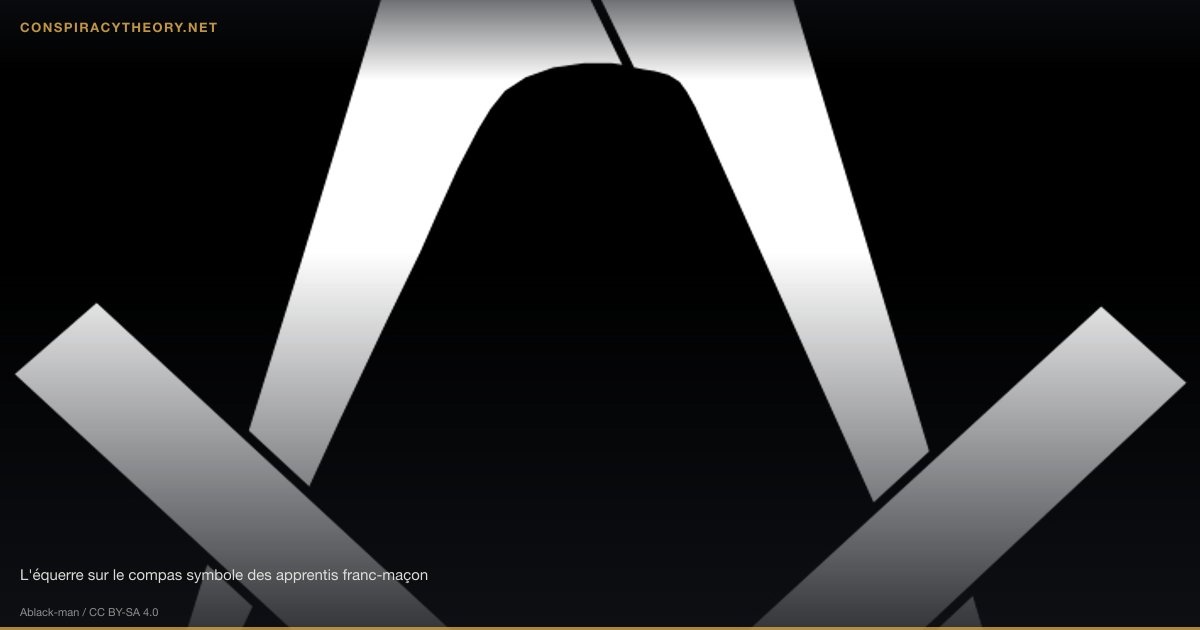
Occult symbolism embedded in public institutions. Proponents claim that Masonic symbols — the Eye of Providence, the compass and square, the pentagram, the obelisk — are deliberately incorporated into government buildings, currency, city plans, and corporate logos as markers of hidden Masonic authority. The layout of Washington, D.C., and the imagery on the U.S. one-dollar bill are the most frequently cited examples.
-
Orchestration of revolutions and wars. Conspiracy theorists attribute the French Revolution, the American Revolution, the Bolshevik Revolution, and both World Wars to Masonic planning. A widely circulated but fabricated letter purportedly from Albert Pike to Giuseppe Mazzini, allegedly outlining plans for three world wars, is frequently cited despite having no documented provenance.
-
Suppression of religion. Particularly in Catholic traditions, Freemasonry is accused of waging a systematic campaign to undermine Christianity, promote secularism, and ultimately establish an atheistic or deistic world order.
-
Mutual protection networks. A more mundane but persistent claim is that Freemasons in positions of authority — judges, police officers, politicians, business leaders — systematically favor fellow Masons, cover up one another’s misconduct, and operate a network of preferential treatment that subverts meritocracy and the rule of law.
Evidence & Debunking
What Proponents Cite
Conspiracy theorists point to several categories of evidence:
-
Historical membership of powerful figures. Fourteen U.S. presidents were Freemasons, including George Washington, James Monroe, Andrew Jackson, Theodore Roosevelt, Franklin D. Roosevelt, Harry S. Truman, and Gerald Ford. Kings, prime ministers, generals, and captains of industry across Europe and the Americas have been lodge members. Proponents interpret this as evidence of a coordinated Masonic power structure.
-
Masonic secrecy. The use of secret handshakes, passwords, initiation rituals, and oaths of confidentiality is cited as evidence that the organization has something significant to hide.
-
Symbolic presence. The Eye of Providence on the U.S. Great Seal (adopted in 1782 and appearing on the dollar bill since 1935), the Masonic cornerstone-laying ceremonies for prominent government buildings, and alleged geometric patterns in the street layout of Washington, D.C., are presented as proof of Masonic influence over the founding and governance of the United States.
-
The P2 scandal. The exposure of the P2 lodge in Italy in 1981 is cited as proof that Masonic lodges do engage in genuine political conspiracies.
-
Fabricated documents. The Pike-Mazzini letter, Taxil’s writings, and various other fabricated or misattributed texts continue to circulate as evidence.
Why the Theory Is Debunked
The central claims of Freemasonry conspiracy theories are contradicted by historical evidence, scholarly research, and fundamental logic:
-
Membership does not equal conspiracy. The fact that powerful individuals belonged to Masonic lodges does not demonstrate coordinated action. Freemasonry in the eighteenth and nineteenth centuries functioned much as modern social clubs, professional associations, and civic organizations do — as networking venues. Members held wildly divergent political views; Masonic lodges included both American revolutionaries and British loyalists, both Union and Confederate officers during the Civil War.
-
Freemasonry is extensively documented. Masonic rituals, constitutions, organizational structures, and histories have been published and studied by both members and outsiders for centuries. James Anderson’s Constitutions of the Free-Masons was published in 1723. The “secrets” of Masonic ritual have been publicly available in print for nearly three hundred years.
-
The Taxil hoax discredits key claims. The most dramatic allegations against Freemasonry — Satanic worship, Luciferian ritual, demonic manifestations — originated with a confessed fraudster. Taxil publicly admitted he fabricated everything. Continuing to cite his claims as evidence requires ignoring his documented confession.
-
The Pike-Mazzini letter is fabricated. No original document or contemporaneous copy of the alleged Pike letter outlining three world wars has ever been produced. The letter first appeared in the writings of William Guy Carr in 1958, who cited a source that did not contain the claimed text. Historians classify it as a twentieth-century fabrication.
-
Freemasonry has declined, not expanded. If Freemasonry were a vehicle for world domination, one would expect its membership to grow. In fact, global Masonic membership has declined dramatically since its mid-twentieth-century peak. In the United States, membership fell from approximately four million in the 1950s to under one million by the 2020s. Most lodges struggle with aging membership and declining recruitment.
-
Internal diversity contradicts unified agenda. Freemasonry encompasses hundreds of independent Grand Lodges worldwide, many of which do not recognize one another. The United Grand Lodge of England does not recognize the Grand Orient de France. American Grand Lodges historically excluded Black men, leading to the creation of parallel Prince Hall lodges. An organization this fragmented and internally divided cannot plausibly operate as a unified global conspiracy.
-
The P2 scandal was the exception, not the rule. The P2 lodge was expelled from the Grand Orient of Italy in 1976, five years before the scandal became public, precisely because it violated Masonic norms. Italian Freemasonry and the Italian government both condemned P2’s activities. Citing P2 as representative of Freemasonry is comparable to citing a rogue corporate subsidiary as representative of all corporations.
Cultural Impact
Freemasonry conspiracy theories have exerted substantial influence on politics, religion, literature, and popular culture across several centuries.
Political Consequences
Anti-Masonic sentiment has been a political force in numerous countries. The Anti-Masonic Party in the United States (1828-1838) demonstrated that suspicion of secret societies could be channeled into organized political action. In Europe, authoritarian regimes of both the far right and far left suppressed Masonic lodges: the Nazi regime banned Freemasonry in 1935 and sent an estimated 80,000 to 200,000 Masons to concentration camps; the Soviet Union and its satellite states likewise prohibited the organization; Franco’s Spain, Mussolini’s Italy, and Vichy France all persecuted Masons.
In the Islamic world, anti-Masonic sentiment remains widespread. Several Muslim-majority countries ban Freemasonry outright, and the claim that Freemasonry is a vehicle for Zionism and Western imperialism is a common theme in Middle Eastern political discourse. Hamas’s 1988 charter explicitly names Freemasonry (alongside Rotary Clubs and Lions Clubs) as part of an alleged Zionist conspiracy.
Religious Discourse
The Catholic Church’s centuries-long opposition to Freemasonry has profoundly shaped both Catholic identity and anti-Masonic rhetoric. Evangelical Protestant churches, particularly in the American South, have also maintained strong anti-Masonic traditions, with some denominations requiring members to renounce Masonic affiliation. These religious objections — grounded in concerns about secret oaths, syncretistic ritual, and perceived competition with church authority — have provided theological legitimacy to more extreme conspiratorial claims.
Literature and Popular Culture
Freemasonry has been a rich subject for fiction and popular entertainment. Dan Brown’s The Lost Symbol (2009) centers on Masonic history and symbols in Washington, D.C. Umberto Eco’s Foucault’s Pendulum (1988) satirizes conspiracy theories involving Templars, Freemasons, and other secret societies. Leo Tolstoy explored Freemasonry through the character of Pierre Bezukhov in War and Peace (1869). Films such as From Hell (2001), National Treasure (2004), and The Man Who Would Be King (1975) draw on Masonic themes. Video game franchises including Assassin’s Creed incorporate Masonic elements into their fictional narratives.
The pervasiveness of Freemasonry in popular culture has created a feedback loop: fictional portrayals inspire conspiratorial beliefs, which in turn generate demand for more fiction exploring Masonic mysteries.
Impact on Freemasonry Itself
Conspiracy theories have measurably affected the fraternity. Lodges have faced vandalism, arson, and threats. Members in some countries face social stigma or professional consequences. The persistent association of Freemasonry with sinister agendas has contributed to membership decline, as potential recruits are deterred by public suspicion. In response, many Grand Lodges have adopted more transparent public communications strategies, opened their buildings to public tours, and actively engaged with media to counter misinformation.
Timeline
- 1717 — The first Grand Lodge of Freemasonry is established in London, formalizing the fraternal organization.
- 1723 — James Anderson publishes The Constitutions of the Free-Masons, the first printed Masonic regulatory document.
- 1738 — Pope Clement XII issues In eminenti apostolatus specula, the first papal condemnation of Freemasonry.
- 1751 — Pope Benedict XIV reaffirms the ban on Catholic participation in Freemasonry with Providas Romanorum.
- 1797 — Augustin Barruel publishes Memoirs Illustrating the History of Jacobinism, blaming Freemasons and the Illuminati for the French Revolution.
- 1797 — John Robison publishes Proofs of a Conspiracy, making parallel accusations against Masonic lodges.
- 1826 — William Morgan disappears in New York after threatening to publish Masonic secrets, sparking national outrage.
- 1828 — The Anti-Masonic Party is founded in the United States, becoming the first significant third party in American politics.
- 1871 — Albert Pike publishes Morals and Dogma of the Ancient and Accepted Scottish Rite of Freemasonry, later misquoted by conspiracy theorists as evidence of Luciferian worship.
- 1884 — Pope Leo XIII issues Humanum genus, the most detailed papal attack on Freemasonry, characterizing it as part of the “kingdom of Satan.”
- 1885 — Leo Taxil begins publishing fabricated claims that Freemasonry practices Satanism and Luciferian ritual.
- 1897 — Taxil publicly confesses that his entire body of anti-Masonic work was a deliberate hoax.
- 1903 — The fabricated Protocols of the Elders of Zion is published, giving rise to the “Judeo-Masonic conspiracy” theory.
- 1935 — Nazi Germany bans Freemasonry; persecution of Masons intensifies across fascist Europe.
- 1958 — William Guy Carr publishes Pawns in the Game, popularizing the fabricated Pike-Mazzini letter.
- 1976 — The Propaganda Due (P2) lodge in Italy is expelled from the Grand Orient of Italy for irregular activities.
- 1981 — The P2 scandal becomes public, revealing Licio Gelli’s secret network of politicians, military officials, and intelligence agents.
- 1983 — The Vatican’s Congregation for the Doctrine of the Faith reaffirms that Catholic membership in Masonic lodges constitutes grave sin.
- 2004 — National Treasure brings Masonic treasure-hunt mythology to a mass audience.
- 2009 — Dan Brown publishes The Lost Symbol, centering on Masonic history in Washington, D.C.
- 2010s-2020s — Anti-Masonic claims proliferate on social media platforms, often recycling Taxil-era fabrications and the fraudulent Pike-Mazzini letter.
Sources & Further Reading
- Barruel, Augustin. Memoirs Illustrating the History of Jacobinism. 4 vols. London, 1797-1798.
- Bullock, Steven C. Revolutionary Brotherhood: Freemasonry and the Transformation of the American Social Order, 1730-1840. University of North Carolina Press, 1996.
- Dickie, John. The Craft: How the Freemasons Made the Modern World. PublicAffairs, 2020.
- Harwood-Smart, Cathy. “The Leo Taxil Hoax: A Study in Anti-Masonic Deception.” Ars Quatuor Coronatorum 127 (2014).
- Jacob, Margaret C. The Origins of Freemasonry: Facts and Fictions. University of Pennsylvania Press, 2006.
- Jacob, Margaret C. Living the Enlightenment: Freemasonry and Politics in Eighteenth-Century Europe. Oxford University Press, 1991.
- Jasper, William F. The United Nations Exposed. John Birch Society, 2001. (Primary source for anti-Masonic claims.)
- Katz, Jacob. Jews and Freemasons in Europe, 1723-1939. Harvard University Press, 1970.
- Knight, Stephen. The Brotherhood: The Explosive Expose of the Secret World of the Freemasons. Grafton Books, 1984.
- Morris, S. Brent. The Complete Idiot’s Guide to Freemasonry. Alpha Books, 2006.
- Ode, A. M. “Secret Societies and Social Panic: The Morgan Affair Revisited.” Journal of the Early Republic 15, no. 4 (1995).
- Pike, Albert. Morals and Dogma of the Ancient and Accepted Scottish Rite of Freemasonry. Charleston, 1871. (Primary source, frequently misquoted.)
- Pipes, Daniel. Conspiracy: How the Paranoid Style Flourishes and Where It Comes From. Free Press, 1997.
- Ridley, Jasper. The Freemasons: A History of the World’s Most Powerful Secret Society. Arcade Publishing, 2001.
- Robison, John. Proofs of a Conspiracy Against All the Religions and Governments of Europe. Edinburgh, 1797.
- Stevenson, David. The Origins of Freemasonry: Scotland’s Century, 1590-1710. Cambridge University Press, 1988.

Frequently Asked Questions
Do Freemasons secretly control the government?
What is the connection between Freemasonry and the Illuminati?
Was the Leo Taxil hoax about Freemasonry real?
Infographic
Share this visual summary. Right-click to save.