The Fruit of the Loom Cornucopia

Overview
If you had to pick one example of the Mandela Effect that most stubbornly resists debunking — not because the evidence is ambiguous, but because the false memory is so vivid and so specific and shared by so many people that it feels genuinely wrong to call it false — it would probably be this one.
The Fruit of the Loom logo features a cluster of fruit: an apple, green grapes, purple grapes, and currants, arranged as a still-life grouping. That’s it. That’s the logo. Fruit. No background element, no framing device, no decorative basket.
But ask people to describe it and a remarkable number of them will add a detail that isn’t there and has never been there: a brown cornucopia — a horn of plenty — curving behind or beneath the fruit arrangement. They don’t vaguely recall “something behind the fruit.” They specifically remember a cornucopia. They can describe its shape, its color, its position relative to the fruit. Some people will draw it from memory, and their drawings look almost identical to each other.
There has never been a cornucopia in the Fruit of the Loom logo. The company has confirmed this. Former designers have confirmed this. Every archived version of the logo confirms this. And yet the false memory persists with a ferocity that makes the Berenstain Bears spelling look like a minor misunderstanding.
The Logo’s Actual History
Fruit of the Loom was founded in 1851 in Warwick, Rhode Island. The fruit logo has been a part of the brand’s identity for over a century, though it has undergone several redesigns. Early versions featured a more painterly arrangement of fruit; modern versions are sleeker and more stylized. In 2020, the company simplified the logo further, reducing the fruit to minimal graphic elements.
Across every version — Victorian-era woodcut, mid-century illustration, 1980s redesign, modern minimalism — the composition is the same: fruit arranged together, no cornucopia. The design has always been about the fruit itself, not about any container or framework holding the fruit.
In the late 2010s, when the cornucopia debate reached peak intensity online, Fruit of the Loom’s official social media accounts acknowledged the phenomenon. The company didn’t treat it as a PR crisis; they treated it as a curiosity. Their responses were playful — because what do you do when millions of customers are confident they remember your logo differently than it’s ever actually looked?
The Frank Wess Filing
The most intriguing piece of circumstantial evidence in the cornucopia debate comes from a 1973 trademark application. Filed by a designer named Frank Wess, the application included a visual description that mentioned “a cornucopia” alongside fruit imagery. This filing was not for Fruit of the Loom — it appears to have been for an unrelated brand concept — but its existence has been seized upon by Mandela Effect researchers as a potential “residue” from the original timeline.
A more measured interpretation: the 1973 filing demonstrates that fruit-and-cornucopia imagery was a common design motif of the era. Thanksgiving decorations, clip art, greeting cards, and grocery store displays all paired fruit with cornucopias throughout the mid-20th century. The association between “arranged fruit” and “cornucopia” was deeply embedded in American visual culture. It would be strange if people didn’t mentally add a cornucopia to a logo that was essentially a Thanksgiving centerpiece minus the horn.
Why This One Hits Different
The Fruit of the Loom cornucopia is considered the strongest Mandela Effect example for several reasons that distinguish it from other cases.
First, the specificity. With the Berenstain Bears, people substitute one letter for another — a plausible phonetic error. With the Monopoly Man’s monocle, people add an accessory associated with the character archetype. These are understandable cognitive shortcuts. But a cornucopia isn’t a generic element. It’s a specific, unusual object — a curved horn overflowing with harvest bounty — that people independently place behind the fruit in the same position and with the same proportions. That convergence is harder to hand-wave.
Second, the emotional certainty. People who misremember the Berenstain spelling usually concede fairly quickly when shown the evidence. People who remember the cornucopia often refuse to accept its absence even when looking directly at the logo. The memory feels too detailed, too specific, too real to be wrong.
Third, the demographics. This isn’t a memory confined to a particular age group or region. People across generations, from baby boomers who wore Fruit of the Loom underwear in the 1970s to millennials who encountered the brand in the 1990s, report the same false memory. Whatever is creating this error, it’s been doing it consistently for decades.
The Cognitive Explanation
Schema theory provides the most robust explanation. A “schema” is a mental framework that helps the brain organize and interpret information. Americans have an extremely strong schema linking fruit arrangements to cornucopias — Thanksgiving imagery has drilled this association into the culture since childhood. When the brain encounters a logo that looks like a fruit arrangement, the cornucopia schema activates and inserts the missing element.
This is exactly the kind of error that Deepak Prasad and Wilma Bainbridge’s 2022 University of Chicago study was designed to investigate. Their research confirmed that Mandela Effect errors aren’t random — people converge on the same “wrong” version because they’re all running the same cognitive software, with the same schemas, producing the same predictable errors.
The cornucopia case is the schema effect at its most powerful, because the association between fruit-still-life and cornucopia isn’t subtle or obscure. It’s one of the most deeply ingrained visual associations in American culture. Your brain isn’t making a mistake; it’s making a prediction based on a lifetime of correlated visual data. It’s just that, in this one case, the prediction is wrong.
Timeline
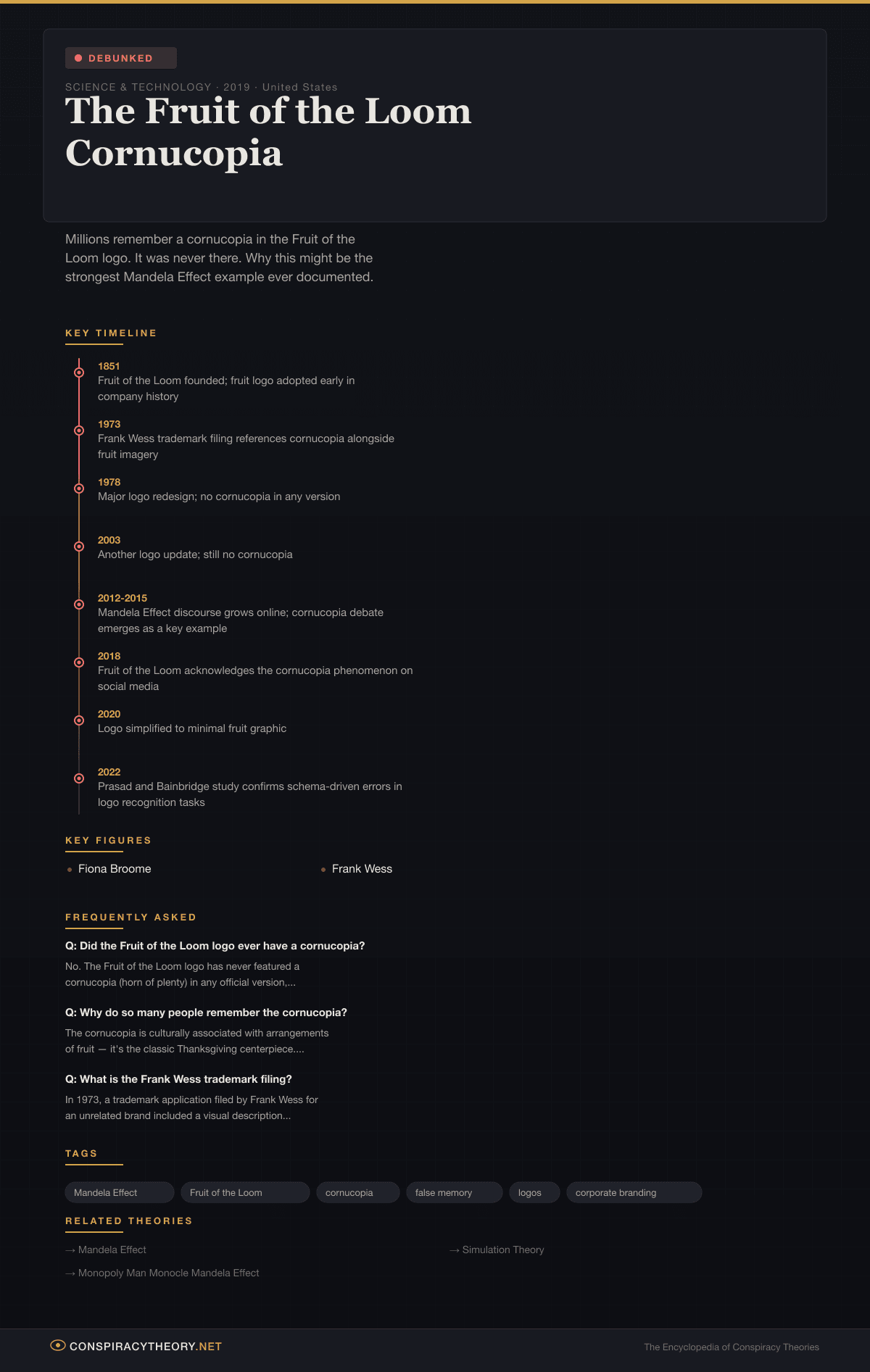
- 1851 — Fruit of the Loom founded; fruit logo adopted early in company history
- 1973 — Frank Wess trademark filing references cornucopia alongside fruit imagery
- 1978 — Major logo redesign; no cornucopia in any version
- 2003 — Another logo update; still no cornucopia
- 2012-2015 — Mandela Effect discourse grows online; cornucopia debate emerges as a key example
- 2018 — Fruit of the Loom acknowledges the cornucopia phenomenon on social media
- 2020 — Logo simplified to minimal fruit graphic
- 2022 — Prasad and Bainbridge study confirms schema-driven errors in logo recognition tasks
Sources & Further Reading
- Prasad, Deepak and Wilma Bainbridge. “The Visual Mandela Effect as Evidence for Shared and Specific False Memories.” Psychological Science 33, no. 12 (2022)
- Fruit of the Loom brand history archives
- French, Christopher C. “The Mandela Effect and New Findings in False Memory Research.” The Skeptic, 2019
- Loftus, Elizabeth F. “Planting Misinformation in the Human Mind.” Learning & Memory 12, no. 4 (2005)
Frequently Asked Questions
Did the Fruit of the Loom logo ever have a cornucopia?
Why do so many people remember the cornucopia?
What is the Frank Wess trademark filing?
Infographic
Share this visual summary. Right-click to save.