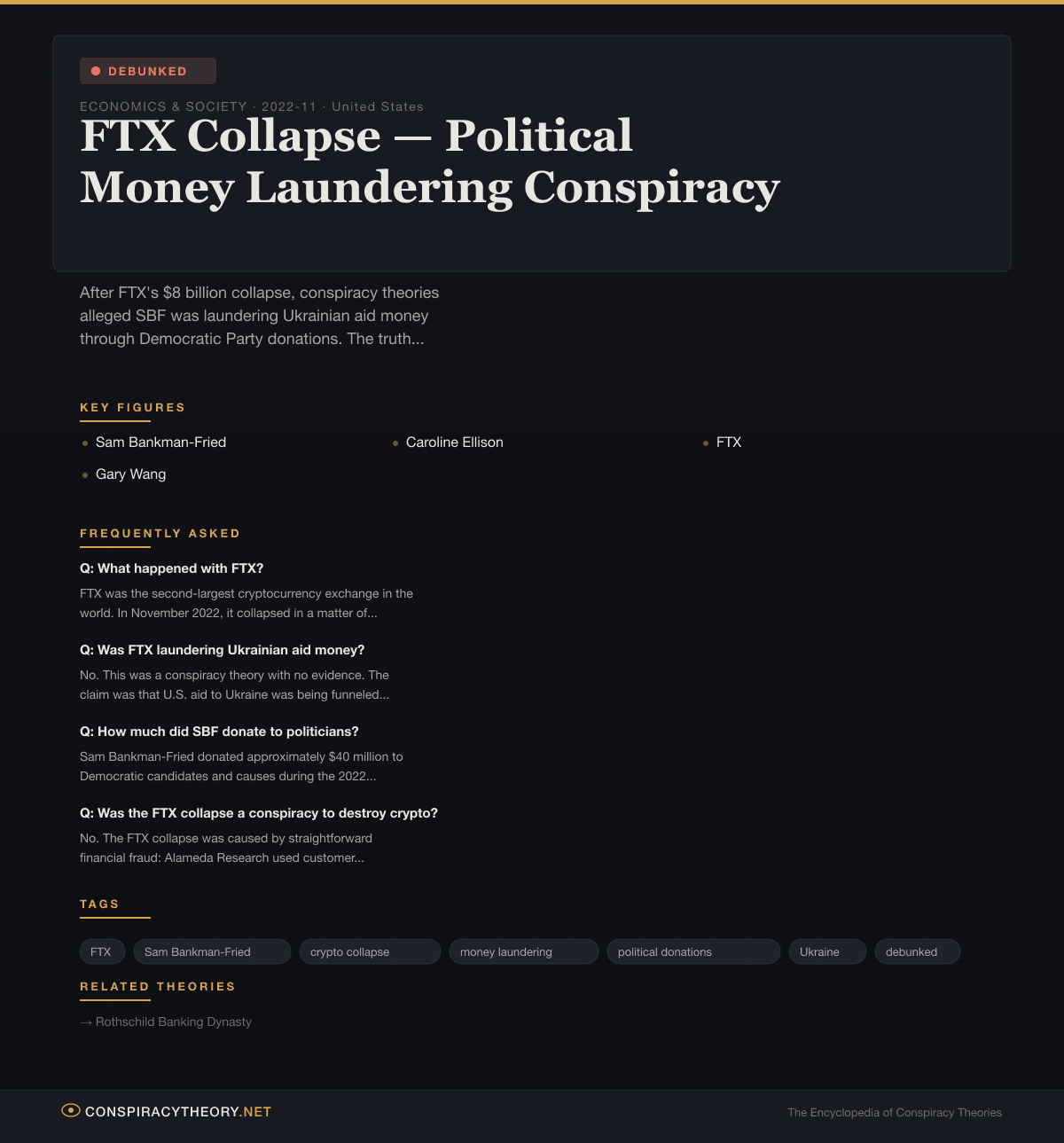
FTX Collapse — Political Money Laundering Conspiracy
Overview
When FTX collapsed in November 2022, the cryptocurrency world experienced its Lehman Brothers moment. The second-largest crypto exchange in the world — valued at $32 billion just months earlier, endorsed by Tom Brady, Larry David, and the Miami Heat — disintegrated in approximately 72 hours. Eight billion dollars in customer funds vanished. Sam Bankman-Fried, the founder, went from being the future of American philanthropy to being a defendant in one of the largest fraud cases in American history.
That was the story. But within hours of FTX’s collapse, a parallel narrative emerged — one that had nothing to do with financial fraud and everything to do with the conspiracy theory ecosystem’s ability to absorb any major event into its existing framework.
The conspiracy theory: SBF wasn’t running a fraud. He was running a money-laundering operation. Specifically, U.S. aid to Ukraine was being secretly funneled through FTX and converted into political donations to the Democratic Party. The crypto exchange was a political slush fund. The collapse wasn’t a fraud — it was either an accident that exposed the scheme or a deliberate takedown by forces who wanted to stop it.
This theory was false in every particular. But it combined several potent ingredients — Ukraine skepticism, Democratic Party distrust, crypto paranoia, and the genuine weirdness of Bankman-Fried’s political spending — into a narrative that spread across social media with remarkable speed.
What Actually Happened
The Fraud
The actual story of FTX’s collapse is less exotic than the conspiracy theory but considerably more criminal. Sam Bankman-Fried — a 30-year-old MIT graduate with a mess of curly hair and a calculated image of nerdy altruism — had built FTX into a crypto giant by 2021. He was featured on the covers of magazines. He testified before Congress. He was the poster child for “effective altruism,” the philosophical movement that advocated earning as much money as possible in order to give it away.
Behind the public image, FTX was operating without basic financial controls. Customer deposits were being transferred to Alameda Research, FTX’s affiliated trading firm run by SBF’s ex-girlfriend Caroline Ellison. Alameda used the money for speculative trades, venture investments, political donations, real estate purchases, and personal expenses. There was no independent board of directors, no functioning accounting department, and no separation between customer funds and company assets.
When the crypto market declined and Alameda’s trades turned sour, there was no money to cover customer withdrawals. CoinDesk’s November 2, 2022 report on Alameda’s balance sheet — which showed the firm was heavily dependent on FTT, FTX’s own token — triggered a bank run. Within days, FTX halted withdrawals, filed for bankruptcy, and revealed an $8 billion hole where customer money should have been.
The Donations
The conspiracy theory latched onto a real fact: SBF was an enormous political donor. He gave approximately $40 million to Democratic candidates and organizations during the 2022 cycle, plus about $5 million to Republicans (a fact conspiracy theorists usually omitted). He was the second-largest individual donor to the Democratic Party that cycle.
The donations were legal but funded by illegal means — SBF was spending money that belonged to FTX customers. When this became clear, Democratic politicians who had received his donations were placed in an awkward position. Many pledged to return or donate the funds.
The conspiracy theory transformed these donations from evidence of a fraudster buying political access (the prosaic reality) into evidence of a money-laundering operation (the exciting fiction).
The Ukraine Connection
The Ukraine element was the conspiracy theory’s most creative — and most baseless — addition. The claim: the Biden administration was sending billions in aid to Ukraine. Ukraine was investing that money in FTX. FTX was converting it to political donations to Democrats. The loop was complete: taxpayer money went to Ukraine, came back through FTX, and ended up in Democratic campaign accounts.
The problems with this theory are numerous:
-
U.S. military aid to Ukraine was primarily weapons and equipment, not cash. The Biden administration sent Javelin missiles, HIMARS rocket systems, and ammunition from existing U.S. military stockpiles. You can’t deposit a Javelin missile at a cryptocurrency exchange.
-
The smaller amount of direct financial aid went to the Ukrainian government for operational expenses and was subject to standard oversight and accounting requirements.
-
FTX did facilitate Ukrainian cryptocurrency donations early in the war, when the Ukrainian government solicited crypto donations from global supporters. This was a legitimate service, publicly announced, and involved private donations from individuals — not U.S. government aid.
-
The timeline doesn’t work. SBF’s major political donations occurred before the bulk of Ukraine aid was authorized. The political spending preceded and was independent of the Ukraine conflict.
-
No evidence has ever been produced showing any connection between U.S. Ukraine aid and FTX. Not an email, not a financial record, not a witness statement. The theory was pure inference based on the coincidence that SBF donated to Democrats and Ukraine received U.S. aid.
The Trial
November 2023
Sam Bankman-Fried was tried in the Southern District of New York in November 2023. The trial lasted approximately one month. The evidence presented was voluminous and devastating: internal records, communications, testimony from cooperating witnesses (including Caroline Ellison and Gary Wang, FTX’s co-founder, both of whom pleaded guilty and testified against SBF).
The evidence showed straightforward financial fraud — customer money was taken and spent. There was no evidence of political money laundering, no evidence of Ukrainian aid recycling, and no evidence of a conspiracy beyond the fraud itself.
SBF was convicted on all seven counts: wire fraud (two counts), securities fraud, commodities fraud, and three counts of conspiracy. In March 2024, he was sentenced to 25 years in federal prison.
The conspiracy theory was not addressed at trial because it was not relevant — it was fiction.
Why the Theory Spread
The Perfect Storm of Distrust
The FTX conspiracy theory succeeded because it connected pre-existing narratives:
- Ukraine skepticism: A significant portion of the American right opposed aid to Ukraine and was primed to believe that the money was being misused
- Democratic Party distrust: SBF’s massive donations to Democrats made him a convenient villain for conservative media
- Crypto suspicion: The opacity of cryptocurrency markets made it easy to imagine hidden financial flows that couldn’t be traced
- Elite distrust: SBF’s connections to Washington — his parents’ Stanford affiliations, his Congressional testimony, his meetings with regulators — fit the narrative of corrupt elite networks
The theory also benefited from timing. It emerged during the 2022 midterm election season, when partisan tensions were high and any story connecting Democrats to financial misconduct was amplified aggressively.
The Information Laundering
The theory’s spread followed a familiar pattern: originating on anonymous social media accounts, amplified by mid-tier conspiracy influencers, and eventually referenced by elected officials and mainstream media outlets (usually in the form of “some people are asking” coverage). By the time fact-checkers addressed the claims, millions of people had already absorbed them.
Timeline
| Date | Event |
|---|---|
| 2019 | FTX founded by Sam Bankman-Fried |
| 2021 | FTX valued at $32 billion; SBF becomes major political donor |
| Feb 2022 | Russia invades Ukraine; FTX facilitates Ukrainian crypto donations |
| 2022 | SBF donates ~$40M to Democrats, ~$5M to Republicans |
| Nov 2, 2022 | CoinDesk reports on Alameda’s balance sheet |
| Nov 6, 2022 | Binance CEO announces plan to sell FTT holdings; bank run begins |
| Nov 8, 2022 | FTX halts withdrawals |
| Nov 11, 2022 | FTX files for bankruptcy; Ukraine money laundering theory emerges |
| Dec 12, 2022 | SBF arrested in the Bahamas |
| Nov 2023 | SBF convicted on all seven counts |
| March 2024 | SBF sentenced to 25 years in prison |
Sources & Further Reading
- Lewis, Michael. Going Infinite: The Rise and Fall of a New Tycoon. W.W. Norton, 2023.
- United States v. Bankman-Fried, S.D.N.Y., Criminal Case No. 22-cr-673 (2023).
- FTX Debtors. First Interim Report of John J. Ray III, Chapter 11 Trustee, April 2023.
- Zeke Faux. “The Bizarre Rise and Catastrophic Fall of Sam Bankman-Fried.” Bloomberg, December 2022.
- Allison, Ian. “Divisions in Sam Bankman-Fried’s Crypto Empire Blur on His Trading Titan Alameda’s Balance Sheet.” CoinDesk, November 2, 2022.
Related Theories
- Crypto/Rothschild Theory — Conspiracy theories about cryptocurrency manipulation
Frequently Asked Questions
What happened with FTX?
Was FTX laundering Ukrainian aid money?
How much did SBF donate to politicians?
Was the FTX collapse a conspiracy to destroy crypto?
Infographic
Share this visual summary. Right-click to save.