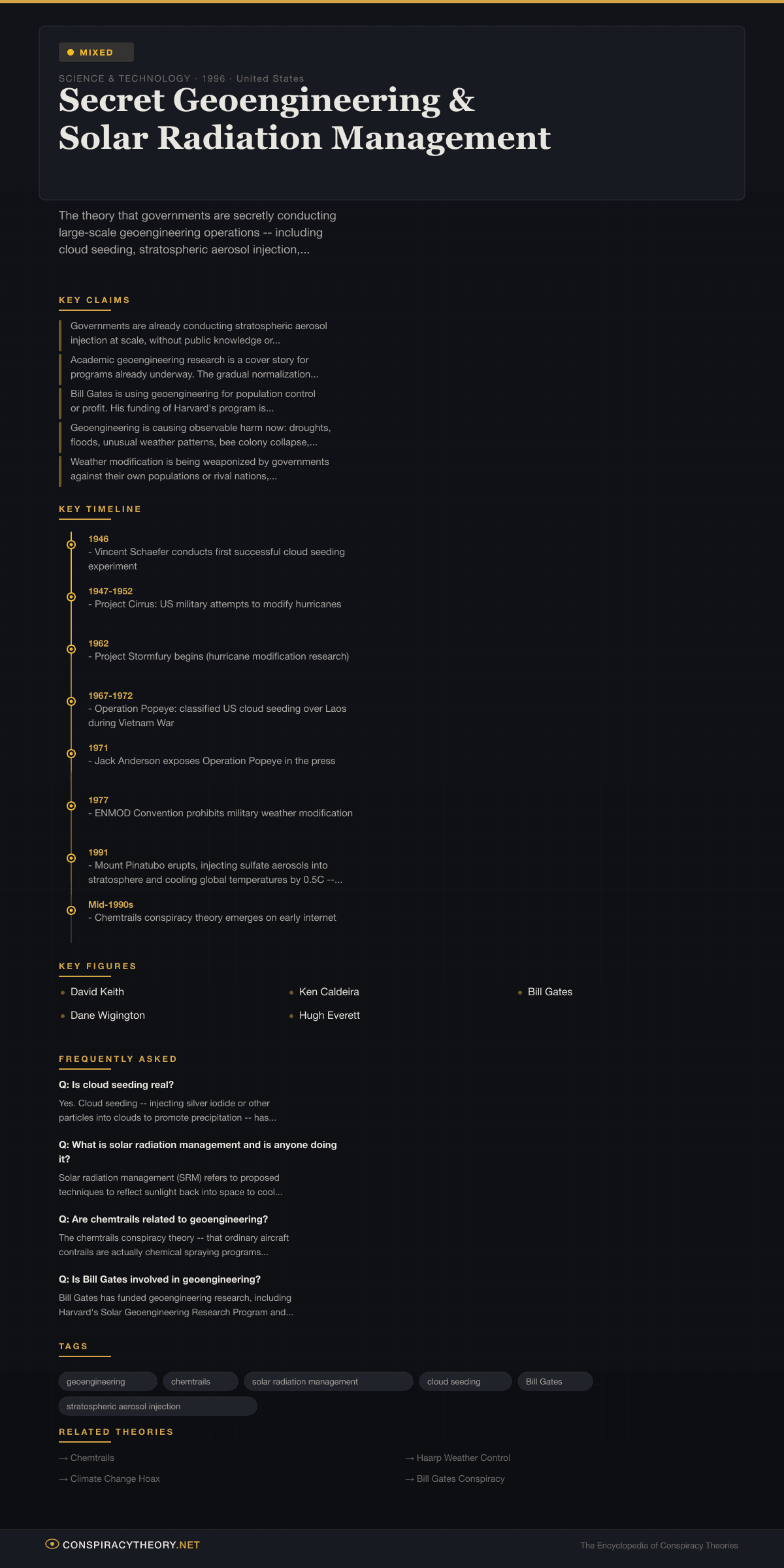
Secret Geoengineering & Solar Radiation Management
Overview
Here is a sentence that sounds like a conspiracy theory but is entirely true: the governments of the United States, China, Russia, the United Arab Emirates, and dozens of other countries routinely fly aircraft that spray chemical substances into the atmosphere to alter weather patterns. The practice is called cloud seeding, it has been operational since 1947, and it is so mundane that the State of Wyoming has a dedicated cloud seeding program run out of its Water Development Office. No one is hiding it. It is, frankly, boring.
Here is a sentence that sounds reasonable but is not (yet) true: governments are secretly spraying reflective aerosol particles into the stratosphere to manipulate global temperatures without public knowledge or consent.
The geoengineering conspiracy occupies the maddening space between these two sentences — a space where real science, real proposals, real government programs, and real billionaire funding collide with paranoid extrapolation, genuine policy concerns about consent and governance, and the venerable chemtrails conspiracy theory that has haunted contrail-phobic observers since the mid-1990s. It is classified as “mixed” because the underlying technologies are real, some are deployed, and the governance questions are genuinely alarming, even though the claim of secret large-scale deployment is not supported by evidence.
Origins & History
Weather Modification: The Real History
The story of deliberate weather modification begins on November 13, 1946, when General Electric researcher Vincent Schaefer flew over Mount Greylock in Massachusetts and dumped six pounds of dry ice into a cloud. Within minutes, the cloud began producing snow. It was the first successful cloud seeding experiment, and it launched decades of increasingly ambitious attempts to control the weather.
By the 1950s, the US military was deeply invested. Project Cirrus (1947-1952) attempted to modify hurricanes by seeding them with dry ice. The results were ambiguous, but the ambition was not: the military saw weather control as a strategic capability. This vision reached its operational peak during the Vietnam War with Operation Popeye (1967-1972), a classified cloud seeding program that sought to extend the monsoon season over the Ho Chi Minh Trail, making roads impassable. The operation seeded clouds with silver iodide over Laos and was successful enough to extend the monsoon by an estimated 30-45 days per year.
When Operation Popeye was exposed by journalist Jack Anderson in 1971, the public backlash contributed to the 1977 Environmental Modification Convention (ENMOD), which prohibited the military use of weather modification. But civilian and commercial weather modification continued openly. Today, China operates the world’s largest weather modification program, employing more than 35,000 people and spending hundreds of millions annually. The UAE’s Rain Enhancement Program uses drones and ground-based generators to seed clouds. In the United States, eight states maintain active weather modification programs, primarily for water resource management and hail suppression.
None of this is secret. None of this is controversial in the scientific community. And yet, the fact that governments have been actively modifying weather for 80 years is the legitimate foundation upon which conspiracy theories about secret geoengineering are built.
From Chemtrails to Geoengineering
The chemtrails conspiracy theory emerged in the mid-1990s, claiming that the persistent white trails left by high-altitude aircraft were not water vapor condensation (contrails) but chemical agents being deliberately sprayed for purposes ranging from population control to mind alteration to weather modification. The theory has been thoroughly debunked by atmospheric scientists — contrail persistence is determined by humidity, temperature, and altitude, and their increasing prevalence correlates with increased air traffic, not secret programs.
But something interesting happened in the 2000s and 2010s: legitimate scientists began publicly discussing geoengineering proposals that sounded remarkably similar to what chemtrails believers had been alleging for years. Stratospheric aerosol injection (SAI) — the proposal to spray reflective sulfate particles into the upper atmosphere to reflect sunlight and cool the planet — involves, in its most discussed implementation, aircraft spraying substances into the sky. The irony was not lost on anyone.
The Academic Turn
The modern geoengineering discussion gained scientific respectability primarily through the work of two atmospheric scientists: Ken Caldeira (then at Stanford’s Carnegie Institution) and David Keith (then at the University of Calgary, later at Harvard). In a influential 2000 paper, Caldeira modeled the effects of stratospheric sulfate aerosol injection and found it could potentially offset significant warming. Keith became the field’s most visible advocate, arguing that SRM research was a moral imperative given the pace of climate change.
In 2009, the Royal Society published a landmark report, Geoengineering the Climate: Science, Governance and Uncertainty, which distinguished between carbon dioxide removal (CDR) techniques and solar radiation management (SRM) techniques and called for a serious research program. The National Academies of Sciences followed with similar reports in 2015 and 2021.
The most contentious development was Harvard’s Solar Geoengineering Research Program and its associated SCoPEx experiment (Stratospheric Controlled Perturbation Experiment), which proposed releasing a small amount of calcium carbonate particles from a high-altitude balloon in northern Sweden to study stratospheric aerosol behavior. The project was partially funded by Bill Gates, which predictably sent conspiracy communities into overdrive. The Swedish Space Corporation canceled the balloon test in 2021 after opposition from environmental groups and the indigenous Sami people, and the SCoPEx advisory committee was dissolved in 2024.
Key Claims
The geoengineering conspiracy theory (as distinct from legitimate policy debate) makes several claims of escalating implausibility:
-
Governments are already conducting stratospheric aerosol injection at scale, without public knowledge or consent. The visible trails behind aircraft are evidence of this program. (This is the chemtrails theory rebranded as geoengineering, and it is not supported by evidence.)
-
Academic geoengineering research is a cover story for programs already underway. The gradual normalization of geoengineering in public discourse is preparation for revealing what has been happening for decades. (The “limited hangout” theory.)
-
Bill Gates is using geoengineering for population control or profit. His funding of Harvard’s program is presented as part of a broader agenda, often linked to his support for vaccination programs and agricultural technology.
-
Geoengineering is causing observable harm now: droughts, floods, unusual weather patterns, bee colony collapse, and health problems are attributed to ongoing secret spraying programs. Dane Wigington’s website GeoengineeringWatch.org is the most prominent platform for these claims.
-
Weather modification is being weaponized by governments against their own populations or rival nations, extending HAARP and Operation Popeye capabilities far beyond what has been publicly acknowledged.
Evidence
What Is Real
The evidence in this case is a layered affair — each layer real, but with conspiracy theorists jumping from legitimate facts to unsupported conclusions:
Cloud seeding is real, operational, and widespread. This is uncontested. Dozens of nations practice it. The technology works, within limits — it can enhance precipitation from existing clouds but cannot create rain from clear skies.
Operation Popeye was real. The US military did secretly modify weather during the Vietnam War. This was revealed, condemned, and led to an international treaty banning military weather modification. But it proves the capability and willingness existed.
Geoengineering research is real and funded. Harvard’s program, funded partially by Gates, conducted serious research into stratospheric aerosol injection. The US National Oceanic and Atmospheric Administration (NOAA) has a dedicated geoengineering research program. In 2024, the White House Office of Science and Technology Policy released a report on solar radiation management research frameworks. This is not secret — it is published in academic journals and discussed in congressional testimony.
Governance concerns are legitimate. The question of who gets to decide whether to deploy planetary-scale geoengineering — a decision that would affect every person on Earth, with potential regional winners and losers — is genuinely unsettled. There is no international governance framework for SRM deployment. A unilateral deployment by one country could alter rainfall patterns in another. These are real concerns raised by serious policy scholars.
Startup companies have attempted small-scale deployment. In 2022, a startup called Make Sunsets launched weather balloons releasing sulfur dioxide into the stratosphere over Mexico without government approval, prompting Mexico to ban solar geoengineering experiments in January 2023. The incident demonstrated that the barrier to entry for rogue geoengineering is disturbingly low.
What Is Not Supported
There is no evidence of large-scale secret stratospheric aerosol injection. Atmospheric monitoring stations worldwide, satellite observations, and independent atmospheric chemistry research would detect the quantities of particles required for meaningful climate modification. The amount of material required for significant cooling — estimated at millions of tonnes of sulfate particles per year — could not be deployed secretly.
Aircraft contrails are contrails. The atmospheric science of contrail formation and persistence is well understood and fully explains the variation in trail behavior that conspiracy theorists attribute to chemical spraying. No independent atmospheric sampling has ever detected unusual chemical compositions in contrails.
Dane Wigington’s claims are not supported by atmospheric science. GeoengineeringWatch.org attributes virtually every extreme weather event to geoengineering, without providing the kind of evidence (atmospheric sampling data, deployment records, program documentation) that would substantiate such claims.
Cultural Impact
The geoengineering conspiracy sits at a fascinating cultural intersection. It is the rare conspiracy theory that is slowly converging with reality — not because the conspiracy was right, but because the science is advancing toward technologies that superficially resemble what conspiracists alleged.
This convergence creates a genuine problem for scientists. Researchers working on SRM have reported that public engagement is complicated by the chemtrails theory. When scientists explain that they are studying how to spray particles in the atmosphere, audiences who have been steeped in chemtrails discourse hear confirmation rather than new information. The conspiracy theory has, paradoxically, both preceded and potentially poisoned the well for legitimate scientific discussion.
The governance question is where the conspiracy theory and legitimate policy concern overlap most uncomfortably. Critics of geoengineering research — including serious scholars and environmental organizations, not just conspiracy theorists — worry that the existence of a technological “fix” for climate change will reduce pressure to cut emissions (the “moral hazard” argument), that SRM deployment could be dominated by wealthy nations at the expense of vulnerable ones, and that research programs create institutional momentum toward deployment regardless of whether it is wise.
More than 60 countries signed an open letter in 2023 calling for a moratorium on solar geoengineering deployment and large-scale outdoor experiments. The African Union has expressed concern that SRM could alter monsoon patterns critical to African agriculture. These are not conspiracy theories — they are legitimate policy positions reflecting genuine uncertainty about the risks.
The geoengineering debate has also become entangled with the climate change denial movement in unexpected ways. Some climate skeptics who previously denied warming now argue that geoengineering is the cause of observed warming, neatly shifting blame from fossil fuels to government programs. Meanwhile, some environmentalists who accept climate science oppose geoengineering research precisely because they fear it will be used to avoid emissions reductions.
Timeline
- 1946 — Vincent Schaefer conducts first successful cloud seeding experiment
- 1947-1952 — Project Cirrus: US military attempts to modify hurricanes
- 1962 — Project Stormfury begins (hurricane modification research)
- 1967-1972 — Operation Popeye: classified US cloud seeding over Laos during Vietnam War
- 1971 — Jack Anderson exposes Operation Popeye in the press
- 1977 — ENMOD Convention prohibits military weather modification
- 1991 — Mount Pinatubo erupts, injecting sulfate aerosols into stratosphere and cooling global temperatures by 0.5C — a natural demonstration of the SRM concept
- Mid-1990s — Chemtrails conspiracy theory emerges on early internet
- 2000 — Ken Caldeira publishes influential modeling study on stratospheric sulfate injection
- 2006 — Paul Crutzen (Nobel Prize-winning atmospheric chemist) publishes paper calling for SRM research
- 2009 — Royal Society publishes landmark geoengineering report
- 2010 — Asilomar International Conference on Climate Intervention Governance
- 2011 — Bill Gates begins funding Harvard geoengineering research
- 2015 — National Academies of Sciences publishes geoengineering research recommendations
- 2021 — Sweden cancels SCoPEx balloon test after indigenous and environmental opposition
- 2022 — Make Sunsets startup launches unauthorized sulfur dioxide balloons over Mexico
- January 2023 — Mexico bans solar geoengineering experiments
- 2024 — White House releases SRM research framework report; SCoPEx advisory committee dissolved
Sources & Further Reading
- Keith, David. A Case for Climate Engineering. MIT Press, 2013.
- Goodell, Jeff. How to Cool the Planet: Geoengineering and the Audacious Quest to Fix Earth’s Climate. Houghton Mifflin Harcourt, 2010.
- Royal Society. Geoengineering the Climate: Science, Governance and Uncertainty. 2009.
- National Academies of Sciences. Reflecting Sunlight: Recommendations for Solar Geoengineering Research and Research Governance. 2021.
- Fleming, James Rodger. Fixing the Sky: The Checkered History of Weather and Climate Control. Columbia University Press, 2010.
- Caldeira, Ken, and Lowell Wood. “Global and Arctic climate engineering: numerical model studies.” Philosophical Transactions of the Royal Society A 366 (2008): 4039-4056.
- Temple, James. “The growing band of rogue geoengineers.” MIT Technology Review, February 2023.
Related Theories
- Chemtrails — The debunked theory that aircraft contrails are chemical spraying
- HAARP Weather Control — Claims that the HAARP facility is a weather weapon
- Climate Change Hoax — Denial of anthropogenic climate change
- Bill Gates Conspiracy — Theories about Gates’s alleged nefarious agenda
Frequently Asked Questions
Is cloud seeding real?
What is solar radiation management and is anyone doing it?
Are chemtrails related to geoengineering?
Is Bill Gates involved in geoengineering?
Infographic
Share this visual summary. Right-click to save.