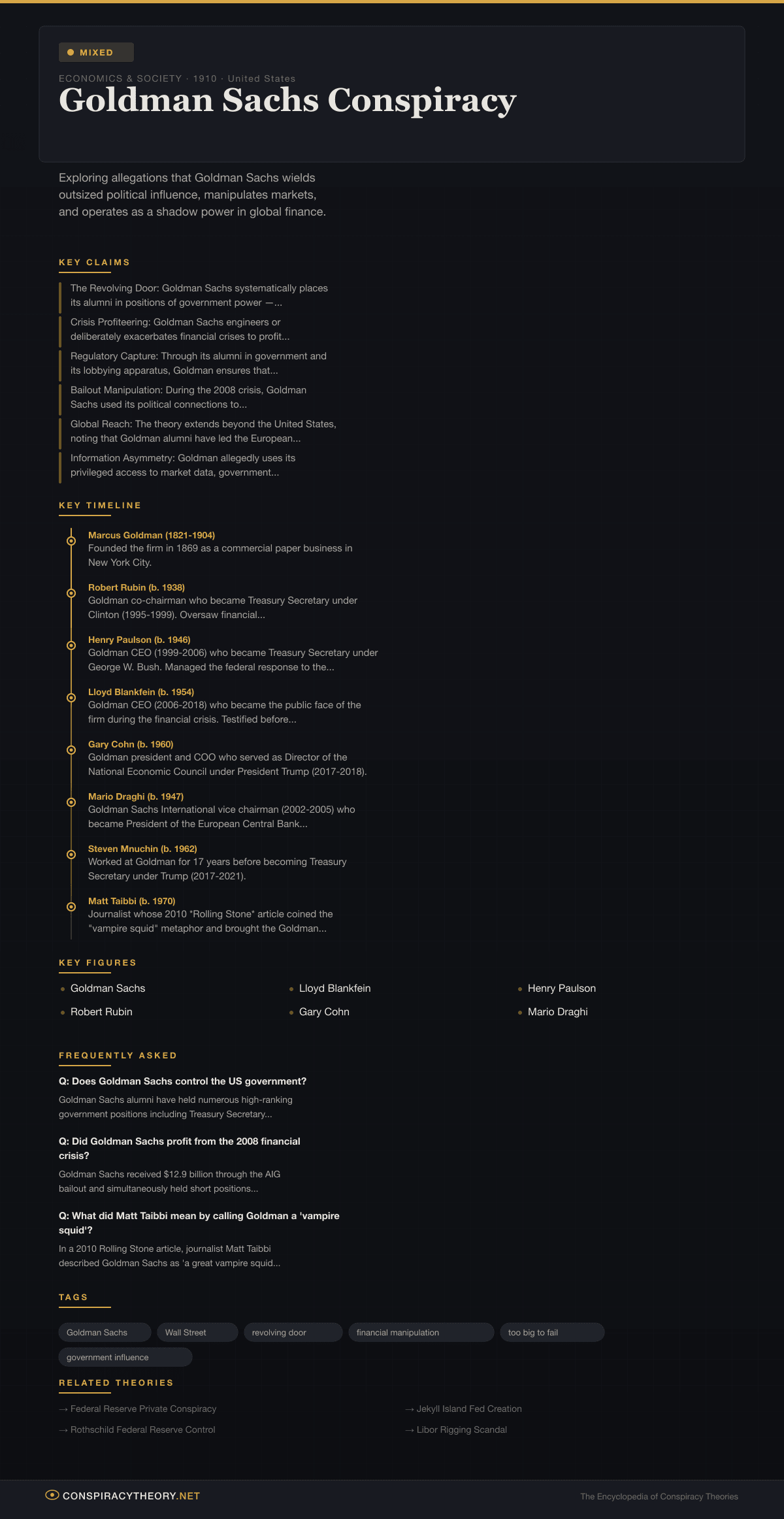
Goldman Sachs Conspiracy

Overview
Goldman Sachs Group, Inc., one of the oldest and most powerful investment banks in the world, has been the subject of persistent conspiracy theories alleging that the firm operates as a shadow government, manipulating markets, capturing regulatory agencies, and placing its alumni in positions of political power to advance its financial interests. These theories range from well-documented criticisms of the “revolving door” between Goldman and government to more speculative claims that the firm orchestrates economic crises for profit.
What makes the Goldman Sachs conspiracy narrative distinctive is that portions of it are grounded in verifiable fact. The firm’s alumni have indeed occupied an extraordinary number of senior government posts across multiple administrations and countries. Goldman was indeed found to have profited from the 2008 financial crisis while its clients suffered losses. These documented realities give the broader conspiracy narrative a foundation that purely speculative theories lack, while also making it difficult to draw a clear line between legitimate institutional critique and unfounded conspiratorial thinking.
The theory’s status is classified as “mixed” because some core claims — particularly regarding the revolving door, conflicts of interest, and specific instances of market manipulation — have been substantiated through investigations, settlements, and public records, while the overarching narrative that Goldman Sachs operates as a coordinated shadow government directing national and global policy remains unproven.
Origins & History
Suspicion of Goldman Sachs traces back to the early twentieth century. The firm, founded in 1869 by Marcus Goldman and later joined by his son-in-law Samuel Sachs, rose to prominence in the commercial paper and securities markets. By the 1920s, Goldman Sachs was deeply involved in the investment trust boom. The firm created the Goldman Sachs Trading Corporation in 1928, a leveraged investment vehicle that soared in value before collapsing spectacularly during the 1929 crash, wiping out investors and earning the firm its first major wave of public distrust. The episode was later documented extensively by economist John Kenneth Galbraith in The Great Crash, 1929, who used Goldman’s trading trust as a case study in the reckless financial engineering that precipitated the Depression.
For decades following the crash, Goldman rebuilt its reputation as a relatively conservative partnership. The modern conspiracy narrative began crystallizing in the 1990s when Robert Rubin, Goldman’s co-chairman, was appointed Treasury Secretary under President Bill Clinton in 1995. Rubin’s tenure saw the repeal of the Glass-Steagall Act in 1999, which had separated commercial and investment banking since 1933. Critics alleged that Rubin used his position to advance deregulatory policies that directly benefited Goldman Sachs and Wall Street at large.
The theory gained substantial momentum during and after the 2008 financial crisis. Henry Paulson, Goldman’s former CEO, served as Treasury Secretary under President George W. Bush during the crisis and oversaw the $700 billion Troubled Asset Relief Program (TARP) as well as the government bailout of AIG, through which Goldman received $12.9 billion at par value for its credit default swaps. The spectacle of a former Goldman CEO directing hundreds of billions in public funds toward the financial sector — including his former firm — cemented the conspiratorial narrative in mainstream discourse.
Matt Taibbi’s landmark 2010 article in Rolling Stone, which branded Goldman Sachs “a great vampire squid wrapped around the face of humanity,” brought the conspiracy narrative to a mass audience and provided it with an enduring metaphor. Taibbi argued that Goldman had engineered or profited from virtually every major market bubble and crash since the 1920s, operating not merely as a bank but as a political machine.
Key Claims
Proponents of the Goldman Sachs conspiracy theory advance several interconnected claims:
-
The Revolving Door: Goldman Sachs systematically places its alumni in positions of government power — Treasury Secretaries, central bank chiefs, regulatory heads, and White House advisors — to ensure favorable policy outcomes. This is alleged to be not coincidental talent recruitment but a deliberate strategy of institutional capture.
-
Crisis Profiteering: Goldman Sachs engineers or deliberately exacerbates financial crises to profit from the resulting chaos, using advance knowledge and superior positioning to short markets while its clients and the public suffer losses.
-
Regulatory Capture: Through its alumni in government and its lobbying apparatus, Goldman ensures that financial regulations are written to benefit the firm or are weakened to the point of ineffectiveness. The repeal of Glass-Steagall and the deregulation of derivatives markets are cited as primary examples.
-
Bailout Manipulation: During the 2008 crisis, Goldman Sachs used its political connections to secure taxpayer-funded bailouts that disproportionately benefited the firm, particularly through the AIG backdoor bailout.
-
Global Reach: The theory extends beyond the United States, noting that Goldman alumni have led the European Central Bank (Mario Draghi), the Bank of England (Mark Carney), and have served in senior government roles in multiple countries, suggesting a coordinated global financial network.
-
Information Asymmetry: Goldman allegedly uses its privileged access to market data, government policy discussions, and client information to trade ahead of markets, effectively operating with an unfair informational advantage.
Evidence
Several documented facts lend credibility to aspects of the Goldman Sachs conspiracy theory:
The Revolving Door — Documented: The number of Goldman Sachs alumni who have held senior government positions is a matter of public record and is extraordinary by any measure. Robert Rubin (Treasury Secretary, 1995-1999), Henry Paulson (Treasury Secretary, 2006-2009), and Steven Mnuchin (Treasury Secretary, 2017-2021, though he spent most of his career elsewhere) all held the nation’s top financial post. Gary Cohn served as Director of the National Economic Council under President Trump. Internationally, Mario Draghi served as President of the European Central Bank (2011-2019) and later as Prime Minister of Italy, while Mark Carney served as Governor of both the Bank of Canada and the Bank of England. Neel Kashkari, who managed TARP, was a former Goldman vice president. The list extends to dozens of other senior appointments across administrations of both parties.
The Abacus Scandal — SEC Action: In 2010, the Securities and Exchange Commission charged Goldman Sachs with fraud for creating and selling a synthetic collateralized debt obligation (CDO) called Abacus 2007-AC1, which was designed in collaboration with hedge fund manager John Paulson (no relation to Henry Paulson) to fail. Goldman sold the CDO to investors without disclosing that Paulson had selected the underlying mortgage bonds specifically because he believed they would default, and that he was simultaneously shorting the instrument. Goldman settled for $550 million — at the time the largest SEC penalty ever paid by a Wall Street firm — without admitting or denying wrongdoing.
AIG Backdoor Bailout — Government Records: When the federal government bailed out American International Group (AIG) in September 2008, Goldman Sachs received $12.9 billion in payments at full face value for credit default swaps it held with AIG. A 2009 report by the Special Inspector General for TARP (SIGTARP) criticized the New York Federal Reserve, then led by Timothy Geithner, for not negotiating haircuts on these payments. Critics noted that Henry Paulson, as Treasury Secretary, had recused himself from decisions directly involving Goldman but had been centrally involved in the broader decision to rescue AIG. The Government Accountability Office and the Financial Crisis Inquiry Commission both documented concerns about conflicts of interest in the bailout process.
Senate Investigations: In 2011, the U.S. Senate Permanent Subcommittee on Investigations, chaired by Senator Carl Levin, released a 639-page report concluding that Goldman Sachs had misled clients and Congress about its activities during the mortgage crisis. The report documented internal communications showing Goldman employees describing securities they were selling as “junk” and “crap” while simultaneously betting against them.
Commodity Manipulation Allegations: Goldman Sachs has faced scrutiny for its activities in commodity markets. A 2013 New York Times investigation revealed that Goldman’s subsidiary Metro International Trade Services had allegedly created artificial bottlenecks in aluminum warehousing, inflating the price of the metal and costing consumers an estimated $5 billion. Goldman denied the allegations.
Debunking / Verification
While the documented evidence above is substantial, several aspects of the broader conspiracy theory do not withstand scrutiny:
Coordination vs. Coincidence: The revolving door between Goldman Sachs and government is real, but attributing it to a coordinated conspiracy requires assumptions not supported by evidence. Goldman Sachs is one of the most prestigious firms on Wall Street, and its senior employees are, by definition, among the most experienced people in finance. Presidents of both parties draw from this talent pool for the same reason corporations recruit from elite universities — it is where credentialed expertise concentrates. This does not preclude conflicts of interest, but neither does it prove coordinated institutional capture.
Competing Interests: The theory assumes Goldman acts as a monolithic entity with a single agenda. In practice, Goldman’s interests have sometimes conflicted with the policies pursued by its alumni in government. Robert Rubin’s strong-dollar policy, for example, was not universally beneficial to Goldman’s trading operations. Henry Paulson’s decision to let Lehman Brothers fail — a Goldman competitor — has been cited as evidence of conspiracy, but the same decision also destabilized markets in ways that threatened Goldman itself.
Regulatory Actions Against Goldman: If Goldman truly controlled the regulatory apparatus, the firm would presumably not have faced the enforcement actions it has. The $550 million Abacus settlement, a $5 billion settlement with the Department of Justice in 2016 over mortgage-backed securities, and various state-level actions suggest that regulatory independence, while imperfect, is not entirely absent.
Survivorship Bias: Critics of the theory note that Goldman Sachs is far from the only financial institution that places alumni in government. Executives from Citigroup, JPMorgan Chase, and other major banks have also held senior government posts. Goldman’s prominence in the narrative may reflect its brand visibility as much as any unique degree of influence.
Not Unique Historically: The pattern of financiers moving into government long predates Goldman Sachs. Andrew Mellon, a banking magnate, served as Treasury Secretary from 1921 to 1932. The intermingling of finance and government is a structural feature of capitalist democracies, not evidence of a single firm’s conspiracy.
Cultural Impact
The Goldman Sachs conspiracy theory has had a measurable impact on public discourse, financial regulation, and political culture.
Matt Taibbi’s “vampire squid” metaphor became one of the most cited phrases in financial journalism, entering common usage as shorthand for predatory Wall Street behavior. The phrase resonated during the Occupy Wall Street movement of 2011, where Goldman Sachs served as a primary symbol of the “1%” and the perceived corruption of the financial system.
The narrative influenced legislative efforts. The Dodd-Frank Wall Street Reform and Consumer Protection Act of 2010, while not targeting Goldman specifically, was shaped in part by public anger over the perceived Goldman-government nexus. Provisions requiring greater transparency in derivatives trading and the Volcker Rule restricting proprietary trading by banks were responses to the kinds of activities critics attributed to Goldman and its peers.
In electoral politics, Goldman Sachs connections became a liability. During the 2016 presidential campaign, Senator Ted Cruz faced criticism for his wife Heidi Cruz’s employment at Goldman Sachs, and Hillary Clinton was attacked for accepting speaking fees from the firm. Senator Bernie Sanders made Goldman Sachs a recurring target in his campaign rhetoric, and Donald Trump ran campaign ads featuring Goldman Sachs CEO Lloyd Blankfein as a symbol of a corrupt global power structure. Ironically, Trump subsequently appointed multiple Goldman alumni to his administration, including Steven Mnuchin and Gary Cohn.
The theory has also influenced popular culture beyond politics. The 2015 film The Big Short, based on Michael Lewis’s book, dramatized the financial crisis in ways that reinforced elements of the Goldman narrative. Television programs, documentaries, and podcasts have explored the Goldman-government relationship extensively.
Key Figures
- Marcus Goldman (1821-1904) — Founded the firm in 1869 as a commercial paper business in New York City.
- Robert Rubin (b. 1938) — Goldman co-chairman who became Treasury Secretary under Clinton (1995-1999). Oversaw financial deregulation including the repeal of Glass-Steagall. Later joined Citigroup.
- Henry Paulson (b. 1946) — Goldman CEO (1999-2006) who became Treasury Secretary under George W. Bush. Managed the federal response to the 2008 financial crisis, including TARP and the AIG bailout.
- Lloyd Blankfein (b. 1954) — Goldman CEO (2006-2018) who became the public face of the firm during the financial crisis. Testified before Congress and generated controversy with his remark that Goldman was doing “God’s work.”
- Gary Cohn (b. 1960) — Goldman president and COO who served as Director of the National Economic Council under President Trump (2017-2018).
- Mario Draghi (b. 1947) — Goldman Sachs International vice chairman (2002-2005) who became President of the European Central Bank (2011-2019) and Prime Minister of Italy (2021-2022).
- Steven Mnuchin (b. 1962) — Worked at Goldman for 17 years before becoming Treasury Secretary under Trump (2017-2021).
- Matt Taibbi (b. 1970) — Journalist whose 2010 Rolling Stone article coined the “vampire squid” metaphor and brought the Goldman conspiracy narrative to mainstream audiences.
Timeline
- 1869 — Marcus Goldman founds a commercial paper business in New York, later becoming Goldman Sachs.
- 1928 — Goldman Sachs Trading Corporation is created as a leveraged investment trust.
- 1929 — The trading trust collapses during the stock market crash, devastating investors and damaging the firm’s reputation.
- 1933 — The Glass-Steagall Act separates commercial and investment banking in response to the crash.
- 1995 — Robert Rubin becomes Treasury Secretary under President Clinton.
- 1999 — The Gramm-Leach-Bliley Act repeals Glass-Steagall, allowing banks to combine commercial, investment, and insurance operations. Rubin departs Treasury shortly before.
- 2006 — Henry Paulson leaves Goldman Sachs to become Treasury Secretary under President George W. Bush.
- 2007 — Goldman Sachs creates the Abacus 2007-AC1 CDO. The firm begins building short positions against the mortgage market while continuing to sell mortgage-backed securities to clients.
- 2008 — The financial crisis unfolds. Goldman Sachs converts to a bank holding company to access Federal Reserve lending. AIG is bailed out; Goldman receives $12.9 billion through AIG counterparty payments. Goldman receives $10 billion in TARP funds (repaid in 2009).
- 2010 — The SEC charges Goldman with fraud over the Abacus CDO; Goldman settles for $550 million. Matt Taibbi publishes the “vampire squid” article. The Dodd-Frank Act is signed into law.
- 2011 — The Senate Permanent Subcommittee on Investigations releases its report on Goldman’s role in the financial crisis. Mario Draghi becomes President of the European Central Bank.
- 2013 — Allegations surface regarding Goldman’s aluminum warehousing practices and commodity market manipulation.
- 2016 — Goldman Sachs reaches a $5 billion settlement with the Department of Justice over its sale of mortgage-backed securities. Goldman connections become a major issue in the U.S. presidential campaign.
- 2017 — Gary Cohn and Steven Mnuchin join the Trump administration, prompting renewed criticism of the Goldman-government revolving door.
- 2020 — Goldman Sachs agrees to pay over $2.9 billion in penalties related to the 1MDB Malaysian sovereign wealth fund scandal, admitting to a conspiracy to bribe foreign officials.
Sources & Further Reading
- Galbraith, John Kenneth. The Great Crash, 1929. Houghton Mifflin, 1955. A foundational account of the speculative mania that included Goldman Sachs Trading Corporation’s rise and collapse.
- Taibbi, Matt. “The Great American Bubble Machine.” Rolling Stone, April 5, 2010. The article that popularized the “vampire squid” metaphor and outlined Goldman’s alleged role in successive financial crises.
- Cohan, William D. Money and Power: How Goldman Sachs Came to Rule the World. Doubleday, 2011. A comprehensive history of Goldman Sachs drawing on extensive interviews with current and former employees.
- U.S. Senate Permanent Subcommittee on Investigations. “Wall Street and the Financial Crisis: Anatomy of a Financial Collapse.” April 13, 2011. The 639-page Senate report documenting Goldman’s activities during the mortgage crisis.
- Financial Crisis Inquiry Commission. The Financial Crisis Inquiry Report. U.S. Government Printing Office, 2011. The official government investigation into the causes of the 2008 financial crisis.
- Ellis, Charles D. The Partnership: The Making of Goldman Sachs. Penguin Press, 2008. An authorized history of the firm written with the cooperation of Goldman partners.
- Lewis, Michael. The Big Short: Inside the Doomsday Machine. W.W. Norton, 2010. Narrative account of the investors who predicted the mortgage crisis, with significant attention to Goldman’s role.
- SIGTARP (Special Inspector General for TARP). “Factors Affecting Efforts to Limit Payments to AIG Counterparties.” November 17, 2009. Government report on the AIG counterparty payments, including $12.9 billion to Goldman Sachs.
- U.S. Department of Justice. “Goldman Sachs Agrees to Pay More Than $2.9 Billion in Connection with the Sale of Residential Mortgage-Backed Securities.” April 11, 2016. DOJ press release on the mortgage-backed securities settlement.
Frequently Asked Questions
Does Goldman Sachs control the US government?
Did Goldman Sachs profit from the 2008 financial crisis?
What did Matt Taibbi mean by calling Goldman a 'vampire squid'?
Infographic
Share this visual summary. Right-click to save.