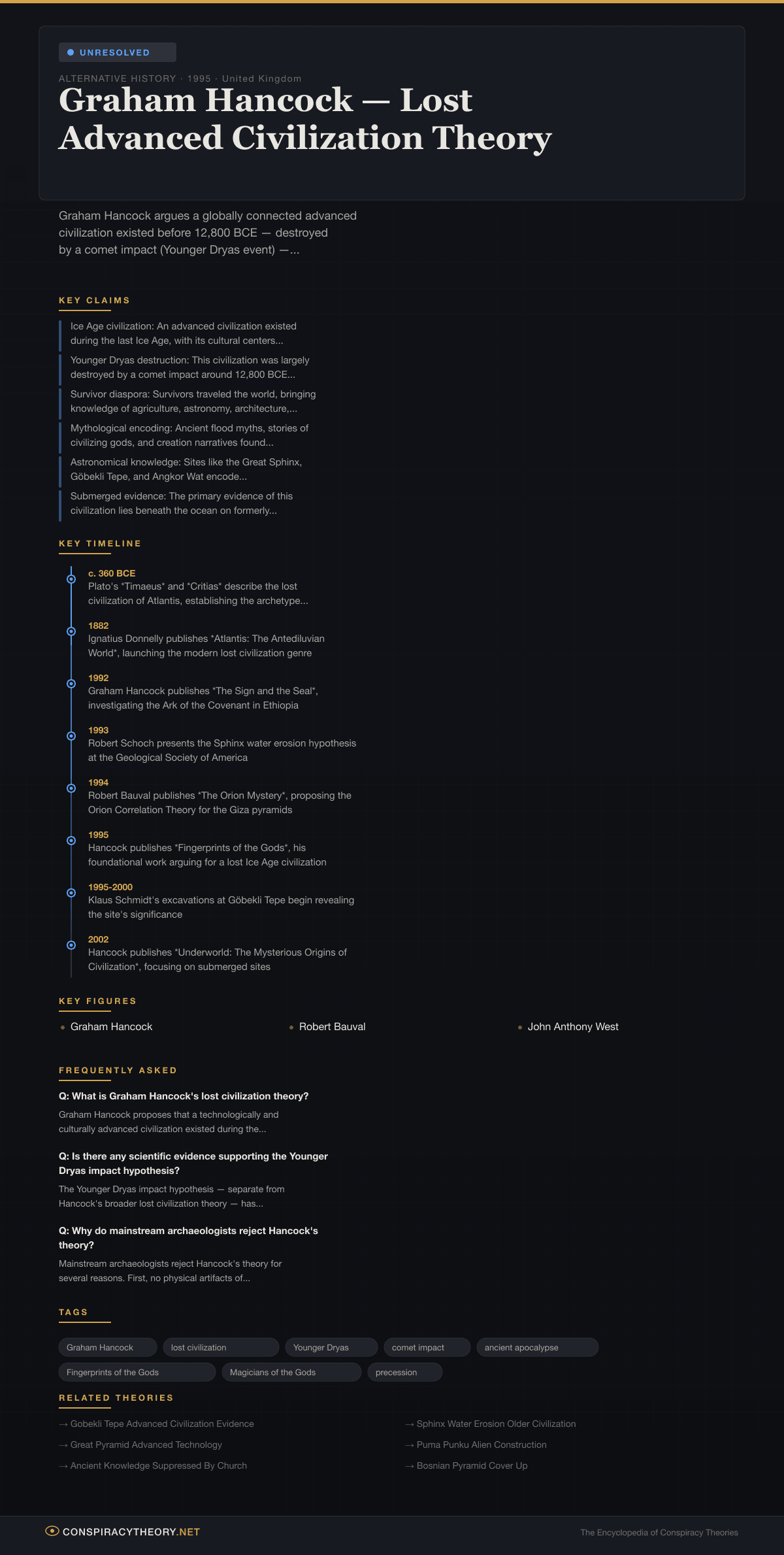
Graham Hancock — Lost Advanced Civilization Theory
Overview
Graham Hancock is a British journalist and author whose body of work, spanning more than three decades, advances the hypothesis that a technologically sophisticated civilization existed during the last Ice Age but was largely destroyed by a catastrophic event around 12,800 years ago. His books — most notably Fingerprints of the Gods (1995), Magicians of the Gods (2015), and America Before (2019) — along with his Netflix documentary series Ancient Apocalypse (2022), have made this theory one of the most widely known alternative history narratives in popular culture.
Hancock’s central thesis holds that survivors of this lost civilization dispersed around the globe after the catastrophe, bringing advanced knowledge of agriculture, architecture, astronomy, and mathematics to the “primitive” societies they encountered. In this framework, the rapid emergence of complex civilizations in Egypt, Mesopotamia, the Indus Valley, and Mesoamerica is not the result of independent development but rather the product of a knowledge transfer from these enigmatic survivors — whom Hancock identifies with the various “civilizing gods” and “culture heroes” found in mythological traditions worldwide.
The theory has attracted millions of adherents and generated intense controversy. Mainstream archaeologists and historians overwhelmingly reject Hancock’s hypothesis, arguing that it lacks material evidence, misrepresents archaeological findings, and implicitly diminishes the achievements of indigenous peoples by attributing their accomplishments to outside intervention. Hancock and his supporters counter that the archaeological establishment is resistant to paradigm-shifting ideas and that the absence of evidence — particularly given that rising sea levels at the end of the Ice Age submerged vast coastal areas — is not evidence of absence.
Origins & History
Graham Hancock began his career as a journalist, working as East Africa correspondent for The Economist and later as a foreign correspondent for the Sunday Times. His early books, including The Sign and the Seal (1992) — an investigation into the possible location of the Ark of the Covenant in Ethiopia — demonstrated his talent for narrative non-fiction built around historical mysteries.
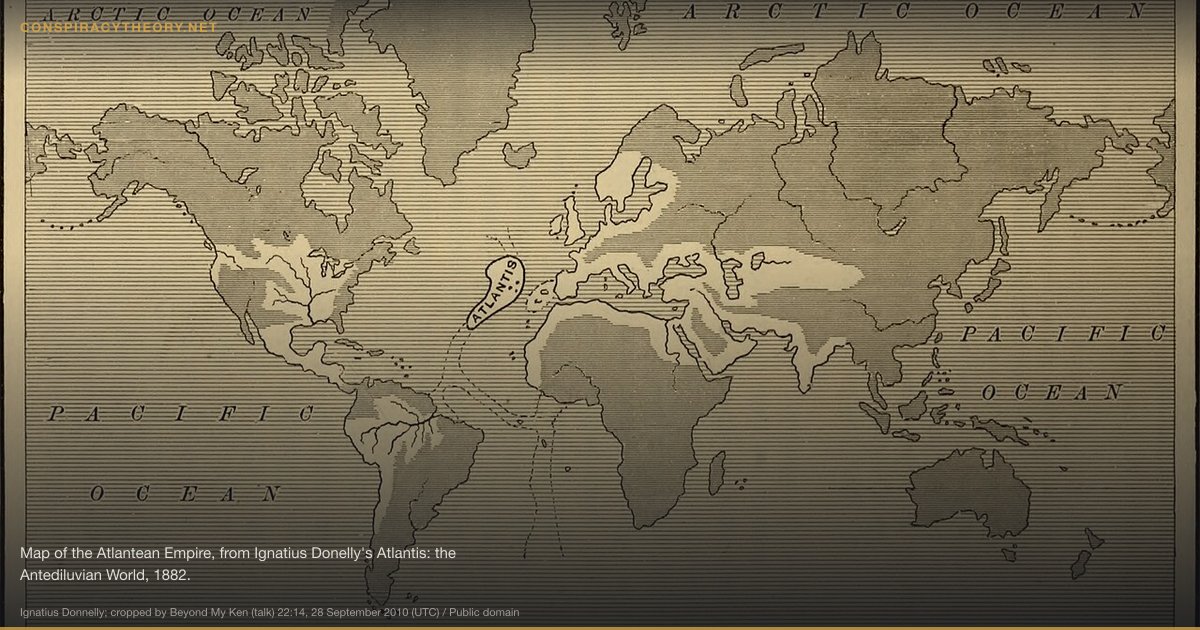
The intellectual foundation of Hancock’s lost civilization theory draws from several earlier traditions. The idea of a lost advanced prehistoric civilization has deep roots in Western thought, from Plato’s account of Atlantis in the Timaeus and Critias dialogues (c. 360 BCE) through Ignatius Donnelly’s Atlantis: The Antediluvian World (1882) to the “diffusionist” school of early 20th-century anthropology. Hancock’s specific contribution was to synthesize these older ideas with emerging geological evidence, astronomical correlations, and archaeological discoveries into a coherent modern narrative.
Fingerprints of the Gods, published in 1995, became an international bestseller and established the core of Hancock’s theory. The book argued that the Great Sphinx of Giza, the Nazca Lines of Peru, and various other ancient monuments encoded astronomical information — particularly related to the precession of the equinoxes — that could only have been known by a civilization far more advanced than those credited with building them. Hancock drew heavily on the work of Robert Bauval, whose Orion Correlation Theory proposed that the layout of the Giza pyramids mirrored the constellation Orion as it appeared around 10,500 BCE, and on the geological arguments of John Anthony West and Robert Schoch regarding water erosion on the Sphinx.
The theory evolved significantly with Magicians of the Gods (2015), which incorporated new scientific evidence, most notably the Younger Dryas impact hypothesis. This geological theory, first proposed by Richard Firestone and colleagues in 2007, suggests that a comet or asteroid fragment struck or exploded over North America approximately 12,800 years ago, triggering the Younger Dryas cold period and causing widespread megafaunal extinctions. Hancock adopted this hypothesis as the mechanism for the destruction of his proposed lost civilization, arguing that the Younger Dryas impact provided the catastrophe that myths of a great flood described.
The discovery and excavation of Göbekli Tepe in Turkey provided Hancock with what he considered his strongest piece of evidence. A site of monumental scale dating to approximately 9600 BCE — built during a period when humans were supposed to be simple hunter-gatherers — seemed to support the existence of a more advanced predecessor society. Hancock argued that Göbekli Tepe was built by survivors of the lost civilization as a repository of knowledge, deliberately buried to preserve it for the future.
Ancient Apocalypse, released on Netflix in November 2022, brought Hancock’s ideas to a global audience of millions and reignited the academic debate. The series became one of Netflix’s most-watched documentaries, prompting a formal response from the Society for American Archaeology, which wrote to Netflix criticizing the show for presenting unfounded theories as legitimate alternatives to established science.
Key Claims
- Ice Age civilization: An advanced civilization existed during the last Ice Age, with its cultural centers located on coastal lands now submerged beneath post-glacial sea level rise of approximately 120 meters
- Younger Dryas destruction: This civilization was largely destroyed by a comet impact around 12,800 BCE that triggered the Younger Dryas cold period, massive flooding, and environmental catastrophe
- Survivor diaspora: Survivors traveled the world, bringing knowledge of agriculture, astronomy, architecture, and other advanced skills to indigenous populations, explaining the sudden emergence of complex societies in multiple regions
- Mythological encoding: Ancient flood myths, stories of civilizing gods, and creation narratives found across dozens of cultures preserve genuine memories of this lost civilization and its destruction
- Astronomical knowledge: Sites like the Great Sphinx, Göbekli Tepe, and Angkor Wat encode sophisticated astronomical knowledge — particularly relating to the precession of the equinoxes — inherited from the lost civilization
- Submerged evidence: The primary evidence of this civilization lies beneath the ocean on formerly exposed continental shelves, which have been inadequately explored by marine archaeology
- Academic suppression: Mainstream archaeology actively resists these ideas due to institutional inertia, career incentives, and an unwillingness to reconsider fundamental assumptions about human history
Evidence
Evidence cited by Hancock and supporters:
The Younger Dryas impact hypothesis provides the geological mechanism for Hancock’s proposed catastrophe. Multiple peer-reviewed studies published since 2007 have identified anomalous concentrations of platinum, nanodiamonds, magnetic microspherules, and other potential impact markers in sediment layers dating to approximately 12,800 years ago. These markers have been found at sites across four continents. While the impact hypothesis remains debated, it has gained increasing scientific legitimacy as additional evidence has accumulated.
Göbekli Tepe demonstrates that pre-agricultural societies were capable of monumental construction far earlier than previously believed. The site’s T-shaped pillars, some weighing up to 20 tons, were quarried, carved, and erected during a period when humans were supposedly incapable of such feats. The deliberate burial of the site around 8000 BCE adds an element of intentional knowledge preservation.
The water erosion hypothesis for the Great Sphinx, proposed by geologist Robert Schoch of Boston University, suggests the Sphinx shows patterns of erosion consistent with heavy rainfall that last occurred in Egypt prior to approximately 5000 BCE, potentially pushing the monument’s construction date back thousands of years before the conventional dating to the reign of Pharaoh Khafre (c. 2500 BCE).
Cross-cultural similarities in mythology, particularly flood narratives, appear in traditions spanning every inhabited continent. Hancock argues that the universality of these stories — combined with their specific details about surviving teachers who brought civilization after the flood — constitutes a form of oral historical evidence.
Underwater archaeological discoveries, including submerged megalithic structures off the coasts of Japan (Yonaguni), India (Dwarka), and the Mediterranean, suggest that significant human activity occurred on lands now beneath the sea. The post-Ice Age sea level rise of approximately 120 meters submerged millions of square kilometers of formerly habitable coastal land, and less than 5% of the ocean floor has been surveyed at high resolution.
Evidence against Hancock’s theory:
The most fundamental challenge to Hancock’s theory is the absence of material evidence. Advanced civilizations produce distinctive material signatures — metal alloys, manufactured ceramics, processed materials, writing systems, and extensive refuse deposits. No such artifacts dating to the pre-Younger Dryas period have been found anywhere in the archaeological record, despite extensive excavation on every continent.
Cross-cultural similarities can be explained through universal human cognitive patterns, convergent evolution, and common responses to shared environments. Flood myths, for example, are expected in societies that live near rivers, coastlines, and flood plains — which is where most early civilizations developed. Pyramidal structures appear worldwide because the pyramid is the most structurally stable shape for building with stone.
Hancock’s interpretation of specific sites often contradicts the conclusions of researchers who have spent decades studying them. The archaeologists who excavated Göbekli Tepe, for example, reject the lost civilization interpretation and provide evidence-based explanations for the site’s construction by local hunter-gatherer communities. Similarly, Egyptologists present extensive evidence that the Sphinx was built during Khafre’s reign.
The Younger Dryas impact hypothesis, even if confirmed, does not validate Hancock’s broader theory. A comet impact 12,800 years ago could have had devastating environmental effects without requiring the existence of an advanced civilization to be destroyed.
Debunking / Verification
Graham Hancock’s lost civilization theory remains in the “unresolved” category, though it is important to distinguish between the theory’s individual components and its overarching narrative.
The Younger Dryas impact hypothesis has gained some scientific support and remains an active area of geological research. The extraordinary capabilities of pre-agricultural societies, as demonstrated at Göbekli Tepe, are now accepted by mainstream archaeology. The existence of significant submerged archaeological sites is acknowledged and increasingly investigated.
However, the central claim — that these individual facts point to a single lost advanced civilization — remains unsubstantiated. Mainstream archaeology contends that each of these phenomena has explanations that do not require positing a precursor civilization for which no material evidence exists. The theory is considered unfalsifiable by many critics because its core evidence is claimed to lie beneath the ocean, and any absence of evidence is attributed to inadequate investigation or deliberate suppression.
The Society for American Archaeology’s 2022 response to Ancient Apocalypse summarized the mainstream position: while acknowledging that archaeological models are regularly updated as new evidence emerges, the organization stated that Hancock’s specific claims lack evidentiary support and that his narrative framework, which attributes the achievements of indigenous peoples to outside intervention, carries troubling ideological implications.
Cultural Impact
Graham Hancock’s work has had an enormous impact on popular understanding of ancient history, arguably greater than any academic archaeologist alive today. His books have sold millions of copies in dozens of languages, and Ancient Apocalypse became one of Netflix’s most-viewed documentary series, reaching audiences that peer-reviewed archaeological research never could.
The cultural impact extends beyond entertainment. Hancock’s work has popularized several legitimate scientific concepts for mass audiences, including the Younger Dryas impact hypothesis, the significance of Göbekli Tepe, and the extent of post-Ice Age sea level rise. His advocacy for increased marine archaeological survey has contributed to growing interest and investment in underwater archaeology.
The theory has profoundly influenced the “alternative history” genre, inspiring a generation of authors, YouTubers, and podcasters who build on Hancock’s framework. The Joe Rogan Experience podcast, which has featured Hancock numerous times — including a viral debate with archaeologist Flint Dibble in 2024 — has introduced the theory to audiences numbering in the tens of millions.
However, the theory has also generated significant concern among professional archaeologists and historians. Critics argue that Hancock’s narrative, by attributing the achievements of ancient Egyptian, Mesoamerican, and other civilizations to a lost (implicitly superior) predecessor society, implicitly diminishes the accomplishments of indigenous peoples. This critique has become particularly prominent in the post-colonial reevaluation of how Western narratives have historically marginalized non-European achievements.
The debate between Hancock and mainstream archaeology has become a flashpoint in broader cultural conversations about expertise, institutional authority, and the democratization of knowledge in the internet age. Hancock frames himself as an investigative journalist challenging a closed-minded establishment; mainstream archaeologists frame the conflict as a case of popular misinformation undermining scientific rigor.
Timeline
- c. 360 BCE — Plato’s Timaeus and Critias describe the lost civilization of Atlantis, establishing the archetype for lost civilization narratives
- 1882 — Ignatius Donnelly publishes Atlantis: The Antediluvian World, launching the modern lost civilization genre
- 1992 — Graham Hancock publishes The Sign and the Seal, investigating the Ark of the Covenant in Ethiopia
- 1993 — Robert Schoch presents the Sphinx water erosion hypothesis at the Geological Society of America
- 1994 — Robert Bauval publishes The Orion Mystery, proposing the Orion Correlation Theory for the Giza pyramids
- 1995 — Hancock publishes Fingerprints of the Gods, his foundational work arguing for a lost Ice Age civilization
- 1995-2000 — Klaus Schmidt’s excavations at Göbekli Tepe begin revealing the site’s significance
- 2002 — Hancock publishes Underworld: The Mysterious Origins of Civilization, focusing on submerged sites
- 2007 — Firestone et al. publish the Younger Dryas impact hypothesis in Proceedings of the National Academy of Sciences
- 2015 — Hancock publishes Magicians of the Gods, incorporating the Younger Dryas impact hypothesis
- 2019 — Hancock publishes America Before, extending his theory to North and South American archaeology
- November 2022 — Netflix releases Ancient Apocalypse, bringing Hancock’s theory to a massive global audience
- December 2022 — Society for American Archaeology writes to Netflix criticizing the series
- April 2024 — Graham Hancock and archaeologist Flint Dibble debate on the Joe Rogan Experience podcast
- October 2024 — Ancient Apocalypse Season 2 released on Netflix
Sources & Further Reading
- Hancock, Graham. Fingerprints of the Gods: The Evidence of Earth’s Lost Civilization. New York: Crown, 1995.
- Hancock, Graham. Magicians of the Gods: The Forgotten Wisdom of Earth’s Lost Civilization. New York: Thomas Dunne Books, 2015.
- Firestone, R.B., et al. “Evidence for an Extraterrestrial Impact 12,900 Years Ago that Contributed to the Megafaunal Extinctions and the Younger Dryas Cooling.” Proceedings of the National Academy of Sciences 104, no. 41 (2007): 16016-16021.
- Fagan, Garrett G. Archaeological Fantasies: How Pseudoarchaeology Misrepresents the Past and Misleads the Public. London: Routledge, 2006.
- Society for American Archaeology. “Letter to Netflix Regarding Ancient Apocalypse.” December 2022.
- Bauval, Robert. The Orion Mystery: Unlocking the Secrets of the Pyramids. New York: Crown, 1994.
- Ancient Apocalypse (Netflix documentary series, 2022-2024), featuring Graham Hancock.
Frequently Asked Questions
What is Graham Hancock's lost civilization theory?
Is there any scientific evidence supporting the Younger Dryas impact hypothesis?
Why do mainstream archaeologists reject Hancock's theory?
Infographic
Share this visual summary. Right-click to save.